Concrete Reinforcing Fiber Market Size & Growth Forecast 2027–2036, By Segments (Application, Product), Regional Demand Trends (North America, Asia Pacific, Europe), Key Country Insights (U.S., Japan, South Korea, Germany, France, Italy), and Competitive Landscape
Market Size and Growth Outlook
Concrete Reinforcing Fiber Market size was around USD 2.9 billion in 2026 and is slated to grow at a 8.27% CAGR from 2027 to 2036, attaining USD 6.42 billion by 2036. The industry revenue for 2027 is estimated at USD 3.1 billion.
Get more details on this report
Request Free Sample ReportConcrete Reinforcing Fiber Market Intelligence Snapshot
Regional Market Dynamics
- Asia Pacific led the market in 2026 because of extensive residential, commercial, and infrastructure construction, creating sustained demand for durable fiber-reinforced concrete across diverse applications.
- North America is forecast to grow at a 7.8% CAGR as infrastructure rehabilitation and commercial construction increase demand for reinforcement solutions that improve durability and reduce maintenance.
Segment Momentum
- Infrastructure leads due to high demand for durability and crack control in transport and public works projects, where fibers improve long-term concrete performance under heavy and repeated loading conditions.
- Basalt fibers are growing fastest as they offer improved durability and material stability, aligning with evolving construction needs for more balanced reinforcement solutions in modern concrete applications.
Market Expansion Drivers
- Rapid infrastructure and urban construction activities increasing demand for durable reinforced concrete solutions.
- Growing adoption of precast and low-maintenance construction materials accelerating fiber-reinforced concrete usage.
- Rising innovation in synthetic and hybrid fiber technologies improving concrete performance and fire resistance.
Leading Market Participants
- Major players in the concrete reinforcing fiber market include Sika AG (Switzerland), BASF SE (Germany), Bekaert SA (Belgium), Owens Corning (United States), CEMEX, S.A.B. de C.V. (Mexico), Forta Corporation (United States), Nycon Corporation (United States), ABC Polymer Industries, LLC (United States), The Euclid Chemical Company (United States), GCP Applied Technologies Inc. (United States).
Global Market Forecast Snapshot
Market Outlook
- 2026 Market Size: USD 2.9 billion
- 2027 Estimated Market Size: USD 3.1 billion.
- Projected Market Size: USD 6.42 billion by 2036
- Growth Forecast: 8.27% CAGR (2027-2036)
Regional and Segment Outlook
- Leading Regional Market: Asia Pacific
- High-Growth Regional Hub: North America
- Core Revenue Segment: Infrastructure (Application) | Steel (Product)
- Emerging Opportunity Segment: Infrastructure (Application) | Basalt (Product)
Market Growth Drivers and Industry Trends
Rapid infrastructure and urban construction activities increasing demand for durable reinforced concrete solutions
Accelerating infrastructure development and urban construction are creating greater requirements for concrete structures with enhanced durability and mechanical performance, supporting the concrete reinforcing fiber market growth. Fibers incorporated into concrete can improve properties such as crack control, toughness, impact resistance, and structural durability, making them useful across floors, pavements, tunnels, bridges, and other construction applications. As cities expand and infrastructure projects increasingly emphasize service life and structural reliability, contractors and engineers are seeking reinforcement approaches that can complement or reduce reliance on conventional reinforcement methods in suitable applications. The growing volume of commercial, residential, transportation, and civil infrastructure construction is therefore increasing the use of fiber-reinforced concrete solutions.
Growing adoption of precast and low-maintenance construction materials accelerating fiber-reinforced concrete usage
The construction industry's shift toward prefabricated components and materials that require less maintenance will boost the concrete reinforcing fiber market demand by increasing the need for concrete systems capable of delivering consistent performance during manufacturing and service. Fiber reinforcement can improve crack resistance and toughness in precast elements, supporting their use in controlled production environments where durability and dimensional consistency are important. Low-maintenance construction approaches are also becoming more attractive as project owners seek to reduce repair requirements and lifecycle costs. Fiber-reinforced concrete can be incorporated into a variety of precast products and construction elements, enabling manufacturers to improve performance while maintaining efficient production processes.
Rising innovation in synthetic and hybrid fiber technologies improving concrete performance and fire resistance
Advances in synthetic and hybrid reinforcement technologies are expanding the performance characteristics available from fiber-reinforced concrete, which will drive the concrete reinforcing fiber market growth. Synthetic fibers can provide benefits related to crack control, toughness, and durability, while hybrid systems combine different fiber types to address multiple performance requirements within the same concrete formulation. Specialized fibers are also being developed to improve resistance to heat and fire-related deterioration, an important consideration for tunnels, industrial structures, parking facilities, and other applications exposed to demanding conditions. Ongoing improvements in fiber geometry, material composition, dispersion, and compatibility with concrete mixes are enabling engineers to select reinforcement solutions according to specific structural and environmental requirements.
| Growth Driver | Impact on CAGR | Regulatory Influence | Geographic Relevance | Adoption Rate | Impact Timeline |
|---|---|---|---|---|---|
| Rapid infrastructure and urban construction activities increasing demand for durable reinforced concrete solutions | 2.30% | Moderate | Asia Pacific, Middle East | High | Near Term |
| Growing adoption of precast and low-maintenance construction materials accelerating fiber-reinforced concrete usage | 2.00% | Moderate | North America, Europe | High | Mid Term |
| Rising innovation in synthetic and hybrid fiber technologies improving concrete performance and fire resistance | 1.60% | Moderate | Asia Pacific, North America | Emerging | Long Term |
Unlock insights tailored to your business with our bespoke market research solutions.
Click to get your customized report now.
Regional Demand Dynamics
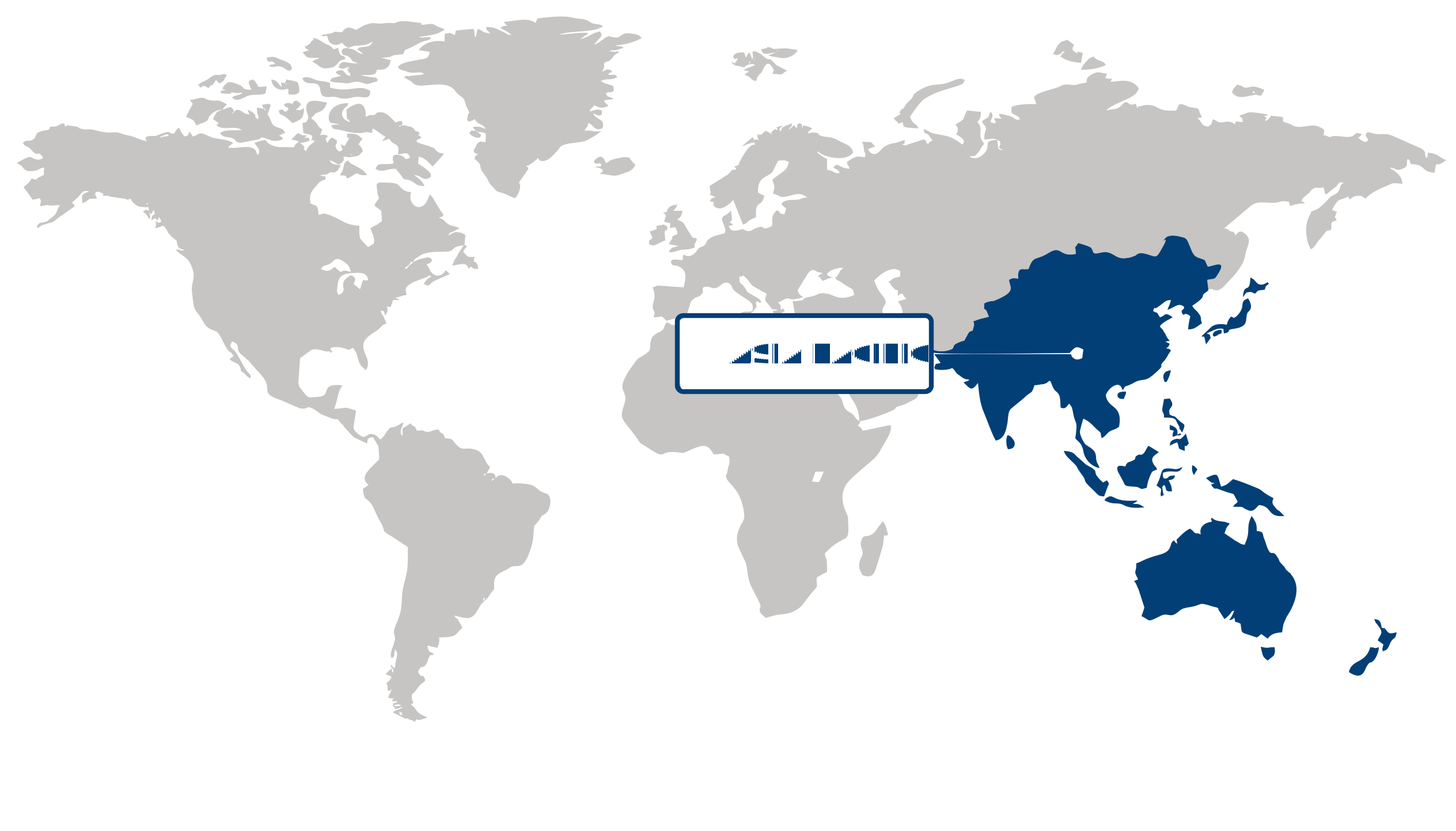
Asia Pacific (Largest Region)
In the concrete reinforcing fiber market, Asia Pacific held the largest regional position in 2026, driven by extensive infrastructure development, rapid urbanization, and sustained construction activity across residential, commercial, transportation, and industrial projects. The region's large construction base supports demand for reinforcement solutions that improve concrete toughness, crack control, durability, and resistance to demanding operating conditions. Increasing emphasis on construction efficiency and longer-lasting infrastructure is encouraging the incorporation of fiber reinforcement into concrete applications. Expanding industrialization, infrastructure modernization, and investment in resilient construction practices are further reinforcing the region's established market position.
North America (Fastest-Growing Region)
North America represents the fastest-growing region, supported by infrastructure renewal, commercial construction activity, and increasing demand for durable and performance-oriented building materials. The rehabilitation of aging structures is creating opportunities for reinforcing technologies that can improve concrete service life while helping address maintenance requirements. Contractors and infrastructure developers are also showing greater interest in reinforcement approaches that can improve construction efficiency and reduce reliance on conventional reinforcement methods in suitable applications. Strong technical capabilities within the construction sector, combined with greater attention to infrastructure resilience and material performance, are contributing to expanding adoption of concrete reinforcing fibers.
| Parameter | North America | Asia Pacific | Europe | Latin America | MEA |
|---|---|---|---|---|---|
| Innovation Hub i Scale Nascent Developing Advanced | |||||
| Cost-Sensitive Region i Scale Low Medium High | |||||
| Regulatory Environment i Scale Restrictive Neutral Supportive | |||||
| Demand Drivers i Scale Weak Moderate Strong | |||||
| Development Stage i Scale Emerging Developing Developed | |||||
| Adoption Rate i Scale Low Medium High | |||||
| New Entrants / Startups i Scale Sparse Moderate Dense | |||||
| Macro Indicators i Scale Weak Stable Strong |
Key Country Insights
Germany 🇩🇪
Sustainable Construction MaterialsGermany prioritizes concrete reinforcing fibers that improve structural performance while supporting resource-efficient construction practices. Demand is driven by infrastructure modernization and stricter engineering standards encouraging longer service life and optimized material consumption.
France 🇫🇷
Urban Infrastructure RenewalFrance utilizes concrete reinforcing fibers across urban redevelopment and transport infrastructure projects where long-term pavement and structural performance are important. Demand is supported by investments in durable construction materials that reduce lifecycle maintenance requirements.
Italy 🇮🇹
Heritage Construction IntegrationItaly applies concrete reinforcing fibers in infrastructure upgrades and restoration projects requiring structural reinforcement without compromising engineering flexibility. The market reflects growing interest in extending asset life through modern reinforcement materials.
Japan 🇯🇵
Seismic Reinforcement SolutionsJapan incorporates concrete reinforcing fibers into structures requiring improved crack resistance and seismic resilience. The country's focus on resilient infrastructure and rehabilitation projects encourages wider use of fiber-reinforced concrete in both public and private developments.
South Korea 🇰🇷
Smart Infrastructure ApplicationsSouth Korea is expanding the use of concrete reinforcing fibers in transport networks, industrial facilities, and smart city developments. Construction firms increasingly adopt advanced reinforcement technologies to improve structural longevity and construction efficiency.
United States 🇺🇸
Infrastructure Durability FocusThe U.S. market emphasizes concrete reinforcing fibers for transportation, industrial, and commercial infrastructure where durability and reduced maintenance are key priorities. Growing adoption of advanced construction methods supports broader integration of synthetic and steel fiber solutions across diverse project types.
Segment Leadership and Growth Trends
Concrete Reinforcing Fiber Market Share (%), by Application, 2026
Go beyond the chart, access full insights & data tables
Request Free Sample ReportApplication Segment Analysis: Infrastructure (Largest & Fastest-Growing Segment)
The infrastructure segment dominated the concrete reinforcing fiber market in 2026 and is also the fastest-growing application segment, driven by the need for durable and performance-oriented construction materials across major infrastructure projects. Concrete reinforcing fibers can improve crack resistance, toughness, and structural durability, making them valuable in applications where long service life and reduced maintenance are priorities. Increasing investment in transportation networks, public facilities, utilities, and other infrastructure assets is supporting demand for reinforcement technologies that can improve concrete performance while enhancing construction efficiency.
Product Segment Analysis: Steel (Largest Segment) vs Basalt (Fastest-Growing Segment)
Steel fibers represented the largest product segment in the concrete reinforcing fiber market in 2026, supported by their established use in applications requiring high tensile strength, toughness, and resistance to mechanical stresses. Their proven performance in demanding concrete structures makes them suitable for industrial floors, infrastructure components, and other construction applications where reinforcement reliability is critical. Familiarity among contractors and engineers, along with established incorporation methods, continues to support the widespread use of steel fibers.
Basalt fibers are experiencing the fastest growth as construction stakeholders increasingly seek reinforcement materials that combine performance with durability and material efficiency. Basalt fibers offer attractive characteristics for concrete reinforcement, including resistance to environmental degradation and suitability for applications where long-term material performance is important. Growing interest in alternative reinforcement solutions and greater attention to durable construction materials are encouraging broader consideration of basalt fiber across infrastructure and building applications.
| Segment | Sub-Segment | Largest Segment | Fastest Growing |
|---|---|---|---|
| Application | Infrastructure, Building & Construction, Industrial | Infrastructure | Infrastructure |
| Product | Polyethylene, Polypropylene, Steel, Basalt, Others | Steel | Basalt |
Competitive Landscape and Market Positioning
Prominent players in the concrete reinforcing fiber market:
1. Sika AG (Switzerland)
2. BASF SE (Germany)
3. Bekaert SA (Belgium)
4. Owens Corning (United States)
5. CEMEX S.A.B. de C.V. (Mexico)
6. Forta Corporation (United States)
7. Nycon Corporation (United States)
8. ABC Polymer Industries LLC (United States)
9. The Euclid Chemical Company (United States)
10. GCP Applied Technologies Inc. (United States)
Infrastructure development is increasing demand for durable reinforcement materials. Fiber-enhanced composites are improving structural strength and longevity. The concrete reinforcing fiber market is advancing through high-performance construction material innovations.
| Company | Market Share | Company Revenue | Revenue CAGR (%) | Product Portfolio | Geographic Presence | Innovation / R&D Focus | Strategic Developments |
|---|---|---|---|---|---|---|---|
| Sika AG (Switzerland) | |||||||
| BASF SE (Germany) | |||||||
| Bekaert SA (Belgium) | |||||||
| Owens Corning (United States) | |||||||
| CEMEX S.A.B. de C.V. (Mexico) | |||||||
| Forta Corporation (United States) | |||||||
| Nycon Corporation (United States) | |||||||
| ABC Polymer Industries LLC (United States) | |||||||
| The Euclid Chemical Company (United States) | |||||||
| GCP Applied Technologies Inc. (United States). |
Industry Development/News
| Company Name | Date | Key Development |
|---|---|---|
| Bekaert | Mar-25 | Bekaert inaugurated its India Concrete Expertise Centre in Maharashtra to advance research in fiber-reinforced concrete technologies. The facility includes specialized laboratories focused on testing steel fiber applications in spray concrete, reinforcing the company’s R&D capabilities in construction reinforcement materials and structural performance optimization. |
| Arkema | Feb-24 | Arkema partnered with Sireg Geotech to develop bendable composite rebar using Elium thermoplastic resin and fiberglass reinforcement. The solution offers an alternative to traditional steel reinforcement, enhancing flexibility and performance characteristics for infrastructure applications and supporting innovation in composite construction materials. |
| Nuvoco Vistas Corp. Ltd. | Aug-23 | Nuvoco Vistas Corp. Ltd. received a patent for its Fibre Reinforced Cement Composition, branded as Duraguard Microfiber Cement. The material incorporates engineered clinker and fly ash composition to improve bonding strength, crack resistance, durability, and permeability, strengthening advanced cement product innovation in construction applications. |
| Owens Corning | Aug-22 | Owens Corning entered a joint venture with Pultron Composites to manufacture fiberglass rebar for construction applications. The collaboration expands production capacity and market access for fiberglass reinforcement products used in residential and flatwork applications, supporting substitution of traditional steel reinforcement materials. |
Customize Your Report
Explore examples of how this report can be tailored to different research needs, including custom segments, additional topics or chapters, and related reports. Click a section of the wheel or its numbered marker to explore the available options.
Concrete Reinforcing Fiber Market — Custom Segments
| Segment | Sub-Segment |
|---|---|
| Concrete Type | Ready-Mix Concrete, Precast Concrete, Shotcrete, Cast-in-Place Concrete |
| Construction Method | Conventional Construction, Precast Construction, 3D Concrete Printing, Shotcrete Construction |
| Reinforcement Function | Crack Control, Structural Reinforcement, Impact & Abrasion Resistance, Shrinkage & Thermal Control |
Concrete Reinforcing Fiber Market — Custom TOC
| Custom Chapter | Custom Details |
|---|---|
| Infrastructure Project Demand Assessment |
|
| Alternative Reinforcement Benchmarking |
|
| Contractor and Specifier Adoption Insights |
|
Need a different cut of the data?
Request Custom ResearchHow large is the concrete reinforcing fiber market?
What is the anticipated CAGR of the concrete reinforcing fiber industry?
Why is infrastructure development driving stronger adoption in the concrete reinforcing fiber market?
How are advances in fiber technology influencing purchasing decisions in the concrete reinforcing fiber market?
Why is infrastructure the leading application in the concrete reinforcing fiber market?
What is driving faster adoption of basalt fibers in concrete reinforcement applications?
What makes Asia Pacific the leading region in the concrete reinforcing fiber market?
How is North America driving growth in the concrete reinforcing fiber market?
Who holds a significant market share in the concrete reinforcing fiber landscape?
Our Clients
"Your insights on workforce structures were spot-on. The analysis on mid-to-senior level roles validated some of our hiring decisions and highlighted gaps."
Ateliers De France
"The report gave us insights on competitors in the market. It helped our team refine our bidding strategy for upcoming contracts."
Clark Construction
"The reports provided a deep dive into market trends, and competitive landscape. The strategic insights and recommendations have been very helpful."
Rudolph and Sletten
Our Research Team & Methodology
Every Fundamental Business Insights report is built by a dedicated vertical research team, validated through a structured primary-and-secondary methodology, and reviewed for accuracy before it reaches you.
Research Team Overview
Prepared by the Construction & Manufacturing Research Team
Delivery
Published
Demand
Available
Support
Trust & Compliance
Research Domains
10 coverage areasResearch Intelligence
| Source | Reference |
|---|---|
| International Organization for Standardization (ISO) | www.iso.org |
| ASTM International | www.astm.org |
| National Institute of Standards and Technology (NIST) | www.nist.gov |
| International Code Council (ICC) | www.iccsafe.org |
| American Concrete Institute (ACI) | www.concrete.org |
| American Institute of Steel Construction (AISC) | www.aisc.org |
| Construction Industry Institute (CII) | www.construction-institute.org |
| Associated General Contractors of America (AGC) | www.agc.org |
| Association of Equipment Manufacturers (AEM) | www.aem.org |
| Building Owners and Managers Association (BOMA) | www.boma.org |
| American Society of Civil Engineers (ASCE) | www.asce.org |
| National Ready Mixed Concrete Association (NRMCA) | www.nrmca.org |
| International Facility Management Association (IFMA) | www.ifma.org |
| World Green Building Council (WorldGBC) | worldgbc.org |
| International Federation of Consulting Engineers (FIDIC) | fidic.org |
| International Labour Organization (ILO) | www.ilo.org |
| American Society of Mechanical Engineers (ASME) | www.asme.org |
| Society of Manufacturing Engineers (SME) | www.sme.org |
| National Association of Home Builders (NAHB) | www.nahb.org |
| European Construction Industry Federation (FIEC) | www.fiec.eu |
Research Workflow & Quality Assurance
Data Collection
Verified information gathered through primary and secondary research.
Data Triangulation
Cross-validation using multiple independent data sources.
Forecast Modelling
Market estimates developed using historical trends and analytical models.
Analyst Validation
Findings reviewed by domain experts for accuracy and consistency.
Editorial & Quality Review
Final editorial, quality, and compliance checks before publication.
Final Publication
Released after successful completion of the internal review process.
Report Coverage
📊 Market Assessment
- Market Size & Forecast
- Market Segmentation
- Regional Analysis
- Growth Drivers & Challenges
- Market Dynamics
🏢 Competitive Intelligence
- Competitive Landscape
- Company Profiles
- Competitive Benchmarking
- Mergers & Acquisitions
- Market Share Analysis or Key Company Strategies
🔍 Strategic Analysis
- Value Chain Analysis
- Porter's Five Forces
- PESTLE Analysis
- Pricing Trends
- Supply-Demand Analysis
🚀 Future Outlook
- Technology Landscape
- Regulatory Landscape
- Investment & Funding Landscape
- Emerging Opportunities
- Future Market Outlook
Have a question about this report or need a custom scope?
Request Customization