Composites Market Size & Growth Forecast 2027–2036, By Segments (Product, Manufacturing Process, End-use, Resin Type), Regional Demand Trends (North America, Asia Pacific, Europe), Key Country Insights (U.S., Japan, South Korea, Germany, France, Italy), and Competitive Landscape
Market Size and Growth Outlook
Composites Market size was estimated at USD 120.6 billion in 2026 and is projected to grow at a 7.98% CAGR from 2027 to 2036, surpassing USD 259.88 billion by 2036. The industry revenue for 2027 is assessed at USD 128.7 billion.
Get more details on this report
Request Free Sample ReportComposites Market Intelligence Snapshot
Regional Market Dynamics
- Asia Pacific held a 48.12% share in 2026, supported by large-scale manufacturing, strong industrial demand, established supplier networks, and cost-efficient production that sustain high material consumption.
- North America is expected to grow at an 8.25% CAGR as manufacturers increase adoption of high-performance composites through investments in product development, process optimization, and advanced engineering applications.
Segment Momentum
- Glass Fiber accounted for 63% of the market in 2026 due to its balance of strength, weight reduction, affordability, and dependable performance across high-volume structural and semi-structural manufacturing applications.
- Compression Molding Process is expanding fastest because manufacturers seek faster production cycles, greater consistency, and scalable output to support higher-volume composite manufacturing with improved operational efficiency.
Market Expansion Drivers
- Rising aerospace and automotive lightweighting demand driven by fuel efficiency and emission reduction mandates.
- Expanding wind energy installations accelerating fiber-reinforced composite adoption in turbine blade manufacturing.
- Automation and additive manufacturing advances improving composite production efficiency and reducing material waste.
Leading Market Participants
- Top players in the composites market include Toray Industries, Inc. (Japan), Owens Corning (United States), Hexcel Corporation (United States), Solvay S.A. (Belgium), Teijin Limited (Japan), SGL Carbon SE (Germany), DuPont de Nemours, Inc. (United States), PPG Industries, Inc. (United States), China Jushi Co., Ltd. (China), Compagnie de Saint-Gobain S.A. (France).
Global Market Forecast Snapshot
Market Outlook
- 2026 Market Size: USD 120.6 billion
- 2027 Estimated Market Size: USD 128.7 billion.
- Projected Market Size: USD 259.88 billion by 2036
- Growth Forecast: 7.98% CAGR (2027-2036)
Regional and Segment Outlook
- Leading Regional Market: Asia Pacific
- High-Growth Regional Hub: North America
- Core Revenue Segment: Glass Fiber (Product) | Layup Process (Manufacturing Process) | Automotive & Transportation (End-use) | Thermoset (Resin Type)
- Emerging Opportunity Segment: Carbon Fiber (Product) | Compression Molding Process (Manufacturing Process) | Wind Energy (End-use) | Thermoplastic (Resin Type)
Market Growth Drivers and Industry Trends
Rising aerospace and automotive lightweighting demand driven by fuel efficiency and emission reduction mandates
The need to improve fuel economy and reduce vehicle emissions is increasing the adoption of lightweight structural materials, which will drive the composites market growth across aerospace and automotive applications. Fiber-reinforced composites can deliver high strength and stiffness while reducing component weight compared with many conventional materials, making them valuable for aircraft structures, vehicle body components, interiors, and other weight-sensitive applications. As manufacturers face greater pressure to improve energy efficiency and meet evolving emissions requirements, composites are being incorporated into designs where weight reduction can contribute to lower fuel or energy consumption without compromising structural performance.
Expanding wind energy installations accelerating fiber-reinforced composite adoption in turbine blade manufacturing
Growth in wind power capacity is strengthening demand for durable and lightweight materials capable of supporting increasingly demanding turbine designs, thereby propelling the composites market. Wind turbine blades rely extensively on fiber-reinforced composite structures because these materials provide the combination of strength, fatigue resistance, and relatively low weight required for large rotating components. As turbine manufacturers pursue longer and more efficient blades to capture greater wind energy, composite materials are increasingly important for maintaining structural integrity while controlling blade weight and supporting the aerodynamic requirements of modern wind turbines.
Automation and additive manufacturing advances improving composite production efficiency and reducing material waste
Manufacturing technology improvements are enabling composite producers to address production complexity, labor requirements, and material utilization challenges, strengthening the composites market demand. Automated fiber placement, robotic handling, digital process controls, and other advanced manufacturing techniques can improve consistency while reducing variability during composite fabrication. Additive manufacturing is also expanding opportunities for producing customized components, tooling, and composite structures with more controlled material deposition, helping manufacturers limit unnecessary material use and improve production flexibility for applications requiring complex geometries or specialized performance characteristics.
| Growth Driver | Impact on CAGR | Regulatory Influence | Geographic Relevance | Adoption Rate | Impact Timeline |
|---|---|---|---|---|---|
| Rising aerospace and automotive lightweighting demand driven by fuel efficiency and emission reduction mandates | 2.40% | High | North America, Europe | High | Near Term |
| Expanding wind energy installations accelerating fiber-reinforced composite adoption in turbine blade manufacturing | 2.20% | Moderate | Asia Pacific, Europe | High | Mid Term |
| Automation and additive manufacturing advances improving composite production efficiency and reducing material waste | 1.70% | Low | Asia Pacific, North America | Medium | Mid Term |
Unlock insights tailored to your business with our bespoke market research solutions.
Click to get your customized report now.
Regional Demand Dynamics
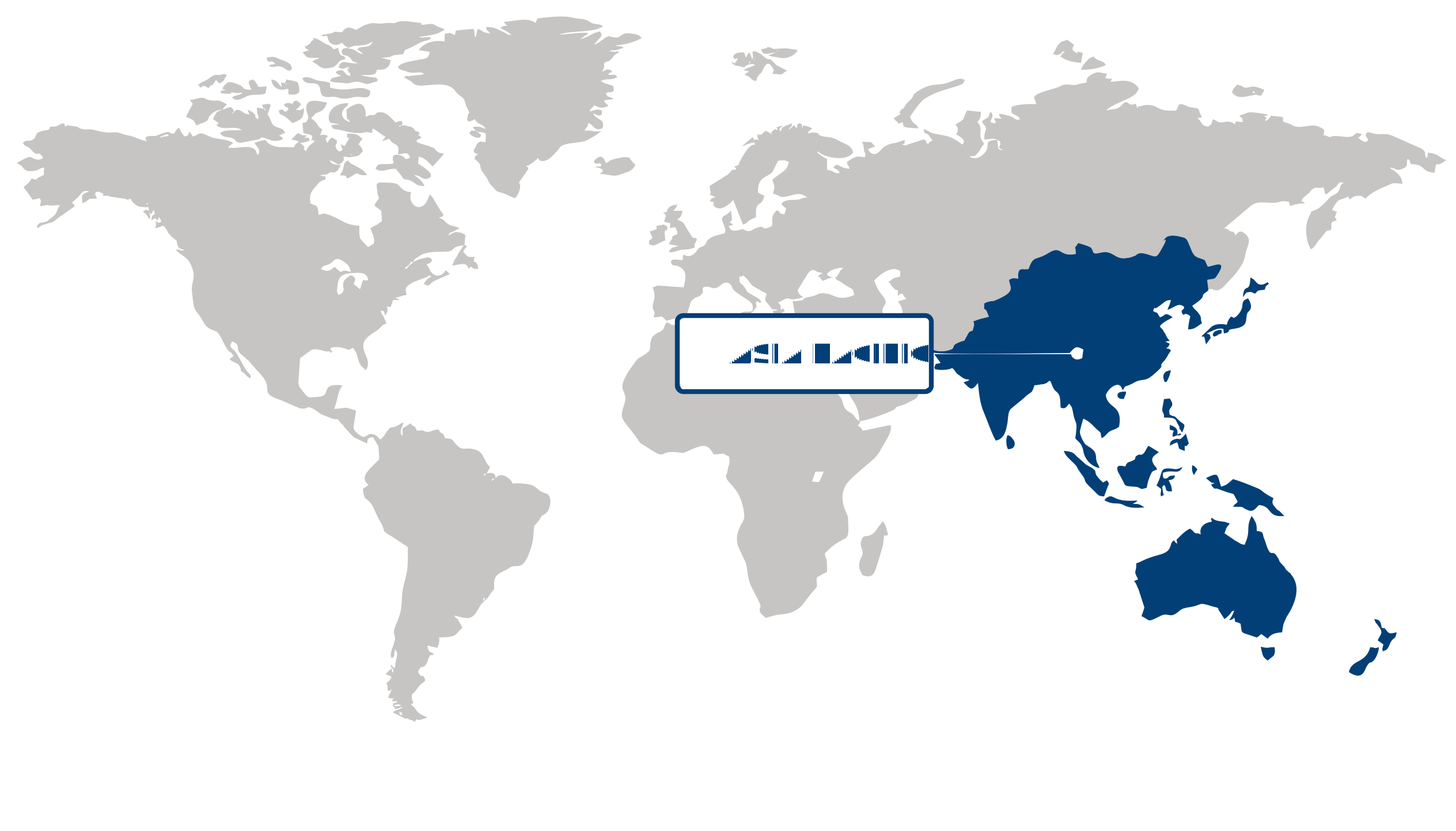
Asia Pacific (Largest Region)
The Asia Pacific composites market represented a 48.12% share in 2026, supported by strong manufacturing activity, infrastructure development, and broad utilization of lightweight and high-performance materials across multiple industries. Composites are increasingly adopted where manufacturers require combinations of strength, durability, corrosion resistance, and reduced weight, creating opportunities across transportation, construction, wind energy, electronics, and industrial applications. The region’s extensive automotive and industrial manufacturing base provides a substantial demand foundation, while infrastructure modernization is encouraging the use of durable materials with long service lives. Growing interest in energy efficiency and lightweight product design is also supporting substitution toward composite materials in applications where conventional materials may offer fewer performance advantages.
North America (Fastest-Growing Region)
North America is the fastest-growing regional market, driven by demand for lightweight materials in aerospace, automotive, renewable energy, construction, and advanced industrial applications. Manufacturers are increasingly evaluating composites to improve product performance, reduce weight, and enhance resistance to demanding operating environments. Continued development of advanced manufacturing processes is also making composite components more practical for complex applications and supporting broader design flexibility. In addition, investments in infrastructure modernization and clean energy technologies are creating new applications for composite materials, while increasing emphasis on durability, fuel efficiency, and lifecycle performance is encouraging greater adoption across established and emerging end-use sectors.
| Parameter | North America | Asia Pacific | Europe | Latin America | MEA |
|---|---|---|---|---|---|
| Innovation Hub i Scale Nascent Developing Advanced | |||||
| Cost-Sensitive Region i Scale Low Medium High | |||||
| Regulatory Environment i Scale Restrictive Neutral Supportive | |||||
| Demand Drivers i Scale Weak Moderate Strong | |||||
| Development Stage i Scale Emerging Developing Developed | |||||
| Adoption Rate i Scale Low Medium High | |||||
| New Entrants / Startups i Scale Sparse Moderate Dense | |||||
| Macro Indicators i Scale Weak Stable Strong |
Key Country Insights
Germany 🇩🇪
Industrial Lightweight EngineeringGermany continues integrating composites into automotive, industrial equipment, and transportation applications requiring weight reduction and structural strength. Manufacturers are prioritizing automated production technologies and high-performance material systems.
France 🇫🇷
Mobility Materials ExpansionFrance is applying composites across aerospace, transportation, and energy projects requiring lightweight and corrosion-resistant materials. Industrial buyers increasingly prioritize recyclable composite solutions and efficient manufacturing methods.
Italy 🇮🇹
Industrial Design ApplicationsItaly is expanding composite material use in automotive, marine, and industrial manufacturing where strength and design flexibility are valued. Producers are focusing on customized composite solutions that support efficient fabrication and durable end products.
Japan 🇯🇵
Precision Composite DevelopmentJapan is advancing composite materials for automotive, electronics, and industrial applications where dimensional stability and durability are essential. Domestic manufacturers focus on high-quality processing techniques and specialized material formulations.
South Korea 🇰🇷
Advanced Manufacturing MaterialsSouth Korea is increasing composite adoption across mobility, electronics, and renewable energy industries. Manufacturers are investing in innovative production processes that improve component performance while supporting lightweight product design.
United States 🇺🇸
Aerospace Material InnovationThe U.S. composites market is driven by demand from aerospace, automotive, and renewable energy manufacturers seeking lightweight, durable materials. Companies are expanding advanced composite production while improving manufacturing efficiency and material performance.
Segment Leadership and Growth Trends
Composites Market Share (%), by Product, 2026
Go beyond the chart, access full insights & data tables
Request Free Sample ReportProduct Segment Analysis: Glass Fiber (Largest Segment) vs Carbon Fiber (Fastest-Growing Segment)
Glass fiber held the largest position in the composites market, accounting for a 63% share in 2026, supported by its favorable combination of strength, durability, corrosion resistance, and cost efficiency. Its broad applicability across construction, transportation, wind energy, marine, and industrial components has established glass fiber as a widely adopted reinforcement material. The ability to produce lightweight structures while maintaining mechanical performance also supports demand as manufacturers seek alternatives to conventional materials and improve material efficiency.
Carbon fiber is experiencing faster growth as industries increasingly prioritize high-performance materials that combine exceptional strength and stiffness with low weight. Its advantages are particularly relevant to aerospace, automotive, renewable energy, and advanced sporting applications where weight reduction can improve efficiency and performance. Growing demand for lightweight structural components and the expansion of advanced manufacturing applications are creating additional opportunities for carbon fiber composites.
Manufacturing Process Segment Analysis: Layup Process (Largest Segment) vs Compression Molding Process (Fastest-Growing Segment)
The layup process accounted for the largest share of 36.99% in the composites market in 2026, reflecting its flexibility in producing composite structures with varied shapes, dimensions, and material configurations. The process is widely suited to applications requiring customized components and is established across aerospace, marine, automotive, construction, and industrial manufacturing. Its adaptability to different reinforcement materials and relatively flexible production requirements continue to support its broad utilization.
Compression molding is gaining traction as manufacturers seek faster, more consistent, and scalable methods for producing composite components. The process enables efficient shaping of materials under controlled pressure while supporting repeatable production and reduced material waste. Increasing demand for lightweight components in automotive, electrical, and industrial applications, together with the need for higher manufacturing productivity, is strengthening adoption of compression molding.
| Segment | Sub-Segment | Largest Segment | Fastest Growing |
|---|---|---|---|
| Product | Carbon Fiber, Glass Fiber, Natural Fiber, Others | Glass Fiber | Carbon Fiber |
| Manufacturing Process | Layup Process, Filament Winding Process, Injection Molding Process, Pultrusion Process, Compression Molding Process, Resin Transfer Molding Process, Others | Layup Process | Compression Molding Process |
| End-use | Aerospace & Defense, Automotive & Transportation, Construction & Infrastructure, Wind Energy, Electrical & Electronics, Construction and Infrastructure, Pipes & Tanks, Marine, Others | Automotive & Transportation | Wind Energy |
| Resin Type | Thermoset, Thermoplastic | Thermoset | Thermoplastic |
Competitive Landscape and Market Positioning
Major players in the composites market:
1. Toray Industries Inc. (Japan)
2. Owens Corning (United States)
3. Hexcel Corporation (United States)
4. Solvay S.A. (Belgium)
5. Teijin Limited (Japan)
6. SGL Carbon SE (Germany)
7. DuPont de Nemours Inc. (United States)
8. PPG Industries Inc. (United States)
9. China Jushi Co. Ltd. (China)
10. Compagnie de Saint-Gobain S.A. (France)
The composites market is advancing through material innovation and lightweight structural applications. Demand from transportation and industrial sectors is driving performance improvements. Continuous research is enhancing strength-to-weight efficiency and durability characteristics.
| Company | Market Share | Company Revenue | Revenue CAGR (%) | Product Portfolio | Geographic Presence | Innovation / R&D Focus | Strategic Developments |
|---|---|---|---|---|---|---|---|
| Toray Industries Inc. (Japan) | |||||||
| Owens Corning (United States) | |||||||
| Hexcel Corporation (United States) | |||||||
| Solvay S.A. (Belgium) | |||||||
| Teijin Limited (Japan) | |||||||
| SGL Carbon SE (Germany) | |||||||
| DuPont de Nemours Inc. (United States) | |||||||
| PPG Industries Inc. (United States) | |||||||
| China Jushi Co. Ltd. (China) | |||||||
| Compagnie de Saint-Gobain S.A. (France). |
Industry Development/News
| Company Name | Date | Key Development |
|---|---|---|
| Vestas and GE Vernova | Jun-25 | GE Vernova and Vestas moved to acquire assets from the defunct wind blade manufacturer TPI Composites. This transaction secures strategic composite blade manufacturing capacity and aftermarket components for both companies, fostering vertical integration within the wind energy supply chain and improving control over critical turbine manufacturing assets. |
| Touchstone Advanced Composites | Jun-25 | Touchstone Advanced Composites completed a 30% expansion of its Triadelphia, West Virginia facility, tripling its available cleanroom space. This capital project significantly scales production capacity for high-performance composite components, enhancing precision manufacturing capabilities and environmental control to meet the specialized demands of the aerospace and advanced industrial sectors. |
| Advanced Cooling Technologies | May-25 | Advanced Cooling Technologies acquired Canyon Composites, integrating composite material expertise into its existing thermal management portfolio. This strategic acquisition enables the development of high-performance integrated thermal control systems for satellite and aerospace applications, strengthening the company's competitive positioning in mission-critical thermal technology markets. |
| Archer | May-25 | Archer acquired a composite manufacturing facility and associated patent portfolio from Overair to bolster its defense aviation capabilities. The acquisition accelerates the company’s internal production capacity and intellectual property development for advanced composite airframe structures, reinforcing vertical integration for its high-performance aerospace programs. |
| Schütz Group | May-25 | Schütz Group acquired Euro-Composites, significantly expanding its footprint in the aerospace and industrial composite materials sector. The integration of ready-to-assemble composite structures and formed solutions complements Schütz’s existing industrial engineering capabilities, enhancing its global manufacturing reach in advanced materials production. |
| INEOS Enterprises | May-25 | INEOS Enterprises finalized the €1.7 billion sale of its composites business to KPS Capital Partners. This major divestment transfers ownership of a substantial industrial composites unit, reshaping the company's business portfolio while ensuring the continued operation and strategic development of the composites business under new investment leadership. |
| Toray Advanced Composites | May-25 | Toray Advanced Composites acquired Gordon Plastics, gaining specialized assets and intellectual property in continuous fiber-reinforced thermoplastic composites. This acquisition expands Toray's advanced materials portfolio and manufacturing capacity, providing enhanced solutions for high-growth aerospace and industrial applications that require high-performance, lightweight thermoplastic materials. |
| Parker Hannifin | May-25 | Parker Hannifin entered an agreement to divest its North America composites and fuel containment division to SK Capital Partners. As part of a broader corporate portfolio restructuring, this move transfers specialized composite operations, allowing Parker Hannifin to refocus strategic resources on its core industrial technology segments. |
| Bcomp | Apr-25 | Bcomp secured $40 million in Series C funding to accelerate the scale-up of its proprietary flax fiber-based composite technologies. The investment is earmarked for expanding global production capacity and increasing the penetration of sustainable, natural fiber reinforcement solutions within the automotive and industrial manufacturing sectors. |
| Teijin | Sep-24 | Teijin expanded its glass fiber prepreg production capacity at its manufacturing facility in Thailand. This investment serves to solidify the company's market position by increasing output to meet growing demand for composite materials, supporting supply chain requirements for regional and international customers in high-performance application segments. |
Customize Your Report
Explore examples of how this report can be tailored to different research needs, including custom segments, additional topics or chapters, and related reports. Click a section of the wheel or its numbered marker to explore the available options.
Composites Market — Custom Segments
| Segment | Sub-Segment |
|---|---|
| Performance Grade | Standard-Grade Composites, High-Performance Composites, Ultra-High-Performance Composites |
| Application Form | Finished Composite Parts & Components, Sheets & Panels, Tubes & Profiles, Preforms & Semi-Finished Materials, Prepregs |
| Sustainability Profile | Conventional Composites, Recycled-Content Composites, Bio-Based Composites, Recyclable & Circular Composites |
Composites Market — Custom TOC
| Custom Chapter | Custom Details |
|---|---|
| End-Use Industry Adoption Roadmap |
|
| Lightweighting Opportunity Assessment |
|
| Sustainable Composite Materials and Circularity |
|
Need a different cut of the data?
Request Custom ResearchWhat is the market size of composites?
What is the expected industry size of composites by 2036?
How are performance-driven material requirements influencing the shift toward advanced composites in high-value industries?
Why is manufacturing process selection shifting toward more automated composite production methods?
Why is Glass Fiber the largest product segment in the composites market?
Why is the Compression Molding Process the fastest-growing manufacturing process?
Why is Asia Pacific the leading regional market for composites?
What is driving composites market growth in North America?
Which organizations are considered leaders in the composites landscape?
Our Clients
"The report helped us understand emerging consumer trends in our product category. It clarified where to focus innovation for the next product launch."
LyondellBasell
"The regional forecast section was incredibly useful. We were able to identify two new potential partners in Europe thanks to the vendor mapping you included."
SABIC
"We appreciated how actionable the recommendations were. It guided us to improve supply chain resilience."
Olin Corporation
Our Research Team & Methodology
Every Fundamental Business Insights report is built by a dedicated vertical research team, validated through a structured primary-and-secondary methodology, and reviewed for accuracy before it reaches you.
Research Team Overview
Prepared by the Chemicals & Materials Research Team
Delivery
Published
Demand
Available
Support
Trust & Compliance
Research Domains
10 coverage areasResearch Intelligence
| Source | Reference |
|---|---|
| American Chemistry Council (ACC) | www.americanchemistry.com |
| European Chemical Industry Council (Cefic) | cefic.org |
| International Council of Chemical Associations (ICCA) | icca-chem.org |
| European Chemicals Agency (ECHA) | echa.europa.eu |
| U.S. Environmental Protection Agency (EPA) | www.epa.gov |
| ASTM International | www.astm.org |
| International Organization for Standardization (ISO) | www.iso.org |
| National Institute of Standards and Technology (NIST) | www.nist.gov |
| Plastics Industry Association (PLASTICS) | www.plasticsindustry.org |
| European Biplastics | www.european-bioplastics.org |
| The Adhesive and Sealant Council (ASC) | www.ascouncil.org |
| National Association of Corrosion Engineers (AMPP) | www.ampp.org |
| Society of Plastics Engineers (SPE) | www.4spe.org |
| International Fertilizer Association (IFA) | www.fertilizer.org |
| CropLife International | croplife.org |
| Packaging Europe | packagingeurope.com |
| Flexible Packaging Association (FPA) | www.flexpack.org |
| Battery Council International (BCI) | batterycouncil.org |
| International Copper Association (ICA) | internationalcopper.org |
| World Steel Association | worldsteel.org |
Research Workflow & Quality Assurance
Data Collection
Verified information gathered through primary and secondary research.
Data Triangulation
Cross-validation using multiple independent data sources.
Forecast Modelling
Market estimates developed using historical trends and analytical models.
Analyst Validation
Findings reviewed by domain experts for accuracy and consistency.
Editorial & Quality Review
Final editorial, quality, and compliance checks before publication.
Final Publication
Released after successful completion of the internal review process.
Report Coverage
📊 Market Assessment
- Market Size & Forecast
- Market Segmentation
- Regional Analysis
- Growth Drivers & Challenges
- Market Dynamics
🏢 Competitive Intelligence
- Competitive Landscape
- Company Profiles
- Competitive Benchmarking
- Mergers & Acquisitions
- Market Share Analysis or Key Company Strategies
🔍 Strategic Analysis
- Value Chain Analysis
- Porter's Five Forces
- PESTLE Analysis
- Pricing Trends
- Supply-Demand Analysis
🚀 Future Outlook
- Technology Landscape
- Regulatory Landscape
- Investment & Funding Landscape
- Emerging Opportunities
- Future Market Outlook
Have a question about this report or need a custom scope?
Request Customization