Common-Mode Chokes Market Size & Forecasts 2026-2035, By Segments (Type, End-Use), Growth Opportunities, Innovation Landscape, Regulatory Shifts, Strategic Regional Insights (U.S., Japan, China, South Korea, UK, Germany, France), and Competitive Dynamics (TDK, Murata, Taiyo Yuden, Wurth Elektronik, Eaton)
Market Size and Growth Outlook
Common-Mode Chokes Market size is estimated to increase from USD 708.7 million in 2025 to USD 1.38 billion by 2035, supported by a CAGR exceeding 6.9% during 2026-2035. In 2026, revenues are forecast to reach USD 751.45 million.
Get more details on this report
Request Free Sample ReportCommon-Mode Chokes Market Intelligence Snapshot
Regional Market Dynamics
Segment Momentum
Market Expansion Drivers
Leading Market Participants
Global Market Forecast Snapshot
Market Outlook
Regional and Segment Outlook
Market Growth Drivers and Industry Trends
Expansion in Industrial and Automotive Applications: Accelerating electrification and industrial automation increase exposure to conducted and radiated noise in powertrains, drives, and factory networks, making filtration essential; the common-mode chokes market is being pulled by OEMs such as Tesla and Bosch and by system integrators like Siemens that require automotive- and industrial-grade EMC components. SAE International standards and OEM press releases from Bosch and Tesla documenting power-electronics roadmaps illustrate rising specification stringency. incumbents can capitalize by scaling automotive-qualified lines and securing long-term supplier contracts, while new entrants can focus on modular, ruggedized designs or niche certifications. Observable trends in EV rollouts and factory digitization will sustain demand for automotive- and industrial-grade filters.
Advancements in Core Materials and Miniaturization: Breakthroughs in ferrite compositions and precision winding techniques from suppliers like TDK and Murata, together with manufacturing advances reported by Vishay, are enabling smaller, higher-frequency common-mode chokes market offerings that fit tight board real estate and higher switching-speed designs. Product announcements from TDK and Murata about compact, high-permeability components and ongoing academic and industry R&D (documented in IEEE conference proceedings) demonstrate material-driven performance gains. Incumbents can monetize R&D by integrating miniaturized chokes into power modules; entrants can differentiate with specialized, high-frequency parts or co-development services. Continued material innovation and process scaling will progressively drive component-level consolidation into denser system designs.
Industry Restraints:
Raw Material Price Volatility and Supply Constraints: Volatile prices and limited availability of ferrite, copper, and specialty alloys directly raise unit costs and extend lead times, slowing design cycles and procurement predictability for common-mode chokes. London Metal Exchange data on copper price swings and demand trends reported by the International Copper Study Group (ICSG) illustrate the underlying commodity pressure, while corporate disclosures from Murata Manufacturing Co., Ltd. and TDK Corporation have flagged procurement challenges and cost inflation for passive components. The net effect compresses margins for smaller vendors, forces larger suppliers into long‑term contracts or vertical integration, and encourages customers to delay product launches. Given continued electrification and geopolitical supply risks, these pressures are likely to persist in the near to medium term, favoring players with diversified sourcing and financial flexibility.
EMC Regulatory Complexity and Certification Costs: Growing electromagnetic compatibility (EMC) requirements and fragmented certification regimes increase development time and nonrecurring engineering costs for choke makers. Compliance obligations under the European Commission’s EMC Directive 2014/30/EU, FCC Part 15 in the United States, IEC 61000‑4‑3 testing standards, and automotive rules such as UNECE Regulation No. 10 impose multiple test cycles and lab certifications (Underwriters Laboratories, TÜV Rheinland) before market entry. That raises barriers for startups and niche suppliers while advantaging incumbents that can amortize certification costs across large portfolios. As product integration and automotive electrification advance, regulatory complexity and testing burdens will remain a binding constraint, pushing vendors to invest in in‑house test capabilities or strategic partnerships to maintain time to market.
| Growth Driver | Impact on CAGR | Regulatory Influence | Geographic Relevance | Adoption Rate | Impact Timeline |
|---|---|---|---|---|---|
| Increasing demand for EMI suppression in electronics | 2.50% | Short term (≤ 2 yrs) | North America, Europe | Medium | Fast |
| Growth in industrial and automotive applications | 2.00% | Medium term (2–5 yrs) | Asia Pacific, North America | Medium | Moderate |
| Advancements in core materials and miniaturization | 2.40% | Long term (5+ yrs) | Europe, Asia Pacific | Low | Slow |
Unlock insights tailored to your business with our bespoke market research solutions.
Click to get your customized report now.
Regional Demand Dynamics
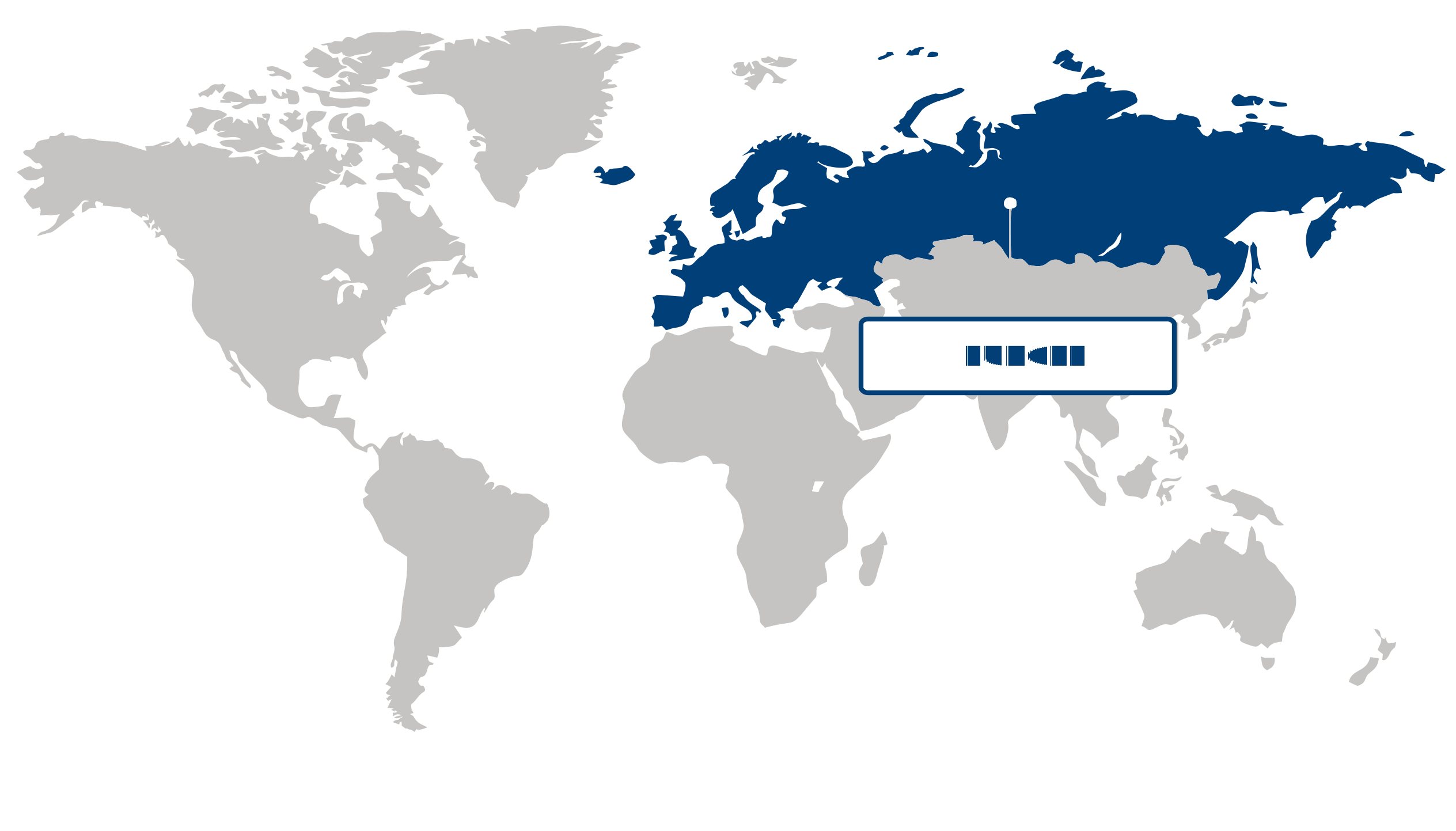
Europe captured over 32.00% of the global common-mode chokes market in 2025 and is the largest regional market, driven principally by stringent electromagnetic compatibility regimes and elevated industrial noise-suppression needs. The EU’s Electromagnetic Compatibility Directive (2014/30/EU) and standards set by CENELEC, alongside enforcement activity by the European Commission, have pushed manufacturers to integrate EMC components earlier in design cycles; product literature and solutions from Siemens AG and ABB Ltd. further underscore demand for integrated suppression. Robust manufacturing clusters, strong capital expenditure in automation, and Green Deal–linked electrification projects sustain demand, making Europe a fertile commercial landscape for suppliers expanding into industrial, building, and grid retrofit segments. Forward-looking policy alignment and corporate compliance commitments point to sustained opportunities for higher-value, application-specific chokes.
Germany anchors the European common-mode chokes market as an industrial and automotive engineering hub where electrification and strict in-vehicle EMC requirements amplify demand for noise suppression components. German OEMs such as Robert Bosch GmbH and Volkswagen AG emphasize EMC-compliant power electronics in EV and automation roadmaps, and oversight by the Bundesnetzagentur and initiatives from the Bundesministerium für Wirtschaft und Klimaschutz reinforce compliance-driven procurement. Strong Tier-1 ecosystems and local R&D centers enable suppliers to co-develop customized chokes for high-volume production, positioning Germany as a scale and innovation gateway that strengthens regional supply chains and accelerates roll-out across neighboring markets.
France is positioned as a pivotal hub in Europe for the common-mode chokes market, where grid modernization and building electrification create distinct opportunities for EMI mitigation. Major systems integrators like Schneider Electric and grid operator RTE (Réseau de Transport d'Électricité), together with policy support from the Ministry for the Ecological Transition and ADEME, are accelerating deployments of power electronics and smart-grid assets that require robust common-mode suppression. France’s emphasis on energy efficiency and large public infrastructure programs favors suppliers that can deliver certified, application-specific chokes for renewable integration and industrial retrofit projects, reinforcing Europe-wide demand and standards-driven procurement.
Asia Pacific Market Analysis:
Asia Pacific emerged as the fastest-growing region in the common-mode chokes market, registering a robust CAGR of 7.8% driven by the rapid expansion of telecommunications infrastructure and consumer electronics manufacturing. The region's dense 5G rollouts and handset, PCB, and power-electronics production hubs—backed by GSMA Intelligence noting accelerated Asia-Pacific 5G adoption and the China Ministry of Industry and Information Technology (MIIT) ongoing base-station buildouts—are creating steady demand for interference suppression and EMI components. Major OEMs and EMS providers such as Samsung Electronics, Foxconn, and Huawei, alongside component leaders Murata Manufacturing and TDK, are scaling supply and qualification programs. Policy support, localization efforts, and growing electric-vehicle electronics further reinforce supply-chain investments, positioning the region for sustained component demand and innovation-led opportunities.
Japan plays a technology-intense role in the common-mode chokes market, driven by high-reliability requirements across automotive, industrial, and premium consumer segments. Domestic manufacturers like Murata Manufacturing Co., Ltd. and TDK Corporation are expanding product lines and qualification services to meet stringent OEM requirements, while the Ministry of Economy, Trade and Industry (METI) policies supporting automotive electrification and advanced manufacturing sustain demand. Toyota’s electrification programs and Panasonic’s component partnerships emphasize long-term quality and lifecycle support, prompting localized engineering and higher-margin product development. Japan’s engineering depth and certified supply chains make it a critical source of specialized chokes that bolster regional technical capability and premium market segments.
China serves as a volume engine for the common-mode chokes market, where telecom network densification and mass consumer-electronics assembly are concentrated. The China Ministry of Industry and Information Technology (MIIT) continues to support 5G infrastructure deployment while operators such as China Mobile and vendors like Huawei procure large volumes of EMI components for base stations and CPE. Contract manufacturers including Foxconn and consumer brands such as Xiaomi enable rapid scaling of PCB assemblies embedding chokes, and domestic component producers are increasing capacity to meet procurement preferences and cost targets. These dynamics create deep supplier networks and competitive manufacturing economics that amplify Asia Pacific’s growth potential.
North America Market Trends:
Maintained high potential in the common-mode chokes market, North America is a focal region where accelerating electrification of transport, rapid data-center growth, and tighter electromagnetic compatibility expectations are boosting demand for EMI solutions. Demand signals include U.S. Department of Energy emphasis on vehicle and charging infrastructure electrification, Federal Communications Commission (FCC) Part 15 EMI requirements tightening emissions compliance, and corporate expansions such as Tesla press releases on Gigafactory growth and Amazon Web Services announcements about regional data-center builds. Supply-chain resilience initiatives led by the U.S. Department of Commerce (CHIPS and Science Act implementation) further favor local sourcing of passive components. These dynamics create near-term volumes and premium product windows for suppliers and integrators seeking scale in North America.
As the principal national market, the U.S. anchors the common-mode chokes market through federal incentives, industrial policy, and large OEM demand that translate directly into component uptake. The U.S. Department of Energy programs and National Renewable Energy Laboratory analyses on electrification, combined with General Motors press releases on EV manufacturing investments and hyperscaler infrastructure announcements from Microsoft, concretely illustrate OEM and infrastructure pull for robust EMI components. Strategic implication: suppliers prioritizing U.S.-focused qualification, local assembly, and close OEM partnerships are best positioned to convert policy- and investment-driven demand into sustained share gains across North America.
| Parameter | North America | Asia Pacific | Europe | Latin America | MEA |
|---|---|---|---|---|---|
| Innovation Hub i Scale Nascent Developing Advanced | |||||
| Cost-Sensitive Region i Scale Low Medium High | |||||
| Regulatory Environment i Scale Restrictive Neutral Supportive | |||||
| Demand Drivers i Scale Weak Moderate Strong | |||||
| Development Stage i Scale Emerging Developing Developed | |||||
| Adoption Rate i Scale Low Medium High | |||||
| New Entrants / Startups i Scale Sparse Moderate Dense | |||||
| Macro Indicators i Scale Weak Stable Strong |
Segment Leadership and Growth Trends
Common-Mode Chokes Market Share (%), by Type, 2026
Go beyond the chart, access full insights & data tables
Request Free Sample ReportPower line chokes dominated the common-mode chokes market, driven by widespread adoption of power‑line EMI suppression in switching power supplies and AC/DC adapters across consumer electronics and industrial equipment. Their lead reflects demand for compact, high‑current, low‑loss components as device power densities rise and regulators tighten conducted emissions limits; Texas Instruments application notes and Murata Manufacturing Co., Ltd. product literature document EMI mitigation topologies using such chokes. Supply‑chain shifts toward specialized ferrite materials and competitive activity from TDK and Vishay create scale and innovation opportunities for incumbents, while smaller specialists can capture niche design‑in slots. Continued relevance is expected as power conversion density and EMC standards persist in the near to medium term.
Analysis by End-Use
Automotive represented largest share of the common-mode chokes market, propelled by rapid EV adoption and increasing electronic content per vehicle that require robust EMI filtering. Leadership stems from integration in traction inverters, onboard chargers and advanced driver‑assistance electronics, supported by International Energy Agency reporting on electrification trends and UNECE R10 EMC regulation that raise compliance demands; Murata and TDK highlight automotive‑grade choke portfolios meeting AEC‑Q200 and high‑temperature requirements. Supplier consolidation, software‑defined vehicle architectures and functional‑safety priorities create strategic openings for Tier‑1s and agile entrants. The segment should remain central as vehicle electrification and stringent EMC rules continue to advance.
| Segment | Sub-Segment | Largest Segment | Fastest Growing |
|---|---|---|---|
| Type | Power Line Chokes, Signal Line Chokes, Data Line Chokes | ||
| End-Use | Consumer Electronics, Telecommunications, Automotive, Medical, Industrial |
Competitive Landscape and Market Positioning
Across the competitive landscape, the Top 10 are reshaping their positions through targeted partnerships with channel and OEM players, selective portfolio refreshes, and stepped-up investments in materials and process innovation. Many have broadened application-specific offerings for automotive, telecom, and industrial customers, tightened supply-chain collaboration, and introduced smaller, higher-frequency solutions to defend share. These initiatives accelerate differentiation, raise technical entry barriers, and force peers to modernize product and manufacturing capabilities to retain strategic accounts.
Strategic / Actionable Recommendations for Regional Players
North America — deepen ties with systems integrators and defense/automotive OEMs, expand local prototyping and qualification capabilities, and pursue selective alliances to secure long-lead customers and supply resilience while prioritizing reliability-focused product variants and compliance support.
Asia Pacific — leverage proximity to high-volume electronics manufacturers through closer co-development, scale investments in high-frequency miniaturization and automated production, and align with regional material and module suppliers to accelerate cost and feature leadership.
Europe — emphasize tailored solutions for industrial and automotive niches, collaborate with Tier 1 suppliers on customized modules, highlight eco-design and standards alignment, and exploit specialized manufacturing clusters to command premium positions.
| Company | Market Share | Company Revenue | Revenue CAGR (%) | Product Portfolio | Geographic Presence | Innovation / R&D Focus | Strategic Developments |
|---|---|---|---|---|---|---|---|
| No companies available. | |||||||
Industry Development/News
| Company Name | Date | Key Development |
|---|
Customize Your Report
Explore examples of how this report can be tailored to different research needs, including custom segments, additional topics or chapters, and related reports. Click a section of the wheel or its numbered marker to explore the available options.
Common-Mode Chokes Market — Custom Segments
| Segment | Sub-Segment |
|---|---|
| No segment data available. | |
Common-Mode Chokes Market — Custom TOC
| Custom Chapter | Custom Details | ||
|---|---|---|---|
| No custom TOC data available. | |||
Need a different cut of the data?
Request Custom ResearchWhat is the market size of common-mode chokes?
What is the expected industry size of common-mode chokes by 2035?
Which territory demonstrates the strongest presence in the common-mode chokes market?
Which geography represents the strongest growth trajectory for the common-mode chokes sector?
What share does power line chokes segment hold in the common-mode chokes sector as of 2025?
Where is the automotive segment seeing the strongest adoption within the common-mode chokes industry?
Which organizations are considered leaders in the common-mode chokes landscape?
Our Clients
"Working with FBI has been a good experience. The market report provided a holistic view, covering everything from emerging trends to potential risks."
Semtech Corporation
"The experience was highly positive. The team showcased remarkable flexibility in adapting to our specific needs and delivered report that perfectly aligned with all our requirements."
TSMC
"What really stood out to me was how clearly and promptly the Fundamental Business Insights team communicated throughout. It made the collaboration feel effortless."
NXP Semiconductors
Our Research Team & Methodology
Every Fundamental Business Insights report is built by a dedicated vertical research team, validated through a structured primary-and-secondary methodology, and reviewed for accuracy before it reaches you.
Research Team Overview
Prepared by the Electronics & Semiconductors Research Team
Delivery
Published
Demand
Available
Support
Trust & Compliance
Research Domains
10 coverage areasResearch Intelligence
| Source | Reference |
|---|---|
| Semiconductor Industry Association (SIA) | www.semiconductors.org |
| SEMI | www.semi.org |
| JEDEC Solid State Technology Association | www.jedec.org |
| IEEE | www.ieee.org |
| IPC – Association Connecting Electronics Industries | www.ipc.org |
| International Electrotechnical Commission (IEC) | www.iec.ch |
| International Organization for Standardization (ISO) | www.iso.org |
| U.S. Bureau of Industry and Security (BIS) | www.bis.gov |
| U.S. Patent and Trademark Office (USPTO) | www.uspto.gov |
| European Patent Office (EPO) | www.epo.org |
| Taiwan Semiconductor Industry Association (TSIA) | www.tsia.org.tw |
| World Semiconductor Trade Statistics (WSTS) | www.wsts.org |
| International Energy Agency (IEA) | www.iea.org |
| GSMA | www.gsma.com |
| 3GPP | www.3gpp.org |
| ITU (International Telecommunication Union) | www.itu.int |
| Omdia (public insights) | omdia.tech.informa.com |
| Display Supply Chain Consultants (DSCC) | www.displaysupplychain.com |
| U.S. Department of Energy (DOE) | www.energy.gov |
| NIST (National Institute of Standards and Technology) | www.nist.gov |
Research Workflow & Quality Assurance
Data Collection
Verified information gathered through primary and secondary research.
Data Triangulation
Cross-validation using multiple independent data sources.
Forecast Modelling
Market estimates developed using historical trends and analytical models.
Analyst Validation
Findings reviewed by domain experts for accuracy and consistency.
Editorial & Quality Review
Final editorial, quality, and compliance checks before publication.
Final Publication
Released after successful completion of the internal review process.
Report Coverage
📊 Market Assessment
- Market Size & Forecast
- Market Segmentation
- Regional Analysis
- Growth Drivers & Challenges
- Market Dynamics
🏢 Competitive Intelligence
- Competitive Landscape
- Company Profiles
- Competitive Benchmarking
- Mergers & Acquisitions
- Market Share Analysis or Key Company Strategies
🔍 Strategic Analysis
- Value Chain Analysis
- Porter's Five Forces
- PESTLE Analysis
- Pricing Trends
- Supply-Demand Analysis
🚀 Future Outlook
- Technology Landscape
- Regulatory Landscape
- Investment & Funding Landscape
- Emerging Opportunities
- Future Market Outlook
Have a question about this report or need a custom scope?
Request Customization