Commercial Vessel Market Size & Growth Forecast 2027–2036, By Segments (Type, Fuel Type, Application), Regional Demand Trends (North America, Asia Pacific, Europe), Key Country Insights (U.S., Japan, South Korea, Germany, France, Italy), and Competitive Landscape
Market Size and Growth Outlook
Commercial Vessel Market size was over USD 160.37 Billion in 2026 and is likely to grow at 3.24% CAGR between 2027 and 2036, exceeding USD 220.6 Billion by 2036. The industry revenue for 2027 is estimated at USD 164.7 Billion.
Get more details on this report
Request Free Sample ReportCommercial Vessel Market Intelligence Snapshot
Regional Market Dynamics
- Asia Pacific leads through its maritime trade ecosystem, strong shipbuilding capabilities, major ports, and industrial centers supporting sustained commercial vessel demand.
- Regional demand is strengthened by expanding trade, port infrastructure investment, fleet modernization, and adoption of efficient vessel technologies focused on emissions reduction.
Segment Momentum
- Container ships led with a 27% share in 2026, supported by expanding containerized trade, efficient cargo handling, and their importance in global supply chain operations.
- LNG is the fastest-growing fuel type as shipowners increasingly adopt cleaner propulsion solutions driven by emission reduction goals, environmental regulations, and expanding LNG infrastructure.
Market Expansion Drivers
- Increasing cross-border trade activities supporting commercial fleet expansion
- Rising investments in port infrastructure enhancing vessel deployment capacity
- Fleet modernization programs accelerating adoption of fuel-efficient vessels
Leading Market Participants
- Major companies in the commercial vessel market include China State Shipbuilding Corporation (China), Fincantieri S.p.A. (Italy), Hyundai Heavy Industries Co., Ltd. (South Korea), Samsung Heavy Industries Co., Ltd. (South Korea), Imabari Shipbuilding Co., Ltd. (Japan), Japan Marine United Corporation (Japan), Meyer Werft GmbH (Germany), Mitsubishi Heavy Industries, Ltd. (Japan), Yangzijiang Shipbuilding Holdings Ltd. (Singapore), Daewoo Shipbuilding & Marine Engineering Co., Ltd. (South Korea)
Global Market Forecast Snapshot
Market Outlook
- 2026 Market Size: USD 160.37 Billion
- 2027 Estimated Market Size: USD 164.7 Billion
- Projected Market Size: USD 220.6 Billion by 2036
- Growth Forecast: 3.24% CAGR (2027-2036)
Regional and Segment Outlook
- Leading Regional Market: Asia Pacific
- High-Growth Regional Hub: Asia Pacific
- Core Revenue Segment: Container Ships (Type) | Heavy Fuel Oil (Fuel Type) | Repair & Maintenance (Application)
- Emerging Opportunity Segment: Container Ships (Type) | Liquefied Natural Gas (LNG) (Fuel Type) | Repair & Maintenance (Application)
Market Growth Drivers and Industry Trends
Increasing cross-border trade activities supporting commercial fleet expansion
Growing cross-border movement of manufactured products, commodities, energy resources, and consumer goods is increasing the need for maritime transportation capacity across international trade routes. The commercial vessel market will expand as shipping operators add or replace vessels to accommodate changing cargo flows and strengthen connectivity between production centers, ports, and consumer markets. Higher trade activity also encourages fleet owners to optimize vessel capacity and route coverage, supporting demand for cargo ships and other commercial vessels suited to different transportation requirements. As global supply chains become more interconnected, shipping remains a critical means of moving large volumes of goods over long distances, sustaining fleet investment alongside evolving trade patterns.
Rising investments in port infrastructure enhancing vessel deployment capacity
Port expansion and modernization are improving the ability of maritime facilities to accommodate larger vessels, higher cargo volumes, and more efficient loading and unloading operations. This development will support the commercial vessel market by creating infrastructure capable of handling expanded fleet capacity and improving vessel turnaround across major trade gateways. Investments in deeper berths, upgraded cargo-handling systems, expanded terminals, and improved connectivity can reduce operational constraints that previously limited vessel deployment. Enhanced port capabilities also encourage shipping operators to consider vessels with greater capacity or specialized configurations as ports adapt to changing cargo requirements and evolving maritime logistics networks.
Fleet modernization programs accelerating adoption of fuel-efficient vessels
Shipping companies are increasingly modernizing fleets to improve operating efficiency and address pressure to reduce fuel consumption and emissions. The commercial vessel market will benefit as operators retire older, less efficient vessels and procure designs incorporating more efficient propulsion systems, optimized hull configurations, and technologies that reduce energy requirements during voyages. Fuel-efficient vessels can improve operating economics by lowering fuel exposure over long routes while also helping fleet owners respond to increasingly stringent environmental expectations. Modernization programs therefore extend beyond replacement of aging assets, with procurement decisions increasingly influenced by lifecycle operating costs, environmental performance, and the ability to maintain competitiveness across international shipping routes.
| Growth Driver | Impact on CAGR | Regulatory Influence | Geographic Relevance | Adoption Rate | Impact Timeline |
|---|---|---|---|---|---|
| Increasing cross-border trade activities supporting commercial fleet expansion | 2.1% | Moderate | Asia Pacific, Europe | High | Near Term |
| Rising investments in port infrastructure enhancing vessel deployment capacity | 1.8% | Moderate | Asia Pacific, Middle East & Africa | High | Mid Term |
| Fleet modernization programs accelerating adoption of fuel-efficient vessels | 1.5% | High | North America, Europe | Emerging | Long Term |
Unlock insights tailored to your business with our bespoke market research solutions.
Click to get your customized report now.
Regional Demand Dynamics
Asia Pacific (Largest & Fastest-Growing Region)
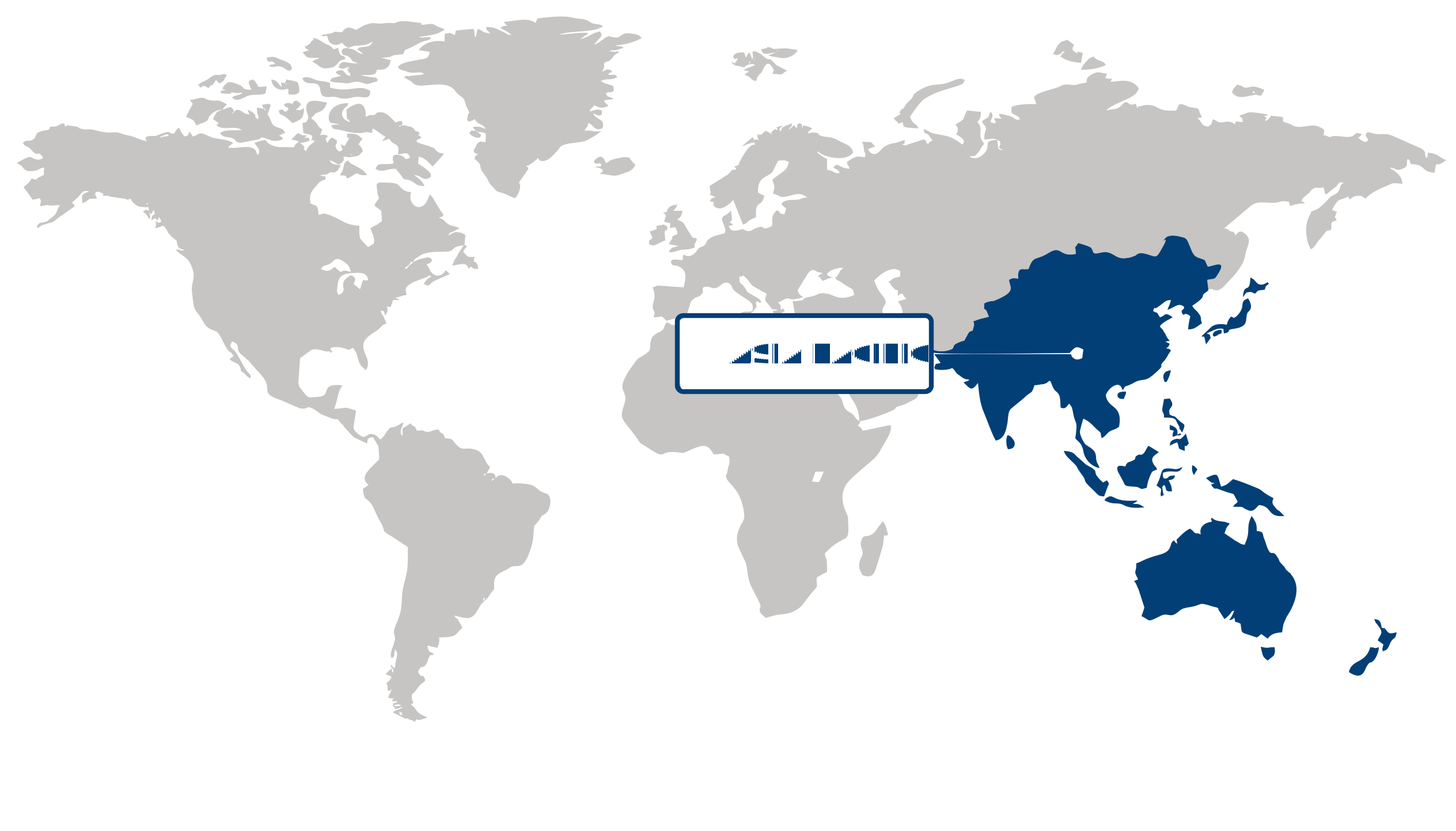
The Asia Pacific commercial vessel market was led by Asia Pacific, which held the largest share in 2026 and is also expected to remain the fastest-growing regional market. The region's position is closely linked to its extensive maritime trade ecosystem, strong shipbuilding capabilities, and concentration of major ports and industrial manufacturing centers. Expanding international and intra-regional trade is sustaining demand for commercial vessels used across container transportation, bulk shipping, offshore activities, and other maritime applications. Continued investment in port infrastructure, fleet modernization, and more efficient vessel technologies is further supporting regional demand, while growing attention to emissions reduction and maritime efficiency is encouraging operators to upgrade fleets and adopt advanced vessel solutions.
| Parameter | North America | Asia Pacific | Europe | Latin America | MEA |
|---|---|---|---|---|---|
| Innovation Hub i Scale Nascent Developing Advanced | |||||
| Cost-Sensitive Region i Scale Low Medium High | |||||
| Regulatory Environment i Scale Restrictive Neutral Supportive | |||||
| Demand Drivers i Scale Weak Moderate Strong | |||||
| Development Stage i Scale Emerging Developing Developed | |||||
| Adoption Rate i Scale Low Medium High | |||||
| New Entrants / Startups i Scale Sparse Moderate Dense | |||||
| Macro Indicators i Scale Weak Stable Strong |
Key Country Insights
United States 🇺🇸
Fleet Modernization DriveThe U.S. commercial vessel market is shaped by ongoing fleet renewal across cargo and offshore segments, with operators prioritizing fuel efficiency, emissions compliance, and digital navigation systems. Investment activity is concentrated in upgrading aging vessels to meet stricter maritime operational standards.
Germany 🇩🇪
Green Ship EngineeringGermany emphasizes advanced shipbuilding capabilities focused on low-emission propulsion systems and energy-efficient vessel design. Shipyards and marine engineers are prioritizing alternative fuels and compliance-driven engineering for European and global shipping operators.
Japan 🇯🇵
High-Efficiency Vessel DesignJapan’s commercial vessel market focuses on precision-built, fuel-efficient ships optimized for long-haul trade routes. Shipbuilders emphasize technological refinement, automation, and reliability to maintain competitiveness in global maritime manufacturing.
South Korea 🇰🇷
Large-Scale Shipbuilding StrengthSouth Korea leverages its large-scale shipbuilding capacity to deliver high-value commercial vessels, including LNG carriers and container ships. Industry priorities include production efficiency, order backlog management, and next-generation propulsion systems.
France 🇫🇷
Specialized Maritime EngineeringFrance concentrates on specialized vessel segments and advanced marine engineering solutions, particularly in defense-adjacent and complex commercial applications. Shipbuilders focus on high-spec designs and integration of advanced onboard systems.
Italy 🇮🇹
Mediterranean Fleet OptimizationItaly’s commercial vessel market is driven by Mediterranean trade routes, with emphasis on ferry, cargo, and short-sea shipping vessels. Operators prioritize operational efficiency, retrofit programs, and fleet adaptability for regional maritime logistics.
Segment Leadership and Growth Trends
Commercial Vessel Market Share (%), by Type, 2026
Go beyond the chart, access full insights & data tables
Request Free Sample ReportType Segment Analysis: Container Ships (Largest & Fastest-Growing Segment)
The commercial vessel market was led by the container ships segment, which accounted for 27% in 2026, while also emerging as the fastest-growing vessel type. The segment's leadership is supported by the continued expansion of global containerized trade and the growing need for efficient transportation of manufactured goods across international shipping routes. Container ships offer high cargo handling efficiency, standardized logistics operations, and optimized turnaround times, making them indispensable to modern supply chains. Ongoing investments in fleet modernization, larger cargo capacities, and digital vessel management technologies are further reinforcing the segment's strong market position and sustained growth.
Fuel Type Segment Analysis: Heavy Fuel Oil (Largest Segment) vs Liquefied Natural Gas (LNG) (Fastest-Growing Segment)
Heavy fuel oil represented the largest fuel type segment in 2026, supported by its long-standing use across commercial shipping fleets and its compatibility with a broad range of existing marine engines. Many vessel operators continue to rely on heavy fuel oil because of established bunkering infrastructure, operational familiarity, and its suitability for long-haul maritime transportation. The extensive global fleet designed around conventional fuel systems has further contributed to the segment's dominant position.
Liquefied natural gas (LNG) is the fastest-growing fuel type as the commercial vessel market increasingly shifts toward cleaner marine propulsion solutions. Stricter environmental regulations, growing emphasis on reducing vessel emissions, and expanding investments in LNG bunkering infrastructure are encouraging shipowners to adopt LNG-powered vessels. Advances in engine technology and the maritime industry's focus on balancing operational efficiency with environmental performance continue to accelerate the adoption of LNG as an alternative marine fuel.
Application Segment Analysis: Repair & Maintenance (Largest & Fastest-Growing Segment)
Holding the largest share of the commercial vessel market, the repair & maintenance segment remained dominant in 2026 while also registering the fastest growth. Continuous maintenance is essential for ensuring vessel safety, regulatory compliance, fuel efficiency, and uninterrupted commercial operations throughout a ship's service life. Aging global fleets, increasing inspection requirements, and the growing adoption of predictive maintenance technologies are driving sustained demand for repair services. Rising investments in vessel upgrades, retrofitting, and lifecycle extension programs further strengthen the segment's leadership and long-term growth prospects.
| Segment | Sub-Segment | Largest Segment | Fastest Growing |
|---|---|---|---|
| Type | Container Ships, Passenger Vessels, Reefer Ships, Tankers, Fishing Vessels, Tugs, Bulk Carriers, Others | Container Ships | Container Ships |
| Fuel Type | Liquefied Natural Gas (LNG), Diesel Oil, Heavy Fuel Oil, Others | Heavy Fuel Oil | Liquefied Natural Gas (LNG) |
| Application | New Build, Repair & Maintenance | Repair & Maintenance | Repair & Maintenance |
Competitive Landscape and Market Positioning
Key companies in the commercial vessel market:
- China State Shipbuilding Corporation (China)
- Fincantieri S.p.A. (Italy)
- Hyundai Heavy Industries Co., Ltd. (South Korea)
- Samsung Heavy Industries Co., Ltd. (South Korea)
- Imabari Shipbuilding Co., Ltd. (Japan)
- Japan Marine United Corporation (Japan)
- Meyer Werft GmbH (Germany)
- Mitsubishi Heavy Industries Ltd. (Japan)
- Yangzijiang Shipbuilding Holdings Ltd. (Singapore)
- Daewoo Shipbuilding & Marine Engineering Co., Ltd. (South Korea)
The commercial vessel market is undergoing a competitive shift as shipbuilders and maritime solution providers focus on efficiency, sustainability, and vessel adaptability. Competitive differentiation is increasingly linked to the ability to deliver advanced designs that address changing operational requirements, including improved fuel performance and integration of emerging technologies. Participants with stronger design capabilities and flexible manufacturing approaches are better positioned as vessel owners seek long-term value from new fleet investments.
| Company | Market Share | Company Revenue | Revenue CAGR (%) | Product Portfolio | Geographic Presence | Innovation / R&D Focus | Strategic Developments |
|---|---|---|---|---|---|---|---|
| China State Shipbuilding Corporation (China) | |||||||
| Fincantieri S.p.A. (Italy) | |||||||
| Hyundai Heavy Industries Co. Ltd. (South Korea) | |||||||
| Samsung Heavy Industries Co. Ltd. (South Korea) | |||||||
| Imabari Shipbuilding Co. Ltd. (Japan) | |||||||
| Japan Marine United Corporation (Japan) | |||||||
| Meyer Werft GmbH (Germany) | |||||||
| Mitsubishi Heavy Industries Ltd. (Japan) | |||||||
| Yangzijiang Shipbuilding Holdings Ltd. (Singapore) | |||||||
| Daewoo Shipbuilding & Marine Engineering Co. Ltd. (South Korea) |
Industry Development/News
| Company Name | Date | Key Development |
|---|---|---|
| Intel Marine | Apr-26 | Intel Marine outlined a partnership-driven strategy to scale U.S. commercial shipbuilding capacity. By integrating regional industry capabilities, the initiative intends to alleviate domestic production constraints and position the company for upcoming federal vessel fleet requirements. |
| Archipelago Yachts | Feb-26 | Archipelago Yachts established its first fully controlled production facility by opening a dedicated shipyard in Newport on the Isle of Wight. This investment brings key manufacturing capabilities in-house to secure stricter operational control over future commercial vessel fabrication. |
| Cochin Shipyard | Oct-25 | Cochin Shipyard announced plans to raise ₹6,000 crore over the next five to six years to finance critical expansion initiatives. The capital injection is directly intended to strengthen heavy commercial shipbuilding capacity and support long-term output growth in manufacturing. |
| Bahri | Oct-25 | Bahri signed an agreement with International Maritime Industries to construct six Ultramax bulk carriers, establishing Saudi Arabia's first large-scale domestic commercial vessel building program. The order modernization strategy drives localized maritime engineering and expands regional shipbuilding footprints. |
| HD Korea Shipbuilding & Offshore Engineering | Sep-25 | HD Korea Shipbuilding & Offshore Engineering approved the corporate merger of Hyundai Mipo and Hyundai Heavy Industries into a single, unified entity. The consolidation integrates large-scale industrial assets to optimize commercial vessel manufacturing capacity and bolster overall global market competitiveness. |
| Sea-Flux | Sep-25 | Sea-Flux secured nearly NZ$3 million in investment to accelerate the international expansion of its cloud-based vessel management software platform. The funding accelerates geographic scalability and drives digital fleet management technology adoption among commercial maritime operators. |
| MSC Cruises | Jul-25 | MSC Cruises partnered with Carnival Corporation and Royal Caribbean Group to expand Grand Bahama Shipyard. The strategic infrastructure collaboration increases total shipyard capacity and enhances regional maintenance, repair, and overhaul capabilities for large commercial cruise vessels. |
| thyssenkrupp Marine Systems | Apr-25 | thyssenkrupp Marine Systems and Ulstein Verft signed a Letter of Intent to collaborate on future shipbuilding projects. The industrial cooperation expands combined shipyard capabilities to design, engineer, and manufacture next-generation commercial vessel architectures. |
| Shin Kurushima Dockyard Co., Ltd. | Aug-23 | Shin Kurushima Dockyard Co., Ltd. collaborated with Mitsubishi Shipbuilding Co., Ltd. to facilitate the delivery of a proprietary Fuel Gas Supply System. The high-pressure dual-fuel marine engine technology integration marks a meaningful commercial milestone for eco-friendly propulsion systems. |
| A.P. Moller-Maersk | Jun-23 | A.P. Moller-Maersk ordered six 9,000 TEU mid-sized container vessels from Yangzijiang Shipbuilding Group. The contract expands high-capacity asset pipelines by introducing dual-fuel engines operating on green methanol, with deliveries scheduled through 2026 and 2027. |
Customize Your Report
Explore examples of how this report can be tailored to different research needs, including custom segments, additional topics or chapters, and related reports. Click a section of the wheel or its numbered marker to explore the available options.
Commercial Vessel Market — Custom Segments
| Segment | Sub-Segment |
|---|---|
| Vessel Size | Small, Medium, Large, Very Large |
| Ownership Model | Privately Owned, State-Owned, Leasing-Owned |
| Vessel Order Status | On Order, Under Construction, Delivered |
Commercial Vessel Market — Custom TOC
| Custom Chapter | Custom Details |
|---|---|
| Shipowner Procurement and Investment Benchmarking |
|
| Maritime Decarbonization Readiness Assessment |
|
| Marine Aftermarket and Lifecycle Services Opportunity Assessment |
|
Need a different cut of the data?
Request Custom ResearchHow big is the commercial vessel market?
What is the anticipated CAGR of the commercial vessel industry?
How are expanding global trade flows influencing investment decisions in the commercial vessel market?
Why is fleet modernization becoming a strategic priority for commercial vessel operators?
Why do container ships dominate the commercial vessel market?
How is LNG adoption influencing growth in the commercial vessel market?
Why does Asia Pacific dominate the commercial vessel market?
What is supporting continued commercial vessel growth in Asia Pacific?
Who are the major participants shaping the commercial vessel landscape?
Our Clients
"The team surpassed our expectations with the report depth. The actionable insights provided proved crucial in navigating market challenges."
Tata Motors
"We found the report to be very informative. The expertise and attention to market nuances significantly influenced our business direction."
DENSO Corporation
"The consumer survey findings were quite good. We now have a clearer picture of the customer churning and retention strategy."
HL Mando
Our Research Team & Methodology
Every Fundamental Business Insights report is built by a dedicated vertical research team, validated through a structured primary-and-secondary methodology, and reviewed for accuracy before it reaches you.
Research Team Overview
Prepared by the Automotive & Transportation Research Team
Delivery
Published
Demand
Available
Support
Trust & Compliance
Research Domains
10 coverage areasResearch Intelligence
| Source | Reference |
|---|---|
| International Organization of Motor Vehicle Manufacturers (OICA) | www.oica.net |
| SAE International | www.sae.org |
| International Energy Agency (IEA) | www.iea.org |
| International Transport Forum (ITF) | www.itf-oecd.org |
| International Road Federation (IRF) | www.irf.global |
| International Organization for Standardization (ISO) | www.iso.org |
| United Nations Economic Commission for Europe (UNECE) | unece.org |
| National Highway Traffic Safety Administration (NHTSA) | www.nhtsa.gov |
| U.S. Department of Transportation (USDOT) | www.transportation.gov |
| European Automobile Manufacturers' Association (ACEA) | www.acea.auto |
| Society of Indian Automobile Manufacturers (SIAM) | www.siam.in |
| International Air Transport Association (IATA) | www.iata.org |
| International Civil Aviation Organization (ICAO) | www.icao.int |
| International Maritime Organization (IMO) | www.imo.org |
| International Union of Railways (UIC) | uic.org |
| American Public Transportation Association (APTA) | www.apta.com |
| International Federation of Robotics (IFR) | ifr.org |
| CharIN | www.charin.global |
| World Shipping Council | www.worldshipping.org |
| International Federation of Freight Forwarders Associations (FIATA) | fiata.org |
Research Workflow & Quality Assurance
Data Collection
Verified information gathered through primary and secondary research.
Data Triangulation
Cross-validation using multiple independent data sources.
Forecast Modelling
Market estimates developed using historical trends and analytical models.
Analyst Validation
Findings reviewed by domain experts for accuracy and consistency.
Editorial & Quality Review
Final editorial, quality, and compliance checks before publication.
Final Publication
Released after successful completion of the internal review process.
Report Coverage
📊 Market Assessment
- Market Size & Forecast
- Market Segmentation
- Regional Analysis
- Growth Drivers & Challenges
- Market Dynamics
🏢 Competitive Intelligence
- Competitive Landscape
- Company Profiles
- Competitive Benchmarking
- Mergers & Acquisitions
- Market Share Analysis or Key Company Strategies
🔍 Strategic Analysis
- Value Chain Analysis
- Porter's Five Forces
- PESTLE Analysis
- Pricing Trends
- Supply-Demand Analysis
🚀 Future Outlook
- Technology Landscape
- Regulatory Landscape
- Investment & Funding Landscape
- Emerging Opportunities
- Future Market Outlook
Have a question about this report or need a custom scope?
Request Customization