Commercial Helicopter Market Size & Growth Forecast 2027–2036, By Segments (Type, Application), Regional Demand Trends (North America, Asia Pacific, Europe), Key Country Insights (U.S., Japan, South Korea, Germany, France, Italy), and Competitive Landscape
Market Size and Growth Outlook
Commercial Helicopter Market size was more than USD 7.5 billion in 2026 and is set to grow at a 4.09% CAGR between 2027 and 2036, reaching USD 11.2 billion by 2036. The industry revenue for 2027 is assessed at USD 7.76 billion.
Get more details on this report
Request Free Sample ReportCommercial Helicopter Market Intelligence Snapshot
Regional Market Dynamics
- Europe accounted for 34.98% of the market in 2026, supported by mature fleet operations, extensive maintenance capabilities, and steady demand across transport, emergency services, offshore, and law enforcement missions.
- Asia Pacific is expected to expand at a 6.22% CAGR as operators increase helicopter deployment for regional connectivity, emergency response, tourism, and infrastructure-related transport across developing aviation networks.
Segment Momentum
- Medium helicopters lead with a 53.55% share because they balance payload, range, and operating costs, making them suitable for passenger transport, utility missions, and offshore support roles.
- Heavy helicopters are growing fastest due to rising need for higher lift capacity and longer endurance in complex missions where medium platforms are operationally constrained.
Market Expansion Drivers
- Rising emergency medical services and public safety operations driving helicopter utilization.
- Offshore oil and gas exploration expansion increasing demand for commercial rotorcraft operations.
- Hybrid-electric propulsion and fleet leasing models improving operational efficiency and adoption.
Leading Market Participants
- Major companies in the commercial helicopter market include Airbus SE (Netherlands), Bell Textron Inc. (United States), Leonardo S.p.A. (Italy), Lockheed Martin Corporation (United States), Russian Helicopters JSC (Russia), Hindustan Aeronautics Limited (India), MD Helicopters, Inc. (United States), Enstrom Helicopter Corporation (United States), Kaman Corporation (United States), Robinson Helicopter Company (United States).
Global Market Forecast Snapshot
Market Outlook
- 2026 Market Size: USD 7.5 billion
- 2027 Estimated Market Size: USD 7.76 billion.
- Projected Market Size: USD 11.2 billion by 2036
- Growth Forecast: 4.09% CAGR (2027-2036)
Regional and Segment Outlook
- Leading Regional Market: Europe
- High-Growth Regional Hub: Asia Pacific
- Core Revenue Segment: Medium (Type) | Law Enforcement & Public Safety (Application)
- Emerging Opportunity Segment: Heavy (Type) | Medical Services (Application)
Market Growth Drivers and Industry Trends
Rising emergency medical services and public safety operations driving helicopter utilization
Increasing reliance on rapid aerial transportation for emergency medical response and public safety missions will drive the commercial helicopter market growth as operators require aircraft capable of reaching locations where ground transportation can be slow or impractical. Helicopters provide rapid patient evacuation, medical transport, disaster response, firefighting, search and rescue, and law enforcement capabilities, making them valuable for time-sensitive operations. Expansion of emergency response networks and the need to serve remote or difficult-to-access areas are encouraging public agencies, healthcare providers, and specialized operators to maintain and modernize rotorcraft fleets. Mission flexibility, vertical takeoff and landing capability, and the ability to operate from constrained locations further support helicopter deployment across these services.
Offshore oil and gas exploration expansion increasing demand for commercial rotorcraft operations
Growing offshore exploration and production activities will support the commercial helicopter market growth by increasing the requirement for reliable transportation between coastal bases and offshore facilities. Helicopters provide an efficient means of moving workers, maintenance personnel, equipment, and supplies to platforms and other remote installations where conventional transportation options are limited. Offshore operations also require dependable crew rotation and rapid access for maintenance and emergency response, creating recurring demand for rotorcraft services. As exploration and production activities extend across geographically dispersed offshore locations, operators place greater emphasis on aircraft range, payload capability, safety, and operational reliability for routine transportation missions.
Hybrid-electric propulsion and fleet leasing models improving operational efficiency and adoption
Emerging propulsion technologies and flexible aircraft acquisition models are reshaping operating economics within the commercial helicopter market, creating opportunities for broader fleet adoption. Hybrid-electric propulsion has the potential to reduce fuel consumption, emissions, noise, and operating costs in applications where the technology is technically suitable, while continued development of electric and hybrid power systems is encouraging operators to evaluate next-generation rotorcraft. At the same time, leasing models can reduce the upfront capital burden associated with fleet acquisition and provide operators with greater flexibility in managing aircraft capacity and replacement cycles. These developments are particularly relevant to commercial operators seeking to modernize fleets while maintaining financial flexibility and improving mission economics.
| Growth Driver | Impact on CAGR | Regulatory Influence | Geographic Relevance | Adoption Rate | Impact Timeline |
|---|---|---|---|---|---|
| Rising emergency medical services and public safety operations driving helicopter utilization | 2.30% | Moderate | North America, Europe, Asia Pacific | High | Near Term |
| Offshore oil and gas exploration expansion increasing demand for commercial rotorcraft operations | 2.00% | Moderate | North America, Middle East & Africa | High | Mid Term |
| Hybrid-electric propulsion and fleet leasing models improving operational efficiency and adoption | 1.60% | Low | Europe, North America, Asia Pacific | Emerging | Long Term |
Unlock insights tailored to your business with our bespoke market research solutions.
Click to get your customized report now.
Regional Demand Dynamics
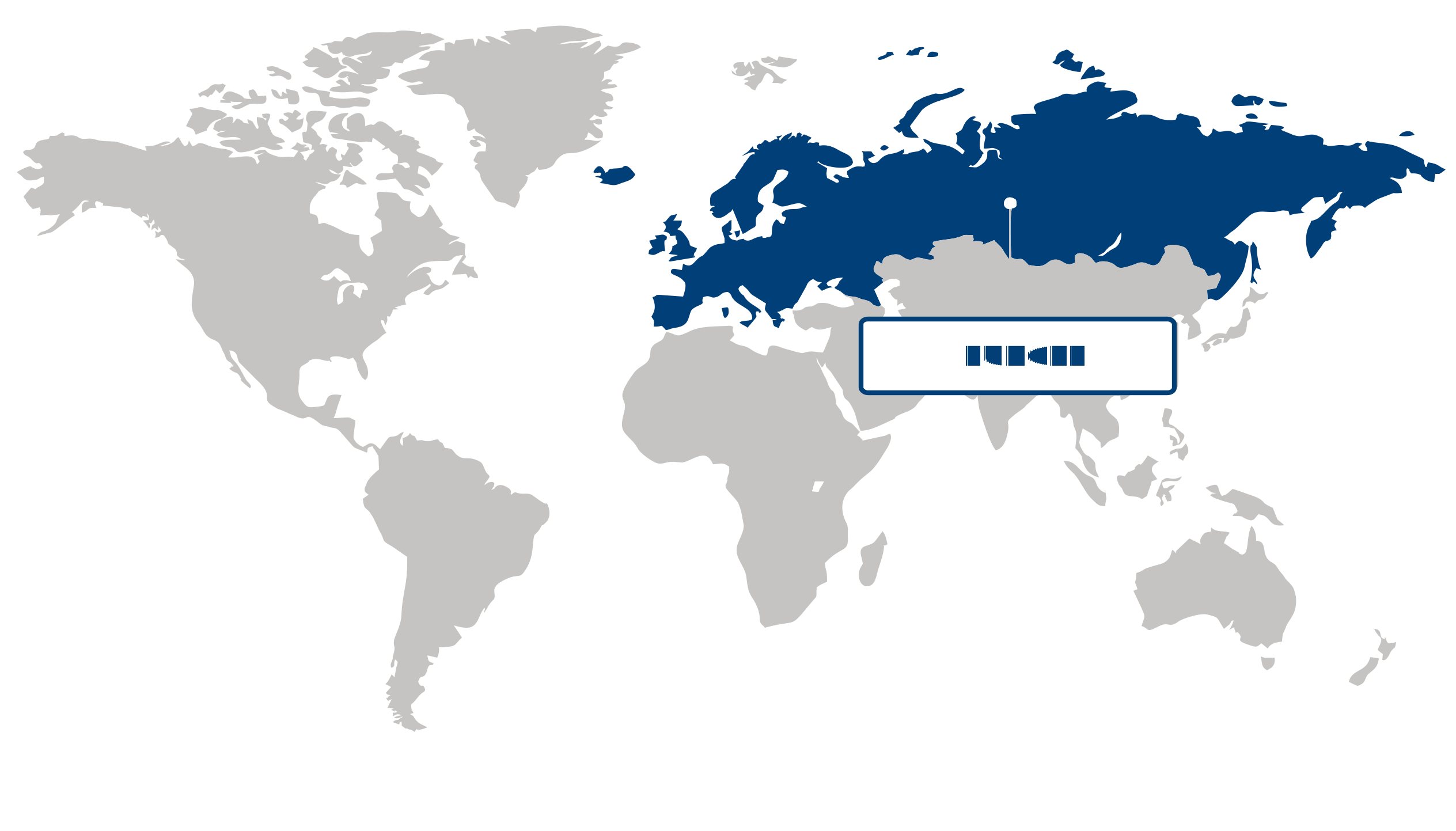
Europe (Largest Region)
The commercial helicopter market was led by Europe in 2026, which accounted for a 34.98% share, reflecting the region's mature aerospace ecosystem, established helicopter operating infrastructure, and broad use of rotorcraft across commercial and specialized missions. Helicopters play an important role in applications including passenger transportation, tourism, emergency services, offshore operations, and other activities where flexible point-to-point mobility is valuable. Strong aviation safety standards and established maintenance and support capabilities also encourage operators to invest in modern and efficient aircraft. At the same time, growing attention to fleet modernization, operational efficiency, and lower environmental impact is supporting demand for advanced commercial helicopter solutions across the region.
Asia Pacific (Fastest-Growing Region)
Asia Pacific is the fastest-growing regional market, benefiting from expanding aviation infrastructure, rising demand for specialized transportation, and increasing use of helicopters in areas where conventional transportation networks face geographic or accessibility constraints. Growth in tourism, emergency medical services, offshore activities, corporate transportation, and remote-area connectivity is broadening the commercial application base for helicopters. Urban expansion and increasing investment in aviation services are also encouraging the development of supporting infrastructure and operational capabilities. As regional economies strengthen their aviation networks and seek more flexible transportation solutions, demand for commercial helicopters is expected to gain further momentum.
| Parameter | North America | Asia Pacific | Europe | Latin America | MEA |
|---|---|---|---|---|---|
| Innovation Hub i Scale Nascent Developing Advanced | |||||
| Cost-Sensitive Region i Scale Low Medium High | |||||
| Regulatory Environment i Scale Restrictive Neutral Supportive | |||||
| Demand Drivers i Scale Weak Moderate Strong | |||||
| Development Stage i Scale Emerging Developing Developed | |||||
| Adoption Rate i Scale Low Medium High | |||||
| New Entrants / Startups i Scale Sparse Moderate Dense | |||||
| Macro Indicators i Scale Weak Stable Strong |
Key Country Insights
Germany 🇩🇪
Industrial Aviation SupportGermany emphasizes commercial helicopters supporting industrial logistics, emergency response, and specialized transport operations. Demand favors technologically advanced aircraft capable of integrating enhanced safety systems and efficient mission management capabilities.
France 🇫🇷
Aerospace Innovation HubFrance benefits from a mature aerospace ecosystem supporting commercial helicopter manufacturing, modernization, and service capabilities. Domestic operators increasingly value aircraft equipped with advanced avionics, safety enhancements, and efficient lifecycle support.
Italy 🇮🇹
Regional Mobility ServicesItaly utilizes commercial helicopters for medical transport, tourism, offshore support, and regional mobility requirements. Fleet investments increasingly focus on operational flexibility, passenger comfort, and reduced operating costs across varied service environments.
Japan 🇯🇵
Disaster Response CapabilityJapan relies on commercial helicopters for disaster response, medical evacuation, and remote area connectivity. The country's operational priorities encourage investment in reliable aircraft with strong all-weather performance and advanced navigation technologies.
South Korea 🇰🇷
Multi-Mission OperationsSouth Korea continues expanding commercial helicopter applications across emergency services, infrastructure inspection, and offshore activities. Operators seek versatile platforms capable of supporting multiple mission profiles while improving operational reliability.
United States 🇺🇸
Fleet Modernization DemandThe U.S. commercial helicopter market focuses on fleet renewal for emergency medical services, offshore transport, utility operations, and corporate aviation. Operators increasingly prioritize helicopters with improved operational efficiency, digital avionics, and lower maintenance requirements.
Segment Leadership and Growth Trends
Commercial Helicopter Market Share (%), by Type, 2026
Go beyond the chart, access full insights & data tables
Request Free Sample ReportType Segment Analysis: Medium (Largest Segment) vs Heavy (Fastest-Growing Segment)
Medium helicopters dominated the commercial helicopter market, accounting for a 53.55% share in 2026. Their leading position is supported by their balance of payload capacity, operating flexibility, and suitability across a broad range of commercial missions. Medium helicopters can serve diverse requirements without the higher operational demands associated with larger aircraft, making them well suited for transportation, utility operations, offshore activities, and other applications requiring a combination of range and carrying capability. Their versatility across varied operating environments continues to reinforce demand from commercial operators seeking adaptable rotorcraft.
Heavy helicopters are advancing at the fastest pace as demand increases for aircraft capable of handling more demanding commercial missions requiring greater payload capacity and operational endurance. Their capabilities make them particularly valuable for specialized transportation, heavy-lift operations, offshore activities, and missions involving substantial equipment or personnel. Growing requirements for higher-capacity aerial services and the expansion of applications where conventional aircraft may face operational limitations are creating stronger opportunities for heavy helicopters.
Application Segment Analysis: Law Enforcement & Public Safety (Largest Segment) vs Medical Services (Fastest-Growing Segment)
Law enforcement & public safety represented the largest application segment of the commercial helicopter market in 2026, reflecting the critical role of helicopters in surveillance, emergency response, search and rescue, disaster management, and public security operations. Rotorcraft provide rapid access to difficult or congested locations while enabling aerial observation and timely deployment of personnel. Their ability to operate in situations where ground transportation is constrained makes helicopters valuable for public agencies seeking flexible and responsive emergency capabilities.
Medical services are experiencing the fastest growth as healthcare systems increasingly require rapid patient transport and access to specialized emergency care. Helicopters can significantly improve the reach of medical evacuation services by connecting patients in remote or difficult-to-access areas with appropriate healthcare facilities. Rising emphasis on emergency response, timely treatment, and improved access to critical care is encouraging greater utilization of helicopter-based medical services.
| Segment | Sub-Segment | Largest Segment | Fastest Growing |
|---|---|---|---|
| Type | Light, Medium, Heavy, Very Large | Medium | Heavy |
| Application | Oil & Gas, Transport, Medical Services, Law Enforcement & Public Safety, Others | Law Enforcement & Public Safety | Medical Services |
Competitive Landscape and Market Positioning
Top players in the commercial helicopter market:
1. Airbus SE (Netherlands)
2. Bell Textron Inc. (United States)
3. Leonardo S.p.A. (Italy)
4. Lockheed Martin Corporation (United States)
5. Russian Helicopters JSC (Russia)
6. Hindustan Aeronautics Limited (India)
7. MD Helicopters Inc. (United States)
8. Enstrom Helicopter Corporation (United States)
9. Kaman Corporation (United States)
10. Robinson Helicopter Company (United States)
Aviation safety and operational efficiency are central to next-generation rotorcraft development. Enhanced avionics and lightweight materials are improving performance capabilities. The commercial helicopter market is evolving through advanced engineering and modernization efforts.
| Company | Market Share | Company Revenue | Revenue CAGR (%) | Product Portfolio | Geographic Presence | Innovation / R&D Focus | Strategic Developments |
|---|---|---|---|---|---|---|---|
| Airbus SE (Netherlands) | |||||||
| Bell Textron Inc. (United States) | |||||||
| Leonardo S.p.A. (Italy) | |||||||
| Lockheed Martin Corporation (United States) | |||||||
| Russian Helicopters JSC (Russia) | |||||||
| Hindustan Aeronautics Limited (India) | |||||||
| MD Helicopters Inc. (United States) | |||||||
| Enstrom Helicopter Corporation (United States) | |||||||
| Kaman Corporation (United States) | |||||||
| Robinson Helicopter Company (United States). |
Industry Development/News
| Company Name | Date | Key Development |
|---|---|---|
| Bell | May-26 | Bell reported a 9% year-over-year increase in Q1 revenues, despite a reduction in commercial unit deliveries from 29 to 20 aircraft. This performance indicates a strategic shift in segment dynamics, where revenue generation is becoming increasingly decoupled from raw delivery volumes and more reliant on aftermarket services, program performance, and specialized aviation solutions. |
| Voxelis | Apr-26 | Voxelis is developing real-time wildfire mapping technology integrated directly into helicopter platforms. By transforming standard rotorcraft into active data-gathering and intelligence nodes, this initiative enhances the functional value of commercial helicopter missions. It positions the aircraft as vital infrastructure for environmental monitoring and emergency response, expanding the market's role beyond traditional transport. |
| The Helicopter Company | Nov-25 | The Helicopter Company acquired a 76% majority stake in Heliconia, marking a significant expansion of its operational footprint into the African market. This strategic acquisition broadens the company's international service portfolio and strengthens its competitive positioning within emerging aviation markets by integrating established regional operational capabilities. |
| The European Heli Centre | Nov-25 | The European Heli Centre has commenced construction on a new training facility in Lelystad, with full operations targeted for 2027. The facility will incorporate advanced full-flight simulator capabilities, representing a meaningful expansion of regional training infrastructure designed to address the increasing demand for professional rotary-wing pilot qualifications and operational proficiency in Europe. |
| GE Aerospace | Aug-25 | GE Aerospace entered a strategic supply agreement with a UK-based provider for helicopter engine components. This partnership is designed to optimize supply chain resilience and increase the availability of critical parts for rotorcraft operators. The move strengthens the broader maintenance and support ecosystem by facilitating localized sourcing for both commercial and military helicopter engines. |
| Bell Textron | Jul-25 | Bell Textron has accelerated its MV-75 FLRAA program, involving increased capital investment across its Dallas-Fort Worth operations. This initiative reflects a strategic prioritization of advanced vertical lift platforms and long-term investment in next-generation rotorcraft technology, reinforcing the company's commitment to defense-related development programs and future manufacturing readiness. |
| Shin-Nihon Helicopters | Jun-25 | Shin-Nihon Helicopters executed a purchase agreement for two Bell 429 helicopters to bolster its existing rotorcraft fleet. These assets are designated for specialized utility missions, including powerline patrol and personnel transport. The acquisition expands the company's operational capacity and reinforces the deployment of high-performance twin-engine platforms within the Japanese commercial aviation sector. |
| Airbus S.A.S | Mar-25 | Airbus S.A.S unveiled the H140, a new 3-tonne class light twin-engine helicopter designed for multi-mission capabilities. The platform introduces advancements in performance, operational cost-efficiency, and crew comfort. This launch signifies a strategic effort to enhance the company's competitive standing in the light-twin segment by addressing evolving requirements for utility and commercial transport operations. |
| Leonardo S.P.A. | Mar-25 | Leonardo S.P.A. secured orders for approximately 30 helicopters across several key models, including the AW109, AW169, AW139, and AW189. This significant commercial intake highlights sustained demand across its rotorcraft portfolio and reinforces the company's market-leading position by expanding its active fleet footprint across diverse commercial segments and global operational theaters. |
Customize Your Report
Explore examples of how this report can be tailored to different research needs, including custom segments, additional topics or chapters, and related reports. Click a section of the wheel or its numbered marker to explore the available options.
Commercial Helicopter Market — Custom Segments
| Segment | Sub-Segment |
|---|---|
| Ownership Model | Direct Ownership, Leasing, Fractional Ownership, Charter-Based Access |
| Sales Channel | Direct Manufacturer Sales, Authorized Dealers & Distributors, Brokers & Resellers |
| Engine Type | Single-Engine Helicopters, Twin-Engine Helicopters |
Commercial Helicopter Market — Custom TOC
| Custom Chapter | Custom Details |
|---|---|
| Fleet Modernization Opportunity Assessment |
|
| Urban Air Mobility Integration Outlook |
|
| Aftermarket Services Opportunity Assessment |
|
Need a different cut of the data?
Request Custom ResearchWhat is the market valuation of commercial helicopter?
What are the growth projections for the commercial helicopter industry?
How are emergency medical and public safety operations shaping demand in the commercial helicopter market?
Why are hybrid-electric propulsion and leasing models becoming important growth drivers in the commercial helicopter market?
Why do medium helicopters dominate commercial helicopter operations?
What is driving faster growth in heavy commercial helicopter demand?
Why is Europe the largest regional market for commercial helicopters?
What is fueling commercial helicopter market growth in Asia Pacific?
Which companies dominate the commercial helicopter landscape?
Our Clients
"The reports offered a comprehensive view of the Food and Beverage landscape, covering market trends, consumer behavior, and competitive dynamics."
Terma A/S
"Our experience in acquiring market research reports has been outstanding — the depth of analysis and actionable insights have proven invaluable."
The Aerospace Corporation
"Fundamental Business Insights demonstrated a keen understanding of our business needs, delivering reports tailored to our specific objectives."
Kongsberg Gruppen
Our Research Team & Methodology
Every Fundamental Business Insights report is built by a dedicated vertical research team, validated through a structured primary-and-secondary methodology, and reviewed for accuracy before it reaches you.
Research Team Overview
Prepared by the Aerospace & Defence Research Team
Delivery
Published
Demand
Available
Support
Trust & Compliance
Research Domains
10 coverage areasResearch Intelligence
| Source | Reference |
|---|---|
| International Civil Aviation Organization (ICAO) | www.icao.int |
| International Air Transport Association (IATA) | www.iata.org |
| Federal Aviation Administration (FAA) | www.faa.gov |
| European Union Aviation Safety Agency (EASA) | www.easa.europa.eu |
| Aerospace Industries Association (AIA) | www.aia-aerospace.org |
| NATO | www.nato.int |
| U.S. Department of Defense (DoD) | www.defense.gov |
| Defense Advanced Research Projects Agency (DARPA) | www.darpa.mil |
| National Aeronautics and Space Administration (NASA) | www.nasa.gov |
| European Space Agency (ESA) | www.esa.int |
| SAE International | www.sae.org |
| RTCA | www.rtca.org |
| ASTM International | www.astm.org |
| International Organization for Standardization (ISO) | www.iso.org |
| National Institute of Standards and Technology (NIST) | www.nist.gov |
| International Organization for Standardization - Aerospace (IAQG standards via 9100 series) | iaqg.org |
| Airports Council International (ACI World) | aci.aero |
| Missile Defense Agency (MDA) | www.mda.mil |
| Stockholm International Peace Research Institute (SIPRI) | www.sipri.org |
| Jane's (Janes) | www.janes.com |
Research Workflow & Quality Assurance
Data Collection
Verified information gathered through primary and secondary research.
Data Triangulation
Cross-validation using multiple independent data sources.
Forecast Modelling
Market estimates developed using historical trends and analytical models.
Analyst Validation
Findings reviewed by domain experts for accuracy and consistency.
Editorial & Quality Review
Final editorial, quality, and compliance checks before publication.
Final Publication
Released after successful completion of the internal review process.
Report Coverage
📊 Market Assessment
- Market Size & Forecast
- Market Segmentation
- Regional Analysis
- Growth Drivers & Challenges
- Market Dynamics
🏢 Competitive Intelligence
- Competitive Landscape
- Company Profiles
- Competitive Benchmarking
- Mergers & Acquisitions
- Market Share Analysis or Key Company Strategies
🔍 Strategic Analysis
- Value Chain Analysis
- Porter's Five Forces
- PESTLE Analysis
- Pricing Trends
- Supply-Demand Analysis
🚀 Future Outlook
- Technology Landscape
- Regulatory Landscape
- Investment & Funding Landscape
- Emerging Opportunities
- Future Market Outlook
Have a question about this report or need a custom scope?
Request Customization