CNC Fiber Laser Market Size & Forecasts 2026-2035, By Segments (Mode of Operation, Laser Power, Application, End Use Industry), Growth Opportunities, Innovation Landscape, Regulatory Shifts, Strategic Regional Insights (U.S., Japan, China, South Korea, UK, Germany, France), and Competitive Dynamics (TRUMPF, Trumpf, IPG Photonics, Rofin-Sinar, Mitsubishi Electric)
Market Size and Growth Outlook
CNC Fiber Laser Market size is estimated to increase from USD 6.53 billion in 2025 to USD 14.76 billion by 2035, supported by a CAGR exceeding 8.5% during 2026-2035. In 2026, revenues are forecast to reach USD 7.01 billion.
Get more details on this report
Request Free Sample ReportCNC Fiber Laser Market Intelligence Snapshot
Regional Market Dynamics
Segment Momentum
Market Expansion Drivers
Leading Market Participants
Global Market Forecast Snapshot
Market Outlook
Regional and Segment Outlook
Market Growth Drivers and Industry Trends
The growing integration of laser cutting technologies in metal fabrication is a critical catalyst transforming the CNC fiber laser market. Manufacturers are increasingly favoring laser cutting for its superior precision, flexibility, and waste-reduction benefits compared to traditional cutting methods, as highlighted in a recent report by the Metal Construction Association. This shift reflects evolving consumer demand for faster product customization and higher quality finishes, encouraging investments in advanced CNC fiber laser systems. For incumbents, this trend invites expansion by upgrading product portfolios to meet stricter fabrication standards, while new entrants can leverage innovation in laser optics and control software. Observing procurement patterns in automotive and aerospace sectors underscores a sustained preference for laser cutting, indicating robust ongoing demand for advanced fiber laser technologies.
Automation in Manufacturing Requiring Precision Laser Systems
Automation's rapid proliferation across industries is intensifying demand for precision-driven CNC fiber laser solutions, essential for maintaining operational accuracy and throughput. The International Federation of Robotics reports increased deployment of automated cells integrating laser cutting modules to enhance manufacturing efficiency and consistency. CNC fiber laser market players benefit from this as automated workflows often necessitate seamless laser system integration with robotics, fostering partnerships and bespoke technology development. For new entrants, specializing in adaptive laser control systems or IoT-enabled diagnostics can provide competitive advantage. Continued regulatory emphasis on workplace safety and error reduction ensures that manufacturers will prioritize precision laser automation, solidifying this growth driver as foundational to advanced manufacturing ecosystems.
Long-term Shift to High-Power Fiber Laser Platforms
The transition towards high-power fiber laser platforms is reshaping competitive dynamics within the CNC fiber laser market by enabling faster processing speeds and penetration capabilities essential for thicker materials. Industry leaders like TRUMPF and IPG Photonics have publicly emphasized their roadmaps to develop kilowatt-plus fiber lasers, addressing complex applications in shipbuilding and heavy machinery. This shift is fueled by the demand for robust, energy-efficient solutions aligned with sustainability and cost-reduction goals. Established companies can leverage scale and R&D investments to dominate high-power segments, while startups focusing on modular, scalable systems may capture niche applications. Emerging vendor announcements and procurement data validate that high-power fiber lasers are becoming industry benchmarks, ensuring their centrality to future market configurations.
Industry Restraints:
High Initial Capital Expenditure
The substantial upfront investment required for CNC fiber laser systems significantly curtails market growth by deterring adoption, especially among small and medium-sized enterprises (SMEs) that operate under tighter capital constraints. These systems, known for precision and efficiency, demand costly integration and maintenance expenses, complicating budgeting and ROI calculations. For instance, TRUMPF, a leading laser technology firm, highlights the high entry costs as a barrier for widespread deployment despite the technology’s operational benefits. Consequently, incumbent manufacturers face pressure to justify price points with demonstrable efficiency gains, while new entrants struggle to compete without strong financing or partnerships. The persistence of this financial hurdle suggests a continued segmentation, where larger industrial players dominate, and smaller firms remain cautious, potentially slowing democratization and innovation diffusion within the CNC fiber laser landscape.
Supply Chain Disruptions and Component Scarcity
Ongoing disruptions in global supply chains, particularly shortages of critical components such as semiconductors and specialized laser diodes, have constrained the CNC fiber laser market’s responsiveness and scalability. The Semiconductor Industry Association (SIA) has documented persistent global chip shortages that exacerbate manufacturing lead times and inflate costs, directly impacting production schedules for laser equipment manufacturers including IPG Photonics. This constraint intensifies operational risks and uncertainty for both established vendors and newcomers, compelling firms to diversify suppliers or invest in inventory buffers, which increases working capital needs. Given the complex, globalized supply networks underpinning these technologies, such vulnerabilities are likely to endure, compelling strategic shifts toward regionalized sourcing and modular designs to enhance resilience in coming years.
| Growth Driver | Impact on CAGR | Regulatory Influence | Geographic Relevance | Adoption Rate | Impact Timeline |
|---|---|---|---|---|---|
| Increasing adoption of laser cutting in metal fabrication | 1.40% | Short term (≤ 2 yrs) | Asia Pacific, Europe | Low | Fast |
| Automation in manufacturing requiring precision laser systems | 1.20% | Medium term (2–5 yrs) | North America, Europe | Medium | Moderate |
| Long-term shift to high-power fiber laser platforms | 1.10% | Long term (5+ yrs) | Asia Pacific, North America | Low | Moderate |
Unlock insights tailored to your business with our bespoke market research solutions.
Click to get your customized report now.
Regional Demand Dynamics
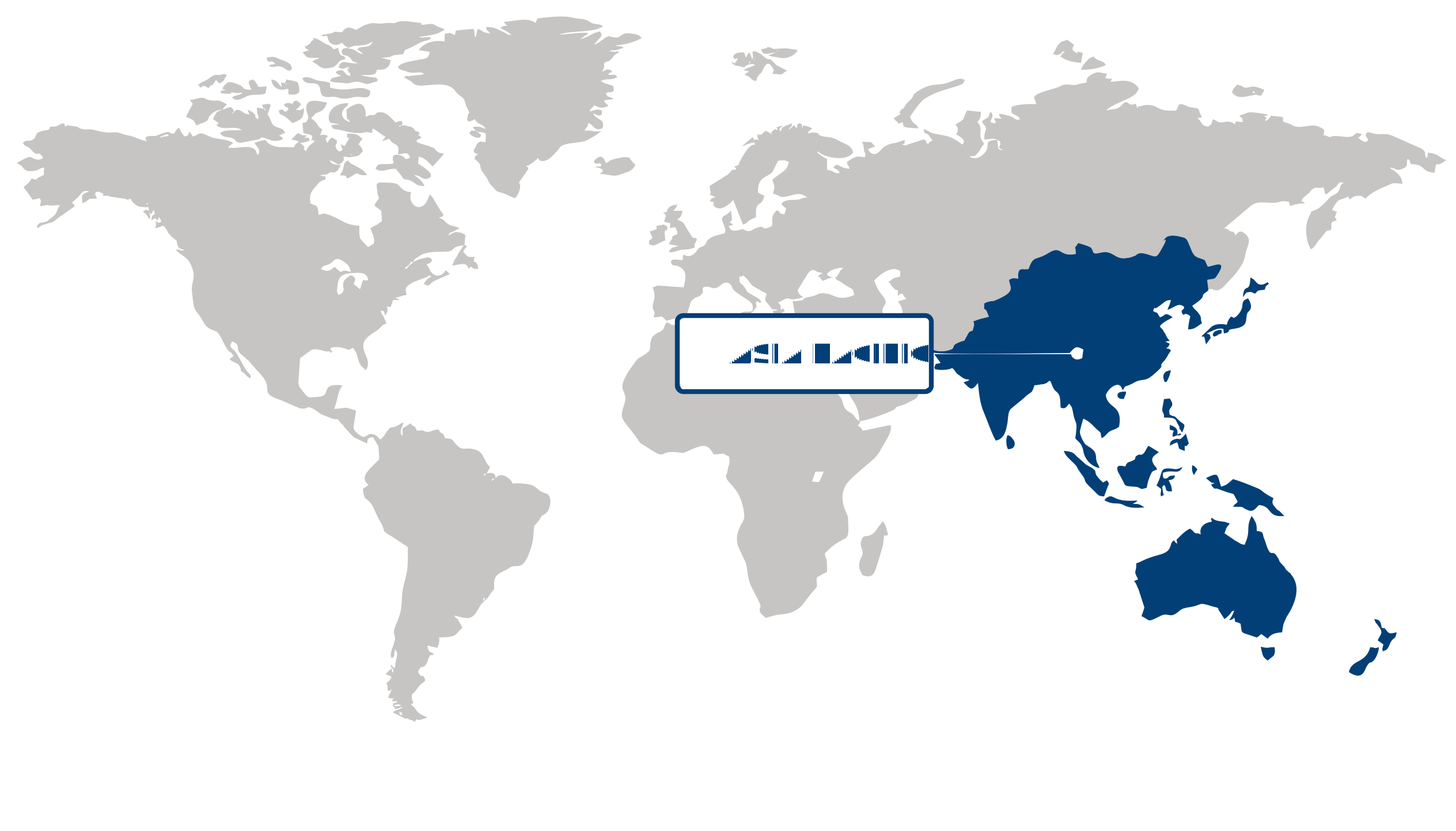
Asia Pacific dominated the CNC fiber laser market with a commanding 45% share in 2025, coupled with a robust 10.2% CAGR, making it both the largest and fastest-growing region globally. This leadership is driven primarily by expansive metal fabrication and automotive manufacturing sectors, especially in China and Japan, which fuel demand for high-precision laser cutting technologies. The region's rapid industrialization, government-backed manufacturing incentives, and significant investments in smart factories promote advanced CNC fiber laser adoption. Notably, companies such as TRUMPF have expanded operations here, reflecting the competitive intensity and technological upgrading underway. Furthermore, Asia Pacific’s supply chain resilience amid global disruptions and cultural focus on manufacturing innovation intensify its growth potential. These dynamics position the region as a pivotal hub for CNC fiber laser advancements, promising significant long-term market opportunities aligned with increasing automation and sustainability trends.
Japan plays a pivotal role in the Asia Pacific CNC fiber laser market, driven by its technological expertise and mature automotive sector. The country's emphasis on precision engineering and automation, underscored by the Ministry of Economy, Trade and Industry (METI) initiatives to promote Industry 4.0, accelerates fiber laser utilization in metal fabrication. Toyota’s adoption of advanced laser systems exemplifies how demand for efficiency and quality is shaping the market. Japan’s stringent regulatory standards for manufacturing safety and quality assurance further catalyze high-end CNC fiber laser integration. Strategically, Japan’s innovation leadership amplifies regional development by setting benchmarks that spur cross-border technology diffusion and elevate market sophistication.
China anchors the Asia Pacific CNC fiber laser market as the largest manufacturing hub, driven by its expansive automotive and metal fabrication industries. The government’s Made in China 2025 policy incentivizes smart manufacturing adoption, including fiber laser technologies, to enhance productivity and reduce environmental impact. Companies like Han’s Laser Technology Industry Group are expanding fiber laser applications, supported by robust infrastructure and a rapidly growing skilled workforce. Moreover, China’s evolving regulatory landscape, emphasizing emissions reduction and industrial upgrading, propels fiber laser usage for cleaner, more efficient processes. China's dominant industrial output and policy-driven modernization underpin the region's market growth, reinforcing Asia Pacific's status as the global CNC fiber laser market powerhouse.
North America Market Analysis:
North America held a substantial share in the CNC fiber laser market, driven by the region’s advanced manufacturing landscape and strong industrial base. Demand in North America is bolstered by sectors such as aerospace, automotive, and defense, where precision machining and high throughput are critical. The presence of leading CNC fiber laser technology providers, including IPG Photonics and Coherent Inc., supports continuous innovation and adoption. Additionally, regulatory emphasis on energy efficiency and emissions reduction fosters demand for fiber laser solutions that maximize operational sustainability. North America’s established supply chains and skilled workforce also facilitate rapid integration of cutting-edge laser technologies, reinforcing its significant market position. With increasing digitalization of manufacturing processes and government incentives for advanced manufacturing, the region offers considerable growth prospects for the CNC fiber laser market.
The U.S. plays a pivotal role in reinforcing North America’s CNC fiber laser market dominance, driven by high industrial automation penetration and robust R&D investment. Government initiatives, such as those by the Department of Energy and the Manufacturing USA institutes, promote innovation in laser-based manufacturing technologies to enhance productivity and lower environmental impact. The U.S. manufacturing sector’s shift towards smart factories and adoption of Industry 4.0 standards increase demand for precise, reliable fiber laser systems. Furthermore, companies like Trumpf Inc. and nLIGHT Inc. regularly announce product advancements, reflecting the competitive and innovation-driven environment. This strong domestic demand and technology leadership anchor North America’s strategic advantage in the CNC fiber laser space.
Europe Market Trends:
Europe maintained a notable presence in the CNC fiber laser market, driven by its established manufacturing base and increasing digital integration in industrial processes. The region’s focus on precision engineering and sustainable manufacturing methods has elevated demand for advanced fiber laser technologies that offer energy efficiency and minimal waste. Initiatives by the European Union, such as Horizon Europe, have fostered innovation and public-private collaborations, enhancing operational capabilities for laser-based applications. Furthermore, Europe's robust logistics infrastructure supports timely delivery and supply chain resilience for fiber laser systems, while environmental regulations encourage adoption of cleaner technologies. According to the Fraunhofer Institute for Laser Technology, growing end-use sectors like aerospace and automotive are incorporating CNC fiber lasers to meet stringent quality standards. These factors collectively position Europe as a moderate-growth market with substantial potential for technology-driven expansion and industrial modernization in CNC fiber laser applications.
Germany plays a critical role in Europe’s CNC fiber laser market, reflecting its leadership in precision manufacturing and export-oriented industries. With a strong emphasis on Industry 4.0 integration, German companies leverage fiber laser technology for automated, high-accuracy production lines. The German Electrical and Electronic Manufacturers’ Association highlights increasing investments in laser-based machinery to enhance operational efficiency and reduce carbon footprints. Additionally, government incentives for industrial digitization and sustainability initiatives have accelerated adoption of CNC fiber lasers, particularly in automotive and machinery sectors. This strategic alignment with technological advancement ensures Germany remains a pivotal market within Europe, contributing innovation and expertise that reinforce regional opportunities for CNC fiber laser market growth.
France holds a significant position in the European CNC fiber laser market, characterized by growing usage in aerospace and defense manufacturing. The French government’s support for technological innovation, exemplified by the Strategic Defense and Security Review, encourages deployment of cutting-edge laser systems to maintain competitive advantage in high-precision fabrication. Corporations like Safran utilize CNC fiber lasers to improve component quality and production speed, responding to increased demand for advanced aerospace solutions. Moreover, France’s emphasis on workforce upskilling and digital transformation facilitates smoother integration of laser technologies across industries. This focus not only fuels domestic market growth but also strengthens Europe’s collective capability, reinforcing the region’s appeal for investors targeting the CNC fiber laser market.
| Parameter | North America | Asia Pacific | Europe | Latin America | MEA |
|---|---|---|---|---|---|
| Innovation Hub i Scale Nascent Developing Advanced | |||||
| Cost-Sensitive Region i Scale Low Medium High | |||||
| Regulatory Environment i Scale Restrictive Neutral Supportive | |||||
| Demand Drivers i Scale Weak Moderate Strong | |||||
| Development Stage i Scale Emerging Developing Developed | |||||
| Adoption Rate i Scale Low Medium High | |||||
| New Entrants / Startups i Scale Sparse Moderate Dense | |||||
| Macro Indicators i Scale Weak Stable Strong |
Segment Leadership and Growth Trends
CNC Fiber Laser Market Share (%), by Mode of Operation, 2026
Go beyond the chart, access full insights & data tables
Request Free Sample ReportContinuous Wave dominated the CNC fiber laser market in 2025, capturing the largest share due to its suitability for high-speed and thick metal cutting. This segment benefits from increasing demand in heavy industrial fabrication where precision and throughput are critical, supported by advancements in beam quality and energy efficiency that manufacturers like TRUMPF emphasize in recent press releases. Additionally, customer preferences for robust, reliable systems that integrate seamlessly with automated production lines reinforce leadership. Regulatory encouragement for energy-efficient manufacturing and ongoing digital transformation in factory setups further elevate this segment’s appeal. Established players can leverage this for competitive differentiation, while newcomers find opportunities in niche applications requiring specialized continuous wave configurations. Given these dynamics and the enduring need for efficient cutting in automotive, aerospace, and construction sectors, the Continuous Wave segment is poised to maintain its prominence in the near term.
Analysis by Laser Power
The 3-6 kW segment represented the largest share in the CNC fiber laser market in 2025, driven by its balanced performance suitable for a broad array of industrial applications. This power range meets the versatility needs of manufacturers across sectors like electronics, automotive, and heavy machinery, enabling precision and throughput at optimal operational costs—a factor highlighted in industry updates from the International Laser Technology Association. Supply chain enhancements and the trend toward modular, scalable laser solutions have further solidified this segment's dominance, aligning with workforce shifts favoring user-friendly yet powerful equipment. Both incumbents and emerging firms benefit strategically by targeting this balanced power bracket, which facilitates entry into diverse markets and quick adaptation to evolving production requirements. As digitalization accelerates and industries continue automating, reliance on 3-6 kW lasers for flexible and efficient operations underscores this segment’s sustained relevance.
Analysis by Application
Metal Cutting held the largest share in the CNC fiber laser market in 2025, driven by widespread adoption across fabrication and precision manufacturing industries. The segment’s leadership stems from its ability to support high-quality edge finishes and complex geometries, increasingly demanded in aerospace, automotive, and heavy equipment production. Regulatory focus on material waste reduction and energy-efficient processing, as highlighted by the U.S. Department of Energy, enhances the appeal of laser-based cutting systems. Consumer preference for customizable and high-throughput solutions further propels growth, prompting both established companies and startups to innovate in cutting-head technology and automation integration. This strong foundation in critical manufacturing verticals, coupled with ongoing improvements in laser source reliability and control software, ensures that metal cutting will remain a cornerstone application, sustaining long-term strategic value for market players.
| Segment | Sub-Segment | Largest Segment | Fastest Growing |
|---|---|---|---|
| Mode of Operation | Continuous Wave, Pulsed | ||
| Laser Power | Below 1 kW, 1-3 kW, 3-6 kW, Above 6 kW | ||
| Application | Metal Cutting, Welding, Marking, Drilling, Engraving | ||
| End Use Industry | Manufacturing, Automotive, Aerospace, Electronics, Healthcare |
Competitive Landscape and Market Positioning
The competitive landscape is marked by dynamic collaborations, strategic acquisitions, and continuous enhancements in laser efficiency and automation. Top companies have bolstered their product lines through targeted innovation, expanding applications from sheet metal cutting to additive manufacturing. R&D investments are driving next-gen fiber laser sources with improved power density and beam quality, responding to evolving industrial requirements. Strategic alliances have accelerated technology integration, notably between Western and Asian firms, facilitating knowledge exchange and market penetration. New product introductions often emphasize user-friendly interfaces and multifunctionality, enabling operators to optimize manufacturing cycles. This environment fosters an ongoing race for market share, where agility in adopting emerging technologies and broadening portfolio versatility are decisive.
Strategic / Actionable Recommendations for Regional Players
North American stakeholders should deepen engagement with emerging sectors such as aerospace and advanced automotive manufacturing, leveraging partnerships with tech innovators to incorporate AI-driven process controls. Enhancing service networks will also fortify client retention amid intense global competition.
In Asia Pacific, players can capitalize on evolving industrial automation trends by integrating IoT-enabled laser systems that support smart factory initiatives. Collaborations with regional governments or industry consortia could facilitate technology diffusion and broaden access to growth markets.
European participants are advised to prioritize customization and system flexibility to meet stringent quality standards in precision engineering. Aligning with sustainability protocols through energy-efficient laser development can differentiate offerings and resonate with eco-conscious customers.
| Company | Market Share | Company Revenue | Revenue CAGR (%) | Product Portfolio | Geographic Presence | Innovation / R&D Focus | Strategic Developments |
|---|---|---|---|---|---|---|---|
| No companies available. | |||||||
Industry Development/News
| Company Name | Date | Key Development |
|---|
Customize Your Report
Explore examples of how this report can be tailored to different research needs, including custom segments, additional topics or chapters, and related reports. Click a section of the wheel or its numbered marker to explore the available options.
CNC Fiber Laser Market — Custom Segments
| Segment | Sub-Segment |
|---|---|
| No segment data available. | |
CNC Fiber Laser Market — Custom TOC
| Custom Chapter | Custom Details | ||
|---|---|---|---|
| No custom TOC data available. | |||
Need a different cut of the data?
Request Custom ResearchWhat is the expected industry size of CNC fiber laser by 2035?
Which geographical area accounts for the highest portion of the CNC fiber laser market?
Which region has emerged as the fastest-growing for the CNC fiber laser sector?
Why does continuous wave sub-segment dominate the mode of operation segment of CNC fiber laser sector?
How much is the 3-6 kw segment expected to grow in the CNC fiber laser industry beyond 2025?
What factors give metal cutting segment a competitive edge in the CNC fiber laser sector?
Which is the largest sub-segment within the end use industry segment for CNC fiber laser industry?
Who are the major participants shaping the CNC fiber laser landscape?
Our Clients
"The team at Fundamental Business Insights & Consulting demonstrated a commitment to excellence, not only in the quality of the report but also in their client-centric approach."
FANUC
"The level of detail in the market segmentation provided were particularly noteworthy. The detailed country-level insights were also very helpful."
B&R Industrial Automation GmbH
"The consultant took the time to understand our specific business objectives, ensuring that the reports were tailored to address our unique challenges and opportunities."
KUKA SE & Co. KGaA
Our Research Team & Methodology
Every Fundamental Business Insights report is built by a dedicated vertical research team, validated through a structured primary-and-secondary methodology, and reviewed for accuracy before it reaches you.
Research Team Overview
Prepared by the Industrial Automation & Equipment Research Team
Delivery
Published
Demand
Available
Support
Trust & Compliance
Research Domains
10 coverage areasResearch Intelligence
| Source | Reference |
|---|---|
| International Society of Automation (ISA) | www.isa.org |
| International Organization for Standardization (ISO) | www.iso.org |
| National Institute of Standards and Technology (NIST) | www.nist.gov |
| IEEE | www.ieee.org |
| VDMA (German Mechanical Engineering Industry Association) | www.vdma.org |
| Association for Advancing Automation (A3) | www.automate.org |
| International Federation of Robotics (IFR) | ifr.org |
| ASME (American Society of Mechanical Engineers) | www.asme.org |
| ASHRAE | www.ashrae.org |
| American Society of Heating, Refrigerating and Air-Conditioning Engineers (ASHRAE) | www.ashrae.org |
| Material Handling Industry (MHI) | www.mhi.org |
| OSHA (Occupational Safety and Health Administration) | www.osha.gov |
| National Fire Protection Association (NFPA) | www.nfpa.org |
| ASTM International | www.astm.org |
| International Electrotechnical Commission (IEC) | www.iec.ch |
| Open Process Automation Forum (The Open Group) | www.opengroup.org/open-process-automation-forum |
| AGMA (American Gear Manufacturers Association) | www.agma.org |
| Association of Equipment Manufacturers (AEM) | www.aem.org |
| Food and Agriculture Organization (FAO) | www.fao.org |
| International Labour Organization (ILO) | www.ilo.org |
Research Workflow & Quality Assurance
Data Collection
Verified information gathered through primary and secondary research.
Data Triangulation
Cross-validation using multiple independent data sources.
Forecast Modelling
Market estimates developed using historical trends and analytical models.
Analyst Validation
Findings reviewed by domain experts for accuracy and consistency.
Editorial & Quality Review
Final editorial, quality, and compliance checks before publication.
Final Publication
Released after successful completion of the internal review process.
Report Coverage
📊 Market Assessment
- Market Size & Forecast
- Market Segmentation
- Regional Analysis
- Growth Drivers & Challenges
- Market Dynamics
🏢 Competitive Intelligence
- Competitive Landscape
- Company Profiles
- Competitive Benchmarking
- Mergers & Acquisitions
- Market Share Analysis or Key Company Strategies
🔍 Strategic Analysis
- Value Chain Analysis
- Porter's Five Forces
- PESTLE Analysis
- Pricing Trends
- Supply-Demand Analysis
🚀 Future Outlook
- Technology Landscape
- Regulatory Landscape
- Investment & Funding Landscape
- Emerging Opportunities
- Future Market Outlook
Have a question about this report or need a custom scope?
Request Customization