Climate Adaptation Market Size & Growth Forecast 2027–2036, By Segments (Solution, Industry), Regional Demand Trends (North America, Asia Pacific, Europe), Key Country Insights (U.S., Japan, South Korea, Germany, France, Italy), and Competitive Landscape
Market Size and Growth Outlook
Climate Adaptation Market size was worth USD 35.4 billion in 2026 and is expected to grow at a 14.44% CAGR between 2027 and 2036, attaining USD 136.39 billion by 2036. The industry revenue for 2027 is estimated at USD 39.7 billion.
Get more details on this report
Request Free Sample ReportClimate Adaptation Market Intelligence Snapshot
Regional Market Dynamics
- Asia Pacific held a 45.58% market share in 2026, driven by high exposure to climate risks and sustained investment in resilient infrastructure, water management, flood control, and early-warning systems.
- North America is projected to grow at an 11.65% CAGR as utilities, municipalities, and asset owners accelerate investments in climate resilience projects and infrastructure upgrades.
Segment Momentum
- Technology-based Solutions held a 31.32% share in 2026 due to their broad use in resilience planning, infrastructure management, and decision support, enabling organizations to assess climate risks and allocate resources more effectively.
- Power Generation is growing fastest as operators invest in resilience measures to protect generation assets, transmission reliability, and resource availability from climate-related disruptions affecting operational continuity.
Market Expansion Drivers
- Rising frequency of extreme weather events driving large-scale investment in resilient infrastructure and preparedness systems.
- Expansion of satellite-based climate monitoring and predictive analytics improving environmental risk assessment accuracy.
- Growth of climate finance and public-private partnerships enabling large-scale adaptation project deployment.
Leading Market Participants
- Prominent companies in the climate adaptation market include International Business Machines Corporation (United States), Esri, Inc. (United States), DTN, LLC (United States), Campbell Scientific, Inc. (United States), Climeworks AG (Switzerland), Carbon Engineering ULC (Canada), ClimeCo LLC (United States), CAPA Strategies, LLC (United States), BARANI DESIGN Technologies s. r. o. (Slovakia), Zero Carbon Systems Ltd. (United Kingdom).
Global Market Forecast Snapshot
Market Outlook
- 2026 Market Size: USD 35.4 billion
- 2027 Estimated Market Size: USD 39.7 billion.
- Projected Market Size: USD 136.39 billion by 2036
- Growth Forecast: 14.44% CAGR (2027-2036)
Regional and Segment Outlook
- Leading Regional Market: Asia Pacific
- High-Growth Regional Hub: North America
- Core Revenue Segment: Technology-based Solutions (Solution) | Government (Industry)
- Emerging Opportunity Segment: Early Climate Warning & Environment Monitoring Solutions (Solution) | Power Generation (Industry)
Market Growth Drivers and Industry Trends
Rising frequency of extreme weather events driving large-scale investment in resilient infrastructure and preparedness systems
Increasing exposure to extreme weather events is driving the climate adaptation market as governments, organizations, and infrastructure stakeholders place greater emphasis on resilience and preparedness. Investment in systems designed to withstand environmental disruptions supports demand for adaptation solutions, particularly where infrastructure protection, risk reduction, and preparedness capabilities are becoming operational priorities.
Expansion of satellite-based climate monitoring and predictive analytics improving environmental risk assessment accuracy
Advanced monitoring capabilities are strengthening the climate adaptation market by improving the ability to assess environmental risks and identify potential climate-related vulnerabilities. Satellite-based observation and predictive analytics provide more detailed information for planning and preparedness, enabling stakeholders to incorporate better risk assessments into adaptation strategies and infrastructure decisions.
Growth of climate finance and public-private partnerships enabling large-scale adaptation project deployment
The availability of climate finance and expansion of public-private partnerships are supporting climate adaptation market development by improving the capacity to fund and execute adaptation initiatives. Collaborative financing structures can help mobilize resources for larger projects, while participation from public and private stakeholders supports implementation across infrastructure and preparedness programs.
| Growth Driver | Impact on CAGR | Regulatory Influence | Geographic Relevance | Adoption Rate | Impact Timeline |
|---|---|---|---|---|---|
| Rising frequency of extreme weather events driving large-scale investment in resilient infrastructure and preparedness systems | 2.60% | High | Asia Pacific, North America | High | Near Term |
| Expansion of satellite-based climate monitoring and predictive analytics improving environmental risk assessment accuracy | 2.20% | High | Asia Pacific, Europe | High | Near Term |
| Growth of climate finance and public-private partnerships enabling large-scale adaptation project deployment | 1.90% | High | North America, Europe | Medium | Mid Term |
Unlock insights tailored to your business with our bespoke market research solutions.
Click to get your customized report now.
Regional Demand Dynamics
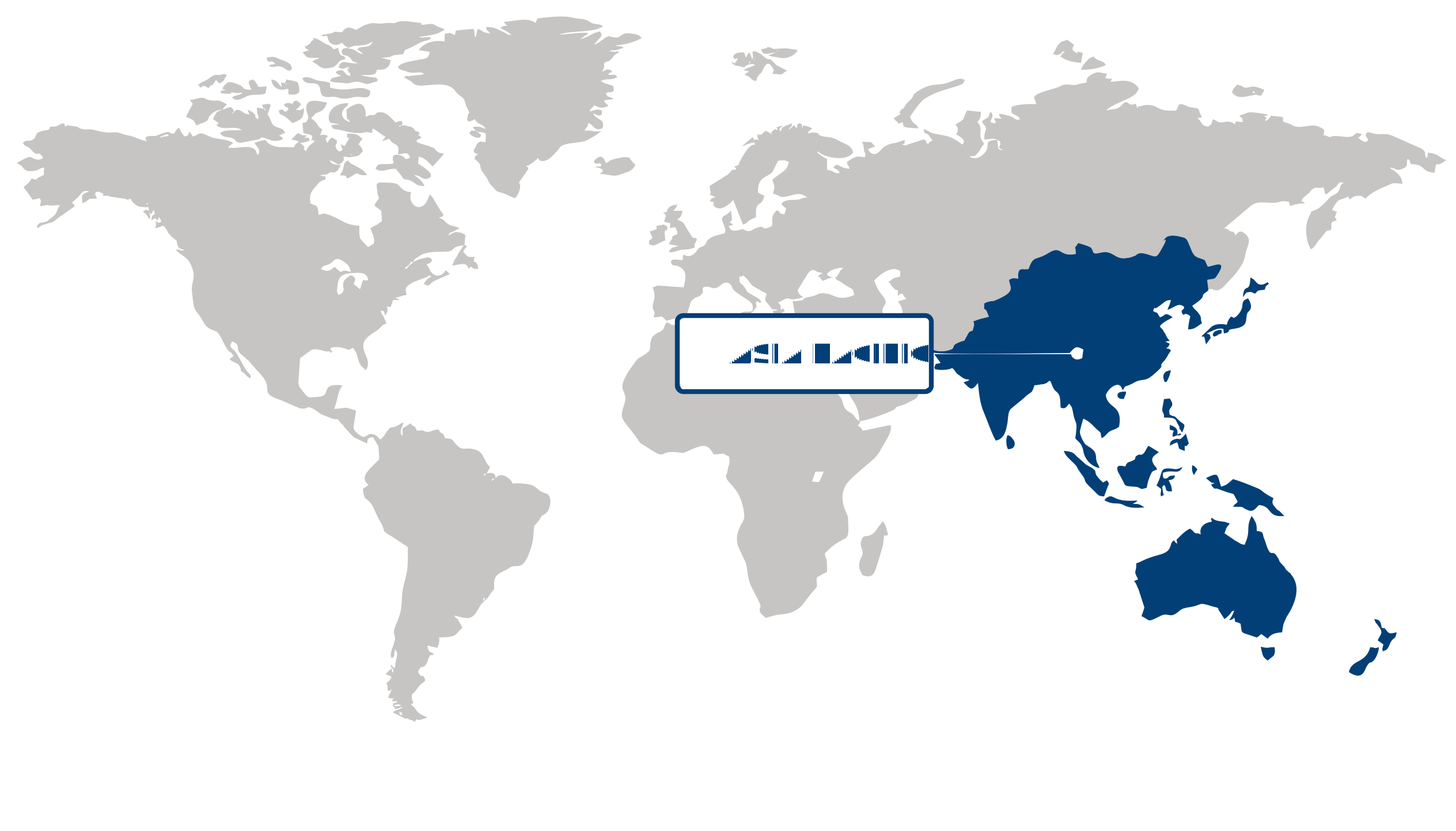
Asia Pacific (Largest Region)
Asia Pacific dominated the climate adaptation market with a 45.58% share in 2026, reflecting the region’s heightened exposure to climate-related risks and the growing need to strengthen resilience across urban, agricultural, industrial, and coastal systems. Rapid urbanization and infrastructure development are increasing the importance of adaptation measures that can address flooding, extreme heat, water stress, changing precipitation patterns, and other environmental pressures. Governments and businesses are increasingly integrating resilience considerations into infrastructure planning, resource management, disaster preparedness, and urban development, supporting demand for adaptation technologies and services. The scale of infrastructure investment across the region also creates opportunities to incorporate climate-resilient designs into new projects rather than relying solely on retrofitting existing assets.
North America (Fastest-Growing Region)
North America is emerging as the fastest-growing regional market, driven by increasing investment in resilient infrastructure, climate risk assessment, disaster preparedness, and resource management. Public and private organizations are placing greater emphasis on protecting critical infrastructure and business operations from extreme weather events, while climate-related financial and operational risks are encouraging more systematic adaptation planning. Advances in environmental monitoring, data analytics, resilient construction practices, and water-management solutions are further enabling organizations to identify vulnerabilities and implement targeted responses. Growing integration of climate resilience into infrastructure investment and corporate planning is strengthening the region’s demand for adaptation solutions across multiple end-use sectors.
| Parameter | North America | Asia Pacific | Europe | Latin America | MEA |
|---|---|---|---|---|---|
| Innovation Hub i Scale Nascent Developing Advanced | |||||
| Cost-Sensitive Region i Scale Low Medium High | |||||
| Regulatory Environment i Scale Restrictive Neutral Supportive | |||||
| Demand Drivers i Scale Weak Moderate Strong | |||||
| Development Stage i Scale Emerging Developing Developed | |||||
| Adoption Rate i Scale Low Medium High | |||||
| New Entrants / Startups i Scale Sparse Moderate Dense | |||||
| Macro Indicators i Scale Weak Stable Strong |
Key Country Insights
Germany 🇩🇪
Industrial Climate PlanningGermany emphasizes climate adaptation strategies that protect industrial facilities, transport networks, and urban infrastructure from climate-related disruptions. Demand is supported by coordinated planning initiatives and investments in engineering solutions that improve resilience across manufacturing and municipal assets.
France 🇫🇷
Urban Adaptation StrategiesFrance prioritizes climate adaptation through sustainable urban planning, water resource management, and ecosystem-based resilience measures. The country's municipalities increasingly adopt integrated adaptation projects that balance environmental protection with infrastructure modernization and long-term climate preparedness.
Italy 🇮🇹
Water Resource ResilienceItaly focuses on climate adaptation solutions that address water scarcity, agricultural resilience, and protection of vulnerable infrastructure from extreme weather events. Investments in integrated water management and regional adaptation planning continue to shape practical implementation across the country.
Japan 🇯🇵
Disaster Preparedness IntegrationJapan incorporates climate adaptation into disaster preparedness by combining early warning technologies, resilient infrastructure, and advanced environmental monitoring. The country's focus on reducing weather-related risks encourages continuous deployment of innovative adaptation measures across public and private sectors.
South Korea 🇰🇷
Smart Resilience DeploymentSouth Korea is integrating smart technologies into climate adaptation initiatives, with emphasis on digital monitoring, water management, and resilient urban infrastructure. Government-backed sustainability programs encourage wider adoption of intelligent systems that strengthen preparedness against climate-related challenges.
United States 🇺🇸
Infrastructure Resilience FocusThe U.S. climate adaptation market is centered on strengthening infrastructure resilience through advanced monitoring, flood mitigation, wildfire preparedness, and climate risk analytics. Public agencies and private organizations increasingly prioritize integrated adaptation solutions that support long-term asset protection and operational continuity.
Segment Leadership and Growth Trends
Climate Adaptation Market Share (%), by Solution, 2026
Go beyond the chart, access full insights & data tables
Request Free Sample ReportSolution Segment Analysis: Technology-based Solutions (Largest Segment) vs Early Climate Warning & Environment Monitoring Solutions (Fastest-Growing Segment)
Technology-based solutions held the largest share of the climate adaptation market, accounting for 31.32% in 2026, as organizations increasingly deploy digital and technology-enabled tools to manage climate-related risks and strengthen resilience. These solutions support activities such as risk assessment, infrastructure planning, resource management, and operational decision-making, helping stakeholders respond more effectively to changing environmental conditions. Growing investment in resilient infrastructure and increasing integration of technology into climate planning are reinforcing this segment's market position.
Early climate warning & environment monitoring solutions are advancing rapidly as governments, communities, and infrastructure operators place greater emphasis on anticipating climate-related hazards rather than responding only after events occur. Monitoring capabilities can support timely decision-making around extreme weather, environmental changes, and other emerging risks. Rising focus on disaster preparedness, resilience planning, and data-driven environmental management is accelerating adoption of these solutions.
Industry Segment Analysis: Government (Largest Segment) vs Power Generation (Fastest-Growing Segment)
The government segment accounted for the largest share of the climate adaptation market in 2026, reflecting the public sector's central role in developing resilience strategies, protecting critical infrastructure, and coordinating responses to climate-related risks. Government organizations increasingly require adaptation solutions for urban planning, public assets, emergency preparedness, and environmental management. Expanding climate-resilience initiatives and the need to strengthen public infrastructure against environmental disruptions are sustaining demand from this segment.
Power generation is emerging as the fastest-growing industry segment as energy infrastructure faces increasing exposure to climate-related disruptions and changing operating conditions. Power producers are adopting adaptation measures to improve infrastructure resilience, manage environmental risks, and maintain reliable energy supply. The growing importance of grid reliability, infrastructure protection, and climate-aware energy planning is encouraging greater investment in adaptation solutions across the power-generation sector.
| Segment | Sub-Segment | Largest Segment | Fastest Growing |
|---|---|---|---|
| Solution | Natural-based Solutions, Enhanced Natural Process Solutions, Technology-based Solutions, Early Climate Warning & Environment Monitoring Solutions | Technology-based Solutions | Early Climate Warning & Environment Monitoring Solutions |
| Industry | Oil & Gas, Power Generation, Chemical & Petrochemical, Government, Education, Others | Government | Power Generation |
Competitive Landscape and Market Positioning
Prominent players in the climate adaptation market:
1. International Business Machines Corporation (United States)
2. Esri Inc. (United States)
3. DTN LLC (United States)
4. Campbell Scientific Inc. (United States)
5. Climeworks AG (Switzerland)
6. Carbon Engineering ULC (Canada)
7. ClimeCo LLC (United States)
8. CAPA Strategies LLC (United States)
9. BARANI DESIGN Technologies s. r. o. (Slovakia)
10. Zero Carbon Systems Ltd. (United Kingdom)
The climate adaptation market is evolving as organizations increasingly prioritize resilience against environmental risks and climate variability. Technological solutions are improving predictive modeling and risk mitigation planning. Continuous development of integrated adaptation strategies is strengthening preparedness across sectors.
| Company | Market Share | Company Revenue | Revenue CAGR (%) | Product Portfolio | Geographic Presence | Innovation / R&D Focus | Strategic Developments |
|---|---|---|---|---|---|---|---|
| International Business Machines Corporation (United States) | |||||||
| Esri Inc. (United States) | |||||||
| DTN LLC (United States) | |||||||
| Campbell Scientific Inc. (United States) | |||||||
| Climeworks AG (Switzerland) | |||||||
| Carbon Engineering ULC (Canada) | |||||||
| ClimeCo LLC (United States) | |||||||
| CAPA Strategies LLC (United States) | |||||||
| BARANI DESIGN Technologies s. r. o. (Slovakia) | |||||||
| Zero Carbon Systems Ltd. (United Kingdom). |
Industry Development/News
| Company Name | Date | Key Development |
|---|---|---|
| DTN | Jan-26 | DTN launched DTN Weather Hub, a next-generation weather intelligence platform designed to support operational decision-making using real-time meteorological data. The solution translates complex weather inputs into actionable insights, enabling organizations to anticipate climate-related risks, improve preparedness, and reduce disruption across assets, personnel, and critical business operations. |
| ClimeCo | Sep-25 | ClimeCo partnered with Offset AI to provide verified carbon offset solutions linked to artificial intelligence usage. The initiative enables measurement of AI-related carbon emissions through a digital tool and facilitates offsetting via certified climate projects, strengthening corporate sustainability strategies and supporting emerging demand for emissions accountability in digital and computational workloads. |
| Esri | Jul-25 | Esri partnered with Fugro to advance climate resilience capabilities through integrated geospatial intelligence solutions. The collaboration combines ArcGIS technology with satellite earth observation, high-resolution surveying, in-situ measurements, and predictive modeling to improve climate risk assessment, enabling more accurate planning and decision-making for infrastructure and environmental resilience applications. |
| IBM | Feb-25 | IBM collaborated with C40 Cities through the IBM Sustainability Accelerator to develop AI-driven tools supporting urban climate resilience. The initiative focuses on analyzing climate risks such as extreme heat and urban heat islands, enabling cities to enhance adaptation planning, improve vulnerability assessments, and strengthen protective measures for at-risk urban populations. |
| The Nature Conservancy | Oct-24 | The Nature Conservancy, in partnership with the Center for Coastal Climate Resilience and other organizations, developed a first-of-its-kind financing mechanism aimed at mobilizing public and private capital toward coastal wetland restoration projects. The initiative is designed to strengthen climate adaptation outcomes by improving investment flows into nature-based resilience infrastructure and coastal protection systems. |
| Pertamina | May-24 | Pertamina, in collaboration with ExxonMobil and supported by KNOC, advanced a carbon capture and storage (CCS) hub initiative in Indonesia through appraisal drilling activities and a preliminary storage agreement. The project targets depleted reservoirs and saline aquifers, aiming to establish large-scale CO2 storage capacity and develop a commercial CCS framework for long-term emissions reduction infrastructure. |
| AccuWeather | Apr-24 | AccuWeather and Ambient Weather entered a strategic partnership to deliver hyperlocal, real-time weather intelligence through advanced private weather station networks. The collaboration enhances data granularity for broadcasters and operational users, improving localized forecasting accuracy and strengthening climate risk awareness and response capabilities across weather-sensitive sectors. |
| CGG | Mar-24 | CGG signed a Memorandum of Understanding with Baker Hughes to jointly explore carbon capture and storage (CCS) solutions. The collaboration focuses on integrated services for screening, selecting, and monitoring CO2 storage sites, supporting the development of scalable CCS infrastructure and strengthening global deployment of carbon management and climate mitigation technologies. |
| AtkinsRéalis | Mar-24 | AtkinsRéalis partnered with Galliford Try to support water industry clients in delivering AMP8 program objectives. The collaboration provides integrated engineering and design capabilities aimed at improving water infrastructure resilience, enhancing operational performance, and enabling utilities to meet regulatory and climate adaptation requirements within long-term capital investment programs. |
| AECOM Technical Services Inc. | Jan-24 | The City of El Paso approved over USD 1 million in funding to develop a Climate Action Plan, awarding a four-year contract to AECOM Technical Services Inc. The initiative supports structured municipal climate planning, focusing on emissions reduction strategies, resilience measures, and long-term adaptation planning for urban infrastructure and community risk management. |
Customize Your Report
Explore examples of how this report can be tailored to different research needs, including custom segments, additional topics or chapters, and related reports. Click a section of the wheel or its numbered marker to explore the available options.
Climate Adaptation Market — Custom Segments
| Segment | Sub-Segment |
|---|---|
| Climate Risk Type | Flooding & Sea-Level Rise, Extreme Heat, Drought & Water Stress, Wildfires, Storms & Extreme Precipitation |
| Asset Type | Physical Infrastructure, Natural & Ecological Assets, Industrial & Commercial Assets, Agricultural Assets, Critical Public Services |
| Funding Source | Government & Public Funding, Private Investment, Development Finance, Insurance-Linked Funding, Public-Private Partnerships |
Climate Adaptation Market — Custom TOC
| Custom Chapter | Custom Details |
|---|---|
| Climate Risk Mitigation Opportunity Mapping |
|
| Public and Private Investment Landscape |
|
| Adaptation Technology Adoption Assessment |
|
Need a different cut of the data?
Request Custom ResearchHow much revenue does the climate adaptation market generate?
What are the growth projections for the climate adaptation industry?
How are extreme weather events influencing investment priorities in the climate adaptation market?
Why are climate finance and public-private partnerships becoming critical for adaptation project deployment?
Why do technology-based solutions lead the climate adaptation market?
Why is the power generation industry the fastest-growing segment in the climate adaptation market?
Why is Asia Pacific the leading region in the climate adaptation market?
What is driving climate adaptation market growth in North America?
What are the prominent companies operating in the climate adaptation landscape?
Our Clients
"The information presented in the report was genuinely insightful. The data was clear and easy to understand, which made it much easier to interpret the findings."
Amara Raja Group
"The responsiveness and professionalism exhibited by the team were exemplary. They were readily available to address queries, provide clarifications, and offer additional insights."
ONGC
"The reports offered a comprehensive analysis of various segments within the market. The detailed insights into market trends, and regulatory landscapes were excellent."
TotalEnergies
Our Research Team & Methodology
Every Fundamental Business Insights report is built by a dedicated vertical research team, validated through a structured primary-and-secondary methodology, and reviewed for accuracy before it reaches you.
Research Team Overview
Prepared by the Energy & Power Research Team
Delivery
Published
Demand
Available
Support
Trust & Compliance
Research Domains
10 coverage areasResearch Intelligence
| Source | Reference |
|---|---|
| International Energy Agency (IEA) | www.iea.org |
| U.S. Energy Information Administration (EIA) | www.eia.gov |
| International Renewable Energy Agency (IRENA) | www.irena.org |
| International Electrotechnical Commission (IEC) | www.iec.ch |
| International Organization for Standardization (ISO) | www.iso.org |
| IEEE | www.ieee.org |
| CIGRE (International Council on Large Electric Systems) | www.cigre.org |
| World Energy Council (WEC) | www.worldenergy.org |
| U.S. Department of Energy (DOE) | www.energy.gov |
| International Atomic Energy Agency (IAEA) | www.iaea.org |
| American Petroleum Institute (API) | www.api.org |
| Society of Petroleum Engineers (SPE) | www.spe.org |
| Hydrogen Council | hydrogencouncil.com |
| Battery Council International (BCI) | batterycouncil.org |
| Global Wind Energy Council (GWEC) | gwec.net |
| SolarPower Europe | www.solarpowereurope.org |
| World Bioenergy Association (WBA) | worldbioenergy.org |
| International Hydropower Association (IHA) | www.hydropower.org |
| Edison Electric Institute (EEI) | www.eei.org |
| National Renewable Energy Laboratory (NREL) | www.nrel.gov |
Research Workflow & Quality Assurance
Data Collection
Verified information gathered through primary and secondary research.
Data Triangulation
Cross-validation using multiple independent data sources.
Forecast Modelling
Market estimates developed using historical trends and analytical models.
Analyst Validation
Findings reviewed by domain experts for accuracy and consistency.
Editorial & Quality Review
Final editorial, quality, and compliance checks before publication.
Final Publication
Released after successful completion of the internal review process.
Report Coverage
📊 Market Assessment
- Market Size & Forecast
- Market Segmentation
- Regional Analysis
- Growth Drivers & Challenges
- Market Dynamics
🏢 Competitive Intelligence
- Competitive Landscape
- Company Profiles
- Competitive Benchmarking
- Mergers & Acquisitions
- Market Share Analysis or Key Company Strategies
🔍 Strategic Analysis
- Value Chain Analysis
- Porter's Five Forces
- PESTLE Analysis
- Pricing Trends
- Supply-Demand Analysis
🚀 Future Outlook
- Technology Landscape
- Regulatory Landscape
- Investment & Funding Landscape
- Emerging Opportunities
- Future Market Outlook
Have a question about this report or need a custom scope?
Request Customization