Cleanroom Construction Market Size & Growth Forecast 2027–2036, By Segments (Type, Application, Material, Class), Regional Demand Trends (North America, Asia Pacific, Europe), Key Country Insights (U.S., Japan, South Korea, Germany, France, Italy), and Competitive Landscape
Market Size and Growth Outlook
Cleanroom Construction Market size was assessed at USD 6.41 Billion in 2026 and is poised to grow at 7.31% CAGR between 2027 and 2036, crossing USD 12.98 Billion by 2036. The industry revenue for 2027 is estimated at USD 6.81 Billion.
Get more details on this report
Request Free Sample ReportCleanroom Construction Market Intelligence Snapshot
Regional Market Dynamics
- Asia Pacific led in 2026 as pharmaceutical, semiconductor, biotechnology, and advanced manufacturing investments increased demand for controlled production environments and upgraded facilities.
- Expanding healthcare infrastructure, industrial development, manufacturing localization, and investments in advanced facilities are creating sustained demand for new and upgraded cleanrooms.
Segment Momentum
- Modular cleanrooms captured 45.16% of the market in 2026 and remain the fastest-growing type due to their flexibility, scalability, faster installation, and ability to support evolving contamination control requirements.
- Biotechnology is projected to grow the fastest as expanding research, biomanufacturing, and advanced biological processes increase demand for specialized cleanroom facilities with stringent environmental controls.
Market Expansion Drivers
- Expansion of pharmaceutical and biotechnology industries driving cleanroom investments
- Increased research and development investments expanding controlled-environment facilities
- Rising semiconductor manufacturing capacity creating demand for advanced cleanrooms
Leading Market Participants
- Key players in the cleanroom construction market include Lindner Group (Germany), Performance Contracting Group, Inc. (United States), American Cleanroom Systems (United States), Allied Cleanrooms (United States), Angstrom Technology (United States), Clean Air Technology Inc. (United States), Hodess Cleanroom Construction (United States), Total Clean Air (United Kingdom), Turner Construction Company (United States)
Global Market Forecast Snapshot
Market Outlook
- 2026 Market Size: USD 6.41 Billion
- 2027 Estimated Market Size: USD 6.81 Billion
- Projected Market Size: USD 12.98 Billion by 2036
- Growth Forecast: 7.31% CAGR (2027-2036)
Regional and Segment Outlook
- Leading Regional Market: Asia Pacific
- High-Growth Regional Hub: Asia Pacific
- Core Revenue Segment: Modular Cleanroom (Type) | Semiconductor (Application) | Steel (Material) | Class 10,000 (Class)
- Emerging Opportunity Segment: Modular Cleanroom (Type) | Biotechnology (Application) | Steel (Material) | Class 100 (Class)
Market Growth Drivers and Industry Trends
Expansion of pharmaceutical and biotechnology industries driving cleanroom investments
The continued growth of pharmaceutical manufacturing and biotechnology production is increasing the need for highly controlled environments that ensure product quality and regulatory compliance. The cleanroom construction market growth is driven by investments in advanced manufacturing facilities where contamination control is critical for the production of medicines, biologics, vaccines, and other sensitive healthcare products. Companies are expanding production capacity while upgrading existing facilities to meet stringent cleanliness standards and support increasingly sophisticated manufacturing processes. The adoption of modular cleanroom designs, specialized air handling systems, and contamination control technologies is also becoming more prevalent as production requirements evolve.
Increased research and development investments expanding controlled-environment facilities
Growing investment in scientific research and product innovation is encouraging the construction of advanced laboratories and controlled-environment facilities across multiple industries. In this evolving innovation landscape, the cleanroom construction market is benefiting from increasing demand for specialized spaces that support precision research, product testing, and experimental development under tightly regulated environmental conditions. Research organizations and industrial laboratories require cleanroom infrastructure that minimizes airborne contaminants while maintaining stable temperature, humidity, and pressure levels. The expansion of research programs in life sciences, advanced materials, and healthcare technologies is further stimulating demand for high-performance cleanroom environments.
Rising semiconductor manufacturing capacity creating demand for advanced cleanrooms
The expansion of semiconductor fabrication facilities is increasing the requirement for ultra-clean production environments capable of supporting highly sensitive manufacturing processes. This trend will boost the cleanroom construction market demand as chip manufacturers invest in sophisticated cleanroom infrastructure designed to control particulate contamination and maintain process reliability. Semiconductor production requires advanced airflow management, filtration systems, and environmental monitoring technologies to protect microscopic circuit fabrication from defects. The construction of new fabrication plants and the modernization of existing facilities are reinforcing demand for specialized cleanroom solutions that enable consistent production quality and operational efficiency.
| Growth Driver | Impact on CAGR | Regulatory Influence | Geographic Relevance | Adoption Rate | Impact Timeline |
|---|---|---|---|---|---|
| Expansion of pharmaceutical and biotechnology industries driving cleanroom investments | 2% | High | North America, Europe | High | Near Term |
| Increased research and development investments expanding controlled-environment facilities | 1.7% | Moderate | North America, Asia Pacific | High | Mid Term |
| Rising semiconductor manufacturing capacity creating demand for advanced cleanrooms | 1.5% | High | Asia Pacific, North America | Medium | Mid Term |
Unlock insights tailored to your business with our bespoke market research solutions.
Click to get your customized report now.
Regional Demand Dynamics
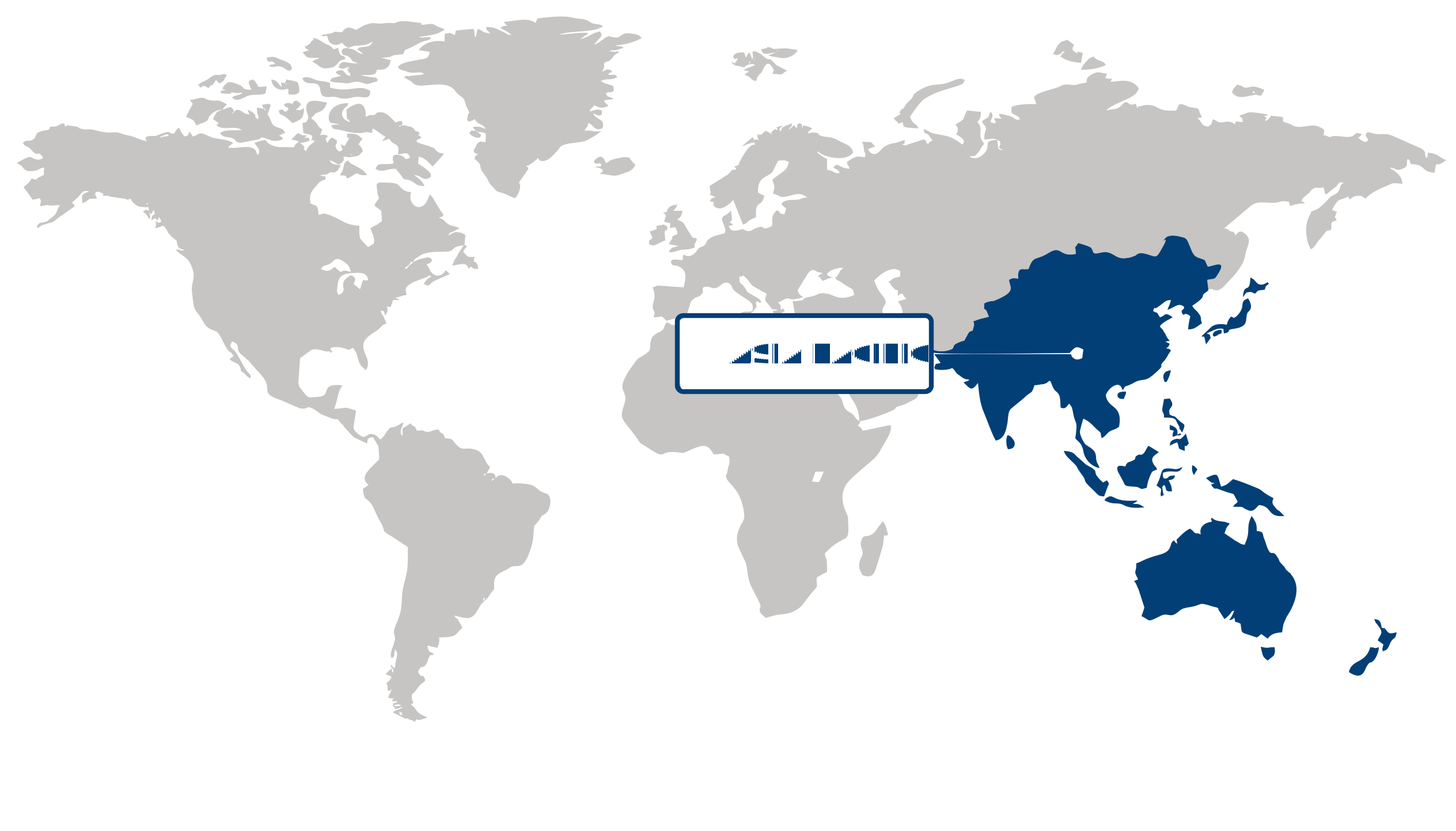
Asia Pacific (Largest & Fastest-Growing Region)
Asia Pacific dominated the cleanroom construction market in 2026 and is projected to maintain the fastest growth, underpinned by expanding pharmaceutical manufacturing, semiconductor production, biotechnology activities, and other industries requiring controlled production environments. Rising investments in advanced manufacturing facilities are increasing the need for cleanrooms designed to manage contamination, temperature, humidity, and air quality requirements. The region's growing industrial base, expanding healthcare infrastructure, and increasing localization of high-technology manufacturing are creating sustained demand for new and upgraded cleanroom facilities.
| Parameter | North America | Asia Pacific | Europe | Latin America | MEA |
|---|---|---|---|---|---|
| Innovation Hub i Scale Nascent Developing Advanced | |||||
| Cost-Sensitive Region i Scale Low Medium High | |||||
| Regulatory Environment i Scale Restrictive Neutral Supportive | |||||
| Demand Drivers i Scale Weak Moderate Strong | |||||
| Development Stage i Scale Emerging Developing Developed | |||||
| Adoption Rate i Scale Low Medium High | |||||
| New Entrants / Startups i Scale Sparse Moderate Dense | |||||
| Macro Indicators i Scale Weak Stable Strong |
Key Country Insights
United States 🇺🇸
Advanced Facility ExpansionThe U.S. cleanroom construction market is driven by investments in semiconductor, pharmaceutical, and biotechnology facilities. Project priorities emphasize modular construction, energy-efficient systems, and flexible designs that accommodate evolving production requirements.
Germany 🇩🇪
Regulated Production InfrastructureGermany focuses on cleanroom construction for pharmaceutical manufacturing, medical technology, and advanced industrial production. Demand centers on validated environments, efficient airflow management, and facilities designed to support strict operational compliance.
Japan 🇯🇵
High-Precision Manufacturing SpacesJapan prioritizes cleanroom construction for electronics, semiconductor, and precision manufacturing applications. Projects increasingly incorporate contamination control technologies, automation compatibility, and optimized environmental monitoring throughout facility operations.
South Korea 🇰🇷
Semiconductor Capacity SupportSouth Korea continues to expand cleanroom construction alongside semiconductor fabrication and advanced electronics manufacturing. Developers emphasize scalable layouts, high-performance filtration systems, and infrastructure capable of supporting sophisticated production processes.
France 🇫🇷
Pharmaceutical Facility ModernizationFrance supports cleanroom construction through pharmaceutical production, life sciences, and healthcare manufacturing investments. New projects increasingly integrate sustainable building practices while maintaining stringent contamination control and operational efficiency.
Italy 🇮🇹
Specialized Production FacilitiesItaly's cleanroom construction market is supported by pharmaceutical manufacturing, medical device production, and specialized industrial applications. Facility developers prioritize adaptable cleanroom configurations, regulatory compliance, and efficient long-term operating performance.
Segment Leadership and Growth Trends
Cleanroom Construction Market Share (%), by Type, 2026
Go beyond the chart, access full insights & data tables
Request Free Sample ReportType Segment Analysis: Modular Cleanroom (Largest & Fastest-Growing Segment)
The modular cleanroom segment dominated the cleanroom construction market, accounting for 45.16% of the market share in 2026, while also representing the fastest-growing segment. Its leading position is supported by the flexibility, scalability, and installation efficiency offered by modular construction systems, which allow facilities to establish controlled environments with less disruption to ongoing operations than conventional construction approaches. Modular cleanrooms can be configured and expanded according to changing production requirements, making them particularly suitable for industries where contamination control standards and facility needs evolve rapidly. Their standardized components also support consistent quality, faster project execution, and easier integration of critical environmental control systems. Growing investments in high-precision manufacturing, life sciences, and other applications requiring stringent contamination management are further strengthening demand for modular solutions, as organizations increasingly prioritize adaptable infrastructure that can support operational expansion while maintaining rigorous cleanroom performance requirements.
Application Segment Analysis: Semiconductor (Largest Segment) vs Biotechnology (Fastest-Growing Segment)
The semiconductor segment held the largest share of the cleanroom construction market, representing 31.32% in 2026. Semiconductor manufacturing requires highly controlled environments to minimize airborne particles and other contaminants that can compromise sensitive fabrication processes and reduce production yields. The increasing complexity and precision of semiconductor manufacturing operations have reinforced the need for advanced cleanroom facilities with tightly controlled temperature, humidity, airflow, and particulate levels. In addition, the continued expansion of semiconductor production capacity and the growing importance of advanced electronics are supporting sustained investment in specialized cleanroom infrastructure. These requirements make semiconductor facilities a major source of demand for cleanroom construction, particularly where stringent environmental control is essential to maintain manufacturing reliability and product quality.
The biotechnology segment is expected to register the fastest growth, driven by expanding research and development activities and the increasing need for controlled environments across biotechnology applications. Biotechnology facilities require stringent contamination control to protect sensitive biological processes, research materials, and production workflows, creating strong demand for specialized cleanroom infrastructure. The growing adoption of advanced biological processes and increasing activity in areas such as cell-based research and biomanufacturing are encouraging organizations to develop or upgrade facilities with more sophisticated environmental controls. As biotechnology operations become more technically demanding, cleanroom construction is increasingly viewed as a critical component of facility design, supporting the segment's rapid expansion and strengthening its role within the broader application landscape.
Material Segment Analysis: Steel (Largest & Fastest-Growing Segment)
The steel segment led the cleanroom construction market and held the largest share in 2026, while also emerging as the fastest-growing material segment. Steel is widely favored for cleanroom construction because of its structural strength, durability, and suitability for demanding industrial and controlled-environment applications. Its robust characteristics enable facilities to maintain structural integrity while accommodating specialized equipment and complex environmental control systems. Steel-based construction can also support long-term operational reliability in settings where stringent hygiene, cleanliness, and contamination-control requirements must be maintained. The material's compatibility with durable surface finishes and its ability to withstand intensive facility use further contribute to its adoption. As cleanroom applications expand across high-precision manufacturing and life science-related industries, the need for resilient and dependable construction materials is reinforcing the position of steel in cleanroom facility development.
| Segment | Sub-Segment | Largest Segment | Fastest Growing |
|---|---|---|---|
| Type | Modular Cleanroom, Soft Wall Cleanroom, Hard Wall Cleanroom, Others | Modular Cleanroom | Modular Cleanroom |
| Application | Biotechnology, Aerospace and Defense, Semiconductor, Healthcare, Pharmaceutical, Others | Semiconductor | Biotechnology |
| Material | Steel, Aluminum, Glass, Others | Steel | Steel |
| Class | Class 10, Class 100, Class 1,000, Class 10,000, Class 100,000 | Class 10,000 | Class 100 |
Competitive Landscape and Market Positioning
Prominent players in the cleanroom construction market:
- Lindner Group (Germany)
- Performance Contracting Group, Inc. (United States)
- American Cleanroom Systems (United States)
- Allied Cleanrooms (United States)
- Angstrom Technology (United States)
- Clean Air Technology, Inc. (United States)
- Hodess Cleanroom Construction (United States)
- Total Clean Air (United Kingdom)
- Turner Construction Company (United States)
Project execution capabilities are becoming a stronger source of competitive differentiation as customers increasingly seek integrated cleanroom solutions that combine design, engineering, construction, and validation within a single delivery framework. Suppliers are investing in modular construction methods and digital project coordination to shorten installation timelines while maintaining strict contamination control requirements. The market is also rewarding firms that can tailor facilities for specialized manufacturing and research environments, where flexibility, regulatory compliance, and long-term operational efficiency influence purchasing decisions as much as construction expertise.
| Company | Market Share | Company Revenue | Revenue CAGR (%) | Product Portfolio | Geographic Presence | Innovation / R&D Focus | Strategic Developments |
|---|---|---|---|---|---|---|---|
| Lindner Group (Germany) | |||||||
| Performance Contracting Group Inc. (United States) | |||||||
| American Cleanroom Systems (United States) | |||||||
| Allied Cleanrooms (United States) | |||||||
| Angstrom Technology (United States) | |||||||
| Clean Air Technology Inc. (United States) | |||||||
| Hodess Cleanroom Construction (United States) | |||||||
| Total Clean Air (United Kingdom) | |||||||
| Turner Construction Company (United States) |
Industry Development/News
| Company Name | Date | Key Development |
|---|---|---|
| Guardtech | Jun-26 | Guardtech partnered with DryR to integrate contamination control and dry room specialization for high-tech manufacturing projects. This collaboration expands service delivery capabilities for environments requiring stringent humidity and particulate control, supporting critical infrastructure development in emerging high-tech sectors. |
| EREMS | Jun-26 | EREMS invested €10 million to expand its space equipment manufacturing facility, incorporating 450 square meters of new cleanroom space. The infrastructure enhancement increases the firm's capacity for high-precision electronics assembly and testing, reflecting significant capital investment in controlled environments within the European aerospace sector. |
| Total Clean Air | May-26 | Total Clean Air acquired full ownership of the Modular Clean Air brand to consolidate its modular cleanroom product portfolio. The vertical integration strengthens the company’s market position and enhances its ability to scale modular construction solutions across diverse industrial applications requiring rapid cleanroom deployment. |
| Samsung Electronics | Feb-26 | Samsung Electronics accelerated construction of its Pyeongtaek P5 semiconductor facility using a "Shell First" strategy to expedite capacity for high-bandwidth memory production. The project significantly impacts the scale of cleanroom infrastructure required for next-generation semiconductor manufacturing and highlights aggressive timelines in fab construction. |
| Ardmac | Dec-25 | Ardmac implemented autonomous robotic layout technology across its construction sites to enhance cleanroom project execution. By leveraging digital models for millimetre-accurate construction, the initiative improves precision and operational efficiency, setting a new benchmark for technical standards in controlled environment build-outs. |
| Exyte | Sep-25 | Exyte launched Nixyte, a joint venture brand with JGC, to provide regional engineering, procurement, and construction services for high-tech industries in Southeast Asia. The platform expands the company’s ability to deliver large-scale, complex cleanroom projects in key emerging manufacturing hubs across Indonesia, the Philippines, Vietnam, and Thailand. |
| PTI Engineered Plastics | Sep-24 | PTI Engineered Plastics expanded its ISO Class 8 cleanroom capacity by 8,000 square feet, effectively tripling its moulding space. This investment significantly increases the firm's controlled manufacturing footprint, enabling the company to meet rising production demand for high-precision plastic components within strictly regulated medical and industrial cleanroom environments. |
| Turner Construction Company | Aug-24 | Turner Construction Company acquired Dornan Engineering Group to enhance its technical expertise in large-scale, complex infrastructure projects. The acquisition provides Turner with specialized capabilities in constructing and commissioning advanced cleanroom facilities, strengthening its competitive standing in sectors requiring sophisticated, high-performance controlled environments. |
| Total Clean Air | Jun-24 | Total Clean Air introduced "Airelab," a portable, frame-free inflatable cleanroom system. The technology offers a unique self-supporting structure that eliminates the need for continuous pumps or external supports, providing a flexible, high-performance solution for rapid-deployment cleanroom requirements in research and mobile industrial settings. |
| Hodess Cleanroom Construction | May-23 | Hodess Cleanroom Construction acquired Protocol Management Services and Clean Rooms West to expand its service footprint and consolidate its market position. The acquisition enables an integrated, end-to-end service model covering design, construction, maintenance, and monitoring, strengthening the firm’s competitive reach in the high-demand cleanroom services sector. |
Customize Your Report
Explore examples of how this report can be tailored to different research needs, including custom segments, additional topics or chapters, and related reports. Click a section of the wheel or its numbered marker to explore the available options.
Cleanroom Construction Market — Custom Segments
| Segment | Sub-Segment |
|---|---|
| Project Type | New Construction, Expansion, Renovation & Retrofit, Relocation & Conversion |
| Facility Size | Small-Scale Facilities, Mid-Size Facilities, Large-Scale Facilities |
| Construction Delivery Model | Design-Bid-Build, Design-Build, Engineering-Procurement-Construction (EPC), Turnkey Construction |
Cleanroom Construction Market — Custom TOC
| Custom Chapter | Custom Details |
|---|---|
| Facility Planning & Construction Cost Benchmarking |
|
| Cleanroom Retrofit & Expansion Opportunity |
|
| Modular Cleanroom Adoption Strategy |
|
Need a different cut of the data?
Request Custom ResearchWhat is the current size of the cleanroom construction market?
What are the growth projections for the cleanroom construction industry?
Why are pharmaceutical and biotechnology investments accelerating cleanroom construction?
How is semiconductor manufacturing influencing demand for advanced cleanroom infrastructure?
Why are modular cleanrooms the leading segment in the cleanroom construction market?
Which application segment is expected to witness the fastest growth in the cleanroom construction market?
Why does Asia Pacific dominate the cleanroom construction market?
What is supporting Asia Pacific's fastest market growth?
Who are the leading players in the cleanroom construction landscape?
Our Clients
"Your insights on workforce structures were spot-on. The analysis on mid-to-senior level roles validated some of our hiring decisions and highlighted gaps."
Ateliers De France
"The report gave us insights on competitors in the market. It helped our team refine our bidding strategy for upcoming contracts."
Clark Construction
"The reports provided a deep dive into market trends, and competitive landscape. The strategic insights and recommendations have been very helpful."
Rudolph and Sletten
Our Research Team & Methodology
Every Fundamental Business Insights report is built by a dedicated vertical research team, validated through a structured primary-and-secondary methodology, and reviewed for accuracy before it reaches you.
Research Team Overview
Prepared by the Construction & Manufacturing Research Team
Delivery
Published
Demand
Available
Support
Trust & Compliance
Research Domains
10 coverage areasResearch Intelligence
| Source | Reference |
|---|---|
| International Organization for Standardization (ISO) | www.iso.org |
| ASTM International | www.astm.org |
| National Institute of Standards and Technology (NIST) | www.nist.gov |
| International Code Council (ICC) | www.iccsafe.org |
| American Concrete Institute (ACI) | www.concrete.org |
| American Institute of Steel Construction (AISC) | www.aisc.org |
| Construction Industry Institute (CII) | www.construction-institute.org |
| Associated General Contractors of America (AGC) | www.agc.org |
| Association of Equipment Manufacturers (AEM) | www.aem.org |
| Building Owners and Managers Association (BOMA) | www.boma.org |
| American Society of Civil Engineers (ASCE) | www.asce.org |
| National Ready Mixed Concrete Association (NRMCA) | www.nrmca.org |
| International Facility Management Association (IFMA) | www.ifma.org |
| World Green Building Council (WorldGBC) | worldgbc.org |
| International Federation of Consulting Engineers (FIDIC) | fidic.org |
| International Labour Organization (ILO) | www.ilo.org |
| American Society of Mechanical Engineers (ASME) | www.asme.org |
| Society of Manufacturing Engineers (SME) | www.sme.org |
| National Association of Home Builders (NAHB) | www.nahb.org |
| European Construction Industry Federation (FIEC) | www.fiec.eu |
Research Workflow & Quality Assurance
Data Collection
Verified information gathered through primary and secondary research.
Data Triangulation
Cross-validation using multiple independent data sources.
Forecast Modelling
Market estimates developed using historical trends and analytical models.
Analyst Validation
Findings reviewed by domain experts for accuracy and consistency.
Editorial & Quality Review
Final editorial, quality, and compliance checks before publication.
Final Publication
Released after successful completion of the internal review process.
Report Coverage
📊 Market Assessment
- Market Size & Forecast
- Market Segmentation
- Regional Analysis
- Growth Drivers & Challenges
- Market Dynamics
🏢 Competitive Intelligence
- Competitive Landscape
- Company Profiles
- Competitive Benchmarking
- Mergers & Acquisitions
- Market Share Analysis or Key Company Strategies
🔍 Strategic Analysis
- Value Chain Analysis
- Porter's Five Forces
- PESTLE Analysis
- Pricing Trends
- Supply-Demand Analysis
🚀 Future Outlook
- Technology Landscape
- Regulatory Landscape
- Investment & Funding Landscape
- Emerging Opportunities
- Future Market Outlook
Have a question about this report or need a custom scope?
Request Customization