Class 8 Truck Market Size & Growth Forecast 2027–2036, By Segments (Cab, Ownership, Axle, Fuel, Application, Horsepower), Regional Demand Trends (North America, Asia Pacific, Europe), Key Country Insights (U.S., Japan, South Korea, Germany, France, Italy), and Competitive Landscape
Market Size and Growth Outlook
Class 8 Truck Market size was valued at USD 264.42 Billion in 2026 and is anticipated to grow at 5.08% CAGR from 2027 to 2036, surpassing USD 434.01 Billion by 2036. The industry revenue for 2027 is assessed at USD 275.6 Billion.
Get more details on this report
Request Free Sample ReportClass 8 Truck Market Intelligence Snapshot
Regional Market Dynamics
- Asia Pacific accounted for 41.26% in 2026, supported by freight activity, industrial production, logistics development, and heavy-duty vehicle demand across construction, mining, and manufacturing.
- North America is expected to grow fastest as freight movement, e-commerce distribution, fleet modernization, and transportation infrastructure investment increase demand for newer, efficient trucks.
Segment Momentum
- Fleet operators accounted for 65.09% of the market in 2026, benefiting from centralized maintenance, optimized vehicle utilization, economies of scale, and advanced fleet management technologies that improve operational efficiency.
- The 6x2 axle segment is growing quickly as fleet operators prioritize fuel efficiency, lower vehicle weight, and reduced operating costs while maintaining sufficient load capacity for regional and highway freight operations.
Market Expansion Drivers
- Rising freight and e-commerce logistics growth driving heavy-duty truck demand across supply chains
- Fleet replacement cycles and aging vehicle replacement accelerating new truck procurement demand
- Emissions and efficiency regulations driving transition to low-emission heavy-duty truck fleets
Leading Market Participants
- Leading companies in the class 8 truck market include Daimler Truck Holding AG (Germany), Volvo Group (Sweden), PACCAR Inc. (United States), Traton SE (Germany), DAF Trucks N.V. (Netherlands), Navistar International Corporation (United States), Isuzu Motors Ltd. (Japan), Tata Motors Limited (India), Dongfeng Motor Corporation (China), Sinotruk (China)
Global Market Forecast Snapshot
Market Outlook
- 2026 Market Size: USD 264.42 Billion
- 2027 Estimated Market Size: USD 275.6 Billion
- Projected Market Size: USD 434.01 Billion by 2036
- Growth Forecast: 5.08% CAGR (2027-2036)
Regional and Segment Outlook
- Leading Regional Market: Asia Pacific
- High-Growth Regional Hub: North America
- Core Revenue Segment: Sleeper Cab (Cab) | Fleet Operator (Ownership) | 6x4 (Axle) | Diesel (Fuel) | Freight Delivery (Application) | 400HP - 500HP (Horsepower)
- Emerging Opportunity Segment: Day Cab (Cab) | Fleet Operator (Ownership) | 6x2 (Axle) | Hybrid Electric (Fuel) | Freight Delivery (Application) | 300HP - 400HP (Horsepower)
Market Growth Drivers and Industry Trends
Rising freight and e-commerce logistics growth driving heavy-duty truck demand across supply chains
Expansion of freight transportation and increasing logistics activity are strengthening demand for heavy-duty commercial vehicles, with the class 8 truck market growth supported by rising movement of goods across supply chains. Growth in e-commerce distribution networks and industrial transportation requirements is increasing the need for reliable trucks capable of handling long-distance and high-volume cargo operations. Fleet operators are prioritizing heavy-duty vehicles that provide operational efficiency and support expanding freight activities.
Fleet replacement cycles and aging vehicle replacement accelerating new truck procurement demand
Aging commercial fleets are creating consistent replacement requirements as operators seek to maintain reliability, reduce maintenance challenges, and improve operational performance. The class 8 truck market benefits from accelerated procurement activity driven by scheduled fleet renewal programs and the need to replace older vehicles with newer models. Transportation companies are upgrading their fleets to enhance productivity, improve driver support features, and align vehicle capabilities with changing logistics demands.
Emissions and efficiency regulations driving transition to low-emission heavy-duty truck fleets
Stricter environmental requirements are influencing fleet modernization strategies, and the class 8 truck market growth is being shaped by increasing adoption of cleaner and more fuel-efficient heavy-duty transportation solutions. Truck manufacturers and fleet operators are exploring alternative powertrains and efficiency improvements to meet evolving emissions standards while maintaining freight performance. Regulatory pressure is encouraging investment in advanced vehicle technologies that reduce environmental impact and improve long-term operating economics.
| Growth Driver | Impact on CAGR | Regulatory Influence | Geographic Relevance | Adoption Rate | Impact Timeline |
|---|---|---|---|---|---|
| Rising freight and e-commerce logistics growth driving heavy-duty truck demand across supply chains | 2.1% | Moderate | North America, Asia Pacific | High | Near Term |
| Fleet replacement cycles and aging vehicle replacement accelerating new truck procurement demand | 1.7% | Moderate | North America, Europe | High | Near Term |
| Emissions and efficiency regulations driving transition to low-emission heavy-duty truck fleets | 1.3% | High | Europe, North America | High | Mid Term |
Unlock insights tailored to your business with our bespoke market research solutions.
Click to get your customized report now.
Regional Demand Dynamics
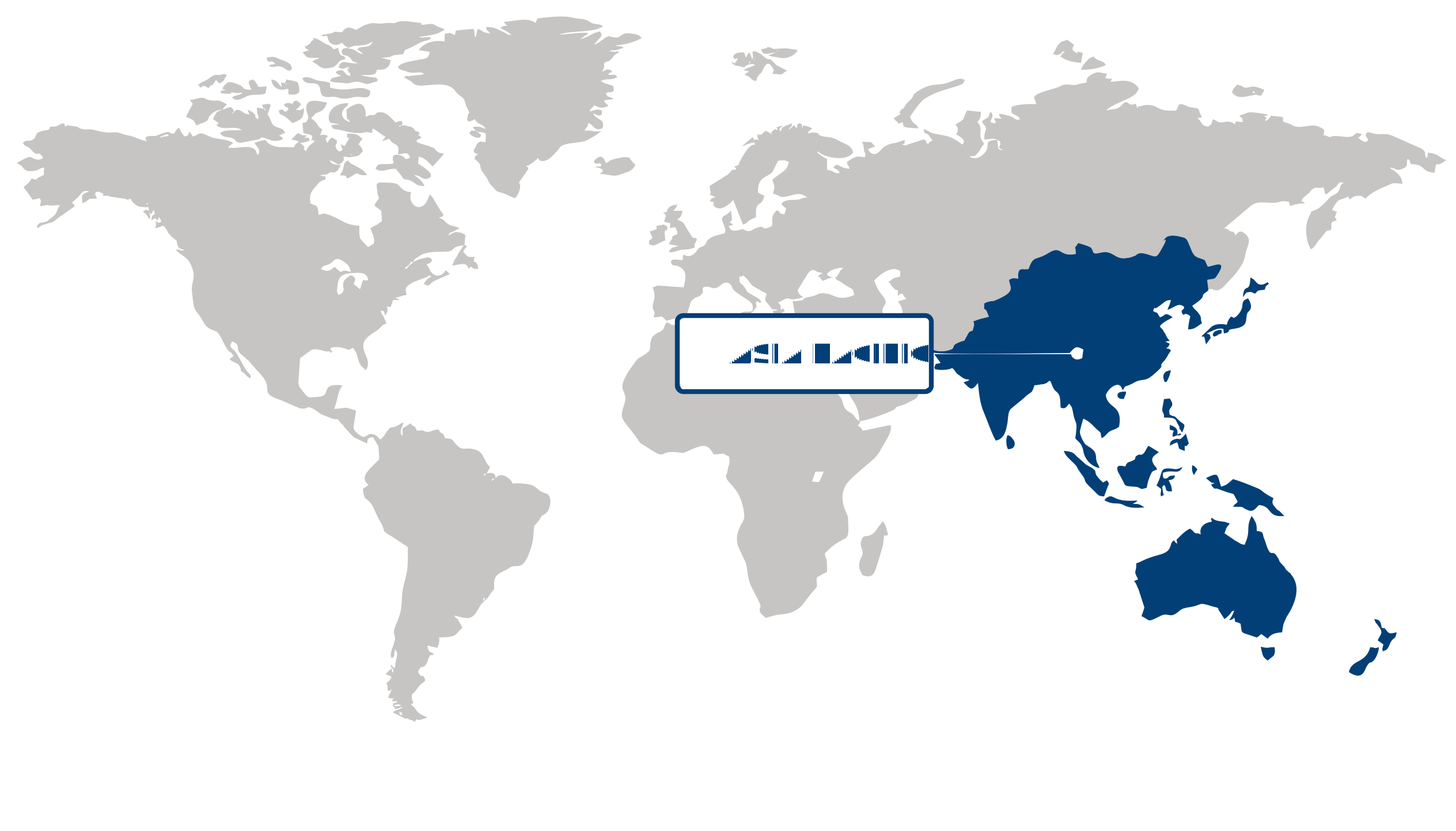
Asia Pacific (Largest Region)
Asia Pacific accounted for 41.26% of the class 8 truck market in 2026, supported by extensive freight transportation activity, expanding industrial production, and the continued development of logistics infrastructure. Strong demand for heavy-duty vehicles across construction, mining, manufacturing, and long-distance goods transportation is reinforcing regional adoption. Ongoing investments in road connectivity and distribution networks, together with the need for efficient fleet operations, are sustaining demand for high-capacity commercial vehicles across major economies.
North America (Fastest-Growing Region)
North America is expected to register the fastest growth in the class 8 truck market, driven by sustained freight movement, expanding e-commerce distribution, and continued investment in transportation and logistics infrastructure. The region's mature trucking industry creates consistent demand for heavy-duty vehicles, while fleet modernization is encouraging the replacement of aging vehicles with more efficient and technologically advanced models. Increasing attention to fuel efficiency, vehicle connectivity, and lower operating costs is further supporting the adoption of newer class 8 trucks.
| Parameter | North America | Asia Pacific | Europe | Latin America | MEA |
|---|---|---|---|---|---|
| Innovation Hub i Scale Nascent Developing Advanced | |||||
| Cost-Sensitive Region i Scale Low Medium High | |||||
| Regulatory Environment i Scale Restrictive Neutral Supportive | |||||
| Demand Drivers i Scale Weak Moderate Strong | |||||
| Development Stage i Scale Emerging Developing Developed | |||||
| Adoption Rate i Scale Low Medium High | |||||
| New Entrants / Startups i Scale Sparse Moderate Dense | |||||
| Macro Indicators i Scale Weak Stable Strong |
Key Country Insights
United States 🇺🇸
Long-Haul Fleet RenewalThe U.S. class 8 truck market is shaped by fleet replacement cycles, freight efficiency requirements, and expanding telematics adoption. Fleet operators increasingly evaluate fuel efficiency, driver support technologies, and maintenance optimization when purchasing new heavy-duty trucks.
Germany 🇩🇪
Advanced Commercial EngineeringGermany prioritizes technologically advanced class 8 trucks that improve fuel economy, driver comfort, and fleet productivity. Manufacturers continue integrating digital fleet management features and lower-emission powertrain technologies for commercial transport operators.
Japan 🇯🇵
Efficient Logistics TransportJapan emphasizes reliable class 8 trucks suited for efficient freight movement and demanding logistics operations. Operators value durable vehicle platforms, optimized operating costs, and advanced safety technologies supporting commercial fleet performance.
South Korea 🇰🇷
Fleet Technology AdoptionSouth Korea is expanding adoption of connected class 8 trucks equipped with telematics and advanced driver assistance systems. Fleet modernization strategies increasingly focus on operational efficiency, predictive maintenance, and digital fleet visibility.
France 🇫🇷
Low-Emission Fleet PlanningFrance encourages class 8 truck procurement strategies aligned with stricter environmental expectations and fleet modernization initiatives. Transport companies increasingly assess alternative powertrains alongside conventional heavy-duty vehicles for long-distance freight operations.
Italy 🇮🇹
Regional Freight OptimizationItaly focuses on class 8 trucks capable of supporting regional logistics, cross-border freight, and infrastructure-related transport. Fleet operators seek versatile vehicles that balance payload capability, operating efficiency, and regulatory compliance.
Segment Leadership and Growth Trends
Class 8 Truck Market Share (%), by Cab, 2026
Go beyond the chart, access full insights & data tables
Request Free Sample ReportCab Segment Analysis: Sleeper Cab (Largest Segment) vs Day Cab (Fastest-Growing Segment)
The sleeper cab segment dominated the class 8 truck market, accounting for 69.12% in 2026. Its leadership is supported by the growing demand for long-haul freight transportation, where driver comfort, onboard resting facilities, and operational efficiency are essential. Sleeper cabs enable carriers to optimize long-distance operations while supporting driver retention and regulatory compliance, making them the preferred configuration for extended transportation routes.
The day cab segment is projected to experience the fastest growth as regional freight movement, urban logistics, and short-distance distribution continue to expand. Businesses increasingly favor day cabs for their lower operating costs, improved maneuverability, and suitability for routes that do not require overnight travel. The continued development of regional supply chains and last-mile logistics further strengthens demand for this segment.
Ownership Segment Analysis: Fleet Operator (Largest & Fastest-Growing Segment)
In the class 8 truck market, the fleet operator segment held the largest share of 65.09% in 2026 while also emerging as the fastest-growing segment. Large fleet operators benefit from economies of scale, centralized maintenance, optimized vehicle utilization, and advanced fleet management technologies that enhance operational efficiency. Growing freight demand, increasing investment in logistics modernization, and the adoption of digital fleet management solutions continue to reinforce the segment's leadership and growth prospects.
Axle Segment Analysis: 6x4 (Largest Segment) vs 6x2 (Fastest-Growing Segment)
The 6x4 axle segment accounted for 56.39% in 2026, making it the leading segment in the class 8 truck market. Its dominance is driven by its superior traction, load-carrying capability, and ability to operate efficiently across demanding road conditions. These advantages make 6x4 configurations highly suitable for heavy-duty freight transportation, construction activities, and long-distance hauling where reliability and payload capacity are critical.
The 6x2 axle segment is anticipated to grow at the fastest pace due to increasing emphasis on fuel efficiency, lower vehicle weight, and reduced operating costs. Fleet operators are increasingly adopting 6x2 configurations for suitable freight applications to improve overall transportation efficiency while maintaining adequate load capacity for regional and highway operations.
| Segment | Sub-Segment | Largest Segment | Fastest Growing |
|---|---|---|---|
| Cab | Day Cab, Sleeper Cab | Sleeper Cab | Day Cab |
| Ownership | Fleet Operator, Independent Operator | Fleet Operator | Fleet Operator |
| Axle | 4x2, 6x4, 6x2 | 6x4 | 6x2 |
| Fuel | Diesel, Natural Gas, Hybrid Electric, Others | Diesel | Hybrid Electric |
| Application | Freight Delivery, Utility Services, Construction & Mining, Others | Freight Delivery | Freight Delivery |
| Horsepower | Below 300HP, 300HP - 400HP, 400HP - 500HP, 500HP & Above | 400HP - 500HP | 300HP - 400HP |
Competitive Landscape and Market Positioning
Leading companies in the class 8 truck market:
- Daimler Truck Holding AG (Germany)
- Volvo Group (Sweden)
- PACCAR, Inc. (United States)
- Traton SE (Germany)
- DAF Trucks N.V. (Netherlands)
- Navistar International Corporation (United States)
- Isuzu Motors Ltd. (Japan)
- Tata Motors Limited (India)
- Dongfeng Motor Corporation (China)
- SinotrUK (China)
Fleet operators are evaluating heavy-duty trucks through a broader ownership perspective, prompting manufacturers to compete on operational efficiency, vehicle uptime, and lifecycle support rather than conventional performance attributes alone. This shift has accelerated investment in connected vehicle technologies, predictive maintenance platforms, and advanced driver assistance capabilities that improve fleet productivity while reducing operating disruptions. Competitive positioning is also being shaped by the transition toward alternative propulsion systems, with manufacturers balancing evolving environmental expectations against the practical demands of long-haul transportation. The ability to provide flexible vehicle configurations, dependable service networks, and adaptable financing and maintenance solutions is becoming increasingly important as customer requirements diversify across freight applications.
| Company | Market Share | Company Revenue | Revenue CAGR (%) | Product Portfolio | Geographic Presence | Innovation / R&D Focus | Strategic Developments |
|---|---|---|---|---|---|---|---|
| Daimler Truck Holding AG (Germany) | |||||||
| Volvo Group (Sweden) | |||||||
| PACCAR Inc. (United States) | |||||||
| Traton SE (Germany) | |||||||
| DAF Trucks N.V. (Netherlands) | |||||||
| Navistar International Corporation (United States) | |||||||
| Isuzu Motors Ltd. (Japan) | |||||||
| Tata Motors Limited (India) | |||||||
| Dongfeng Motor Corporation (China) | |||||||
| Sinotruk (China) |
Industry Development/News
| Company Name | Date | Key Development |
|---|---|---|
| Toyota | May-26 | Toyota advanced its hydrogen Class 8 truck commercialization by executing a 40-truck rollout in Southern California and pursuing a strategic stake in Cellcentric. This initiative significantly expands the company's footprint in heavy-duty zero-emission freight and accelerates the development of dedicated regional fuel infrastructure. |
| Tesla | Apr-26 | Tesla reached a key manufacturing milestone in the electric heavy-duty segment by producing the first Tesla Semi from its high-volume Nevada production line. This development transitions the vehicle into larger-scale commercial deployment, addressing growing fleet demands for zero-emission Class 8 transport options. |
| Hyundai Translead and Hendrickson | Feb-26 | Hyundai Translead and Hendrickson Fleet Solutions established a strategic partnership to launch a dedicated hydrogen truck dealer network across New York and New Jersey. The initiative aims to expand regional logistics access to Hyundai XCIENT Fuel Cell Class 8 vehicles and bolster freight ecosystem commercialization. |
| Windrose | Jan-26 | Windrose secured multi-regional vehicle homologation for its R700 electric Class 8 truck across the United States, European Union, and China. This regulatory milestone permits the company to initiate global commercial deliveries and scale vehicle reservations in major heavy-duty freight markets. |
| Hyundai | May-25 | Hyundai announced the development of its HTWO Energy facility near the Port of Savannah to provide hydrogen production and dispensing capabilities. The infrastructure expansion directly supports the operational viability of Class 8 fuel cell trucks and strengthens the regional logistics supply chain. |
| International | Apr-25 | International expanded its zero-emission commercial vehicle portfolio with the introduction of the eRH Series, a Class 8 electric truck tailored for local and regional haul applications. The launch enhances the company's competitive positioning within the accelerating heavy-duty fleet electrification market. |
| Mack Trucks | Apr-25 | Mack Trucks expanded its heavy-duty vehicle portfolio by introducing an electric variant of its Pioneer Class 8 truck alongside new CARB-compliant engines. This multi-powertrain strategy broadens the company's offerings to help commercial fleet operators comply with tightening regional emissions regulations. |
| Volvo Trucks | Oct-24 | Volvo Trucks commenced production of its redesigned Volvo VNL Class 8 truck at its Virginia manufacturing facility following a $400 million investment. The facility upgrade and new model launch integrate advanced technologies and efficiency optimizations to enhance its competitive posture in North America. |
| Volvo and Daimler Truck | Oct-24 | Volvo and Daimler Truck finalized a binding agreement to form a 50/50 joint venture aimed at developing a standardized, software-defined vehicle platform for heavy-duty commercial trucks. Headquartered in Sweden, the brand-agnostic architecture is designed to establish an open digital standard across the global logistics industry. |
| Volvo | Apr-24 | Volvo announced plans to construct a new heavy-duty truck manufacturing factory in Mexico to complement its existing operational footprint in the United States. The strategic expansion positions the original equipment manufacturer as the sole active participant in the US Class 8 segment utilizing Mexican production facilities. |
Customize Your Report
Explore examples of how this report can be tailored to different research needs, including custom segments, additional topics or chapters, and related reports. Click a section of the wheel or its numbered marker to explore the available options.
Class 8 Truck Market — Custom Segments
| Segment | Sub-Segment |
|---|---|
| Duty Cycle | Short-Haul, Regional-Haul, Long-Haul, Severe-Duty |
| Fleet Size | Small Fleets, Medium Fleets, Large Fleets, Very Large Fleets |
| Purchase Channel | Direct OEM Sales, Dealer Sales, Fleet Procurement Programs |
Class 8 Truck Market — Custom TOC
| Custom Chapter | Custom Details |
|---|---|
| Fleet Total Cost of Ownership Strategies |
|
| Electrification Readiness Assessment |
|
| Autonomous Trucking Adoption Pathways |
|
Need a different cut of the data?
Request Custom ResearchWhat is the market size of class 8 truck?
What is the anticipated CAGR of the class 8 truck industry?
How are freight expansion and fleet replacement cycles influencing Class 8 truck procurement?
How are emissions requirements changing heavy-duty fleet modernization strategies?
Why are fleet operators the largest buyers in the class 8 truck market?
Why is the 6x2 axle segment the fastest-growing in the class 8 truck market?
What drives Asia Pacific's leadership in the class 8 truck market?
How is North America accelerating class 8 truck market growth?
Which organizations are considered leaders in the class 8 truck landscape?
Our Clients
"The team surpassed our expectations with the report depth. The actionable insights provided proved crucial in navigating market challenges."
Tata Motors
"We found the report to be very informative. The expertise and attention to market nuances significantly influenced our business direction."
DENSO Corporation
"The consumer survey findings were quite good. We now have a clearer picture of the customer churning and retention strategy."
HL Mando
Our Research Team & Methodology
Every Fundamental Business Insights report is built by a dedicated vertical research team, validated through a structured primary-and-secondary methodology, and reviewed for accuracy before it reaches you.
Research Team Overview
Prepared by the Automotive & Transportation Research Team
Delivery
Published
Demand
Available
Support
Trust & Compliance
Research Domains
10 coverage areasResearch Intelligence
| Source | Reference |
|---|---|
| International Organization of Motor Vehicle Manufacturers (OICA) | www.oica.net |
| SAE International | www.sae.org |
| International Energy Agency (IEA) | www.iea.org |
| International Transport Forum (ITF) | www.itf-oecd.org |
| International Road Federation (IRF) | www.irf.global |
| International Organization for Standardization (ISO) | www.iso.org |
| United Nations Economic Commission for Europe (UNECE) | unece.org |
| National Highway Traffic Safety Administration (NHTSA) | www.nhtsa.gov |
| U.S. Department of Transportation (USDOT) | www.transportation.gov |
| European Automobile Manufacturers' Association (ACEA) | www.acea.auto |
| Society of Indian Automobile Manufacturers (SIAM) | www.siam.in |
| International Air Transport Association (IATA) | www.iata.org |
| International Civil Aviation Organization (ICAO) | www.icao.int |
| International Maritime Organization (IMO) | www.imo.org |
| International Union of Railways (UIC) | uic.org |
| American Public Transportation Association (APTA) | www.apta.com |
| International Federation of Robotics (IFR) | ifr.org |
| CharIN | www.charin.global |
| World Shipping Council | www.worldshipping.org |
| International Federation of Freight Forwarders Associations (FIATA) | fiata.org |
Research Workflow & Quality Assurance
Data Collection
Verified information gathered through primary and secondary research.
Data Triangulation
Cross-validation using multiple independent data sources.
Forecast Modelling
Market estimates developed using historical trends and analytical models.
Analyst Validation
Findings reviewed by domain experts for accuracy and consistency.
Editorial & Quality Review
Final editorial, quality, and compliance checks before publication.
Final Publication
Released after successful completion of the internal review process.
Report Coverage
📊 Market Assessment
- Market Size & Forecast
- Market Segmentation
- Regional Analysis
- Growth Drivers & Challenges
- Market Dynamics
🏢 Competitive Intelligence
- Competitive Landscape
- Company Profiles
- Competitive Benchmarking
- Mergers & Acquisitions
- Market Share Analysis or Key Company Strategies
🔍 Strategic Analysis
- Value Chain Analysis
- Porter's Five Forces
- PESTLE Analysis
- Pricing Trends
- Supply-Demand Analysis
🚀 Future Outlook
- Technology Landscape
- Regulatory Landscape
- Investment & Funding Landscape
- Emerging Opportunities
- Future Market Outlook
Have a question about this report or need a custom scope?
Request Customization