Class 6 Trucks Market Size & Growth Forecast 2027–2036, By Segments (Horsepower, Axle, Application, Body Type, Fuel), Regional Demand Trends (North America, Asia Pacific, Europe), Key Country Insights (U.S., Japan, South Korea, Germany, France, Italy), and Competitive Landscape
Market Size and Growth Outlook
Class 6 Trucks Market size was worth USD 19.15 Billion in 2026 and is expected to grow at 7.42% CAGR between 2027 and 2036, exceeding USD 39.18 Billion by 2036. The industry revenue for 2027 is assessed at USD 20.36 Billion.
Get more details on this report
Request Free Sample ReportClass 6 Trucks Market Intelligence Snapshot
Regional Market Dynamics
- Asia Pacific held a 50.88% share, supported by expanding freight transportation, industrial activity, infrastructure development, and growing regional goods movement.
- North America is projected to grow fastest as freight movement, construction activity, fleet modernization, and demand for efficient medium-duty vehicles increase.
Segment Momentum
- The 300 HP to 400 HP segment leads the market because it delivers the power and reliability needed for freight transportation, regional hauling, and vocational applications involving heavier loads and varied operating conditions.
- The 200 HP to 300 HP segment is expanding rapidly as fleet operators seek an optimal balance of performance, fuel efficiency, and operating costs for urban and regional transportation activities.
Market Expansion Drivers
- E-commerce logistics boom driving sustained demand for medium-duty freight transportation
- Urban freight expansion increasing utilization of medium-duty trucks in cities
- Fleet electrification and efficiency upgrades improving operational economics of medium-duty trucking
Leading Market Participants
- Major companies in the class 6 trucks market include Freightliner Trucks (United States), Volvo Group (Sweden), Daimler Truck AG (Germany), PACCAR Inc (United States), Navistar International Corporation (United States), Tata Motors Limited (India), Isuzu Motors Limited (Japan), Hino Motors, Ltd. (Japan), Scania AB (Sweden), Dongfeng Motor Corporation (China)
Global Market Forecast Snapshot
Market Outlook
- 2026 Market Size: USD 19.15 Billion
- 2027 Estimated Market Size: USD 20.36 Billion
- Projected Market Size: USD 39.18 Billion by 2036
- Growth Forecast: 7.42% CAGR (2027-2036)
Regional and Segment Outlook
- Leading Regional Market: Asia Pacific
- High-Growth Regional Hub: North America
- Core Revenue Segment: 300 HP to 400 HP (Horsepower) | 4X2 (Axle) | Freight Delivery (Application) | Box (Body Type) | Diesel (Fuel)
- Emerging Opportunity Segment: 200 HP to 300 HP (Horsepower) | 4X2 (Axle) | Freight Delivery (Application) | Box (Body Type) | Hybrid Electric (Fuel)
Market Growth Drivers and Industry Trends
E-commerce logistics boom driving sustained demand for medium-duty freight transportation
The continued expansion of digital commerce is increasing freight movement between distribution centers, fulfillment hubs, and retail locations, which will propel the class 6 trucks market growth. Medium-duty trucks are widely utilized for regional deliveries because they offer an effective balance of payload capacity, maneuverability, and operating efficiency for high-frequency logistics operations. Their ability to support diverse cargo applications enables transportation providers to maintain responsive supply chains while meeting growing expectations for faster order fulfillment.
Urban freight expansion increasing utilization of medium-duty trucks in cities
Growing commercial activity within metropolitan areas has intensified demand for vehicles capable of transporting goods efficiently through urban transportation networks, supporting the class 6 trucks market demand. Class 6 trucks are increasingly deployed for municipal services, retail replenishment, construction material delivery, and local distribution where frequent stops and varied cargo requirements are common. Their adaptability allows fleet operators to manage city logistics while maintaining productivity under challenging traffic and infrastructure conditions.
Fleet electrification and efficiency upgrades improving operational economics of medium-duty trucking
Fleet modernization initiatives are encouraging transportation companies to invest in cleaner and more efficient vehicle technologies, creating favorable conditions for the class 6 trucks market. Electrification, advanced powertrain systems, and connected fleet management technologies help operators reduce fuel consumption, lower maintenance requirements, and improve overall vehicle utilization. These operational improvements support long-term cost optimization while aligning fleet replacement strategies with evolving sustainability goals and efficiency-focused transportation management practices.
| Growth Driver | Impact on CAGR | Regulatory Influence | Geographic Relevance | Adoption Rate | Impact Timeline |
|---|---|---|---|---|---|
| E-commerce logistics boom driving sustained demand for medium-duty freight transportation | 2% | Low | North America, Asia Pacific | High | Near Term |
| Urban freight expansion increasing utilization of medium-duty trucks in cities | 1.8% | Low | Asia Pacific, Europe | High | Near Term |
| Fleet electrification and efficiency upgrades improving operational economics of medium-duty trucking | 1.5% | Moderate | Europe, North America | Emerging | Mid Term |
Unlock insights tailored to your business with our bespoke market research solutions.
Click to get your customized report now.
Regional Demand Dynamics
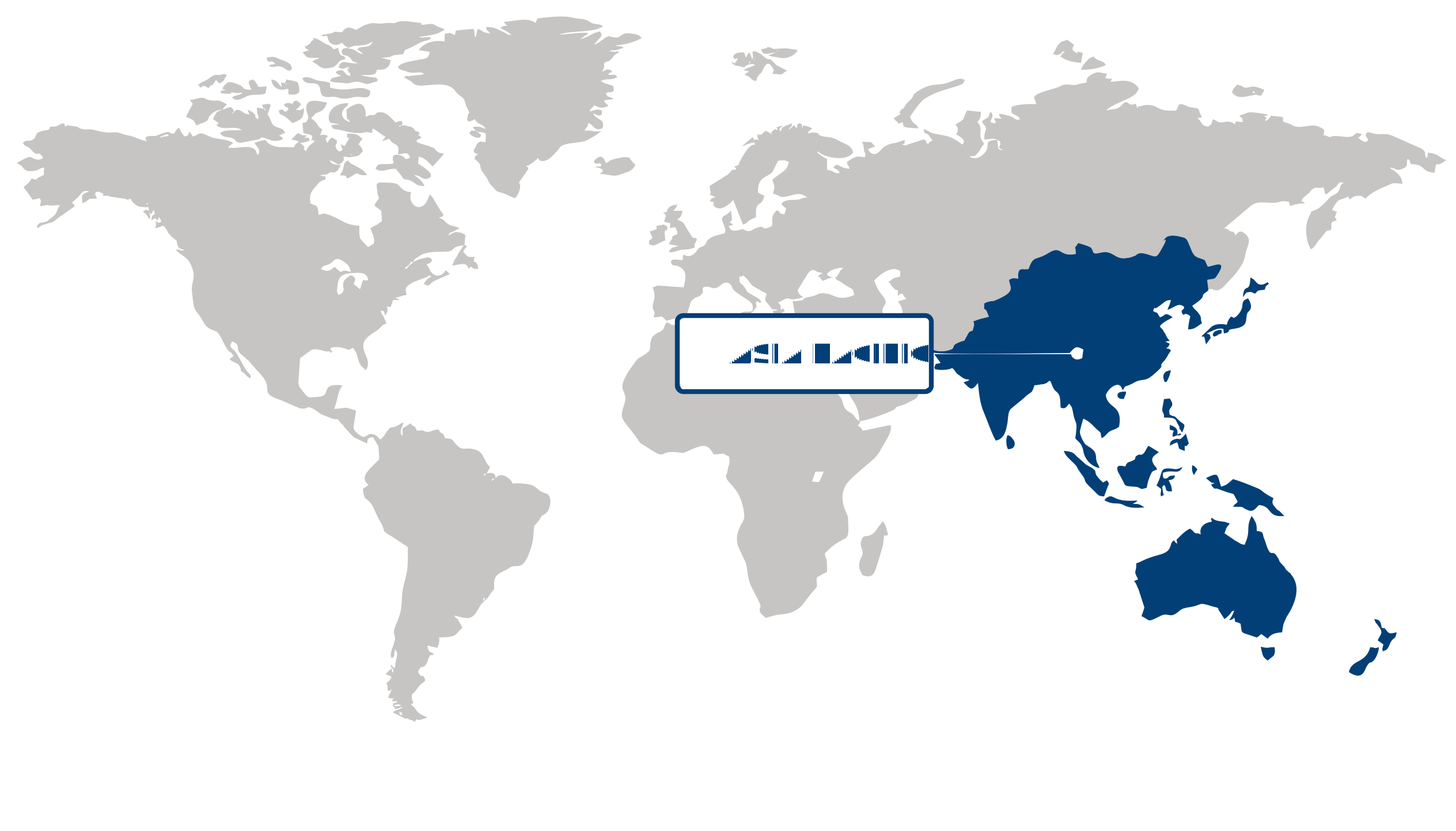
Asia Pacific (Largest Region)
Asia Pacific held the largest share of the class 6 trucks market at 50.88% in 2026, supported by expanding freight transportation, industrial activity, and infrastructure development across the region. The growing movement of goods between manufacturing centers, distribution networks, and urban markets is strengthening demand for medium-duty commercial vehicles. Rising construction and logistics activities are also increasing the need for versatile trucks capable of handling regional transportation and commercial applications. Improvements in road infrastructure and continued development of industrial and urban economies are further supporting regional demand.
North America (Fastest-Growing Region)
North America is expected to experience the fastest growth, benefiting from established logistics networks, strong demand for commercial transportation, and increasing requirements for efficient medium-duty fleets. The expansion of freight movement and construction-related activities is creating additional applications for class 6 trucks across transportation and industrial operations. Fleet modernization and increasing attention to vehicle productivity, operating efficiency, and advanced vehicle technologies are also encouraging investment in newer commercial vehicles, supporting the region's growth trajectory.
| Parameter | North America | Asia Pacific | Europe | Latin America | MEA |
|---|---|---|---|---|---|
| Innovation Hub i Scale Nascent Developing Advanced | |||||
| Cost-Sensitive Region i Scale Low Medium High | |||||
| Regulatory Environment i Scale Restrictive Neutral Supportive | |||||
| Demand Drivers i Scale Weak Moderate Strong | |||||
| Development Stage i Scale Emerging Developing Developed | |||||
| Adoption Rate i Scale Low Medium High | |||||
| New Entrants / Startups i Scale Sparse Moderate Dense | |||||
| Macro Indicators i Scale Weak Stable Strong |
Key Country Insights
United States 🇺🇸
Heavy-duty fleet expansionIn the U.S., class 6 trucks are widely used in regional distribution, utility services, and construction logistics, with operators prioritizing durability and payload versatility. Fleet modernization is influenced by rising demand for vocational applications and gradual adoption of alternative fuel powertrains in medium-heavy duty segments.
Germany 🇩🇪
Vocational truck engineeringGermany’s class 6 truck demand is driven by industrial and municipal applications requiring precision-engineered vocational vehicles. In Germany, emphasis is placed on fuel efficiency, emissions compliance, and integration of advanced driver assistance systems for regulated transport and construction-related operations.
Japan 🇯🇵
Space-efficient truck designJapan’s class 6 truck usage is shaped by constrained urban infrastructure and high-density industrial logistics. In Japan, operators prioritize compact yet powerful truck configurations, optimized fuel efficiency, and reliable performance for tightly scheduled distribution and municipal services.
South Korea 🇰🇷
Infrastructure-driven demandSouth Korea’s class 6 trucks are heavily utilized in construction, infrastructure projects, and regional freight movement. In South Korea, fleet operators emphasize payload optimization, durability under intensive usage, and increasing integration of smart fleet tracking technologies.
France 🇫🇷
Regional freight modernizationFrance’s class 6 truck market supports regional freight corridors and municipal service fleets, with growing focus on emissions reduction. In France, operators are investing in fleet renewal, cleaner diesel alternatives, and improved logistics efficiency across intercity transport routes.
Italy 🇮🇹
Mixed-use commercial fleetsItaly’s class 6 trucks serve diverse applications from urban construction to regional goods transport. In Italy, operators prioritize adaptability, cost efficiency, and gradual modernization of fleets to meet tightening environmental and operational standards.
Segment Leadership and Growth Trends
Class 6 Trucks Market Share (%), by Horsepower, 2026
Go beyond the chart, access full insights & data tables
Request Free Sample ReportHorsepower Segment Analysis: 300 HP to 400 HP (Largest Segment) vs 200 HP to 300 HP (Fastest-Growing Segment)
The class 6 trucks market was led by the 300 HP to 400 HP horsepower segment in 2026. This segment's dominance is attributed to its ability to deliver the power and performance required for demanding commercial transportation applications while maintaining operational reliability. Trucks within this horsepower range are widely utilized across freight transportation, regional hauling, and vocational services where higher power output is essential for carrying heavier loads and operating across varied terrain conditions.
The 200 HP to 300 HP horsepower segment is witnessing the fastest growth as fleet operators increasingly seek vehicles that offer a balance between performance and operating efficiency. These trucks are well suited for urban and regional transportation activities where moderate power requirements are sufficient. Growing emphasis on fuel efficiency, cost optimization, and versatile fleet deployment is contributing to the increasing adoption of trucks within this horsepower category.
Axle Segment Analysis: 4X2 (Largest & Fastest-Growing Segment)
In the class 6 trucks market, the 4X2 axle configuration segment emerged as both the largest and fastest-growing category. Its leading position is supported by widespread use in freight transportation and distribution operations where efficiency, maneuverability, and lower operating complexity are important considerations. The configuration is particularly effective for paved-road applications, enabling operators to achieve dependable performance while managing fleet costs effectively. The segment continues to expand as logistics and delivery networks increasingly prioritize vehicles optimized for regional and urban transportation routes. The 4X2 axle configuration offers favorable payload capability and operational practicality, making it a preferred choice for businesses seeking efficient transportation solutions. Ongoing growth in commercial goods movement is further reinforcing demand for this axle type.
Application Segment Analysis: Freight Delivery (Largest & Fastest-Growing Segment)
Holding the leading position in the class 6 trucks market, the freight delivery application segment was both the largest and fastest-growing category in 2026. The segment benefits from the critical role class 6 trucks play in transporting goods across regional distribution networks, retail supply chains, and commercial logistics operations. Their ability to handle substantial cargo volumes while maintaining flexibility across different delivery environments supports their widespread adoption. Growth in the segment is being driven by expanding e-commerce activity, increasing distribution requirements, and the ongoing modernization of logistics infrastructure. Businesses are investing in transportation assets capable of supporting efficient goods movement and timely deliveries, further strengthening demand for freight delivery applications. As commercial transportation needs continue to evolve, this segment remains central to market expansion.
| Segment | Sub-Segment | Largest Segment | Fastest Growing |
|---|---|---|---|
| Horsepower | 200 HP to 300 HP, 300 HP to 400 HP | 300 HP to 400 HP | 200 HP to 300 HP |
| Axle | 4X2, 6X4, 6X6 | 4X2 | 4X2 |
| Application | Freight Delivery, Utility Services, Construction & Mining, Others | Freight Delivery | Freight Delivery |
| Body Type | Box, Dump, Beverage, Others | Box | Box |
| Fuel | Diesel, Natural Gas, Hybrid Electric, Others | Diesel | Hybrid Electric |
Competitive Landscape and Market Positioning
Major players in the class 6 trucks market:
- Freightliner Trucks (United States)
- Volvo Group (Sweden)
- Daimler Truck AG (Germany)
- PACCAR Inc (United States)
- Navistar International Corporation (United States)
- Tata Motors Limited (India)
- Isuzu Motors Limited (Japan)
- Hino Motors Ltd. (Japan)
- Scania AB (Sweden)
- Dongfeng Motor Corporation (China)
Fleet modernization and shifting commercial transportation requirements are reshaping competition within the Class 6 Trucks Market. Manufacturers are placing greater emphasis on vehicle efficiency, durability, and advanced operational features as customers seek improved productivity across regional and vocational applications. Competitive advantage is increasingly tied to the ability to provide reliable platforms that accommodate evolving fleet strategies, including greater attention to technology-enabled operations and lower operating complexity.
| Company | Market Share | Company Revenue | Revenue CAGR (%) | Product Portfolio | Geographic Presence | Innovation / R&D Focus | Strategic Developments |
|---|---|---|---|---|---|---|---|
| Freightliner Trucks (United States) | |||||||
| Volvo Group (Sweden) | |||||||
| Daimler Truck AG (Germany) | |||||||
| PACCAR Inc (United States) | |||||||
| Navistar International Corporation (United States) | |||||||
| Tata Motors Limited (India) | |||||||
| Isuzu Motors Limited (Japan) | |||||||
| Hino Motors Ltd. (Japan) | |||||||
| Scania AB (Sweden) | |||||||
| Dongfeng Motor Corporation (China) |
Industry Development/News
| Company Name | Date | Key Development |
|---|---|---|
| Gatik | Sep-25 | Gatik secured a five-year commercial partnership with Loblaw to scale its autonomous middle-mile delivery operations across Canada. The agreement outlines the deployment of up to 50 autonomous vehicles, marking a significant commercial expansion of autonomous driving technology within the Class 6 truck market segment. |
| Autocar | Jan-24 | Autocar expanded its medium-duty presence by launching the Class 6 ACMD cabover truck, engineered specifically for vocational refuse and municipal maintenance applications. Incorporating 13 Cummins engine options, the vehicle configuration targets fleet operational efficiency by eliminating the commercial driver's license requirement for operators. |
| Penske Truck Leasing | Oct-23 | Penske Truck Leasing expanded its commercial fleet composition through the procurement and integration of Xos battery-electric vehicles. The deployment involves the Class 6 Xos Stepvan, featuring a 23,000-pound gross vehicle weight rating and a 150-mile operational range, to fulfill diverse sustainable freight requirements for multiple corporate clients. |
| TFI International | Aug-23 | TFI International agreed to acquire asset-light logistics provider JHT Holdings to bolster its commercial vehicle logistics operations. The transaction scales TFI's transportation network supporting major North American Class 6 to 8 truck manufacturers, adding over USD 500 million in projected annual revenues to its logistics portfolio. |
Customize Your Report
Explore examples of how this report can be tailored to different research needs, including custom segments, additional topics or chapters, and related reports. Click a section of the wheel or its numbered marker to explore the available options.
Class 6 Trucks Market — Custom Segments
| Segment | Sub-Segment |
|---|---|
| Fleet Size | Small Fleets, Medium Fleets, Large Fleets |
| Cab Configuration | Day Cab, Sleeper Cab, Crew Cab |
| Duty Cycle | Urban/Short-Haul, Regional/Medium-Haul, Long-Haul |
Class 6 Trucks Market — Custom TOC
| Custom Chapter | Custom Details |
|---|---|
| Medium-Duty Fleet Modernization Outlook |
|
| Vocational Fleet Demand Assessment |
|
| Alternative Powertrain Adoption Roadmap |
|
Need a different cut of the data?
Request Custom ResearchWhat is the market valuation of class 6 trucks?
What are the growth projections for the class 6 trucks industry?
How is e-commerce expansion influencing demand for Class 6 trucks?
Why are fleet modernization initiatives accelerating adoption of advanced Class 6 trucks?
Why is the 300 HP to 400 HP segment the largest in the class 6 trucks market?
Why is the 200 HP to 300 HP horsepower segment growing the fastest in the class 6 trucks market?
Why did Asia Pacific hold the largest share of the class 6 trucks market in 2026?
What is driving the fastest growth of the class 6 trucks market in North America?
Which companies dominate the class 6 trucks landscape?
Our Clients
"The team surpassed our expectations with the report depth. The actionable insights provided proved crucial in navigating market challenges."
Tata Motors
"We found the report to be very informative. The expertise and attention to market nuances significantly influenced our business direction."
DENSO Corporation
"The consumer survey findings were quite good. We now have a clearer picture of the customer churning and retention strategy."
HL Mando
Our Research Team & Methodology
Every Fundamental Business Insights report is built by a dedicated vertical research team, validated through a structured primary-and-secondary methodology, and reviewed for accuracy before it reaches you.
Research Team Overview
Prepared by the Automotive & Transportation Research Team
Delivery
Published
Demand
Available
Support
Trust & Compliance
Research Domains
10 coverage areasResearch Intelligence
| Source | Reference |
|---|---|
| International Organization of Motor Vehicle Manufacturers (OICA) | www.oica.net |
| SAE International | www.sae.org |
| International Energy Agency (IEA) | www.iea.org |
| International Transport Forum (ITF) | www.itf-oecd.org |
| International Road Federation (IRF) | www.irf.global |
| International Organization for Standardization (ISO) | www.iso.org |
| United Nations Economic Commission for Europe (UNECE) | unece.org |
| National Highway Traffic Safety Administration (NHTSA) | www.nhtsa.gov |
| U.S. Department of Transportation (USDOT) | www.transportation.gov |
| European Automobile Manufacturers' Association (ACEA) | www.acea.auto |
| Society of Indian Automobile Manufacturers (SIAM) | www.siam.in |
| International Air Transport Association (IATA) | www.iata.org |
| International Civil Aviation Organization (ICAO) | www.icao.int |
| International Maritime Organization (IMO) | www.imo.org |
| International Union of Railways (UIC) | uic.org |
| American Public Transportation Association (APTA) | www.apta.com |
| International Federation of Robotics (IFR) | ifr.org |
| CharIN | www.charin.global |
| World Shipping Council | www.worldshipping.org |
| International Federation of Freight Forwarders Associations (FIATA) | fiata.org |
Research Workflow & Quality Assurance
Data Collection
Verified information gathered through primary and secondary research.
Data Triangulation
Cross-validation using multiple independent data sources.
Forecast Modelling
Market estimates developed using historical trends and analytical models.
Analyst Validation
Findings reviewed by domain experts for accuracy and consistency.
Editorial & Quality Review
Final editorial, quality, and compliance checks before publication.
Final Publication
Released after successful completion of the internal review process.
Report Coverage
📊 Market Assessment
- Market Size & Forecast
- Market Segmentation
- Regional Analysis
- Growth Drivers & Challenges
- Market Dynamics
🏢 Competitive Intelligence
- Competitive Landscape
- Company Profiles
- Competitive Benchmarking
- Mergers & Acquisitions
- Market Share Analysis or Key Company Strategies
🔍 Strategic Analysis
- Value Chain Analysis
- Porter's Five Forces
- PESTLE Analysis
- Pricing Trends
- Supply-Demand Analysis
🚀 Future Outlook
- Technology Landscape
- Regulatory Landscape
- Investment & Funding Landscape
- Emerging Opportunities
- Future Market Outlook
Have a question about this report or need a custom scope?
Request Customization