Class 4 Truck Market Size & Growth Forecast 2027–2036, By Segments (Fuel, Application, GVWR, Ownership, Product), Regional Demand Trends (North America, Asia Pacific, Europe), Key Country Insights (U.S., Japan, South Korea, Germany, France, Italy), and Competitive Landscape
Market Size and Growth Outlook
Class 4 Truck Market size was worth USD 6.35 Billion in 2026 and is expected to grow at 6.89% CAGR between 2027 and 2036, exceeding USD 12.36 Billion by 2036. The industry revenue for 2027 is calculated at USD 6.72 Billion.
Get more details on this report
Request Free Sample ReportClass 4 Truck Market Intelligence Snapshot
Regional Market Dynamics
- Asia Pacific held 48.76% of the market in 2026, supported by logistics expansion, industrialization, urbanization, infrastructure improvements, and commercial fleet modernization.
- North America is benefiting from fleet replacement, rising freight movement, and demand for efficient medium-duty vehicles incorporating electrification, connectivity, and advanced safety technologies.
Segment Momentum
- Diesel held an 81.34% market share in 2026 due to its strong hauling capability, long operating range, established fueling infrastructure, and dependable performance in commercial transportation applications.
- Class 4b is the fastest-growing GVWR segment as industries increasingly require higher payload capacities for specialized commercial applications, infrastructure projects, and expanding logistics operations.
Market Expansion Drivers
- E-commerce expansion accelerating demand for mid-duty urban delivery truck fleets
- Rising SME logistics growth increasing demand for flexible commercial transport solutions
- Increasing adoption of rental and leasing models supporting fleet accessibility and utilization
Leading Market Participants
- Major companies in the class 4 truck market include PACCAR Inc. (USA), Daimler Truck AG (Germany), Volvo Group (Sweden), Navistar International Corporation (USA), Ford Motor Company (USA), General Motors Company (USA), Isuzu Motors Ltd. (Japan), Hino Motors, Ltd. (Japan), Tata Motors Limited (India), Scania AB (Sweden)
Global Market Forecast Snapshot
Market Outlook
- 2026 Market Size: USD 6.35 Billion
- 2027 Estimated Market Size: USD 6.72 Billion
- Projected Market Size: USD 12.36 Billion by 2036
- Growth Forecast: 6.89% CAGR (2027-2036)
Regional and Segment Outlook
- Leading Regional Market: Asia Pacific
- High-Growth Regional Hub: North America
- Core Revenue Segment: Diesel (Fuel) | Freight Delivery (Application) | Class 4a (GVWR) | Fleet Operator (Ownership) | Box Truck (Product)
- Emerging Opportunity Segment: Hybrid Electric (Fuel) | Freight Delivery (Application) | Class 4b (GVWR) | Fleet Operator (Ownership) | Box Truck (Product)
Market Growth Drivers and Industry Trends
E-commerce expansion accelerating demand for mid-duty urban delivery truck fleets
The rapid expansion of online retail is increasing the need for efficient last-mile distribution networks, which will drive the class 4 truck market growth as logistics operators strengthen their urban delivery capabilities. Class 4 trucks offer an effective balance between payload capacity and maneuverability, making them well suited for navigating congested city environments while supporting frequent delivery schedules. The growing emphasis on faster order fulfillment and expanding regional distribution hubs is encouraging fleet operators to invest in versatile mid-duty vehicles capable of handling diverse parcel and commercial freight requirements.
Rising SME logistics growth increasing demand for flexible commercial transport solutions
Small and medium-sized enterprises are broadening their logistics operations to serve larger customer bases, creating favorable conditions for the class 4 truck market as businesses seek adaptable transportation solutions without the complexity of heavy-duty fleets. These vehicles support a wide variety of commercial applications, including regional goods movement, retail distribution, construction material transport, and service-based operations. Their operational flexibility allows growing enterprises to optimize delivery routes while maintaining cost-efficient fleet management across evolving business needs.
Increasing adoption of rental and leasing models supporting fleet accessibility and utilization
Greater availability of rental and leasing options is improving access to commercial vehicles, and the class 4 truck market is benefiting as businesses acquire fleet capacity without significant upfront capital investment. Flexible ownership models enable companies to scale vehicle deployment according to seasonal demand, project-based operations, or changing logistics requirements while reducing long-term financial commitments. These arrangements also provide access to newer vehicle models with lower maintenance responsibilities, making fleet modernization more practical for businesses of varying sizes.
| Growth Driver | Impact on CAGR | Regulatory Influence | Geographic Relevance | Adoption Rate | Impact Timeline |
|---|---|---|---|---|---|
| E-commerce expansion accelerating demand for mid-duty urban delivery truck fleets | 2% | Moderate | Asia Pacific, North America | High | Near Term |
| Rising SME logistics growth increasing demand for flexible commercial transport solutions | 1.8% | Low | Latin America, Asia Pacific | High | Mid Term |
| Increasing adoption of rental and leasing models supporting fleet accessibility and utilization | 1.5% | Low | Europe, North America | Medium | Mid Term |
Unlock insights tailored to your business with our bespoke market research solutions.
Click to get your customized report now.
Regional Demand Dynamics
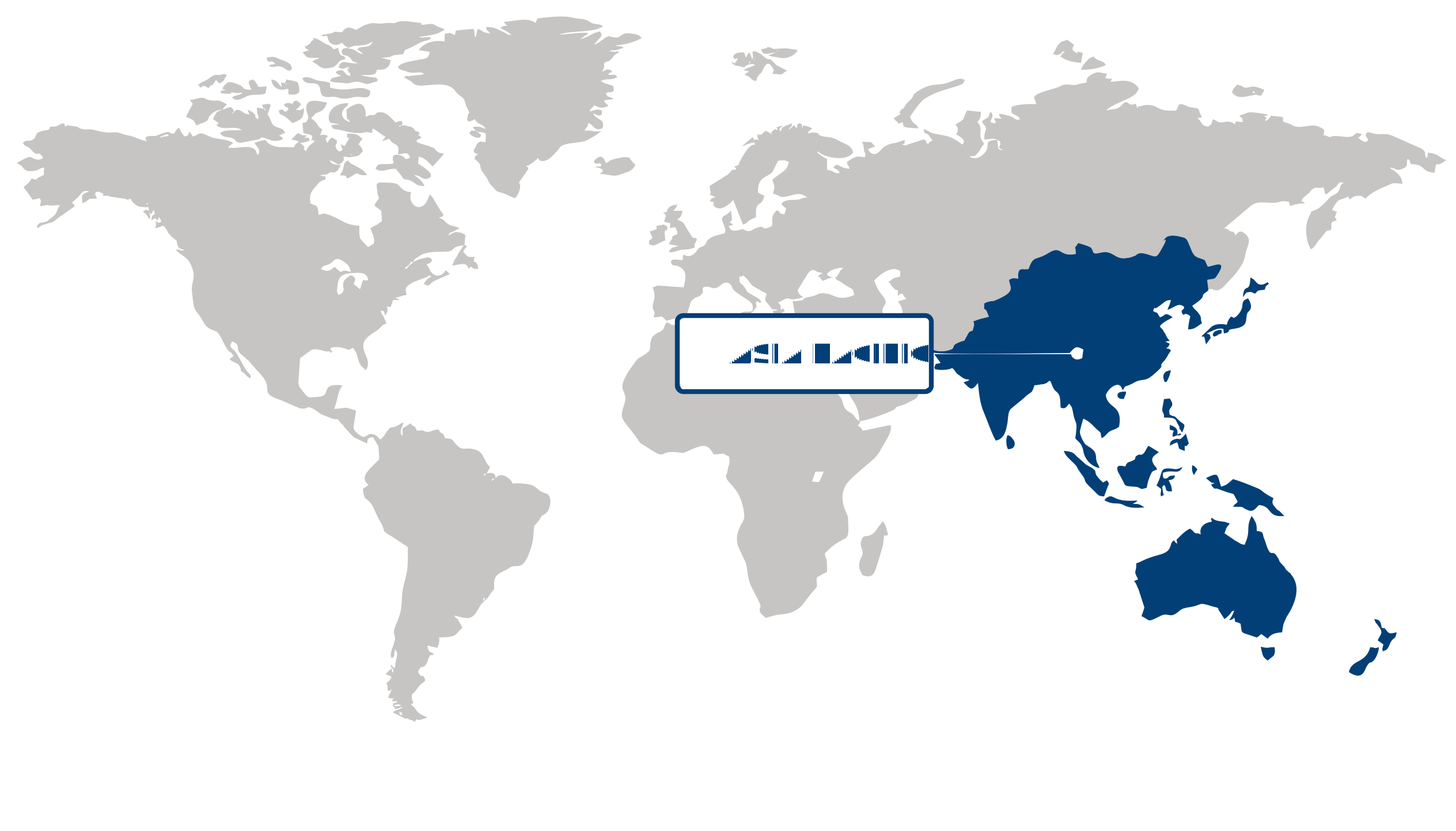
Asia Pacific (Largest Region)
Asia Pacific dominated the class 4 truck market, accounting for the largest share of 48.76% in 2026, driven by expanding logistics and transportation activity, rapid industrialization, and growing demand for commercial vehicles across developing economies. Increasing urbanization and the expansion of construction, manufacturing, retail distribution, and e-commerce are supporting demand for medium-duty transportation solutions. In addition, improvements in road infrastructure and the modernization of commercial vehicle fleets are strengthening the role of class 4 trucks in regional freight and last-mile distribution operations.
North America (Fastest-Growing Region)
North America is projected to register the fastest growth, supported by ongoing fleet replacement, increasing freight movement, and rising demand for efficient medium-duty vehicles across logistics, construction, and service applications. The region's focus on vehicle electrification, fuel efficiency, connectivity, and advanced safety technologies is encouraging investment in newer commercial truck platforms. Growing requirements for flexible transportation solutions in urban and regional delivery networks are also expected to reinforce adoption as fleet operators seek improved operational efficiency and lower ownership costs.
| Parameter | North America | Asia Pacific | Europe | Latin America | MEA |
|---|---|---|---|---|---|
| Innovation Hub i Scale Nascent Developing Advanced | |||||
| Cost-Sensitive Region i Scale Low Medium High | |||||
| Regulatory Environment i Scale Restrictive Neutral Supportive | |||||
| Demand Drivers i Scale Weak Moderate Strong | |||||
| Development Stage i Scale Emerging Developing Developed | |||||
| Adoption Rate i Scale Low Medium High | |||||
| New Entrants / Startups i Scale Sparse Moderate Dense | |||||
| Macro Indicators i Scale Weak Stable Strong |
Key Country Insights
United States 🇺🇸
Medium-Duty Fleet UpgradeThe U.S. market utilizes Class 4 trucks across utility services, regional distribution, and vocational transport applications. Commercial fleets in the U.S. increasingly evaluate electrification readiness, connected fleet solutions, and operational durability when renewing vehicle portfolios.
Germany 🇩🇪
Specialized Fleet IntegrationGermany positions Class 4 trucks within municipal fleets, industrial transport, and specialized commercial operations. Buyers in Germany emphasize engineering quality, safety innovation, and efficient vehicle performance to address increasingly complex operational requirements.
Japan 🇯🇵
Efficient Urban TransportJapan applies Class 4 trucks to urban logistics, infrastructure maintenance, and commercial fleet operations. Vehicle development in Japan focuses on compact dimensions, dependable performance, and technologies that improve productivity in congested operating environments.
South Korea 🇰🇷
Commercial Logistics RenewalSouth Korea continues expanding Class 4 truck deployments to strengthen logistics capacity and commercial transport efficiency. Fleet managers in South Korea prioritize advanced connectivity, fuel-efficient vehicle platforms, and compliance with evolving emissions expectations.
France 🇫🇷
Public Service MobilityFrance utilizes Class 4 trucks across municipal utilities, construction support, and regional commercial distribution. Procurement priorities in France increasingly include lower-emission powertrains, improved driver safety systems, and adaptable chassis suitable for multiple vocational applications.
Italy 🇮🇹
Vocational Transport FlexibilityItaly employs Class 4 trucks for construction support, regional deliveries, and specialized commercial transport services. Businesses in Italy increasingly value configurable vehicle platforms, efficient operating costs, and dependable performance across varied commercial applications.
Segment Leadership and Growth Trends
Class 4 Truck Market Share (%), by Fuel, 2026
Go beyond the chart, access full insights & data tables
Request Free Sample ReportFuel Segment Analysis: Diesel (Largest Segment) vs Hybrid Electric (Fastest-Growing Segment)
The class 4 truck market was dominated by the diesel segment, which captured 81.34% of the market share in 2026. Diesel-powered class 4 trucks remain the preferred choice for commercial operators because of their strong hauling capability, long operating range, and dependable performance in demanding transportation applications. Well-established fueling infrastructure and proven engine reliability continue to support widespread adoption across freight delivery, construction, and utility operations.
The hybrid electric segment is expected to register the fastest growth as fleet operators increasingly seek fuel-efficient alternatives that reduce operating costs and environmental impact. Advances in hybrid propulsion technologies, supportive regulatory initiatives, and growing emphasis on sustainable commercial transportation are encouraging broader adoption. These vehicles offer an effective balance between performance and efficiency, making them attractive for fleets transitioning toward lower-emission operations.
Application Segment Analysis: Freight Delivery (Largest & Fastest-Growing Segment)
The freight delivery segment led the class 4 truck market, accounting for 35.64% of the market share in 2026, while also remaining the fastest-growing application. Rising demand for regional cargo movement, expanding distribution networks, and continued growth in e-commerce have strengthened the requirement for medium-duty trucks capable of reliable and efficient goods transportation. Their adaptability across diverse delivery routes and commercial operations continues to reinforce both the segment's leadership and long-term growth potential.
GVWR Segment Analysis: Class 4a (Largest Segment) vs Class 4b (Fastest-Growing Segment)
The class 4a GVWR segment held the largest share of the class 4 truck market in 2026. Vehicles within this weight classification are widely utilized across commercial transportation, utility services, and regional distribution because they provide an effective balance between payload capacity, maneuverability, and operating efficiency. Their versatility enables businesses to address a broad range of transportation requirements while maintaining cost-effective fleet operations.
The class 4b GVWR segment is projected to witness the fastest growth as industries increasingly require higher payload capacities for specialized commercial applications. Growing infrastructure development, expanding logistics activities, and rising demand for vehicles capable of handling heavier loads are encouraging adoption within this weight category. Continuous improvements in vehicle performance and operational efficiency are expected to further support the segment's expansion.
| Segment | Sub-Segment | Largest Segment | Fastest Growing |
|---|---|---|---|
| Fuel | Diesel, Natural Gas, Hybrid Electric, Others | Diesel | Hybrid Electric |
| Application | Freight Delivery, Utility Services, Construction & Mining, Others | Freight Delivery | Freight Delivery |
| GVWR | Class 4a, Class 4b | Class 4a | Class 4b |
| Ownership | Fleet Operator, Independent Operator | Fleet Operator | Fleet Operator |
| Product | Large Walk-in, Box Truck, City Delivery, Others | Box Truck | Box Truck |
Competitive Landscape and Market Positioning
Major players in the class 4 truck market:
- PACCAR, Inc. (USA)
- Daimler Truck AG (Germany)
- Volvo Group (Sweden)
- Navistar International Corporation (USA)
- Ford Motor Company (USA)
- General Motors Company (USA)
- Isuzu Motors Ltd. (Japan)
- Hino Motors Ltd. (Japan)
- Tata Motors Limited (India)
- Scania AB (Sweden)
The Class 4 truck market is becoming more competitive as demand grows for vehicles that combine medium-duty capability with greater efficiency and application flexibility. Manufacturers are differentiating through enhanced chassis designs, improved safety features, and technology integration that helps operators optimize performance across delivery and specialized commercial activities. Competitive advantage is increasingly tied to the ability to provide reliable, customizable solutions that meet the varied requirements of fleet operators while adapting to broader transportation trends.
| Company | Market Share | Company Revenue | Revenue CAGR (%) | Product Portfolio | Geographic Presence | Innovation / R&D Focus | Strategic Developments |
|---|---|---|---|---|---|---|---|
| PACCAR Inc. (USA) | |||||||
| Daimler Truck AG (Germany) | |||||||
| Volvo Group (Sweden) | |||||||
| Navistar International Corporation (USA) | |||||||
| Ford Motor Company (USA) | |||||||
| General Motors Company (USA) | |||||||
| Isuzu Motors Ltd. (Japan) | |||||||
| Hino Motors Ltd. (Japan) | |||||||
| Tata Motors Limited (India) | |||||||
| Scania AB (Sweden) |
Industry Development/News
| Company Name | Date | Key Development |
|---|---|---|
| Horizon Motor | Jan-26 | Horizon Motor secured CARB approval for its 2026 Class 3–5 electric truck lineup, granting access to California and aligned zero-emission commercial vehicle markets to strengthen its regional footprint. |
| Bollinger Motors | Jan-24 | Bollinger Motors secured a USD 6 million commercial order for 40 units of its B4 Class 4 electric vehicle trucks, indicating tangible commercial adoption and order backlog growth for its zero-emission platform. |
| Morgan Truck Body | Mar-23 | Morgan Truck Body collaborated with Pritchard Commercial to develop and showcase a Class 4 electric parcel van featuring a custom full-height walk-through configuration, demonstrating new product integration capabilities for low-emission logistics fleets. |
Customize Your Report
Explore examples of how this report can be tailored to different research needs, including custom segments, additional topics or chapters, and related reports. Click a section of the wheel or its numbered marker to explore the available options.
Class 4 Truck Market — Custom Segments
| Segment | Sub-Segment |
|---|---|
| Fleet Size | Small Fleets, Medium Fleets, Large Fleets |
| Purchase Channel | Direct OEM Sales, Dealer Sales, Fleet Leasing & Rental |
| End-User Industry | Retail & E-commerce, Utilities & Telecommunications, Food & Beverage Distribution, Parcel & Logistics, Construction & Other Services |
Class 4 Truck Market — Custom TOC
| Custom Chapter | Custom Details |
|---|---|
| Vocational Application Opportunity Assessment |
|
| Alternative Powertrain Transition Analysis |
|
| Fleet Lifecycle Cost Benchmarking |
|
Need a different cut of the data?
Request Custom ResearchWhat is the market valuation of class 4 truck?
What are the growth projections for the class 4 truck industry?
How is e-commerce expansion influencing fleet investment in the class 4 truck market?
Why are rental and leasing models becoming important for class 4 truck fleet expansion?
Why does diesel remain the leading fuel segment in the class 4 truck market?
Which GVWR segment is growing the fastest in the class 4 truck market?
Why does Asia Pacific lead the Class 4 truck market?
What is driving faster Class 4 truck market growth in North America?
Which companies dominate the class 4 truck landscape?
Our Clients
"The team surpassed our expectations with the report depth. The actionable insights provided proved crucial in navigating market challenges."
Tata Motors
"We found the report to be very informative. The expertise and attention to market nuances significantly influenced our business direction."
DENSO Corporation
"The consumer survey findings were quite good. We now have a clearer picture of the customer churning and retention strategy."
HL Mando
Our Research Team & Methodology
Every Fundamental Business Insights report is built by a dedicated vertical research team, validated through a structured primary-and-secondary methodology, and reviewed for accuracy before it reaches you.
Research Team Overview
Prepared by the Automotive & Transportation Research Team
Delivery
Published
Demand
Available
Support
Trust & Compliance
Research Domains
10 coverage areasResearch Intelligence
| Source | Reference |
|---|---|
| International Organization of Motor Vehicle Manufacturers (OICA) | www.oica.net |
| SAE International | www.sae.org |
| International Energy Agency (IEA) | www.iea.org |
| International Transport Forum (ITF) | www.itf-oecd.org |
| International Road Federation (IRF) | www.irf.global |
| International Organization for Standardization (ISO) | www.iso.org |
| United Nations Economic Commission for Europe (UNECE) | unece.org |
| National Highway Traffic Safety Administration (NHTSA) | www.nhtsa.gov |
| U.S. Department of Transportation (USDOT) | www.transportation.gov |
| European Automobile Manufacturers' Association (ACEA) | www.acea.auto |
| Society of Indian Automobile Manufacturers (SIAM) | www.siam.in |
| International Air Transport Association (IATA) | www.iata.org |
| International Civil Aviation Organization (ICAO) | www.icao.int |
| International Maritime Organization (IMO) | www.imo.org |
| International Union of Railways (UIC) | uic.org |
| American Public Transportation Association (APTA) | www.apta.com |
| International Federation of Robotics (IFR) | ifr.org |
| CharIN | www.charin.global |
| World Shipping Council | www.worldshipping.org |
| International Federation of Freight Forwarders Associations (FIATA) | fiata.org |
Research Workflow & Quality Assurance
Data Collection
Verified information gathered through primary and secondary research.
Data Triangulation
Cross-validation using multiple independent data sources.
Forecast Modelling
Market estimates developed using historical trends and analytical models.
Analyst Validation
Findings reviewed by domain experts for accuracy and consistency.
Editorial & Quality Review
Final editorial, quality, and compliance checks before publication.
Final Publication
Released after successful completion of the internal review process.
Report Coverage
📊 Market Assessment
- Market Size & Forecast
- Market Segmentation
- Regional Analysis
- Growth Drivers & Challenges
- Market Dynamics
🏢 Competitive Intelligence
- Competitive Landscape
- Company Profiles
- Competitive Benchmarking
- Mergers & Acquisitions
- Market Share Analysis or Key Company Strategies
🔍 Strategic Analysis
- Value Chain Analysis
- Porter's Five Forces
- PESTLE Analysis
- Pricing Trends
- Supply-Demand Analysis
🚀 Future Outlook
- Technology Landscape
- Regulatory Landscape
- Investment & Funding Landscape
- Emerging Opportunities
- Future Market Outlook
Have a question about this report or need a custom scope?
Request Customization