Cladding Market Size & Growth Forecast 2027–2036, By Segments (Application, Product), Regional Demand Trends (North America, Asia Pacific, Europe), Key Country Insights (U.S., Japan, South Korea, Germany, France, Italy), and Competitive Landscape
Market Size and Growth Outlook
Cladding Market size was worth USD 289.4 billion in 2026 and is expected to grow at a 7.41% CAGR between 2027 and 2036, exceeding USD 591.49 billion by 2036. The industry revenue for 2027 is assessed at USD 307.46 billion.
Get more details on this report
Request Free Sample ReportCladding Market Intelligence Snapshot
Regional Market Dynamics
- Asia Pacific held a 36.68% market share in 2026, supported by extensive residential, commercial, and industrial construction activity that sustains large-scale demand for cladding materials.
- Asia Pacific is projected to grow at an 8.36% CAGR as urban development, infrastructure investment, and rising demand for modern building envelopes increase cladding adoption across new and renovation projects.
Segment Momentum
- Offices lead with a 36.04% share due to consistent demand for durable façade systems that balance aesthetics, weather protection, and long-term performance across large-scale commercial building envelopes.
- Residential applications are growing fastest as renovation activity and new housing projects increase demand for cladding that enhances aesthetics while offering practical installation and maintenance benefits.
Market Expansion Drivers
- Rising demand for energy-efficient building envelopes driving façade modernization projects.
- Urban renovation and retrofitting of aging infrastructure accelerating cladding system adoption.
- Growth in prefabricated lightweight cladding improving installation efficiency and construction speed.
Leading Market Participants
- Key companies in the cladding market include Kingspan Group plc (Ireland), Trespa International B.V. (Netherlands), CENTRIA International (United States), OmniMax International, Inc. (United States), The Cladding Corp (United States), SFS Group AG (Switzerland), Shildan, Inc. (United States), CAREA Group (France), GB Architectural Cladding Products Ltd. (United Kingdom), Avenere Cladding LLC (United States).
Global Market Forecast Snapshot
Market Outlook
- 2026 Market Size: USD 289.4 billion
- 2027 Estimated Market Size: USD 307.46 billion.
- Projected Market Size: USD 591.49 billion by 2036
- Growth Forecast: 7.41% CAGR (2027-2036)
Regional and Segment Outlook
- Leading Regional Market: Asia Pacific
- High-Growth Regional Hub: Asia Pacific
- Core Revenue Segment: Offices (Application) | Terracotta (Product)
- Emerging Opportunity Segment: Residential (Application) | Fiber Cement (Product)
Market Growth Drivers and Industry Trends
Rising demand for energy-efficient building envelopes driving façade modernization projects
Growing emphasis on energy-efficient buildings will drive the cladding market as property owners, developers, and construction stakeholders seek façade systems that contribute to improved thermal performance and building envelope efficiency. Cladding can form an important component of modern façade design by supporting insulation strategies, weather protection, and improved control of heat transfer across the building envelope. Rising attention to energy consumption in commercial, residential, and institutional properties is encouraging upgrades to outdated façade assemblies and the integration of materials designed to complement energy-efficient construction practices. Modern cladding solutions also provide flexibility in material selection and façade configuration, allowing architects and developers to address both functional and aesthetic requirements while improving the overall performance of building exteriors.
Urban renovation and retrofitting of aging infrastructure accelerating cladding system adoption
A growing focus on urban redevelopment and the modernization of aging buildings is strengthening demand in the cladding market as existing structures require improvements to exterior performance, appearance, and weather resistance. Aging façades can experience deterioration, inefficient insulation, and outdated architectural characteristics, encouraging property owners to undertake renovation and retrofit projects rather than relying solely on new construction. Cladding systems can be incorporated into these projects to refresh exterior surfaces while supporting improvements to the building envelope. In densely developed urban areas, façade modernization can also enhance the visual quality and functional performance of older properties without requiring complete structural replacement. The increasing need to upgrade commercial buildings, residential complexes, institutional properties, and other aging assets is consequently creating sustained applications for contemporary cladding solutions.
Growth in prefabricated lightweight cladding improving installation efficiency and construction speed
Increasing adoption of prefabricated and lightweight construction techniques is supporting the medical lifting sling market through faster installation requirements and greater demand for efficient façade assembly. Prefabricated cladding components can be manufactured under controlled conditions and transported to construction sites for relatively streamlined installation, helping reduce on-site fabrication activities and simplify project coordination. Lightweight systems can also reduce handling requirements and provide greater flexibility during façade installation, particularly in projects where construction schedules and site accessibility are important considerations. The integration of modular design, standardized components, and off-site fabrication is further enabling contractors to coordinate cladding installation with broader construction activities, while lightweight materials can accommodate diverse architectural configurations and façade designs.
| Growth Driver | Impact on CAGR | Regulatory Influence | Geographic Relevance | Adoption Rate | Impact Timeline |
|---|---|---|---|---|---|
| Rising demand for energy-efficient building envelopes driving façade modernization projects | 2.00% | Moderate | Asia Pacific, North America, Europe | High | Near Term |
| Urban renovation and retrofitting of aging infrastructure accelerating cladding system adoption | 1.80% | Moderate | Europe, North America, Asia Pacific | High | Mid Term |
| Growth in prefabricated lightweight cladding improving installation efficiency and construction speed | 1.60% | Low | Asia Pacific, Middle East & Africa | Medium | Mid Term |
Unlock insights tailored to your business with our bespoke market research solutions.
Click to get your customized report now.
Regional Demand Dynamics
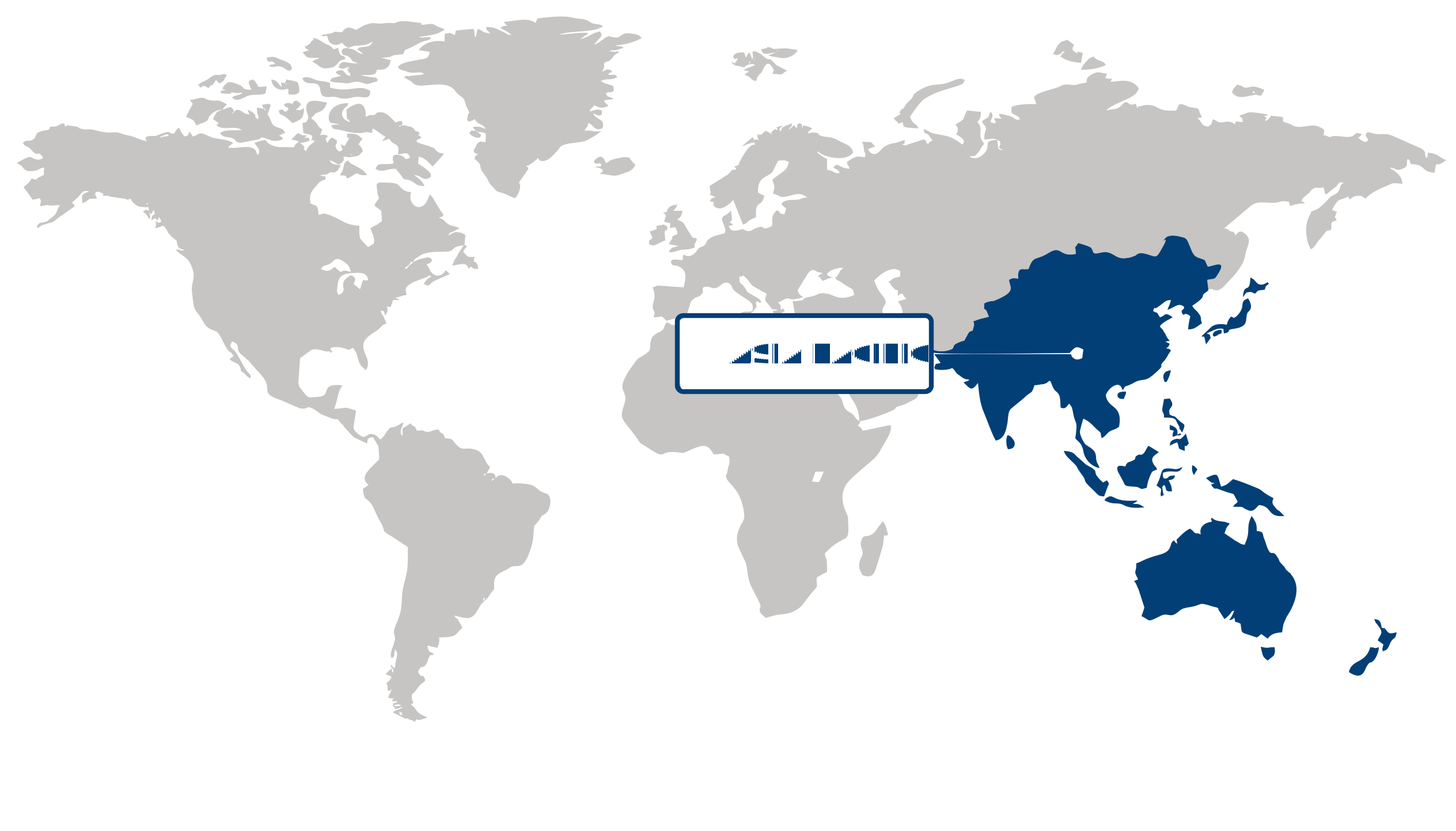
Asia Pacific (Largest & Fastest-Growing Region)
Asia Pacific dominated the cladding market and represented the largest share of 36.68% in 2026, while also serving as the fastest-growing region, supported by rapid urbanization, expanding construction activity, and continued investment in residential, commercial, and industrial infrastructure. Growing demand for energy-efficient and visually appealing building exteriors is encouraging the use of modern cladding systems that provide weather protection, thermal performance, and architectural flexibility. Infrastructure development and urban redevelopment are further creating opportunities for both new-build and renovation applications. In addition, expanding manufacturing capabilities, improving construction supply chains, and increasing adoption of advanced building materials are strengthening regional market development. Rising attention to building durability, energy efficiency, and sustainable construction practices is also encouraging developers and architects to incorporate higher-performance cladding solutions into a wider range of projects.
| Parameter | North America | Asia Pacific | Europe | Latin America | MEA |
|---|---|---|---|---|---|
| Innovation Hub i Scale Nascent Developing Advanced | |||||
| Cost-Sensitive Region i Scale Low Medium High | |||||
| Regulatory Environment i Scale Restrictive Neutral Supportive | |||||
| Demand Drivers i Scale Weak Moderate Strong | |||||
| Development Stage i Scale Emerging Developing Developed | |||||
| Adoption Rate i Scale Low Medium High | |||||
| New Entrants / Startups i Scale Sparse Moderate Dense | |||||
| Macro Indicators i Scale Weak Stable Strong |
Key Country Insights
Germany 🇩🇪
Energy Retrofit MaterialsGermany is using cladding systems extensively in building retrofits aimed at improving insulation and reducing energy consumption. Demand is particularly strong for high-performance façade materials that align with stringent building efficiency and environmental standards.
France 🇫🇷
Low-Carbon Renovation FocusFrance is encouraging the use of cladding systems in building refurbishment projects designed to improve environmental performance. The market favors materials that support energy conservation objectives while maintaining architectural quality in both new and existing structures.
Italy 🇮🇹
Heritage-Compatible FacadesItaly's cladding market is balancing modern construction requirements with the need to preserve architectural character in renovation projects. Demand is growing for versatile materials that provide improved insulation and design flexibility across residential and commercial applications.
Japan 🇯🇵
Resilient Façade SolutionsJapan prioritizes cladding materials that provide durability, lightweight construction, and resilience against seismic activity and harsh weather conditions. Manufacturers are focusing on technologically advanced façade systems suited to dense urban construction projects.
South Korea 🇰🇷
Architectural Design DemandSouth Korea's cladding market is supported by modern commercial developments and urban redevelopment projects seeking visually distinctive building exteriors. Developers are increasingly adopting premium façade materials that combine aesthetics with energy performance.
United States 🇺🇸
Sustainable Building UpgradesThe U.S. cladding market is benefiting from renovation activity and demand for energy-efficient building envelopes. Commercial and residential developers are increasingly selecting materials that improve thermal performance, weather resistance, and compliance with evolving sustainability requirements.
Segment Leadership and Growth Trends
Cladding Market Share (%), by Application, 2026
Go beyond the chart, access full insights & data tables
Request Free Sample ReportApplication Segment Analysis: Offices (Largest Segment) vs Residential (Fastest-Growing Segment)
Offices accounted for the largest share of the cladding market at 36.04% in 2026, supported by the extensive use of exterior cladding to enhance building appearance, weather resistance, thermal performance, and long-term durability. Commercial properties often place strong emphasis on contemporary architectural finishes and energy-efficient building envelopes, making cladding an important component of office construction and renovation projects. Increasing attention to sustainable building practices and visually distinctive facades is further supporting demand across commercial developments.
Residential applications are advancing more rapidly as homeowners and residential developers increasingly prioritize exterior durability, energy performance, and architectural appeal. Cladding provides an opportunity to improve weather protection while offering a wide selection of textures, finishes, and design styles suited to modern housing. Growing interest in energy-efficient homes and low-maintenance exterior materials is also encouraging the adoption of cladding in residential construction, particularly as builders seek solutions that combine functional performance with aesthetic flexibility.
Product Segment Analysis: Terracotta (Largest Segment) vs Fiber Cement (Fastest-Growing Segment)
Terracotta held the largest share of the cladding market at 37.84% in 2026, reflecting its strong combination of architectural appeal, durability, and suitability for distinctive building facades. Its natural appearance and broad design potential make terracotta attractive for projects where aesthetic character is an important consideration alongside weather resistance. Growing interest in durable and visually appealing building materials is helping sustain its use across contemporary architectural projects, while its association with long-lasting facade solutions further supports market acceptance.
Fiber cement is experiencing faster growth as construction stakeholders increasingly seek versatile cladding materials that combine durability, design flexibility, and relatively straightforward maintenance. Fiber cement can replicate the appearance of other exterior materials while providing resistance to common environmental stresses, making it suitable for a broad range of building designs. Its applicability across residential and commercial construction, together with rising interest in practical and cost-conscious facade solutions, is strengthening its adoption.
| Segment | Sub-Segment | Largest Segment | Fastest Growing |
|---|---|---|---|
| Application | Residential, Industrial, Commercial, Offices, Institutional | Offices | Residential |
| Product | Steel, Aluminum, Composite Material, Fiber Cement, Terracotta, Ceramic, Others | Terracotta | Fiber Cement |
Competitive Landscape and Market Positioning
Key companies in the cladding market:
1. Kingspan Group plc (Ireland)
2. Trespa International B.V. (Netherlands)
3. CENTRIA International (United States)
4. OmniMax International Inc. (United States)
5. The Cladding Corp (United States)
6. SFS Group AG (Switzerland)
7. Shildan Inc. (United States)
8. CAREA Group (France)
9. GB Architectural Cladding Products Ltd. (United Kingdom)
10. Avenere Cladding LLC (United States)
A strong shift toward energy-efficient and weather-resistant building envelopes is shaping material innovation across the sector. The cladding market is seeing increased use of composite and eco-friendly materials designed for both durability and aesthetic flexibility. Architectural demand for customizable façades is encouraging more diverse product introductions. Technological advancements in fabrication methods are enabling improved structural performance while supporting sustainability-driven construction practices.
| Company | Market Share | Company Revenue | Revenue CAGR (%) | Product Portfolio | Geographic Presence | Innovation / R&D Focus | Strategic Developments |
|---|---|---|---|---|---|---|---|
| Kingspan Group plc (Ireland) | |||||||
| Trespa International B.V. (Netherlands) | |||||||
| CENTRIA International (United States) | |||||||
| OmniMax International Inc. (United States) | |||||||
| The Cladding Corp (United States) | |||||||
| SFS Group AG (Switzerland) | |||||||
| Shildan Inc. (United States) | |||||||
| CAREA Group (France) | |||||||
| GB Architectural Cladding Products Ltd. (United Kingdom) | |||||||
| Avenere Cladding LLC (United States). |
Industry Development/News
| Company Name | Date | Key Development |
|---|---|---|
| QBM | Feb-26 | QBM expanded its façade portfolio by integrating ROCKWOOL Rockpanel cladding solutions. This strategic move strengthens the company's building materials offering within the Irish market and enhances its competitive positioning in the architectural cladding and roofing supply segment. |
| Performance Contracting Group | Feb-26 | Performance Contracting Group acquired LYMO Construction, a move that expands its architectural cladding and building envelope capabilities across the United States. The integration provides the firm with increased scale and turnkey contractor services, bolstering its façade solutions portfolio. |
| Optomec | Jan-26 | Optomec enhanced its turbine repair capabilities by integrating Siemens SINUMERIK ONE CNC controls with its proprietary AutoClad laser cladding software. This development enables automated, digital-native cladding processes specifically designed for precision manufacturing and aerospace component refurbishment. |
| Global Nuclear Fuel | Jan-26 | Global Nuclear Fuel launched its GNF4 next-generation boiling water reactor fuel design and commenced production. The initiative focuses on material advancement to improve the performance and reliability of nuclear fuel cladding systems, addressing critical safety and efficiency requirements in nuclear power generation. |
| Wall Works | Jan-26 | Wall Works, a private equity-backed platform, acquired specialty contractor CID Construction to expand its network of wall and ceiling contractors. The acquisition strengthens the company’s regional presence in the architectural cladding and interior building systems market, providing additional operational capacity. |
| McGill and Partners | Dec-25 | McGill and Partners finalized a specialized fire safety reinsurance facility designed to improve insurance availability for higher-risk buildings undergoing remediation. This development provides critical financial support for building safety and facade refurbishment projects, addressing insurance capacity gaps in the market. |
Customize Your Report
Explore examples of how this report can be tailored to different research needs, including custom segments, additional topics or chapters, and related reports. Click a section of the wheel or its numbered marker to explore the available options.
Cladding Market — Custom Segments
| Segment | Sub-Segment |
|---|---|
| Building Height | Low-Rise Buildings, Mid-Rise Buildings, High-Rise Buildings |
| Insulation Integration | Non-Insulated Cladding, Cladding with Integrated Insulation, Cladding with External Insulation Systems |
| Distribution Channel | Direct Sales, Specialized Building Material Distributors, General Construction Material Distributors, Retail and Online Channels |
Cladding Market — Custom TOC
| Custom Chapter | Custom Details |
|---|---|
| Green Building Adoption Analysis |
|
| Retrofit Market Opportunity Mapping |
|
| Architectural Trend Impact Assessment |
|
Need a different cut of the data?
Request Custom ResearchHow much is the cladding market worth?
How is the cladding industry expected to grow over the next 10 years?
How are energy-efficiency requirements reshaping demand in the cladding market?
Why is prefabrication becoming important in cladding system adoption?
Why do office applications hold the largest share in the cladding market?
Which application segment is driving the fastest growth in the cladding market?
Why does Asia Pacific dominate the cladding market?
What is driving Asia Pacific's rapid growth in the cladding market?
What are the key competitors in the cladding landscape?
Our Clients
"Your insights on workforce structures were spot-on. The analysis on mid-to-senior level roles validated some of our hiring decisions and highlighted gaps."
Ateliers De France
"The report gave us insights on competitors in the market. It helped our team refine our bidding strategy for upcoming contracts."
Clark Construction
"The reports provided a deep dive into market trends, and competitive landscape. The strategic insights and recommendations have been very helpful."
Rudolph and Sletten
Our Research Team & Methodology
Every Fundamental Business Insights report is built by a dedicated vertical research team, validated through a structured primary-and-secondary methodology, and reviewed for accuracy before it reaches you.
Research Team Overview
Prepared by the Construction & Manufacturing Research Team
Delivery
Published
Demand
Available
Support
Trust & Compliance
Research Domains
10 coverage areasResearch Intelligence
| Source | Reference |
|---|---|
| International Organization for Standardization (ISO) | www.iso.org |
| ASTM International | www.astm.org |
| National Institute of Standards and Technology (NIST) | www.nist.gov |
| International Code Council (ICC) | www.iccsafe.org |
| American Concrete Institute (ACI) | www.concrete.org |
| American Institute of Steel Construction (AISC) | www.aisc.org |
| Construction Industry Institute (CII) | www.construction-institute.org |
| Associated General Contractors of America (AGC) | www.agc.org |
| Association of Equipment Manufacturers (AEM) | www.aem.org |
| Building Owners and Managers Association (BOMA) | www.boma.org |
| American Society of Civil Engineers (ASCE) | www.asce.org |
| National Ready Mixed Concrete Association (NRMCA) | www.nrmca.org |
| International Facility Management Association (IFMA) | www.ifma.org |
| World Green Building Council (WorldGBC) | worldgbc.org |
| International Federation of Consulting Engineers (FIDIC) | fidic.org |
| International Labour Organization (ILO) | www.ilo.org |
| American Society of Mechanical Engineers (ASME) | www.asme.org |
| Society of Manufacturing Engineers (SME) | www.sme.org |
| National Association of Home Builders (NAHB) | www.nahb.org |
| European Construction Industry Federation (FIEC) | www.fiec.eu |
Research Workflow & Quality Assurance
Data Collection
Verified information gathered through primary and secondary research.
Data Triangulation
Cross-validation using multiple independent data sources.
Forecast Modelling
Market estimates developed using historical trends and analytical models.
Analyst Validation
Findings reviewed by domain experts for accuracy and consistency.
Editorial & Quality Review
Final editorial, quality, and compliance checks before publication.
Final Publication
Released after successful completion of the internal review process.
Report Coverage
📊 Market Assessment
- Market Size & Forecast
- Market Segmentation
- Regional Analysis
- Growth Drivers & Challenges
- Market Dynamics
🏢 Competitive Intelligence
- Competitive Landscape
- Company Profiles
- Competitive Benchmarking
- Mergers & Acquisitions
- Market Share Analysis or Key Company Strategies
🔍 Strategic Analysis
- Value Chain Analysis
- Porter's Five Forces
- PESTLE Analysis
- Pricing Trends
- Supply-Demand Analysis
🚀 Future Outlook
- Technology Landscape
- Regulatory Landscape
- Investment & Funding Landscape
- Emerging Opportunities
- Future Market Outlook
Have a question about this report or need a custom scope?
Request Customization