Circulating Fluidized Bed Boilers Market Size & Forecasts 2026-2035, By Segments (Product, Fuel Type, Application, Capacity), Growth Opportunities, Innovation Landscape, Regulatory Shifts, Strategic Regional Insights (U.S., Japan, China, South Korea, UK, Germany, France), and Competitive Dynamics (General Electric, Mitsubishi Hitachi Power Systems, Doosan Heavy Industries, Babcock & Wilcox, Alstom Power)
Market Size and Growth Outlook
Circulating Fluidized Bed Boilers Market size is anticipated to rise from USD 837.84 million in 2025 to USD 1.34 billion by 2035, reflecting a CAGR surpassing 4.8% over the forecast horizon of 2026-2035. The estimated revenue for 2026 is USD 872.53 million.
Get more details on this report
Request Free Sample ReportCirculating Fluidized Bed Boilers Market Intelligence Snapshot
Regional Market Dynamics
Segment Momentum
Market Expansion Drivers
Leading Market Participants
Global Market Forecast Snapshot
Market Outlook
Regional and Segment Outlook
Market Growth Drivers and Industry Trends
The increasing pressure to minimize emissions and improve operational efficiency has heightened demand for advanced coal combustion technologies in the circulating fluidized bed boilers market. Technologies that allow lower combustion temperatures significantly reduce pollutants such as NOx and SOx, meeting stringent environmental regulations imposed by agencies like the U.S. Environmental Protection Agency (EPA). For example, Mitsubishi Power’s recent launch of ultra-low emission fluidized bed boilers underscores innovation that addresses evolving regulatory and sustainability demands. This driver opens strategic avenues for incumbents to enhance existing product portfolios and for new entrants to introduce breakthrough solutions focused on fuel flexibility and emission control. With governments tightening air quality standards globally, the market is poised to integrate more efficient combustion solutions to sustain coal’s role amid increasing environmental scrutiny.
Industrial Expansion in Emerging Economies
Rapid industrialization and urbanization in countries like India and Southeast Asia are fueling energy demand growth, thereby expanding opportunities in the circulating fluidized bed boilers market. The International Energy Agency (IEA) highlights that emerging economies prioritize reliable, scalable power generation infrastructure, encouraging adoption of fluidized bed technology for its fuel adaptability and operational resilience. Companies such as Babcock & Wilcox are capitalizing on this trend by securing contracts for industrial boilers tailored to diverse fuel sources prevalent in these regions. This industrial expansion drives demand for cost-effective and efficient boilers, creating avenues for suppliers to customize products for region-specific fuels and conditions. As infrastructure investments persist, players positioned to support expanding industrial power needs will benefit from sustained market momentum.
Long-Term Shift Toward Waste-to-Energy Plants
The global pivot toward circular economy principles and waste management reforms is accelerating demand for circulating fluidized bed boilers in waste-to-energy (WTE) applications. Governments and organizations like the European Environment Agency (EEA) promote WTE as a sustainable method to reduce landfill use while generating energy from municipal solid waste. Companies such as Valmet have showcased their fluidized bed boilers’ capabilities to process diverse waste streams efficiently, aligning with regulatory frameworks that encourage renewable energy integration. This strategic shift provides both incumbents and startups a pathway to diversify offerings beyond traditional coal, tapping into rising waste valorization efforts. The market in this segment is expected to evolve steadily as regulatory and environmental priorities drive long-term adoption of fluidized bed technology in WTE projects worldwide.
Industry Restraints:
Environmental Emission Regulations and Compliance Costs
Stringent environmental standards, particularly regarding NOx and SOx emissions, notably constrain the circulating fluidized bed (CFB) boilers market by increasing operational complexity and capital expenditure. Regulatory authorities like the U.S. Environmental Protection Agency (EPA) impose rigorous emission limits that compel manufacturers and operators to invest in advanced emission control technologies, such as selective catalytic reduction (SCR) systems. This elevates upfront costs and operational challenges, deterring some utilities, especially smaller operators, from adopting or upgrading CFB technologies. Consequently, firms like Babcock & Wilcox highlight compliance investments as a significant barrier in their annual investor presentations. These regulatory burdens disproportionately affect new market entrants lacking the resources for compliance R&D, slowing the pace of technology diffusion. Given ongoing global tightening of emission norms, particularly in Asia and Europe, regulatory compliance will remain a pivotal restraint, necessitating continuous innovation in cost-effective emission controls and strategic partnerships to sustain market growth.
High Capital Intensity and Long Payback Periods
The significant initial investment required for circulating fluidized bed boilers, coupled with extended payback periods, serves as a critical market barrier. According to International Energy Agency (IEA) analyses, CFB installations often entail higher upfront costs relative to conventional boilers due to specialized design and materials capable of handling diverse fuel types and high combustion temperatures. This deters investors and project developers who face uncertain fuel price volatility and shifting energy policies, impacting return on investment timelines. Established players like Alstom have acknowledged these financial constraints in earnings reports, emphasizing project financing challenges. For new entrants, securing capital is further complicated by unfamiliarity with the technology’s lifecycle costs. Unless financing instruments evolve or cost structures decline through innovation, the capital-intensive nature of CFB boilers will continue to limit market expansion, particularly in emerging economies where access to affordable investment capital remains constrained.
| Growth Driver | Impact on CAGR | Regulatory Influence | Geographic Relevance | Adoption Rate | Impact Timeline |
|---|---|---|---|---|---|
| Rising demand for efficient coal combustion technologies | 1.50% | Short term (≤ 2 yrs) | APAC, MEA | Medium | Moderate |
| Industrial expansion in emerging economies | 1.00% | Medium term (2–5 yrs) | APAC, Latin America | Low | Moderate |
| Long-term shift toward waste-to-energy plants | 0.80% | Long term (5+ yrs) | Europe, APAC | High | Slow |
Unlock insights tailored to your business with our bespoke market research solutions.
Click to get your customized report now.
Regional Demand Dynamics
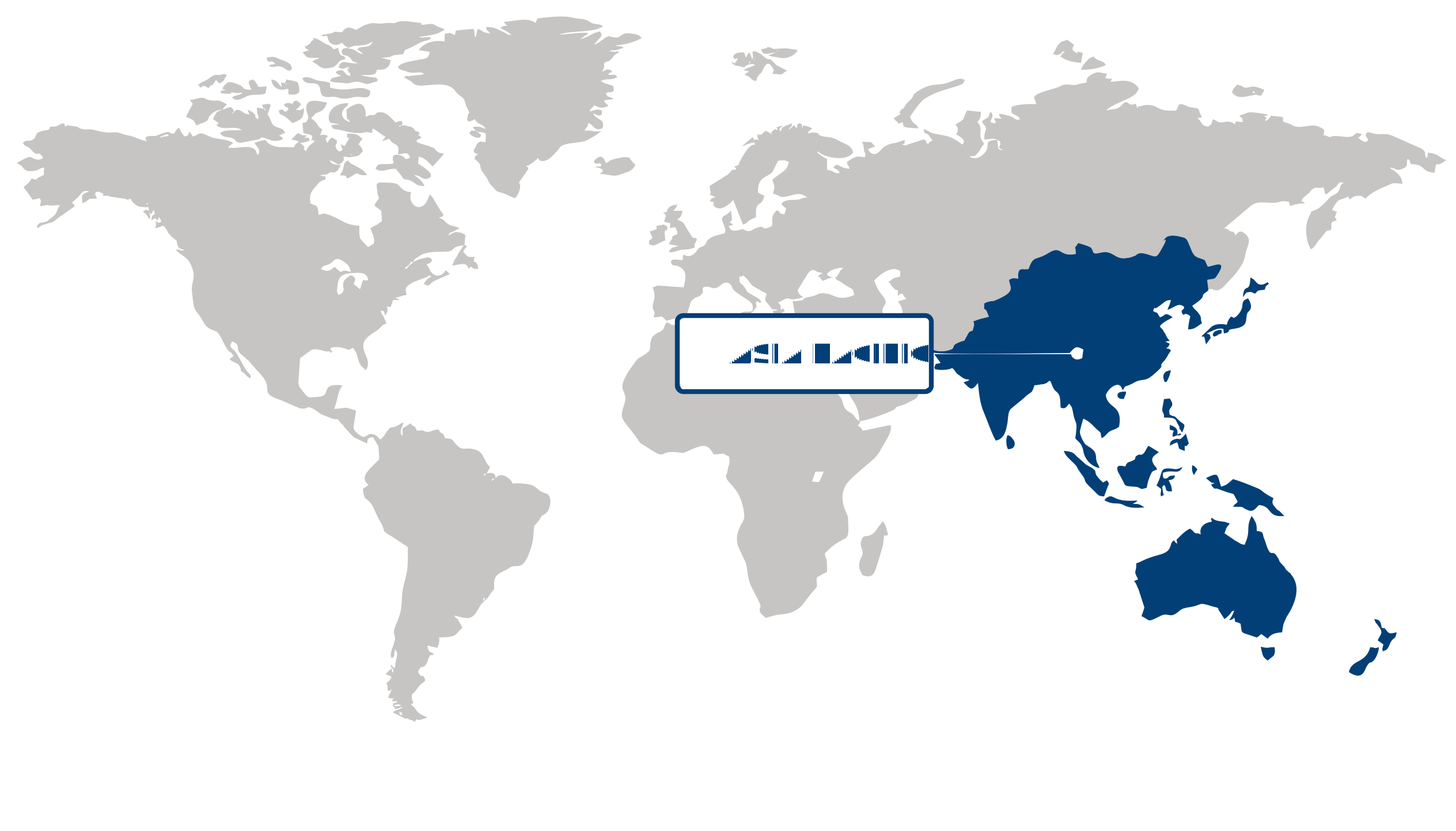
Asia Pacific captured over 40.9% of the global circulating fluidized bed boilers market in 2025, positioning it as the largest and fastest-growing region with a 5.76% CAGR. This leadership is driven primarily by escalating demand for coal and biomass-fired power generation, coupled with a regional commitment to adopting advanced, low-emission boiler technologies. Countries across Asia Pacific are increasingly prioritizing efficiency upgrades to meet stringent environmental standards, as evidenced by the South Korean Ministry of Trade, Industry and Energy’s recent initiatives promoting green power solutions. Furthermore, enhanced operational capabilities and robust infrastructure investments by major firms like BHEL reinforce the region’s competitive advantage. Looking ahead, Asia Pacific’s growing industrial base and government-backed sustainability mandates underscore its vast potential for circulating fluidized bed boiler market expansion.
Japan serves as a pivotal hub in Asia Pacific’s circulating fluidized bed boilers market, leveraging its advanced technological ecosystem and regulatory focus on reducing carbon emissions. The government’s Ministry of Economy, Trade and Industry (METI) has actively supported innovative boiler designs that optimize fuel flexibility and minimize pollutants, catering to Japan’s energy transition goals. Corporations such as Mitsubishi Hitachi Power Systems highlight this trend with product launches aimed at integrating biomass co-firing capabilities. Japan’s sophisticated demand for cleaner and more adaptable power generation solutions underlines its integral role in strengthening the regional market’s trajectory toward sustainability and operational excellence.
China anchors Asia Pacific’s circulating fluidized bed boilers market through sustained coal and biomass-fired power expansion amidst ambitious environmental reforms. The National Energy Administration’s policies encouraging cleaner coal technologies and emissions control have prompted major players like Shanghai Electric to deploy cutting-edge circulating fluidized bed boilers focusing on efficiency and compliance. This dynamic reflects China’s balancing act between meeting fast-paced energy demands and enforcing carbon reduction commitments. Consequently, China’s scale and regulatory rigor continue to propel Asia Pacific’s dominance in circulating fluidized bed boilers, offering strategic opportunities for stakeholders targeting integrated, low-emission power solutions.
North America Market Analysis:
North America held a substantial share in the circulating fluidized bed boilers market, driven by its advanced industrial infrastructure and stringent environmental regulations that prioritize cleaner energy solutions. The region benefits from increasing investments in retrofit and modernization projects of existing power plants to reduce emissions and improve efficiency. The U.S. Environmental Protection Agency’s (EPA) Clean Air Act programs have accelerated the adoption of circulating fluidized bed technology due to its ability to burn a variety of fuels with lower sulfur dioxide and nitrogen oxide emissions. Furthermore, North America’s emphasis on sustainability, coupled with the availability of a skilled workforce and digital transformation in power plant operations, continues to enhance market adoption. These factors position North America as a significant hub with enduring opportunities for circulating fluidized bed boilers, especially as energy sectors aim to balance reliability and environmental compliance.
The U.S. serves as the pivotal market within North America, where government incentives and regulatory frameworks have encouraged utilities to invest in circulating fluidized bed boilers as part of their transition to cleaner technology. The shift towards co-firing biomass with coal and the replacement of outdated boilers aligns with federal policies promoted by the Department of Energy and initiatives such as the Coal Combustion Residuals rule by the EPA. Energy companies like American Electric Power have publicly announced modernization plans incorporating circulating fluidized bed systems to optimize fuel flexibility and emission reductions. This regulatory support and technological advancement highlight the U.S.’s critical role in reinforcing North America’s leadership in this market and underscore the country’s continued strategic importance for investors and technology providers targeting sustainable energy infrastructure upgrades.
Europe Market Trends:
Europe maintained a notable presence in the circulating fluidized bed boilers market, driven by increasing adoption of cleaner energy technologies aligned with stringent environmental regulations. The region’s commitment to reducing carbon emissions under frameworks like the European Green Deal has accelerated investments in advanced boiler technologies offering fuel flexibility and lower emissions, as highlighted by Siemens Energy’s recent project deployments. Moreover, Europe's diversification of energy sources and modernization of industrial infrastructure support steady growth, with key players benefiting from mature supply chains and advanced manufacturing capabilities in countries such as Germany and France. The rising preference for sustainable industrial processes combined with evolving regulatory landscapes and digital integration efforts enhances operational efficiency, positioning Europe as a strategically vital market. Looking ahead, the region’s solid policy backing and technological advancement pipelines promise significant opportunities in circulating fluidized bed boilers, especially in sectors prioritizing emission compliance and operational resilience.
Germany serves as a central growth hub within Europe’s circulating fluidized bed boilers market, leveraging its robust industrial base and proactive climate policies. The country’s Energiewende initiative has spurred demand for efficient, low-emission boilers, exemplified by Andritz AG’s recent contracts to retrofit power plants with circulating fluidized bed technology to accommodate biomass fuels, reducing coal dependency. Germany’s focus on innovation and supply chain optimization supports advanced manufacturing of modular and scalable boiler systems, catering to diverse industrial needs. This environment of heightened regulatory compliance and growing consumer preference for sustainable energy solutions solidifies Germany’s role as a regional leader, driving technological advancement and commercial viability in the circulating fluidized bed boilers market.
France contributes significantly to Europe’s circulating fluidized bed boilers market, underpinned by government incentives for renewable energy integration and emission reduction goals. The French energy policy’s emphasis on shifting to biomass and waste-to-energy plants has boosted demand for circulating fluidized bed boilers tailored to handle varied fuel types, as illustrated by Alstom’s recent collaborations on waste-to-energy projects. Such initiatives reflect the growing competitive intensity in France’s energy sector, encouraging technology adoption that supports both environmental and economic objectives. France’s evolving energy landscape and strategic investments thus enhance its position within the European market, supporting broader regional growth and innovation trajectories in circulating fluidized bed boilers.
| Parameter | North America | Asia Pacific | Europe | Latin America | MEA |
|---|---|---|---|---|---|
| Innovation Hub i Scale Nascent Developing Advanced | |||||
| Cost-Sensitive Region i Scale Low Medium High | |||||
| Regulatory Environment i Scale Restrictive Neutral Supportive | |||||
| Demand Drivers i Scale Weak Moderate Strong | |||||
| Development Stage i Scale Emerging Developing Developed | |||||
| Adoption Rate i Scale Low Medium High | |||||
| New Entrants / Startups i Scale Sparse Moderate Dense | |||||
| Macro Indicators i Scale Weak Stable Strong |
Segment Leadership and Growth Trends
Circulating Fluidized Bed Boilers Market Share (%), by Product, 2026
Go beyond the chart, access full insights & data tables
Request Free Sample ReportThe circulating fluidized bed boilers market in 2025 is dominated by the supercritical segment, which holds the largest share owing to its superior efficiency and alignment with stringent environmental regulations. Increasing regulatory emphasis on reducing emissions and improving thermal performance in power generation has propelled adoption of supercritical boilers, as highlighted by the U.S. Department of Energy’s clean energy initiatives promoting high-efficiency technologies. Utilities and industrial players favor this segment for its ability to optimize fuel consumption and meet sustainability goals, reflecting demand for greener energy solutions. This segment offers strategic opportunities for manufacturers investing in advanced materials and digital monitoring technologies to enhance operational reliability. Given ongoing policy support and technological progress, supercritical circulating fluidized bed boilers are positioned to maintain prominence as a key solution for efficient, low-emission power production.
Analysis by Fuel Type
Coal represented the largest share in the circulating fluidized bed boilers market in 2025, driven by persistent dependency on coal-based fuels for high-capacity boilers in power plants and heavy industries. Despite a global shift toward renewables, coal remains dominant due to abundant reserves and established supply chains, particularly in nations like India and China, where the International Energy Agency reports coal-fired capacity expansions. The segment’s leadership is reinforced by improvements in boiler design that reduce emissions and comply with evolving emission norms enforced by agencies such as the Environmental Protection Agency. Coal-fueled circulating fluidized bed boilers balance operational cost-effectiveness with regulatory compliance, presenting opportunities for firms focusing on retrofit and emission control technologies. This fuel segment’s entrenched role in energy security ensures its continued relevance in the short to medium term, driven by transitional energy policies and infrastructure investments.
Analysis by Application
The energy & power segment held the largest share in the circulating fluidized bed boilers market in 2025, propelled by rapid global expansion of power generation infrastructure demanding efficient and scalable boiler solutions. Growing electricity consumption in emerging economies and modernization of aging thermal plants have accelerated uptake, supported by initiatives like the European Union’s decarbonization roadmap emphasizing efficiency improvements. Stakeholders prioritize circulating fluidized bed boilers for their fuel flexibility and environmental benefits, aligning with sustainability objectives and operational resilience. Market leaders capitalize on this by integrating digital control systems and modular designs that enhance performance and ease maintenance. As power sectors worldwide pursue reliable and cleaner generation capacity, the energy & power application segment remains a cornerstone of market growth and innovation, sustaining investor interest and encouraging technology advancement.
| Segment | Sub-Segment | Largest Segment | Fastest Growing |
|---|---|---|---|
| Product | Subcritical, Supercritical, Ultra-supercritical | ||
| Fuel Type | Coal, Biomass, Others | ||
| Application | Energy & Power, Industrial, Others | ||
| Capacity | Less than 100 MW, 100-200 MW, 200-300 MW, 300 MW & Above |
Competitive Landscape and Market Positioning
The circulating fluidized bed boilers market landscape is shaped by strategic moves among top players, including collaborative ventures and enhanced technological advancements. Joint efforts in R&D have enabled companies like Mitsubishi Hitachi and General Electric to refine combustion efficiency. Concurrently, Doosan Heavy Industries and Babcock & Wilcox have reinforced their offerings through product innovations that address emission reduction. Partnerships between Chinese firms such as Harbin Electric and Shanghai Electric facilitate expansion in emerging economies. European and Japanese firms emphasize sustainable practices, integrating novel materials and digital monitoring systems to boost performance, thereby enhancing their competitiveness and market differentiation.
Strategic / Actionable Recommendations for Regional Players
In North America, aligning with technology pioneers to integrate AI-driven operational analytics could help players capitalize on efficiency demands. Forming alliances with utility providers focused on cleaner energy could expand project pipelines and demonstrate environmental stewardship.
In the Asia Pacific, pursuing collaborations with regional governments to support infrastructure modernization and focusing on cost-effective boiler solutions for industrial users can unlock growth potential. Embracing modular designs that cater to diverse fuel types can differentiate offerings in this multifaceted market.
In Europe, intensifying investment in eco-friendly designs and partnering with research institutions to accelerate carbon capture integration would address stringent environmental regulations. Targeting retrofitting opportunities in aging power plants can preserve market share while advancing sustainability goals.
| Company | Market Share | Company Revenue | Revenue CAGR (%) | Product Portfolio | Geographic Presence | Innovation / R&D Focus | Strategic Developments |
|---|---|---|---|---|---|---|---|
| No companies available. | |||||||
Industry Development/News
| Company Name | Date | Key Development |
|---|
Customize Your Report
Explore examples of how this report can be tailored to different research needs, including custom segments, additional topics or chapters, and related reports. Click a section of the wheel or its numbered marker to explore the available options.
Circulating Fluidized Bed Boilers Market — Custom Segments
| Segment | Sub-Segment |
|---|---|
| No segment data available. | |
Circulating Fluidized Bed Boilers Market — Custom TOC
| Custom Chapter | Custom Details | ||
|---|---|---|---|
| No custom TOC data available. | |||
Need a different cut of the data?
Request Custom ResearchWhat is the anticipated CAGR of the circulating fluidized bed boilers industry?
Which part of the world shows the greatest dominance in the circulating fluidized bed boilers market?
Which geography represents the strongest growth trajectory for the circulating fluidized bed boilers sector?
Where is the supercritical segment seeing the strongest adoption within the circulating fluidized bed boilers industry?
When did coal sub-segment emerge as the largest sub-segment in the fuel type segment of circulating fluidized bed boilers sector?
Why is the energy & power segment leading in the circulating fluidized bed boilers industry?
Why does 100-200 MW sub-segment dominate the capacity segment of circulating fluidized bed boilers sector?
Which organizations are considered leaders in the circulating fluidized bed boilers landscape?
Our Clients
"The information presented in the report was genuinely insightful. The data was clear and easy to understand, which made it much easier to interpret the findings."
Amara Raja Group
"The responsiveness and professionalism exhibited by the team were exemplary. They were readily available to address queries, provide clarifications, and offer additional insights."
ONGC
"The reports offered a comprehensive analysis of various segments within the market. The detailed insights into market trends, and regulatory landscapes were excellent."
TotalEnergies
Our Research Team & Methodology
Every Fundamental Business Insights report is built by a dedicated vertical research team, validated through a structured primary-and-secondary methodology, and reviewed for accuracy before it reaches you.
Research Team Overview
Prepared by the Energy & Power Research Team
Delivery
Published
Demand
Available
Support
Trust & Compliance
Research Domains
10 coverage areasResearch Intelligence
| Source | Reference |
|---|---|
| International Energy Agency (IEA) | www.iea.org |
| U.S. Energy Information Administration (EIA) | www.eia.gov |
| International Renewable Energy Agency (IRENA) | www.irena.org |
| International Electrotechnical Commission (IEC) | www.iec.ch |
| International Organization for Standardization (ISO) | www.iso.org |
| IEEE | www.ieee.org |
| CIGRE (International Council on Large Electric Systems) | www.cigre.org |
| World Energy Council (WEC) | www.worldenergy.org |
| U.S. Department of Energy (DOE) | www.energy.gov |
| International Atomic Energy Agency (IAEA) | www.iaea.org |
| American Petroleum Institute (API) | www.api.org |
| Society of Petroleum Engineers (SPE) | www.spe.org |
| Hydrogen Council | hydrogencouncil.com |
| Battery Council International (BCI) | batterycouncil.org |
| Global Wind Energy Council (GWEC) | gwec.net |
| SolarPower Europe | www.solarpowereurope.org |
| World Bioenergy Association (WBA) | worldbioenergy.org |
| International Hydropower Association (IHA) | www.hydropower.org |
| Edison Electric Institute (EEI) | www.eei.org |
| National Renewable Energy Laboratory (NREL) | www.nrel.gov |
Research Workflow & Quality Assurance
Data Collection
Verified information gathered through primary and secondary research.
Data Triangulation
Cross-validation using multiple independent data sources.
Forecast Modelling
Market estimates developed using historical trends and analytical models.
Analyst Validation
Findings reviewed by domain experts for accuracy and consistency.
Editorial & Quality Review
Final editorial, quality, and compliance checks before publication.
Final Publication
Released after successful completion of the internal review process.
Report Coverage
📊 Market Assessment
- Market Size & Forecast
- Market Segmentation
- Regional Analysis
- Growth Drivers & Challenges
- Market Dynamics
🏢 Competitive Intelligence
- Competitive Landscape
- Company Profiles
- Competitive Benchmarking
- Mergers & Acquisitions
- Market Share Analysis or Key Company Strategies
🔍 Strategic Analysis
- Value Chain Analysis
- Porter's Five Forces
- PESTLE Analysis
- Pricing Trends
- Supply-Demand Analysis
🚀 Future Outlook
- Technology Landscape
- Regulatory Landscape
- Investment & Funding Landscape
- Emerging Opportunities
- Future Market Outlook
Have a question about this report or need a custom scope?
Request Customization