Chip Inductor Market Size & Forecasts 2026-2035, By Segments (Type, Applications), Growth Opportunities, Innovation Landscape, Regulatory Shifts, Strategic Regional Insights (U.S., Japan, China, South Korea, UK, Germany, France), and Competitive Dynamics (Taiyo Yuden, Murata Manufacturing, Samsung Electro-Mechanics, Vishay Intertechnology, TDK Corporation)
Market Size and Growth Outlook
Chip Inductor Market size is predicted to expand from USD 5.84 billion in 2025 to USD 11.17 billion by 2035, with growth underpinned by a CAGR above 6.7% between 2026 and 2035. The industry revenue outlook for 2026 is USD 6.18 billion.
Get more details on this report
Request Free Sample ReportChip Inductor Market Intelligence Snapshot
Regional Market Dynamics
Segment Momentum
Market Expansion Drivers
Leading Market Participants
Global Market Forecast Snapshot
Market Outlook
Regional and Segment Outlook
Market Growth Drivers and Industry Trends
Consumer demand for smaller, multi‑function devices is compressing board real estate and elevating the role of compact inductors; the chip inductor market is therefore shifting toward higher volumetric efficiency as documented by IPC (Association Connecting Electronics Industries) design guidance and product miniaturization evident in Apple device roadmaps and Samsung Electronics mobile platforms. Established manufacturers can monetize scale and advanced packaging lines, while new entrants can differentiate with novel substrates and assembly techniques. Observable supply‑chain investments and OEM design briefs indicate continued prioritization of ultra‑small components in next‑generation consumer and wearable products.
Advancements in High‑Frequency and High‑Reliability Designs
Performance requirements for 5G front ends, automotive electrification, and industrial RF systems are accelerating adoption of advanced chip inductors; Murata Manufacturing Co., Ltd. and TDK Corporation have publicly announced product families targeting higher frequency bands and improved thermal stability, showing how innovation is raising performance baselines. Incumbents can leverage proprietary materials and qualification labs to defend customer relationships, while startups can pursue narrow high‑frequency niches or materials science partnerships. The pattern of regular technical releases from Murata and TDK and supplier roadmaps from telecom OEMs suggests a sustained push toward higher‑frequency, higher‑reliability offerings.
Regulatory and Electromagnetic Compatibility (EMC) Compliance Requirements
Tighter EMC requirements—exemplified by FCC regulations (47 CFR Part 15), IEC standards and CISPR 25 automotive EMC norms—are forcing designers to choose inductors that meet emissions and immunity thresholds, making the chip inductor market more compliance‑driven. Component suppliers that secure accredited testing and provide certified parts gain pricing power, while new entrants can compete by offering low‑noise designs and bundled compliance support. Recent updates from IEC and regulatory guidance from the FCC and automotive standard bodies indicate sustained demand for certified, EMC‑friendly inductors in regulated end markets.
Industry Restraints:
Supply Chain Vulnerabilities
Concentrated production of chip inductors and upstream ferrite and copper feedstocks creates frequent bottlenecks that impede product availability and responsiveness to design cycles. The U.S. Department of Commerce has highlighted semiconductor and component supply‑chain fragility, and corporate disclosures from Murata Manufacturing Co., Ltd. and TDK Corporation have cited logistics and raw‑material pressures that tightened deliveries during recent demand shocks. For incumbents this raises margin pressure, customer prioritization dilemmas, and higher inventory costs; for new entrants it elevates qualification lead times and sourcing risk. Near to medium term, market participants will continue to pursue dual sourcing, regional capacity builds, and contractual hedges, but the structural concentration of suppliers will keep throughput and time‑to‑market constrained.
Miniaturization and Materials Performance Constraints
Shrinking inductors to meet handheld, 5G, and automotive form factors increases trade‑offs among inductance density, Q‑factor, saturation current and thermal dissipation, slowing adoption in performance‑sensitive applications. Technical notes from Murata Manufacturing Co., Ltd. and peer‑reviewed findings in IEEE journals document the physics‑driven losses and thermal limits that accompany scale reductions, while Automotive Electronics Council (AEC) AEC‑Q200 qualification requirements raise validation costs for automotive use. Incumbents must invest in advanced ferrite formulations, packaging and testing to defend positions; challengers face steep R&D and qualification barriers. Expect continued material innovation and longer validation cycles, with design and supply strategies shaped by these persistent physical limits.
| Growth Driver | Impact on CAGR | Regulatory Influence | Geographic Relevance | Adoption Rate | Impact Timeline |
|---|---|---|---|---|---|
| Growing demand for miniaturized passive components in electronics | 2.50% | Short term (≤ 2 yrs) | Asia Pacific, North America | Low | Fast |
| Advancements in high-frequency and high-reliability chip inductors | 2.00% | Medium term (2–5 yrs) | Europe, Asia Pacific | Medium | Moderate |
| Compliance with industry standards for electromagnetic compatibility | 1.50% | Long term (5+ yrs) | North America, Europe | High | Slow |
Unlock insights tailored to your business with our bespoke market research solutions.
Click to get your customized report now.
Regional Demand Dynamics
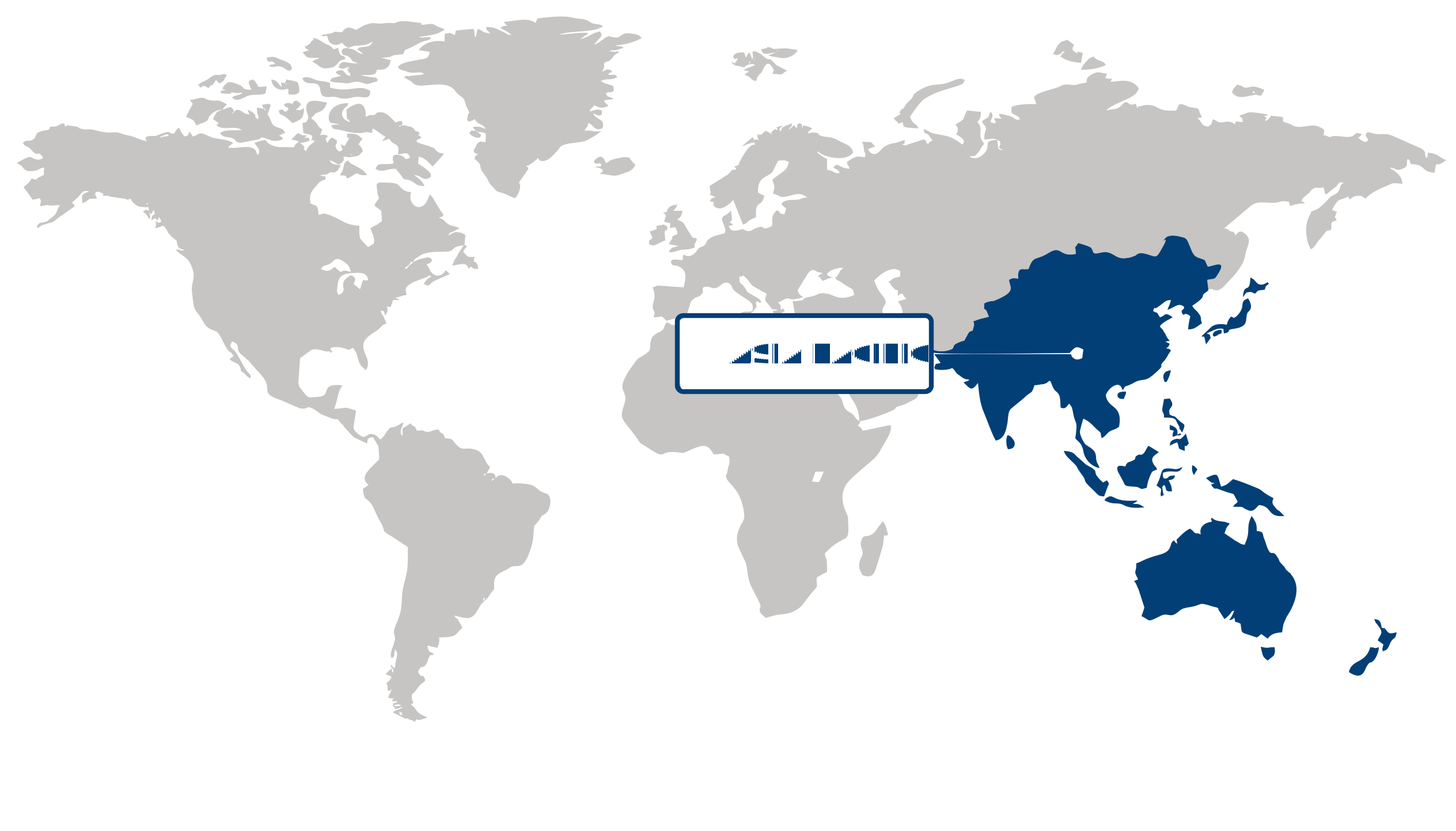
Asia Pacific captured over 42.6% of the global chip inductor market in 2025, making it the largest region by share, driven principally by massive electronics manufacturing hubs across China, Japan and South Korea. The concentration of OEMs and contract manufacturers has intensified demand for high-volume, cost-optimized inductors while suppliers scale capacity and invest in higher-reliability grades; Ministry of Industry and Information Technology of the People’s Republic of China and Japan External Trade Organization (JETRO) reports highlight sustained output in electronics and components. Given ongoing industrial policy support and supply-chain localization, the region presents continued sourcing and innovation opportunities for investors and suppliers.
Japan is positioned as a pivotal hub in Asia Pacific, where the chip inductor market benefits from premium component expertise and rigorous quality standards. Domestic leaders such as Murata Manufacturing Co., Ltd. and TDK have announced capacity and technology investments to serve automotive and industrial segments, and Ministry of Economy, Trade and Industry (METI) initiatives reinforce upstream component R&D. This specialization underpins higher-margin product lines and makes Japan a strategic location for partners targeting reliability-focused applications.
China anchors regional volume and scale in Asia Pacific, and the chip inductor market here is shaped by large contract manufacturers and fast-growing end markets. Hon Hai Precision Industry Co., Ltd. (Foxconn) and major smartphone and EV OEMs sustain high throughput, while the Ministry of Industry and Information Technology reports continued expansion of electronics clusters and domestic supply chains. For investors, China offers scale-driven cost advantages and rapid commercialization, complementing Japan’s high-end focus to reinforce regional market leadership.
North America Market Analysis:
North America emerged as the fastest-growing region, registering a robust CAGR of 8.2% in the chip inductor market, propelled by strong demand for high-performance components in advanced automotive and aerospace sectors. Rapid electrification in passenger and commercial vehicles and increasing avionics complexity are concentrating spend on compact, high-Q inductors used in power conversion and RF subsystems; examples include Ford Motor Company and Tesla accelerating EV platform investments and Boeing modernizing avionics suites. Policy and capital flows—illustrated by the U.S. Department of Commerce’s CHIPS and Science Act support and increased procurement from the U.S. Department of Defense—are reshaping supplier strategies and encouraging local capacity. Given these dynamics and the presence of major OEMs and defense primes, North America offers sustained opportunities for specialized, higher-margin chip inductor designs and nearshore manufacturing partnerships.
The U.S. anchors regional demand in the chip inductor market, where defense procurement and EV electronics create outsized requirements for reliability and performance. OEM-led shifts in design (Ford Motor Company and General Motors integrating advanced power electronics), large airborne platform upgrades led by Boeing and Lockheed Martin, and supply-chain incentives under the U.S. Department of Commerce’s CHIPS initiatives are accelerating domestic sourcing and qualification cycles. Corporate announcements from Intel and Texas Instruments on capacity expansions further signal ecosystem strengthening for component suppliers. Strategically, U.S. end-market intensity shortens time-to-revenue for suppliers that can meet stringent qualification, traceability, and performance needs, reinforcing North America’s role as a high-value market for chip inductor suppliers.
Europe Market Trends:
Europe held a significant share in the chip inductor market, reflecting policy-driven capacity building, robust automotive and industrial electronics demand, and buyer preference for lower-carbon supply chains; the European Commission’s EU Chips Act and Green Deal initiatives, alongside financing from the European Investment Bank, have been cited as enablers, and corporate signals from Infineon and STMicroelectronics press releases underscore capacity and product development moves—this combination of regulatory support, capital flows, and OEM procurement creates a commercially attractive environment for localization and innovation across the region.
Germany anchors the chip inductor market in Europe as the primary manufacturing and systems-integration hub: strong OEM pull from Volkswagen and supplier commitments signaled in Bosch press releases, together with capacity and technology investments noted in Infineon press releases and funding programs referenced by the Federal Ministry for Economic Affairs and Climate Action (BMWK), drive high-volume, automotive-grade demand; strategically, Germany offers scale and quality that attract tier suppliers and support regional supply-chain resilience.
France serves as a strategic adoption and capacity-growth market in the chip inductor market in Europe, driven by active industrial policy and R&D incentives: the French Government’s France 2030 program and targeted support from the Ministry of the Economy, coupled with expansion and partnership announcements from STMicroelectronics press releases, favor higher domestic production and specialist design activity; for investors and suppliers this means France complements Germany’s scale with policy-backed capacity and innovation pathways that strengthen regional opportunity.
| Parameter | North America | Asia Pacific | Europe | Latin America | MEA |
|---|---|---|---|---|---|
| Innovation Hub i Scale Nascent Developing Advanced | |||||
| Cost-Sensitive Region i Scale Low Medium High | |||||
| Regulatory Environment i Scale Restrictive Neutral Supportive | |||||
| Demand Drivers i Scale Weak Moderate Strong | |||||
| Development Stage i Scale Emerging Developing Developed | |||||
| Adoption Rate i Scale Low Medium High | |||||
| New Entrants / Startups i Scale Sparse Moderate Dense | |||||
| Macro Indicators i Scale Weak Stable Strong |
Segment Leadership and Growth Trends
Chip Inductor Market Share (%), by Type, 2026
Go beyond the chart, access full insights & data tables
Request Free Sample ReportLaminated type held largest share in the chip inductor market in 2025, leading the Type segments because laminated constructions meet rising demand for miniaturized, high‑frequency passive components in consumer electronics and telecommunications infrastructure. Leadership reflects manufacturing investments and product roadmaps from Murata Manufacturing and TDK Corporation emphasizing thin, multilayer architectures for RF and power‑line suppression; supply‑chain advances in automated layering and yield improvements have reduced unit cost and environmental waste, aligning with OEM preferences for compact, energy‑efficient modules. This creates strategic advantages for incumbents to leverage scale and for new entrants to specialize in niche RF or sustainable materials. Given ongoing 5G/Wi‑Fi upgrades and handset miniaturization reported by Ericsson and Qualcomm, relevance should persist near term.
Analysis by Applications
Communication systems dominated the chip inductor market in 2025, representing the largest share among Applications segments as compact inductors are essential for smartphones, IoT devices, and telecom equipment. Demand dynamics cited by GSMA and the Ericsson Mobility Report show growing device density and higher-frequency deployments, driving preference for laminated and high‑Q components; Qualcomm’s chipset evolution further incentivizes compact passive integration. Regulatory spectrum reallocations and operator infrastructure rollouts have spurred procurement, while sustainability and supply‑chain resilience favor modular suppliers. Established firms can capitalize on scale and certifications, while agile specialists can target private networks and IoT verticals. Continued 5G densification and edge computing deployments support ongoing relevance.
| Segment | Sub-Segment | Largest Segment | Fastest Growing |
|---|---|---|---|
| Type | Winding Type, Laminated Type, Film Type, Weaving Type, Other | ||
| Applications | Communication Systems, Consumer Appliances, Automotive, Robotics, Power Industry, Others |
Competitive Landscape and Market Positioning
The competitive environment is defined by intensified capability-building and selective consolidation among these leaders. Several have broadened product ranges and manufacturing footprints while deepening design engagement with mobile, automotive, and industrial OEMs; others have prioritized advanced materials, miniaturization, and high-frequency variants to secure system-level wins. Distribution and engineering support have become differentiators, and targeted partnerships and capacity alignment are shifting relative positioning toward suppliers that can combine technical depth with reliable supply and rapid design-in.
Strategic / Actionable Recommendations for Regional Players
North America: Prioritize closer engineering tie-ups with automotive and defense OEMs, bolster certification and high-reliability offerings, and strengthen distributor relationships to capture system-level design wins.
Asia Pacific: Leverage proximity to high-volume electronics OEMs by accelerating miniaturization, advanced packaging compatibility, and localized co-development to convert design-intent into scale.
Europe: Emphasize tailored solutions for industrial and automotive automation, deepen collaborations with Tier‑1 integrators, and offer high-quality customization and after-sales engineering to defend premium segments.
| Company | Market Share | Company Revenue | Revenue CAGR (%) | Product Portfolio | Geographic Presence | Innovation / R&D Focus | Strategic Developments |
|---|---|---|---|---|---|---|---|
| No companies available. | |||||||
Industry Development/News
| Company Name | Date | Key Development |
|---|
Customize Your Report
Explore examples of how this report can be tailored to different research needs, including custom segments, additional topics or chapters, and related reports. Click a section of the wheel or its numbered marker to explore the available options.
Chip Inductor Market — Custom Segments
| Segment | Sub-Segment |
|---|---|
| No segment data available. | |
Chip Inductor Market — Custom TOC
| Custom Chapter | Custom Details | ||
|---|---|---|---|
| No custom TOC data available. | |||
Need a different cut of the data?
Request Custom ResearchHow much revenue does the chip inductor market generate?
What are the growth projections for the chip inductor industry?
Which region emerges as the top contributor to the chip inductor market revenue?
Which region shows the most rapid acceleration in the chip inductor sector?
How does laminated type segment fare in the chip inductor industry?
What share does communication systems segment hold in the chip inductor sector as of 2025?
What are the prominent companies operating in the chip inductor landscape?
Our Clients
"Working with FBI has been a good experience. The market report provided a holistic view, covering everything from emerging trends to potential risks."
Semtech Corporation
"The experience was highly positive. The team showcased remarkable flexibility in adapting to our specific needs and delivered report that perfectly aligned with all our requirements."
TSMC
"What really stood out to me was how clearly and promptly the Fundamental Business Insights team communicated throughout. It made the collaboration feel effortless."
NXP Semiconductors
Our Research Team & Methodology
Every Fundamental Business Insights report is built by a dedicated vertical research team, validated through a structured primary-and-secondary methodology, and reviewed for accuracy before it reaches you.
Research Team Overview
Prepared by the Electronics & Semiconductors Research Team
Delivery
Published
Demand
Available
Support
Trust & Compliance
Research Domains
10 coverage areasResearch Intelligence
| Source | Reference |
|---|---|
| Semiconductor Industry Association (SIA) | www.semiconductors.org |
| SEMI | www.semi.org |
| JEDEC Solid State Technology Association | www.jedec.org |
| IEEE | www.ieee.org |
| IPC – Association Connecting Electronics Industries | www.ipc.org |
| International Electrotechnical Commission (IEC) | www.iec.ch |
| International Organization for Standardization (ISO) | www.iso.org |
| U.S. Bureau of Industry and Security (BIS) | www.bis.gov |
| U.S. Patent and Trademark Office (USPTO) | www.uspto.gov |
| European Patent Office (EPO) | www.epo.org |
| Taiwan Semiconductor Industry Association (TSIA) | www.tsia.org.tw |
| World Semiconductor Trade Statistics (WSTS) | www.wsts.org |
| International Energy Agency (IEA) | www.iea.org |
| GSMA | www.gsma.com |
| 3GPP | www.3gpp.org |
| ITU (International Telecommunication Union) | www.itu.int |
| Omdia (public insights) | omdia.tech.informa.com |
| Display Supply Chain Consultants (DSCC) | www.displaysupplychain.com |
| U.S. Department of Energy (DOE) | www.energy.gov |
| NIST (National Institute of Standards and Technology) | www.nist.gov |
Research Workflow & Quality Assurance
Data Collection
Verified information gathered through primary and secondary research.
Data Triangulation
Cross-validation using multiple independent data sources.
Forecast Modelling
Market estimates developed using historical trends and analytical models.
Analyst Validation
Findings reviewed by domain experts for accuracy and consistency.
Editorial & Quality Review
Final editorial, quality, and compliance checks before publication.
Final Publication
Released after successful completion of the internal review process.
Report Coverage
📊 Market Assessment
- Market Size & Forecast
- Market Segmentation
- Regional Analysis
- Growth Drivers & Challenges
- Market Dynamics
🏢 Competitive Intelligence
- Competitive Landscape
- Company Profiles
- Competitive Benchmarking
- Mergers & Acquisitions
- Market Share Analysis or Key Company Strategies
🔍 Strategic Analysis
- Value Chain Analysis
- Porter's Five Forces
- PESTLE Analysis
- Pricing Trends
- Supply-Demand Analysis
🚀 Future Outlook
- Technology Landscape
- Regulatory Landscape
- Investment & Funding Landscape
- Emerging Opportunities
- Future Market Outlook
Have a question about this report or need a custom scope?
Request Customization