Chemical Recycling of Plastics Market Size & Growth Forecast 2027–2036, By Segments (Product, Type, End-use), Regional Demand Trends (North America, Asia Pacific, Europe), Key Country Insights (U.S., Japan, South Korea, Germany, France, Italy), and Competitive Landscape
Market Size and Growth Outlook
Chemical Recycling of Plastics Market size was around USD 18.1 billion in 2026 and is slated to grow at a 11.21% CAGR from 2027 to 2036, exceeding USD 52.37 billion by 2036. The industry revenue for 2027 is estimated at USD 19.81 billion.
Get more details on this report
Request Free Sample ReportChemical Recycling of Plastics Market Intelligence Snapshot
Regional Market Dynamics
- Europe led the market in 2026 due to its mature circular economy framework, established waste collection and sorting systems, active investment in recycling capacity, and well-structured feedstock supply chains that support commercial operations.
- Asia Pacific is projected to grow at a 10.74% CAGR, driven by rising plastic consumption, expanding recycling infrastructure, investment in advanced recycling technologies, and increasing demand for higher-value recycling pathways.
Segment Momentum
- PE accounted for 32.75% of the market in 2026 due to the large volume of polyethylene waste generated from packaging and consumer applications, providing recyclers with a consistent and accessible feedstock supply.
- Depolymerization is growing fastest because it converts plastic waste into reusable chemical building blocks, supporting higher-value material recovery, improved output consistency, and stronger circularity outcomes.
Market Expansion Drivers
- Escalating global plastic waste volumes accelerating demand for advanced chemical recycling technologies.
- Government recycling investments and sustainability mandates supporting commercial plastics recovery infrastructure.
- Rising automotive and packaging sector adoption increasing demand for recycled polymer feedstocks.
Leading Market Participants
- Leading players in the chemical recycling of plastics market include BASF SE (Germany), LyondellBasell Industries N.V. (Netherlands), Eastman Chemical Company (United States), SABIC (Saudi Arabia), Veolia Environnement S.A. (France), INEOS Group Holdings S.A. (United Kingdom), Agilyx ASA (Norway), Mitsui Chemicals, Inc. (Japan), Exxon Mobil Corporation (United States), Plastic Energy Ltd. (United Kingdom).
Global Market Forecast Snapshot
Market Outlook
- 2026 Market Size: USD 18.1 billion
- 2027 Estimated Market Size: USD 19.81 billion.
- Projected Market Size: USD 52.37 billion by 2036
- Growth Forecast: 11.21% CAGR (2027-2036)
Regional and Segment Outlook
- Leading Regional Market: Europe
- High-Growth Regional Hub: Asia Pacific
- Core Revenue Segment: PE (Product) | Depolymerization (Type) | Packaging (End-use)
- Emerging Opportunity Segment: PP (Product) | Depolymerization (Type) | Automotive (End-use)
Market Growth Drivers and Industry Trends
Escalating global plastic waste volumes accelerating demand for advanced chemical recycling technologies
The accumulation of plastic waste and limitations associated with conventional waste-management approaches are increasing the need for technologies capable of recovering value from difficult-to-recycle materials, which will propel the chemical recycling of plastics market growth. Growing volumes of post-consumer and post-industrial plastics are placing greater pressure on collection, sorting, and recycling systems, particularly for mixed, contaminated, or multilayer materials that are challenging to process mechanically. Chemical recycling can break polymer materials down into usable chemical intermediates or feedstocks, creating opportunities to recover materials that might otherwise be directed toward disposal or lower-value applications. Its ability to complement mechanical recycling is strengthening interest among industries seeking broader solutions for managing complex plastic waste streams.
Government recycling investments and sustainability mandates supporting commercial plastics recovery infrastructure
Public-sector investment in recycling infrastructure and increasingly stringent sustainability requirements are creating a supportive environment for advanced plastics recovery technologies, strengthening chemical recycling of plastics market growth. Governments and regulatory authorities are placing greater emphasis on reducing plastic disposal, improving resource recovery, and establishing more circular material flows, encouraging investment across collection, processing, and recycling infrastructure. Such initiatives can improve the availability of feedstock and create clearer pathways for commercial-scale recycling facilities. Sustainability mandates are also prompting manufacturers and waste-management stakeholders to evaluate technologies capable of recovering materials from plastic streams that are not effectively addressed through traditional recycling processes, supporting the development of integrated chemical recycling infrastructure.
Rising automotive and packaging sector adoption increasing demand for recycled polymer feedstocks
Increasing interest in recycled materials across automotive and packaging applications is strengthening demand for reliable polymer feedstocks, providing an important foundation for chemical recycling of plastics market growth. Automotive manufacturers are seeking material solutions that can support resource efficiency while meeting performance requirements for components and systems, while packaging producers are facing growing pressure to incorporate recycled content into material supply chains. Chemical recycling can produce feedstocks with properties suitable for manufacturing new polymer materials, offering an alternative pathway for recovering value from selected waste streams. As these industries seek more dependable access to recycled inputs, the ability to transform challenging plastic waste into usable feedstock is becoming increasingly relevant to procurement and material-sourcing strategies.
| Growth Driver | Impact on CAGR | Regulatory Influence | Geographic Relevance | Adoption Rate | Impact Timeline |
|---|---|---|---|---|---|
| Escalating global plastic waste volumes accelerating demand for advanced chemical recycling technologies | 2.00% | High | Asia Pacific, Europe | High | Near Term |
| Government recycling investments and sustainability mandates supporting commercial plastics recovery infrastructure | 1.80% | High | North America, Europe | High | Mid Term |
| Rising automotive and packaging sector adoption increasing demand for recycled polymer feedstocks | 1.50% | Moderate | Asia Pacific, North America | Medium | Mid Term |
Unlock insights tailored to your business with our bespoke market research solutions.
Click to get your customized report now.
Regional Demand Dynamics
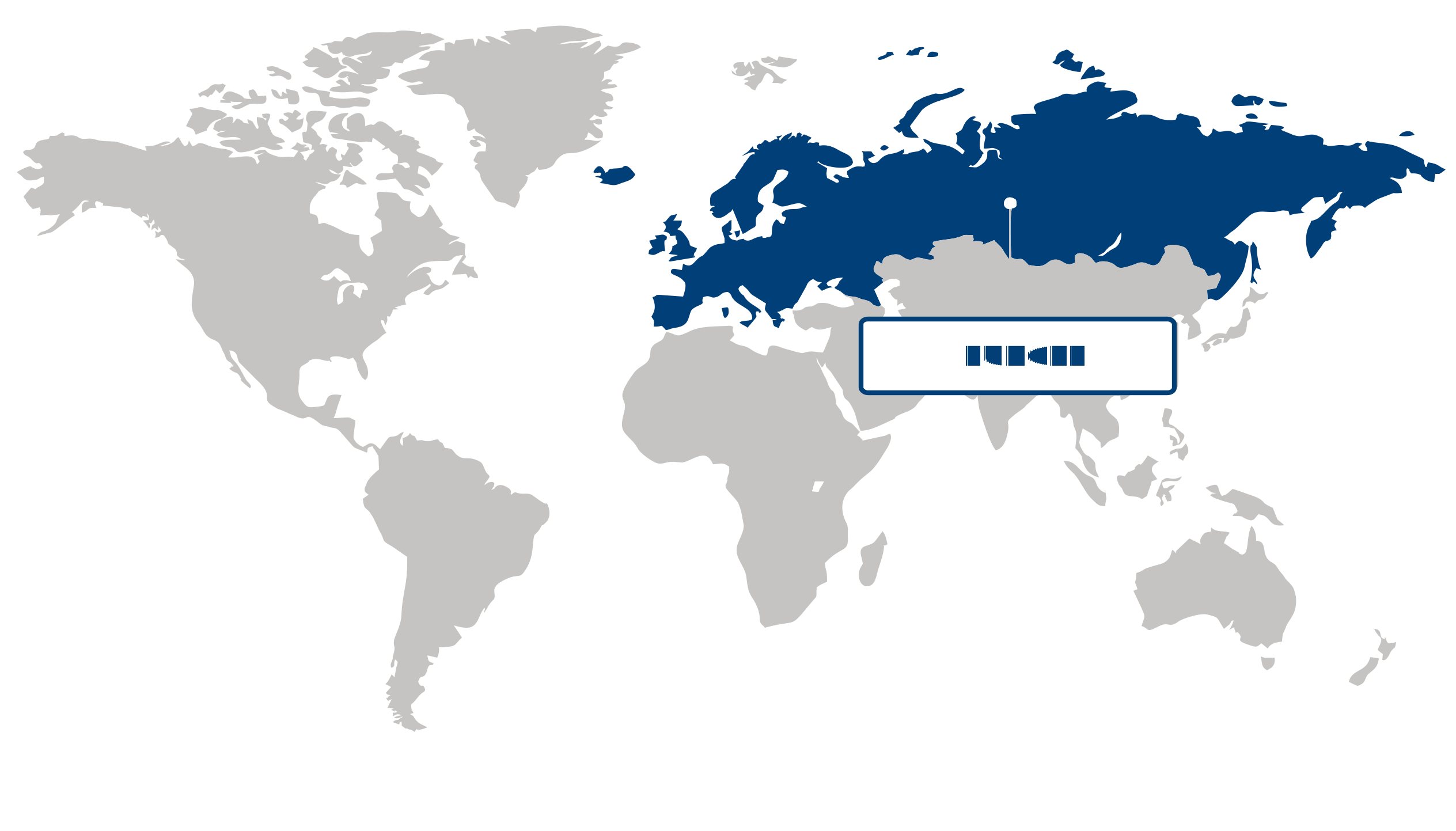
Europe (Largest Region)
Europe represented the largest regional market for chemical recycling of plastics in 2026, reflecting strong emphasis on circular economy principles, waste reduction, and advanced plastic recovery technologies. Regulatory pressure to improve plastic waste management and increase material circularity is encouraging investment in technologies capable of processing difficult-to-recycle plastic streams. The region's established chemical and recycling infrastructure, together with growing demand for recycled feedstocks and greater focus on sustainable manufacturing, is creating favorable conditions for development of chemical recycling capabilities.
Asia Pacific (Fastest-Growing Region)
Asia Pacific is the fastest-growing regional market as plastic consumption, manufacturing activity, and waste generation continue to expand alongside investments in modern recycling infrastructure. Growing environmental concerns and efforts to improve waste management are encouraging governments and industrial stakeholders to explore advanced recycling methods for plastic streams that are challenging to process through conventional mechanical recycling. Increasing interest in circular production models and demand for recovered raw materials are also supporting investment in chemical recycling technologies across the region.
| Parameter | North America | Asia Pacific | Europe | Latin America | MEA |
|---|---|---|---|---|---|
| Innovation Hub i Scale Nascent Developing Advanced | |||||
| Cost-Sensitive Region i Scale Low Medium High | |||||
| Regulatory Environment i Scale Restrictive Neutral Supportive | |||||
| Demand Drivers i Scale Weak Moderate Strong | |||||
| Development Stage i Scale Emerging Developing Developed | |||||
| Adoption Rate i Scale Low Medium High | |||||
| New Entrants / Startups i Scale Sparse Moderate Dense | |||||
| Macro Indicators i Scale Weak Stable Strong |
Key Country Insights
Germany 🇩🇪
Circular Packaging IntegrationGermany is emphasizing chemical recycling as a complement to its mature mechanical recycling infrastructure, particularly for mixed and contaminated plastic streams. Demand from packaging and automotive sectors is encouraging investments in feedstock certification and recycled content traceability.
France 🇫🇷
Regulatory Circularity AlignmentFrance is using chemical recycling to strengthen circular economy targets and improve recovery rates for challenging plastic waste streams. The market is seeing increasing collaboration between waste management companies and packaging producers seeking verified recycled material inputs.
Italy 🇮🇹
Industrial Waste Valorization FocusItaly is prioritizing technologies that convert industrial and post-consumer plastic waste into reusable chemical feedstocks. Interest from packaging and consumer goods manufacturers is encouraging the development of regional recycling projects linked to circular manufacturing initiatives.
Japan 🇯🇵
Resource Efficiency TransitionJapan is promoting chemical recycling technologies that improve material recovery from complex waste while supporting national resource efficiency objectives. Domestic companies are exploring depolymerization and conversion technologies to secure recycled feedstock for manufacturing applications.
South Korea 🇰🇷
Petrochemical Conversion PlatformSouth Korea is integrating chemical recycling into its petrochemical value chain to produce recycled feedstocks and reduce dependence on virgin materials. Major industrial groups are pursuing technology partnerships and plant investments aimed at creating circular plastic production systems.
United States 🇺🇸
Advanced Recycling Investment HubThe U.S. market is centered on scaling chemical recycling facilities that can process difficult-to-recycle plastics and support circular packaging commitments. Partnerships between petrochemical companies, technology providers, and consumer brands are accelerating commercialization of advanced recycling capacity.
Segment Leadership and Growth Trends
Chemical Recycling of Plastics Market Share (%), by Product, 2026
Go beyond the chart, access full insights & data tables
Request Free Sample ReportProduct Segment Analysis: PE (Largest Segment) vs PP (Fastest-Growing Segment)
PE represented the largest product segment in the chemical recycling of plastics market, accounting for a 32.75% share in 2026, supported by its widespread use across packaging, consumer products, and industrial applications. The substantial presence of PE in plastic waste streams provides an important feedstock base for chemical recycling, while growing emphasis on diverting plastic waste from disposal and recovering valuable materials is strengthening demand for technologies capable of processing these polymers.
PP is the fastest-growing product segment, supported by increasing efforts to expand chemical recycling beyond conventional plastic waste streams. Greater focus on circular material management, improved conversion technologies, and the potential to transform recovered PP into useful chemical feedstocks are encouraging broader investment and adoption of recycling approaches for this polymer.
Type Segment Analysis: Depolymerization (Largest & Fastest-Growing Segment)
Depolymerization was both the largest and fastest-growing type segment in the chemical recycling of plastics market in 2026, reflecting its ability to break polymer materials down into chemical components that can potentially be reused as feedstock. Its relevance is increasing as the industry seeks recycling pathways for plastic waste that may be challenging to recover through mechanical methods, while the growing emphasis on closed-loop material systems is further supporting interest in depolymerization technologies.
| Segment | Sub-Segment | Largest Segment | Fastest Growing |
|---|---|---|---|
| Product | PE, PET, PP, PVC, PS, Others | PE | PP |
| Type | Depolymerization, Dissolution, Conversion | Depolymerization | Depolymerization |
| End-use | Packaging, Automotive, Building & Construction, Electrical & Electronics, Textiles, Others | Packaging | Automotive |
Competitive Landscape and Market Positioning
Key companies in the chemical recycling of plastics market:
1. BASF SE (Germany)
2. LyondellBasell Industries N.V. (Netherlands)
3. Eastman Chemical Company (United States)
4. SABIC (Saudi Arabia)
5. Veolia Environnement S.A. (France)
6. INEOS Group Holdings S.A. (United Kingdom)
7. Agilyx ASA (Norway)
8. Mitsui Chemicals Inc. (Japan)
9. Exxon Mobil Corporation (United States)
10. Plastic Energy Ltd. (United Kingdom)
Environmental regulations and circular economy goals are accelerating growth in the chemical recycling of plastics market. The chemical recycling of plastics market is being reshaped by advanced processing technologies that convert waste into reusable raw materials. Strategic partnerships are supporting infrastructure development and scaling of recycling capabilities. Regulatory developments are also encouraging adoption of sustainable waste management systems, while innovation in chemical processing is improving efficiency and output quality.
| Company | Market Share | Company Revenue | Revenue CAGR (%) | Product Portfolio | Geographic Presence | Innovation / R&D Focus | Strategic Developments |
|---|---|---|---|---|---|---|---|
| BASF SE (Germany) | |||||||
| LyondellBasell Industries N.V. (Netherlands) | |||||||
| Eastman Chemical Company (United States) | |||||||
| SABIC (Saudi Arabia) | |||||||
| Veolia Environnement S.A. (France) | |||||||
| INEOS Group Holdings S.A. (United Kingdom) | |||||||
| Agilyx ASA (Norway) | |||||||
| Mitsui Chemicals Inc. (Japan) | |||||||
| Exxon Mobil Corporation (United States) | |||||||
| Plastic Energy Ltd. (United Kingdom). |
Industry Development/News
| Company Name | Date | Key Development |
|---|---|---|
| PolyCycl | Jan-26 | The company secured Series A funding from Rainmatter to accelerate the commercialization of its Generation VI chemical recycling platform. This capital will support the scaling of technology for hard-to-recycle plastics and expand operational capabilities for domestic and international licensing, facilitating the transition from technical maturity to broader industrial deployment. |
| Alterra / Neste / Technip | Nov-24 | The companies entered a collaboration to offer a standardized, modular chemical recycling solution based on Alterra’s proprietary liquefaction technology. By combining Alterra’s process, Neste’s feedstock expertise, and Technip’s engineering capabilities, the partnership aims to reduce pre-investment hurdles and accelerate the global deployment of scalable, economically viable advanced recycling plant capacity. |
| Farrel Pomini | May-24 | The company expanded its recycling solutions by advancing continuous mixer technology specifically optimized for the mechanical and chemical recycling of polymers. The platform, introduced at NPE 2024, addresses industry-wide processing challenges—such as handling irregular feedstocks and temperature-sensitive materials—to improve the efficiency and quality of recycled plastic output in circular supply chains. |
| NextChem | Apr-23 | NextChem acquired a 51% stake in MyRemono, a joint venture established with Biorenova to industrialize the proprietary CatC chemical recycling technology. The transaction included the transfer of patents and a demonstration plant, enabling the development of an industrial-scale facility to recover high-purity monomers from sorted plastic waste, initially targeting polymethyl methacrylate (PMMA) streams. |
Customize Your Report
Explore examples of how this report can be tailored to different research needs, including custom segments, additional topics or chapters, and related reports. Click a section of the wheel or its numbered marker to explore the available options.
Chemical Recycling of Plastics Market — Custom Segments
| Segment | Sub-Segment |
|---|---|
| Feedstock Source | Post-consumer Plastic Waste, Post-industrial Plastic Waste, Mixed Plastic Waste, Commercial & Industrial Plastic Waste |
| Plant Configuration | Standalone Recycling Plants, Integrated Petrochemical Complexes, Integrated Waste Management Facilities |
| Output Market Form | Recycled Polymer Feedstocks, Chemical Intermediates, Hydrocarbon Feedstocks, Fuels & Energy Products |
Chemical Recycling of Plastics Market — Custom TOC
| Custom Chapter | Custom Details |
|---|---|
| Circular Economy Business Model Assessment |
|
| Plastic Waste Feedstock Availability Analysis |
|
| Recycled Polymer Market Opportunity Mapping |
|
Need a different cut of the data?
Request Custom ResearchWhat is the market valuation of chemical recycling of plastics?
How is the chemical recycling of plastics industry size expected to evolve during the forecast period?
How is the rising volume of mixed and hard-to-recycle plastic waste shaping technology adoption in the chemical recycling of plastics market?
Why are regulatory support mechanisms and structured waste systems becoming critical to scaling chemical recycling infrastructure in Europe and beyond?
Why does PE hold the largest share in the chemical recycling of plastics market?
Why is depolymerization the fastest-growing technology in the chemical recycling of plastics market?
Why does Europe lead the chemical recycling of plastics market?
Why is Asia Pacific the fastest-growing region in the chemical recycling of plastics market?
Which companies dominate the chemical recycling of plastics landscape?
Our Clients
"The report helped us understand emerging consumer trends in our product category. It clarified where to focus innovation for the next product launch."
LyondellBasell
"The regional forecast section was incredibly useful. We were able to identify two new potential partners in Europe thanks to the vendor mapping you included."
SABIC
"We appreciated how actionable the recommendations were. It guided us to improve supply chain resilience."
Olin Corporation
Our Research Team & Methodology
Every Fundamental Business Insights report is built by a dedicated vertical research team, validated through a structured primary-and-secondary methodology, and reviewed for accuracy before it reaches you.
Research Team Overview
Prepared by the Chemicals & Materials Research Team
Delivery
Published
Demand
Available
Support
Trust & Compliance
Research Domains
10 coverage areasResearch Intelligence
| Source | Reference |
|---|---|
| American Chemistry Council (ACC) | www.americanchemistry.com |
| European Chemical Industry Council (Cefic) | cefic.org |
| International Council of Chemical Associations (ICCA) | icca-chem.org |
| European Chemicals Agency (ECHA) | echa.europa.eu |
| U.S. Environmental Protection Agency (EPA) | www.epa.gov |
| ASTM International | www.astm.org |
| International Organization for Standardization (ISO) | www.iso.org |
| National Institute of Standards and Technology (NIST) | www.nist.gov |
| Plastics Industry Association (PLASTICS) | www.plasticsindustry.org |
| European Biplastics | www.european-bioplastics.org |
| The Adhesive and Sealant Council (ASC) | www.ascouncil.org |
| National Association of Corrosion Engineers (AMPP) | www.ampp.org |
| Society of Plastics Engineers (SPE) | www.4spe.org |
| International Fertilizer Association (IFA) | www.fertilizer.org |
| CropLife International | croplife.org |
| Packaging Europe | packagingeurope.com |
| Flexible Packaging Association (FPA) | www.flexpack.org |
| Battery Council International (BCI) | batterycouncil.org |
| International Copper Association (ICA) | internationalcopper.org |
| World Steel Association | worldsteel.org |
Research Workflow & Quality Assurance
Data Collection
Verified information gathered through primary and secondary research.
Data Triangulation
Cross-validation using multiple independent data sources.
Forecast Modelling
Market estimates developed using historical trends and analytical models.
Analyst Validation
Findings reviewed by domain experts for accuracy and consistency.
Editorial & Quality Review
Final editorial, quality, and compliance checks before publication.
Final Publication
Released after successful completion of the internal review process.
Report Coverage
📊 Market Assessment
- Market Size & Forecast
- Market Segmentation
- Regional Analysis
- Growth Drivers & Challenges
- Market Dynamics
🏢 Competitive Intelligence
- Competitive Landscape
- Company Profiles
- Competitive Benchmarking
- Mergers & Acquisitions
- Market Share Analysis or Key Company Strategies
🔍 Strategic Analysis
- Value Chain Analysis
- Porter's Five Forces
- PESTLE Analysis
- Pricing Trends
- Supply-Demand Analysis
🚀 Future Outlook
- Technology Landscape
- Regulatory Landscape
- Investment & Funding Landscape
- Emerging Opportunities
- Future Market Outlook
Have a question about this report or need a custom scope?
Request Customization