Cellulose Derivatives Market Size & Growth Forecast 2027–2036, By Segments (Grade, Type), Regional Demand Trends (North America, Asia Pacific, Europe), Key Country Insights (U.S., Japan, South Korea, Germany, France, Italy), and Competitive Landscape
Market Size and Growth Outlook
Cellulose Derivatives Market size was worth USD 8.2 billion in 2026 and is expected to grow at a 6.65% CAGR between 2027 and 2036, reaching USD 15.61 billion by 2036. The industry revenue for 2027 is calculated at USD 8.66 billion.
Get more details on this report
Request Free Sample ReportCellulose Derivatives Market Intelligence Snapshot
Regional Market Dynamics
- Asia Pacific leads through extensive manufacturing activity and strong consumption across industries using cellulose derivatives as thickeners, binders, stabilizers, and film-forming agents in large-scale production.
- Asia Pacific is expected to grow at a 7.8% CAGR as downstream manufacturing expands and demand increases for functional, process-enhancing materials across multiple industrial applications.
Segment Momentum
- Pharmaceutical Grade held a 48.65% share in 2026 because drug manufacturers depend on high-purity materials for binding, coating, controlled release, and formulation consistency in regulated production.
- Hydroxypropyl Methylcellulose (HPMC) is the fastest-growing type due to its versatile use as a thickener, binder, film former, and stabilizer across quality-sensitive manufacturing applications.
Market Expansion Drivers
- Increasing demand for biodegradable packaging materials accelerating cellulose derivative adoption across industries.
- Growing consumer preference for sustainable textiles boosting use of performance-enhancing cellulose additives.
- Rising health consciousness increasing demand for cellulose derivatives in low-fat food formulations.
Leading Market Participants
- Major companies in the cellulose derivatives market include Dow Inc. (United States), Ashland Inc. (United States), Eastman Chemical Company (United States), Shin-Etsu Chemical Co., Ltd. (Japan), Nouryon Chemicals Holding B.V. (Netherlands), Daicel Corporation (Japan), Rayonier Advanced Materials Inc. (United States), LOTTE Fine Chemical Co., Ltd. (South Korea), J.M. Huber Corporation (United States).
Global Market Forecast Snapshot
Market Outlook
- 2026 Market Size: USD 8.2 billion
- 2027 Estimated Market Size: USD 8.66 billion.
- Projected Market Size: USD 15.61 billion by 2036
- Growth Forecast: 6.65% CAGR (2027-2036)
Regional and Segment Outlook
- Leading Regional Market: Asia Pacific
- High-Growth Regional Hub: Asia Pacific
- Core Revenue Segment: Pharmaceutical Grade (Grade) | Hydroxypropyl Methylcellulose (HPMC) (Type)
- Emerging Opportunity Segment: Pharmaceutical Grade (Grade) | Hydroxypropyl Methylcellulose (HPMC) (Type)
Market Growth Drivers and Industry Trends
Increasing demand for biodegradable packaging materials accelerating cellulose derivative adoption across industries
The shift toward biodegradable packaging is creating broader application opportunities for the cellulose derivatives market as manufacturers seek material options aligned with sustainability requirements. Cellulose-based inputs can support packaging formats where reduced reliance on conventional materials is prioritized, while their functional properties enable incorporation into diverse packaging structures and applications across industries.
Growing consumer preference for sustainable textiles boosting use of performance-enhancing cellulose additives
Consumer interest in more sustainable apparel is encouraging textile manufacturers to reassess material inputs and processing approaches, supporting the cellulose derivatives market through greater use of performance-enhancing additives. These derivatives can contribute functional characteristics to textile formulations while helping manufacturers respond to preferences for materials associated with more sustainable production and product positioning.
Rising health consciousness increasing demand for cellulose derivatives in low-fat food formulations
Increasing attention to healthier eating patterns is supporting the cellulose derivatives market as food manufacturers develop low-fat formulations that retain desirable texture and processing characteristics. Cellulose derivatives can provide functional support in these products, helping compensate for changes associated with reduced fat content while maintaining formulation performance and consumer-acceptable product qualities.
| Growth Driver | Impact on CAGR | Regulatory Influence | Geographic Relevance | Adoption Rate | Impact Timeline |
|---|---|---|---|---|---|
| Growing Demand in Pharmaceuticals & Food Industry | 3.00% | Short term (≤ 2 yrs) | North America, Europe (spillover: Asia Pacific) | Medium | Fast |
| Technological Advancements in Cellulose Derivatives | 2.00% | Medium term (2–5 yrs) | Europe, Asia Pacific (spillover: North America) | Low | Moderate |
| Regulatory Standards for Safety & Quality | 1.90% | Long term (5+ yrs) | North America, Europe (spillover: MEA) | High | Moderate |
| Increasing demand for biodegradable packaging materials accelerating cellulose derivative adoption across industries | 2.00% | High | Europe, Asia Pacific | High | Near Term |
| Growing consumer preference for sustainable textiles boosting use of performance-enhancing cellulose additives | 1.70% | Moderate | Asia Pacific, North America | High | Mid Term |
| Rising health consciousness increasing demand for cellulose derivatives in low-fat food formulations | 1.40% | Moderate | North America, Europe | Medium | Mid Term |
Unlock insights tailored to your business with our bespoke market research solutions.
Click to get your customized report now.
Regional Demand Dynamics
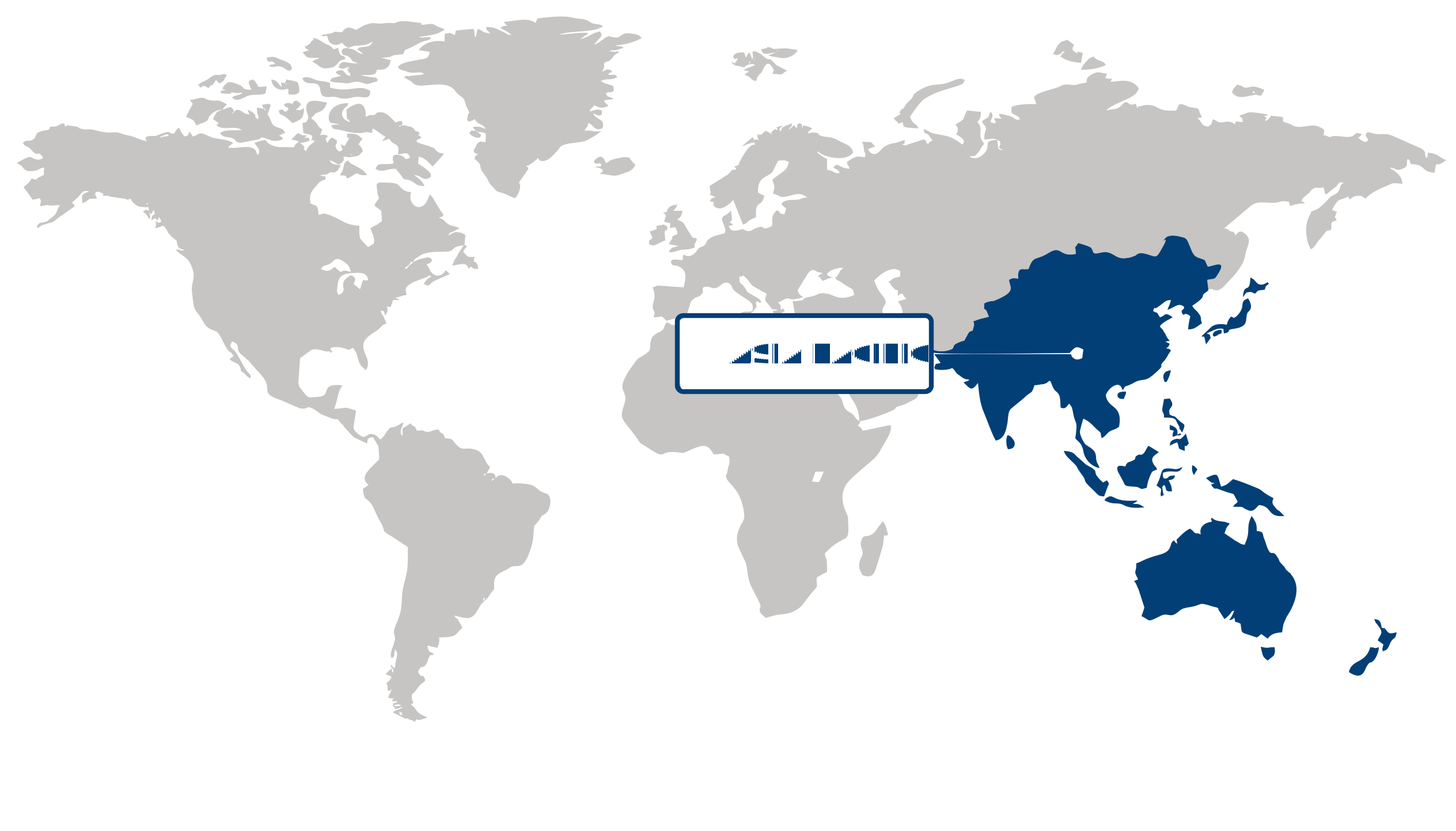
Asia Pacific (Largest & Fastest-Growing Region)
The Asia Pacific cellulose derivatives market held the largest position in 2026 and is also the fastest-growing regional market, supported by expanding pharmaceutical, food, personal care, construction, and industrial manufacturing activities. Cellulose derivatives are widely valued for their thickening, stabilizing, film-forming, binding, and viscosity-control properties, creating diverse applications across formulations and processed products. Rapid industrialization and increasing consumer demand for packaged foods, medicines, personal care products, and specialty materials are broadening regional consumption. The region also benefits from strong manufacturing capabilities and established processing industries, while growing investment in pharmaceutical and chemical production is encouraging the use of higher-value cellulose-based ingredients. Increasing attention to renewable and bio-based materials further strengthens demand as manufacturers seek alternatives that can support product performance while aligning with evolving sustainability priorities.
| Parameter | North America | Asia Pacific | Europe | Latin America | MEA |
|---|---|---|---|---|---|
| Innovation Hub i Scale Nascent Developing Advanced | |||||
| Cost-Sensitive Region i Scale Low Medium High | |||||
| Regulatory Environment i Scale Restrictive Neutral Supportive | |||||
| Demand Drivers i Scale Weak Moderate Strong | |||||
| Development Stage i Scale Emerging Developing Developed | |||||
| Adoption Rate i Scale Low Medium High | |||||
| New Entrants / Startups i Scale Sparse Moderate Dense | |||||
| Macro Indicators i Scale Weak Stable Strong |
Key Country Insights
Germany 🇩🇪
Industrial Formulation ExpertiseGermany emphasizes high-performance cellulose derivatives for industrial formulations requiring consistent quality and regulatory compliance. Producers in Germany are expanding application development for coatings, pharmaceuticals, and engineered construction materials with improved functional performance.
France 🇫🇷
Sustainable Ingredient DevelopmentFrance encourages wider adoption of cellulose derivatives in environmentally conscious food, cosmetics, and pharmaceutical formulations. Companies in France are strengthening bio-based ingredient portfolios to align with evolving regulatory and consumer sustainability expectations.
Italy 🇮🇹
Value-Added FormulationsItaly emphasizes cellulose derivatives for specialty coatings, food processing, and pharmaceutical production requiring reliable functional additives. Manufacturers in Italy are enhancing formulation capabilities to improve product performance while supporting efficient industrial processing.
Japan 🇯🇵
High Purity ApplicationsJapan prioritizes high-purity cellulose derivatives for pharmaceutical formulations, food ingredients, and advanced manufacturing. Companies in Japan continue refining production processes to deliver specialized materials that meet demanding quality and performance requirements.
South Korea 🇰🇷
Specialty Manufacturing BaseSouth Korea is expanding the use of cellulose derivatives across personal care, food processing, and industrial manufacturing. Manufacturers in South Korea are increasing focus on specialty formulations that support product differentiation and sustainable material selection.
United States 🇺🇸
Advanced Materials DemandThe U.S. cellulose derivatives market is supported by demand from pharmaceuticals, food processing, construction, and personal care applications. Manufacturers in the U.S. are investing in specialty grades that improve product functionality while meeting evolving sustainability expectations.
Segment Leadership and Growth Trends
Cellulose Derivatives Market Share (%), by Grade, 2026
Go beyond the chart, access full insights & data tables
Request Free Sample ReportGrade Segment Analysis: Pharmaceutical Grade (Largest & Fastest-Growing Segment)
Pharmaceutical grade accounted for a 48.65% share in 2026, making it both the largest and fastest-growing grade segment in the cellulose derivatives market. Its strong position reflects the extensive use of cellulose derivatives as functional excipients in pharmaceutical formulations, where they can support viscosity control, stabilization, binding, film formation, controlled release, and other formulation requirements. Increasing pharmaceutical manufacturing and the development of sophisticated dosage forms are supporting demand for high-purity cellulose-based materials. The need for consistent quality and performance in regulated drug production further reinforces the importance of pharmaceutical-grade derivatives.
Type Segment Analysis: Hydroxypropyl Methylcellulose (HPMC) (Largest & Fastest-Growing Segment)
Hydroxypropyl methylcellulose (HPMC) held a 42.4% share in 2026 and represented both the largest and fastest-growing type segment in the cellulose derivatives market. Its broad functionality enables use across pharmaceutical formulations, food products, personal care applications, and other industrial processes requiring controlled viscosity, stabilization, film formation, or texture modification. In pharmaceutical applications, HPMC is particularly valuable because of its versatility in oral dosage formulations and controlled-release systems. Expanding demand for functional excipients and growing use of multifunctional cellulose derivatives across diverse end-use industries are reinforcing its market position.
| Segment | Sub-Segment | Largest Segment | Fastest Growing |
|---|---|---|---|
| Grade | Industrial Grade, Food Grade, Pharmaceutical Grade | Pharmaceutical Grade | Pharmaceutical Grade |
| Type | Methyl Cellulose, Hydroxypropyl Methylcellulose (HPMC), Hydroxypropyl Cellulose (HPC), Carboxymethyl Cellulose, Hydroxyethyl Cellulose (HEC), Ethyl Cellulose | Hydroxypropyl Methylcellulose (HPMC) | Hydroxypropyl Methylcellulose (HPMC) |
Competitive Landscape and Market Positioning
Top players in the cellulose derivatives market:
1. Dow Inc. (United States)
2. Ashland Inc. (United States)
3. Eastman Chemical Company (United States)
4. Shin-Etsu Chemical Co. Ltd. (Japan)
5. Nouryon Chemicals Holding B.V. (Netherlands)
6. Daicel Corporation (Japan)
7. Rayonier Advanced Materials Inc. (United States)
8. LOTTE Fine Chemical Co. Ltd. (South Korea)
9. J.M. Huber Corporation (United States)
The cellulose derivatives market is evolving under strong sustainability and application expansion pressures. In the cellulose derivatives market, innovation is increasingly focused on environmentally aligned formulations and functional versatility. Continuous research efforts are supporting broader industrial use cases across food, pharmaceutical, and industrial applications. Strategic restructuring across the value chain is improving production efficiency and material performance.
| Company | Market Share | Company Revenue | Revenue CAGR (%) | Product Portfolio | Geographic Presence | Innovation / R&D Focus | Strategic Developments |
|---|---|---|---|---|---|---|---|
| Dow Inc. (United States) | |||||||
| Ashland Inc. (United States) | |||||||
| Eastman Chemical Company (United States) | |||||||
| Shin-Etsu Chemical Co. Ltd. (Japan) | |||||||
| Nouryon Chemicals Holding B.V. (Netherlands) | |||||||
| Daicel Corporation (Japan) | |||||||
| Rayonier Advanced Materials Inc. (United States) | |||||||
| LOTTE Fine Chemical Co. Ltd. (South Korea) | |||||||
| J.M. Huber Corporation (United States). |
Industry Development/News
| Company Name | Date | Key Development |
|---|---|---|
| Ashland Inc. | Oct-25 | Ashland appointed Tilley Distribution as its exclusive US distributor for cellulosic hydrocolloids used in food, beverage, and nutraceutical applications, including key cellulose-based products. The partnership expands Ashland’s commercial reach and strengthens its distribution network across the US functional food and specialty ingredient market. |
| Shin-Etsu Chemical Co. Ltd. | Jul-25 | Shin-Etsu Chemical marked 40 years of operations through its U.S. subsidiary Shin-Etsu Silicones of America, underscoring its long-term industrial presence in specialty materials. The milestone reflects sustained expansion in polymer-related applications, including cellulose derivative-adjacent industrial and pharmaceutical uses, reinforcing its positioning in high-performance material supply chains. |
| Eastman Chemical Company | Jun-25 | Eastman launched Esmeri CC1N10, a biodegradable cellulose ester micropowder designed for color cosmetics applications. The material is derived from sustainably managed sources and engineered to meet strict EU regulatory requirements, positioning it as a functional alternative to synthetic polymer microparticles in regulated personal care formulations. |
| DAICEL CORPORATION | Mar-25 | Daicel Corporation introduced BELLOCEA BS7, an eco-friendly cellulose acetate spherical particle developed as a sustainable alternative to microplastic beads in cosmetic applications. The product targets growing regulatory and formulation shifts toward biodegradable and environmentally compliant materials in personal care markets. |
| Eastman Chemical Company | Jan-24 | Eastman invested in sustainable cellulose processing technologies aimed at improving environmental efficiency in production operations. The initiative enhances the company’s manufacturing sustainability profile and supports long-term competitiveness in regulated cellulose derivative supply chains. |
| Colorcon | Dec-23 | Colorcon entered an exclusive multi-year partnership with LOTTE Fine Chemical for the development and manufacture of controlled-release and enteric pharmaceutical formulations based on hypromellose cellulose derivatives. The collaboration strengthens pharmaceutical coating capabilities and expands access to advanced cellulose-based drug delivery technologies. |
| Clariant | Oct-23 | Clariant launched the VitiPure excipient series for pharmaceutical applications, expanding its cellulose-based product portfolio for controlled formulation systems. The initiative strengthens its positioning in high-value pharmaceutical excipients and supports demand for advanced drug delivery and controlled-release technologies. |
| Ashland Inc. | Feb-23 | Ashland launched Benecel MX 100 methylcellulose, a plant-based hydrocolloid designed for high-viscosity applications in meat alternatives and plant-based foods. The product supports large-scale manufacturing of vegan protein products and expands Ashland’s presence in clean-label food formulation solutions. |
| Dow | Jul-21 | Dow expanded production capacity for cellulose derivatives including hydroxypropyl methylcellulose to support pharmaceutical and construction applications. The expansion strengthens supply availability across high-demand regulated industries and enhances Dow’s position in functional polymer supply chains. |
| Clariant | Jul-21 | Clariant and India Glycols formed a joint venture focused on renewable ethylene oxide derivatives used in cellulose-related value chains. The collaboration supports integration of bio-based feedstocks and strengthens Clariant’s downstream capabilities in sustainable specialty materials production. |
Customize Your Report
Explore examples of how this report can be tailored to different research needs, including custom segments, additional topics or chapters, and related reports. Click a section of the wheel or its numbered marker to explore the available options.
Cellulose Derivatives Market — Custom Segments
| Segment | Sub-Segment |
|---|---|
| Application | Pharmaceuticals, Food & Beverages, Construction, Personal Care & Cosmetics, Industrial Processing |
| Physical Form | Powder, Granules, Solution, Other Forms |
| Functional Role | Thickening & Rheology Modification, Binding & Film Formation, Stabilization & Emulsification, Water Retention |
Cellulose Derivatives Market — Custom TOC
| Custom Chapter | Custom Details |
|---|---|
| Bio-Based Material Transition Assessment |
|
| End-Use Innovation Opportunity Assessment |
|
| Circular Economy Opportunity Mapping |
|
Need a different cut of the data?
Request Custom ResearchHow much is the cellulose derivatives market worth?
What is the anticipated CAGR of the cellulose derivatives industry?
How is demand for sustainable packaging influencing adoption in the cellulose derivatives market?
What is driving greater use of cellulose derivatives in low-fat and reformulated food products?
Why does pharmaceutical grade dominate the cellulose derivatives market?
Which cellulose derivative type is growing the fastest in the market?
Why is Asia Pacific the leading region in the cellulose derivatives market?
What supports the continued growth of the cellulose derivatives market in Asia Pacific?
What are the key competitors in the cellulose derivatives landscape?
Our Clients
"The report helped us understand emerging consumer trends in our product category. It clarified where to focus innovation for the next product launch."
LyondellBasell
"The regional forecast section was incredibly useful. We were able to identify two new potential partners in Europe thanks to the vendor mapping you included."
SABIC
"We appreciated how actionable the recommendations were. It guided us to improve supply chain resilience."
Olin Corporation
Our Research Team & Methodology
Every Fundamental Business Insights report is built by a dedicated vertical research team, validated through a structured primary-and-secondary methodology, and reviewed for accuracy before it reaches you.
Research Team Overview
Prepared by the Chemicals & Materials Research Team
Delivery
Published
Demand
Available
Support
Trust & Compliance
Research Domains
10 coverage areasResearch Intelligence
| Source | Reference |
|---|---|
| American Chemistry Council (ACC) | www.americanchemistry.com |
| European Chemical Industry Council (Cefic) | cefic.org |
| International Council of Chemical Associations (ICCA) | icca-chem.org |
| European Chemicals Agency (ECHA) | echa.europa.eu |
| U.S. Environmental Protection Agency (EPA) | www.epa.gov |
| ASTM International | www.astm.org |
| International Organization for Standardization (ISO) | www.iso.org |
| National Institute of Standards and Technology (NIST) | www.nist.gov |
| Plastics Industry Association (PLASTICS) | www.plasticsindustry.org |
| European Biplastics | www.european-bioplastics.org |
| The Adhesive and Sealant Council (ASC) | www.ascouncil.org |
| National Association of Corrosion Engineers (AMPP) | www.ampp.org |
| Society of Plastics Engineers (SPE) | www.4spe.org |
| International Fertilizer Association (IFA) | www.fertilizer.org |
| CropLife International | croplife.org |
| Packaging Europe | packagingeurope.com |
| Flexible Packaging Association (FPA) | www.flexpack.org |
| Battery Council International (BCI) | batterycouncil.org |
| International Copper Association (ICA) | internationalcopper.org |
| World Steel Association | worldsteel.org |
Research Workflow & Quality Assurance
Data Collection
Verified information gathered through primary and secondary research.
Data Triangulation
Cross-validation using multiple independent data sources.
Forecast Modelling
Market estimates developed using historical trends and analytical models.
Analyst Validation
Findings reviewed by domain experts for accuracy and consistency.
Editorial & Quality Review
Final editorial, quality, and compliance checks before publication.
Final Publication
Released after successful completion of the internal review process.
Report Coverage
📊 Market Assessment
- Market Size & Forecast
- Market Segmentation
- Regional Analysis
- Growth Drivers & Challenges
- Market Dynamics
🏢 Competitive Intelligence
- Competitive Landscape
- Company Profiles
- Competitive Benchmarking
- Mergers & Acquisitions
- Market Share Analysis or Key Company Strategies
🔍 Strategic Analysis
- Value Chain Analysis
- Porter's Five Forces
- PESTLE Analysis
- Pricing Trends
- Supply-Demand Analysis
🚀 Future Outlook
- Technology Landscape
- Regulatory Landscape
- Investment & Funding Landscape
- Emerging Opportunities
- Future Market Outlook
Have a question about this report or need a custom scope?
Request Customization