Carrageenan Market Size & Growth Forecast 2027–2036, By Segments (Product Type, Function, Application, Processing Technology), Regional Demand Trends (North America, Asia Pacific, Europe), Key Country Insights (U.S., Japan, South Korea, Germany, France, Italy), and Competitive Landscape
Market Size and Growth Outlook
Carrageenan Market size was estimated at USD 1.09 billion in 2026 and is projected to grow at a 5.13% CAGR from 2027 to 2036, exceeding USD 1.8 billion by 2036. The industry revenue for 2027 is calculated at USD 1.14 billion.
Get more details on this report
Request Free Sample ReportCarrageenan Market Intelligence Snapshot
Regional Market Dynamics
- Europe accounted for 36.46% of the market in 2026, supported by a mature food processing industry and consistent demand for carrageenan in texture, stabilization, and viscosity management applications.
- Asia Pacific is expected to grow at a 6.22% CAGR, driven by expanding processed food production, increasing use of stabilizers and thickeners, and growing regional food and beverage manufacturing.
Segment Momentum
- Kappa held a 66.25% share in 2026 because its dependable gel formation and formulation consistency make it the preferred choice across high-volume food and industrial applications.
- Stabilizer is the fastest-growing function as manufacturers increasingly prioritize product consistency, suspension stability, and separation control in more complex formulations throughout shelf life.
Market Expansion Drivers
- Rising demand for plant-based food additives enhancing texture in processed dairy and meat products.
- Growing shift toward vegan and clean-label ingredients replacing animal-derived gelatin alternatives.
- Expansion of pharmaceutical and personal care applications increasing stabilizer and thickener usage.
Leading Market Participants
- Leading players in the carrageenan market include Ingredion Incorporated (United States), Cargill, Incorporated (United States), CP Kelco U.S., Inc. (United States), Ashland Inc. (United States), CEAMSA (Spain), DuPont de Nemours, Inc. (United States), Gelymar S.A. (Chile), W Hydrocolloids, Inc. (Philippines), PT Gumindo Perkasa Industri (Indonesia), Ina Food Industry Co., Ltd. (Japan).
Global Market Forecast Snapshot
Market Outlook
- 2026 Market Size: USD 1.09 billion
- 2027 Estimated Market Size: USD 1.14 billion.
- Projected Market Size: USD 1.8 billion by 2036
- Growth Forecast: 5.13% CAGR (2027-2036)
Regional and Segment Outlook
- Leading Regional Market: Europe
- High-Growth Regional Hub: Asia Pacific
- Core Revenue Segment: Kappa (Product Type) | Thickening Agent (Function) | Food & Beverage (Application) | Semi-refined (Processing Technology)
- Emerging Opportunity Segment: Lambda (Product Type) | Stabilizer (Function) | Pharmaceutical (Application) | Semi-refined (Processing Technology)
Market Growth Drivers and Industry Trends
Rising demand for plant-based food additives enhancing texture in processed dairy and meat products
The carrageenan market growth is being supported by increasing demand for plant-based food additives that can improve the texture, consistency, and stability of processed dairy and meat products. Carrageenan provides gelling, thickening, and emulsifying properties that help manufacturers achieve desirable mouthfeel and product structure across formulations such as plant-based milk, dairy alternatives, processed meats, and prepared foods. As food producers expand their use of non-animal functional ingredients, carrageenan offers a versatile solution for maintaining product quality while meeting formulation requirements, particularly in products where texture and moisture retention are important characteristics.
Growing shift toward vegan and clean-label ingredients replacing animal-derived gelatin alternatives
The growing preference for vegan and clean-label formulations will propel the carrageenan market as food manufacturers seek alternatives to animal-derived gelatin in a wider range of consumer products. Carrageenan, derived from red seaweed, can provide gelling and stabilizing functionality without relying on animal sources, making it suitable for formulations targeting plant-based and vegetarian consumers. This shift is also encouraging product developers to reconsider ingredient lists and adopt recognizable, non-animal functional ingredients in desserts, confectionery, dairy alternatives, and other processed foods, supporting broader incorporation of carrageenan into reformulated and newly developed products.
Expansion of pharmaceutical and personal care applications increasing stabilizer and thickener usage
Beyond food applications, expanding pharmaceutical and personal care formulations are creating additional avenues for carrageenan consumption because of its functional properties as a stabilizer, thickener, and viscosity modifier. In pharmaceutical products, it can support formulation consistency and controlled physical characteristics, while personal care manufacturers can use it in products where texture, suspension, and product stability are important. The increasing development of multifunctional formulations across topical, oral, cosmetic, and hygiene products is widening the application base for carrageenan, allowing manufacturers to incorporate the ingredient into formulations requiring reliable thickening and stabilization.
| Growth Driver | Impact on CAGR | Regulatory Influence | Geographic Relevance | Adoption Rate | Impact Timeline |
|---|---|---|---|---|---|
| Rising demand for carrageenan in food and cosmetics | 2.00% | Short term (≤ 2 yrs) | North America, Europe (spillover: Asia Pacific) | Low | Fast |
| Expansion in processed food and beverage industry | 1.80% | Medium term (2–5 yrs) | Europe, Asia Pacific (spillover: North America) | Medium | Moderate |
| Development of high-purity and sustainable carrageenan | 1.70% | Long term (5+ yrs) | North America, Europe (spillover: Asia Pacific) | High | Slow |
| Rising demand for plant-based food additives enhancing texture in processed dairy and meat products | 2.10% | Moderate | Europe, North America | High | Near Term |
| Growing shift toward vegan and clean-label ingredients replacing animal-derived gelatin alternatives | 1.90% | High | Europe, Asia Pacific | High | Mid Term |
| Expansion of pharmaceutical and personal care applications increasing stabilizer and thickener usage | 1.50% | Moderate | North America, Asia Pacific | Medium | Mid Term |
Unlock insights tailored to your business with our bespoke market research solutions.
Click to get your customized report now.
Regional Demand Dynamics
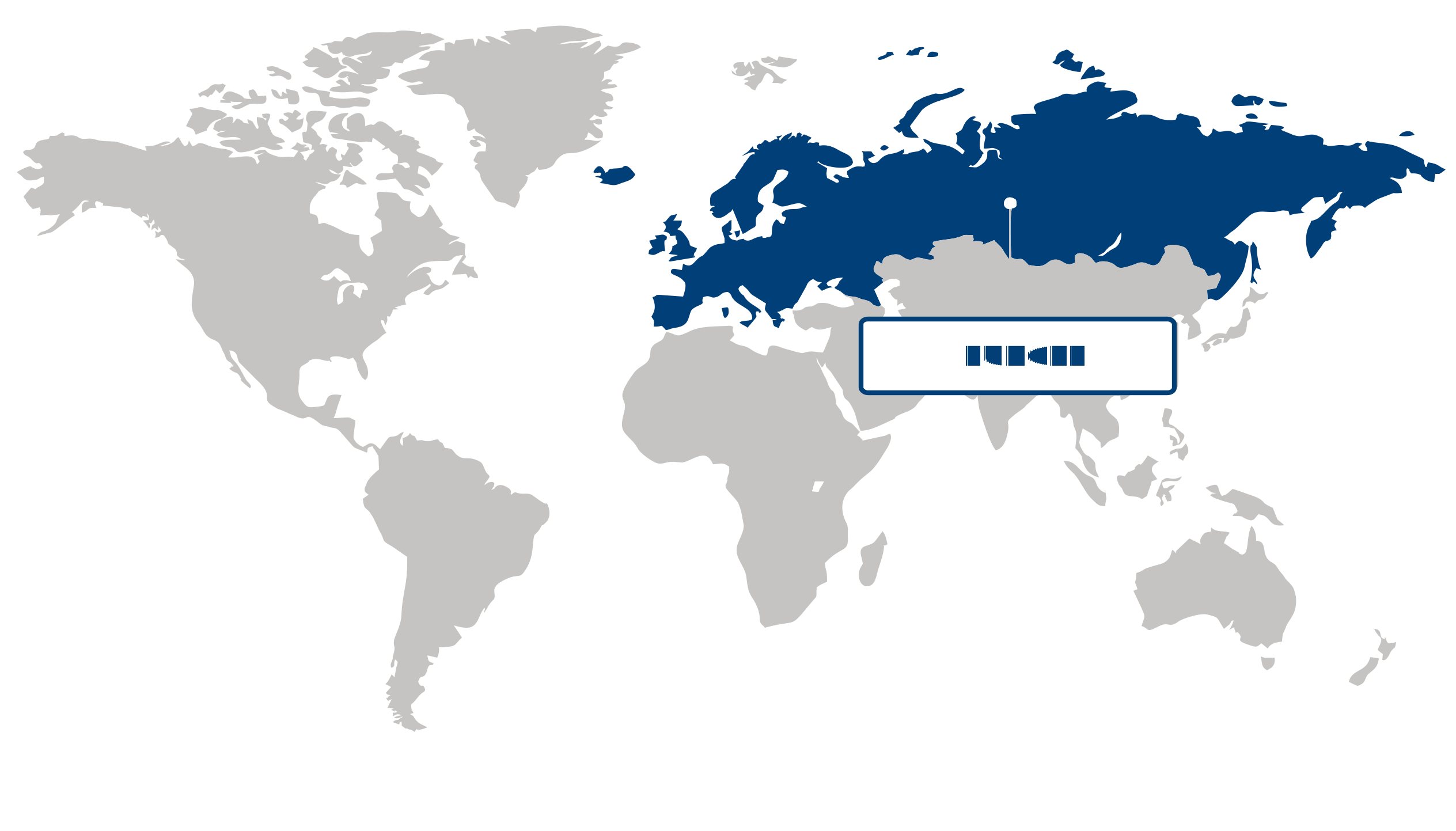
Europe (Largest Region)
Europe held the largest share of the carrageenan market at 36.46% in 2026, supported by strong demand for natural hydrocolloids across food and beverage applications. The region’s established processed-food industry uses carrageenan as a texturizing, stabilizing, and thickening ingredient in products such as dairy alternatives, desserts, sauces, and prepared foods. Growing consumer preference for clean-label and plant-derived ingredients is encouraging manufacturers to incorporate naturally sourced functional ingredients into product formulations. In addition, well-developed food processing infrastructure and stringent standards for ingredient quality and safety support consistent utilization of carrageenan across commercial applications. Expanding demand for convenient and specialty food products further strengthens the region’s established position.
Asia Pacific (Fastest-Growing Region)
Asia Pacific is emerging as the fastest-growing regional market, driven by expanding food processing activity, urbanization, and changing consumer preferences across developing economies. Rising consumption of packaged and convenience foods is creating greater demand for functional ingredients that improve product texture, stability, and shelf performance. The region’s growing dairy alternatives, confectionery, beverage, and processed-food sectors are also broadening the application base for carrageenan. Increasing investment in food manufacturing capabilities and the development of modern distribution networks are improving access to formulated food products, while greater awareness of ingredient functionality is supporting adoption among processors.
| Parameter | North America | Asia Pacific | Europe | Latin America | MEA |
|---|---|---|---|---|---|
| Innovation Hub i Scale Nascent Developing Advanced | |||||
| Cost-Sensitive Region i Scale Low Medium High | |||||
| Regulatory Environment i Scale Restrictive Neutral Supportive | |||||
| Demand Drivers i Scale Weak Moderate Strong | |||||
| Development Stage i Scale Emerging Developing Developed | |||||
| Adoption Rate i Scale Low Medium High | |||||
| New Entrants / Startups i Scale Sparse Moderate Dense | |||||
| Macro Indicators i Scale Weak Stable Strong |
Key Country Insights
Germany 🇩🇪
Functional Ingredient DevelopmentGermany prioritizes carrageenan for food stabilization, texture enhancement, and industrial formulation applications. German producers increasingly focus on product consistency, application-specific performance, and compliance with demanding food quality standards.
France 🇫🇷
Clean Label FormulationsFrance encourages the use of carrageenan in carefully formulated food applications where texture and consistency remain important. French manufacturers balance ingredient functionality with evolving consumer preferences for transparent labeling and product quality.
Italy 🇮🇹
Specialty Food IngredientItaly incorporates carrageenan into dairy products, desserts, and specialty food formulations requiring reliable stabilization. Italian food manufacturers increasingly value ingredient performance, formulation flexibility, and consistent supply to support premium product development.
Japan 🇯🇵
Premium Food ApplicationsJapan applies carrageenan in premium dairy, confectionery, and convenience food products where texture and stability are essential. Japanese manufacturers emphasize ingredient purity and formulation precision to satisfy evolving consumer quality expectations.
South Korea 🇰🇷
Processed Food ExpansionSouth Korea increases carrageenan utilization across processed foods, beverages, and cosmetic formulations. Local manufacturers seek functional ingredients that improve product texture, shelf stability, and manufacturing efficiency while supporting innovation in consumer goods.
United States 🇺🇸
Formulation Innovation HubThe U.S. uses carrageenan extensively in processed foods, beverages, and personal care formulations. Manufacturers continue refining ingredient functionality and clean-label product development while maintaining consistent raw material sourcing and quality assurance practices.
Segment Leadership and Growth Trends
Carrageenan Market Share (%), by Product Type, 2026
Go beyond the chart, access full insights & data tables
Request Free Sample ReportProduct Type Segment Analysis: Kappa (Largest Segment) vs Lambda (Fastest-Growing Segment)
In the carrageenan market, kappa carrageenan accounted for the largest share of 66.25% in 2026, primarily due to its strong gelling capability and broad applicability across food formulations. Its ability to create firm and stable textures makes it particularly suitable for processed foods, dairy-based products, desserts, and other applications where structure and consistency are important. Its established functionality and compatibility with a wide range of formulations continue to support widespread industrial use.
Lambda carrageenan is gaining traction as manufacturers seek ingredients that can provide effective thickening and viscosity enhancement without forming a firm gel. Its suitability for applications requiring smooth texture and suspension properties supports growing utilization across food and beverage formulations. Increasing demand for functional hydrocolloids that can improve product consistency and sensory characteristics is creating favorable conditions for the expansion of the lambda segment.
Function Segment Analysis: Thickening Agent (Largest Segment) vs Stabilizer (Fastest-Growing Segment)
The thickening agent segment led the carrageenan market with a 41.02% share in 2026, reflecting the importance of viscosity control across processed food and beverage formulations. Carrageenan can improve texture, body, and consistency while helping manufacturers achieve desired formulation characteristics. Its versatility in applications such as dairy products, sauces, desserts, and beverages continues to underpin demand for carrageenan used primarily as a thickening agent.
The stabilizer segment is expanding rapidly as food manufacturers place greater emphasis on maintaining product uniformity and physical stability throughout storage and consumption. Carrageenan can help prevent ingredient separation and maintain consistent texture in complex formulations, making its stabilizing function valuable across a range of products. The increasing development of processed foods with demanding formulation requirements is supporting wider use of carrageenan as a stabilizing ingredient.
| Segment | Sub-Segment | Largest Segment | Fastest Growing |
|---|---|---|---|
| Product Type | Kappa, Iota, Lambda | Kappa | Lambda |
| Function | Thickening Agent, Gelling Agent, Stabilizer, Others | Thickening Agent | Stabilizer |
| Application | Food & Beverage, Pharmaceutical, Personal Care & Cosmetics, Others | Food & Beverage | Pharmaceutical |
| Processing Technology | Alcohol Precipitation, Gel Press, Semi-refined | Semi-refined | Semi-refined |
Competitive Landscape and Market Positioning
Key companies in the carrageenan market:
1. Ingredion Incorporated (United States)
2. Cargill Incorporated (United States)
3. CP Kelco U.S. Inc. (United States)
4. Ashland Inc. (United States)
5. CEAMSA (Spain)
6. DuPont de Nemours Inc. (United States)
7. Gelymar S.A. (Chile)
8. W Hydrocolloids Inc. (Philippines)
9. PT Gumindo Perkasa Industri (Indonesia)
10. Ina Food Industry Co. Ltd. (Japan)
In the carrageenan market, demand for natural stabilizers is driving innovation in extraction and processing methods. Product development is focusing on improving functionality across food and pharmaceutical applications. The carrageenan market is also witnessing increased emphasis on sustainable sourcing practices. Continuous research is enhancing gel strength and performance consistency.
| Company | Market Share | Company Revenue | Revenue CAGR (%) | Product Portfolio | Geographic Presence | Innovation / R&D Focus | Strategic Developments |
|---|---|---|---|---|---|---|---|
| Ingredion Incorporated (United States) | |||||||
| Cargill Incorporated (United States) | |||||||
| CP Kelco U.S. Inc. (United States) | |||||||
| Ashland Inc. (United States) | |||||||
| CEAMSA (Spain) | |||||||
| DuPont de Nemours Inc. (United States) | |||||||
| Gelymar S.A. (Chile) | |||||||
| W Hydrocolloids Inc. (Philippines) | |||||||
| PT Gumindo Perkasa Industri (Indonesia) | |||||||
| Ina Food Industry Co. Ltd. (Japan). |
Industry Development/News
| Company Name | Date | Key Development |
|---|---|---|
| Cargill | Apr-26 | Cargill has completed a significant upgrade of its hydrocolloids production facility in Baupte, France, integrating Mechanical Vapor Recompression technology. This initiative aims to reduce site-level fossil fuel emissions by approximately 45% while optimizing energy efficiency, thereby strengthening supply chain resilience and competitive positioning in the production of carrageenan and xanthan gum for global food and beverage applications. |
| Bioweg | Sep-25 | German biotechnology firm Bioweg secured $19 million in Series A funding to scale industrial production of bacterial cellulose-based bio-ingredients. This capital will support the construction of a new manufacturing facility designed to provide high-performance, sustainable rheology modifiers that act as direct functional alternatives to conventional hydrocolloids, including carrageenan, in various industrial and consumer applications. |
| Danone | Sep-25 | Danone has undertaken a major modernization of its Activia brand, incorporating a refreshed product range aimed at functional health. This innovation reflects ongoing formulation shifts within the dairy industry where specialized stabilizers and texturizers, including carrageenan, are essential for maintaining product stability, shelf life, and consumer-preferred texture in gut-health-focused yogurt offerings. |
| Leyte Provincial Government | Aug-25 | The provincial government of Leyte, Philippines, launched a strategic initiative to revitalize local seaweed aquaculture. By addressing declining yields and improving cultivation techniques, the program aims to stabilize the raw material supply chain for red seaweed, a critical input for carrageenan production, ensuring long-term availability and quality control for global ingredient manufacturers. |
| Umaro Foods | Mar-24 | Umaro Foods raised $3.8 million in funding to scale the commercialization of its seaweed-based protein products. This development highlights the expanding role of marine-derived ingredients in the plant-based food sector, emphasizing the growing integration of seaweed-based hydrocolloids in meat analog formulation to achieve desired texture and stability properties. |
Customize Your Report
Explore examples of how this report can be tailored to different research needs, including custom segments, additional topics or chapters, and related reports. Click a section of the wheel or its numbered marker to explore the available options.
Carrageenan Market — Custom Segments
| Segment | Sub-Segment |
|---|---|
| Source Seaweed | Eucheuma Cottonii, Eucheuma Spinosum, Other Red Seaweeds |
| Grade | Food Grade, Pharmaceutical Grade, Industrial Grade |
| Buyer Type | Food & Beverage Manufacturers, Pharmaceutical Manufacturers, Personal Care & Cosmetics Manufacturers, Industrial Manufacturers |
Carrageenan Market — Custom TOC
| Custom Chapter | Custom Details |
|---|---|
| Clean Label Ingredient Adoption Assessment |
|
| Seaweed Supply Chain Assessment |
|
| Alternative Hydrocolloid Competitive Assessment |
|
Need a different cut of the data?
Request Custom ResearchWhat is the market valuation of carrageenan?
What is the projected value of the carrageenan industry by 2036?
How are formulation shifts toward plant-based and clean-label positioning reshaping carrageenan adoption across food manufacturing supply chains?
Why is the stabilizer function of carrageenan gaining faster traction compared with traditional thickening applications in industrial formulations?
Why is Kappa the leading product type in the carrageenan market?
Why is the stabilizer function growing fastest in the carrageenan market?
Why does Europe lead the carrageenan market?
Why is Asia Pacific emerging as the fastest-growing carrageenan market?
Which companies dominate the carrageenan landscape?
Our Clients
"The report provided a thorough look at market trends, technological advancements, and the competitive landscape. The depth of insights was really valuable."
ITC Limited
"We would highly recommend Fundamental Business Insights & Consulting to anyone looking for reliable, detailed, and comprehensive market research in the Food industry."
Tyson Foods
"The clarity and presentation of the information were commendable. The report was delivered timely, which made the overall experience smooth and convenient."
Mondelēz International
Our Research Team & Methodology
Every Fundamental Business Insights report is built by a dedicated vertical research team, validated through a structured primary-and-secondary methodology, and reviewed for accuracy before it reaches you.
Research Team Overview
Prepared by the Food & Beverage Research Team
Delivery
Published
Demand
Available
Support
Trust & Compliance
Research Domains
10 coverage areasResearch Intelligence
| Source | Reference |
|---|---|
| Food and Agriculture Organization (FAO) | www.fao.org |
| World Health Organization (WHO) | www.who.int |
| U.S. Food & Drug Administration (FDA) | www.fda.gov |
| European Food Safety Authority (EFSA) | www.efsa.europa.eu |
| U.S. Department of Agriculture (USDA) | www.usda.gov |
| Codex Alimentarius Commission | www.fao.org/fao-who-codexalimentarius |
| International Organization for Standardization (ISO) | www.iso.org |
| AOAC INTERNATIONAL | www.aoac.org |
| Institute of Food Technologists (IFT) | www.ift.org |
| International Dairy Foods Association (IDFA) | www.idfa.org |
| International Sweeteners Association (ISA) | www.sweeteners.org |
| International Probiotics Association (IPA) | internationalprobiotics.org |
| Good Food Institute (GFI) | gfi.org |
| American Feed Industry Association (AFIA) | www.afia.org |
| International Feed Industry Federation (IFIF) | ifif.org |
| Specialty Food Association (SFA) | www.specialtyfood.com |
| Brewers Association | www.brewersassociation.org |
| International Bottled Water Association (IBWA) | bottledwater.org |
| International Alliance for Dietary/Food Supplement Associations (IADSA) | www.iadsa.org |
| OECD Agriculture & Food | www.oecd.org/agriculture |
Research Workflow & Quality Assurance
Data Collection
Verified information gathered through primary and secondary research.
Data Triangulation
Cross-validation using multiple independent data sources.
Forecast Modelling
Market estimates developed using historical trends and analytical models.
Analyst Validation
Findings reviewed by domain experts for accuracy and consistency.
Editorial & Quality Review
Final editorial, quality, and compliance checks before publication.
Final Publication
Released after successful completion of the internal review process.
Report Coverage
📊 Market Assessment
- Market Size & Forecast
- Market Segmentation
- Regional Analysis
- Growth Drivers & Challenges
- Market Dynamics
🏢 Competitive Intelligence
- Competitive Landscape
- Company Profiles
- Competitive Benchmarking
- Mergers & Acquisitions
- Market Share Analysis or Key Company Strategies
🔍 Strategic Analysis
- Value Chain Analysis
- Porter's Five Forces
- PESTLE Analysis
- Pricing Trends
- Supply-Demand Analysis
🚀 Future Outlook
- Technology Landscape
- Regulatory Landscape
- Investment & Funding Landscape
- Emerging Opportunities
- Future Market Outlook
Have a question about this report or need a custom scope?
Request Customization