Carbide Tools Market Size & Growth Forecast 2027–2036, By Segments (Product Type, Application, Coating Type, End-Use), Regional Demand Trends (North America, Asia Pacific, Europe), Key Country Insights (U.S., Japan, South Korea, Germany, France, Italy), and Competitive Landscape
Market Size and Growth Outlook
Carbide Tools Market size was worth USD 13.29 Billion in 2026 and is expected to grow at 4.54% CAGR between 2027 and 2036, exceeding USD 20.72 Billion by 2036. The industry revenue for 2027 is assessed at USD 13.79 Billion.
Get more details on this report
Request Free Sample ReportCarbide Tools Market Intelligence Snapshot
Regional Market Dynamics
- Asia Pacific leads through strong manufacturing activity and extensive automotive, aerospace, machinery, and electronics production, driving demand for durable, precise, high-performance cutting solutions.
- Industrial automation, advanced production investments, and expanding manufacturing infrastructure across emerging economies are accelerating adoption and positioning Asia Pacific for the fastest growth.
Segment Momentum
- Carbide inserts accounted for 48.65% of the market in 2026 due to their excellent wear resistance, high cutting performance, extended tool life, and broad suitability for precision machining across multiple industries.
- Milling is the fastest-growing application as demand for complex, high-precision components and wider adoption of multi-axis and computer-controlled machining continue to increase the use of carbide milling tools.
Market Expansion Drivers
- Growth in precision machining and advanced manufacturing increasing carbide tool demand
- Rising industrial automation and CNC machining adoption driving tooling efficiency needs
- Advancements in wear-resistant coatings extending tool life in high-speed manufacturing
Leading Market Participants
- Prominent players in the carbide tools market include Sandvik AB (Sweden), Kennametal Inc. (United States), Mitsubishi Materials Corporation (Japan), Kyocera Corporation (Japan), OSG Corporation (Japan), Iscar Ltd. (Israel), Ceratizit Group (Luxembourg), Gühring KG (Germany), Seco Tools AB (Sweden), Walter AG (Germany)
Global Market Forecast Snapshot
Market Outlook
- 2026 Market Size: USD 13.29 Billion
- 2027 Estimated Market Size: USD 13.79 Billion
- Projected Market Size: USD 20.72 Billion by 2036
- Growth Forecast: 4.54% CAGR (2027-2036)
Regional and Segment Outlook
- Leading Regional Market: Asia Pacific
- High-Growth Regional Hub: Asia Pacific
- Core Revenue Segment: Carbide Inserts (Product Type) | Turning (Application) | PVD Coated (Coating Type) | Automotive (End-Use)
- Emerging Opportunity Segment: Carbide Wear Parts (Product Type) | Milling (Application) | CVD Coated (Coating Type) | Aerospace & Defense (End-Use)
Market Growth Drivers and Industry Trends
Growth in precision machining and advanced manufacturing increasing carbide tool demand
Manufacturers across aerospace, automotive, electronics, and medical device production are placing greater emphasis on machining accuracy, dimensional consistency, and superior surface finishes. The carbide tools market growth is driven by the increasing adoption of precision manufacturing processes that require cutting tools capable of maintaining stability under demanding operating conditions. Carbide tooling offers the hardness and rigidity needed for machining complex components while maintaining tight tolerances and reducing material waste. As production standards become more stringent, manufacturers are prioritizing tooling solutions that support consistent quality across high-volume manufacturing operations.
Rising industrial automation and CNC machining adoption driving tooling efficiency needs
The continued expansion of automated production lines and computer-controlled machining systems is increasing expectations for tools that deliver predictable performance with minimal interruption. Rising investments in digital manufacturing will propel the carbide tools market growth because automated machining environments rely on durable cutting tools that maintain accuracy throughout extended production cycles. CNC equipment is designed to operate at high speeds with limited manual intervention, making tool consistency and reliability essential for maximizing productivity. Manufacturers also seek tooling solutions that reduce changeover frequency and support uninterrupted manufacturing schedules across diverse machining applications.
Advancements in wear-resistant coatings extending tool life in high-speed manufacturing
Continuous innovation in coating technologies has significantly improved the ability of carbide cutting tools to withstand heat generation, friction, and abrasive machining environments. The carbide tools market will benefit from these developments as advanced surface coatings enable longer operational life while maintaining cutting performance during high-speed manufacturing processes. Enhanced coating properties improve resistance to oxidation and edge degradation, allowing tools to process difficult materials more effectively without frequent replacement. These performance improvements help manufacturers optimize machining efficiency while maintaining consistent component quality across demanding production environments.
| Growth Driver | Impact on CAGR | Regulatory Influence | Geographic Relevance | Adoption Rate | Impact Timeline |
|---|---|---|---|---|---|
| Growth in precision machining and advanced manufacturing increasing carbide tool demand | 1.8% | Moderate | Asia Pacific, Europe | High | Near Term |
| Rising industrial automation and CNC machining adoption driving tooling efficiency needs | 1.5% | Moderate | North America, Asia Pacific | High | Mid Term |
| Advancements in wear-resistant coatings extending tool life in high-speed manufacturing | 1.3% | Low | Europe, Asia Pacific | Medium | Mid Term |
Unlock insights tailored to your business with our bespoke market research solutions.
Click to get your customized report now.
Regional Demand Dynamics
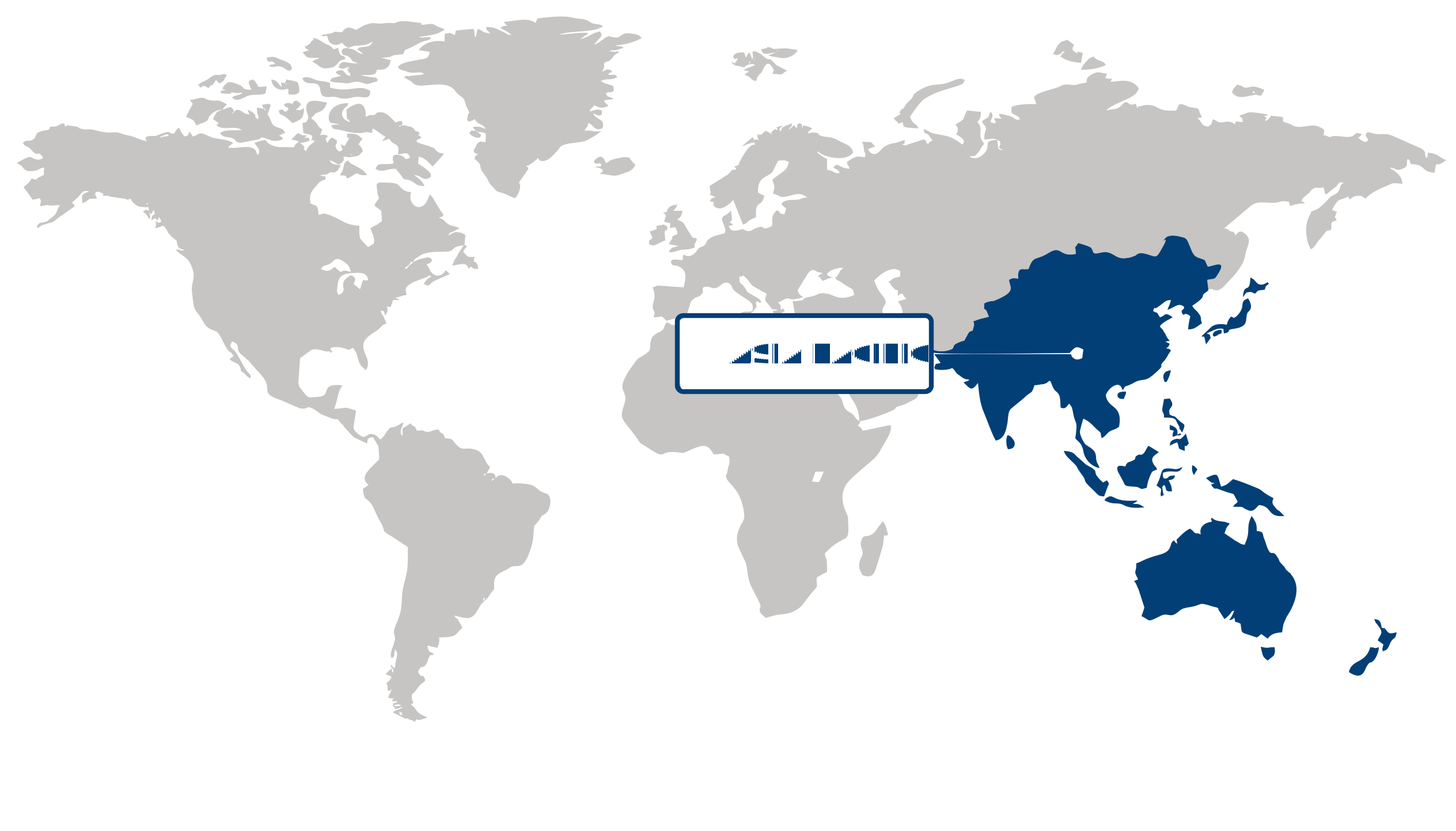
Asia Pacific (Largest & Fastest-Growing Region)
The Asia Pacific region led the carbide tools market in 2026 and is also positioned for the fastest growth, supported by strong manufacturing activity, expanding metalworking operations, and rising demand for high-performance cutting solutions. The region's extensive automotive, aerospace, machinery, and electronics manufacturing base continues to drive the adoption of carbide tools, which offer durability, precision, and improved machining efficiency. Increasing industrial automation and investments in advanced production technologies are further strengthening demand, while the expansion of manufacturing infrastructure across emerging economies is creating additional opportunities for market development.
| Parameter | North America | Asia Pacific | Europe | Latin America | MEA |
|---|---|---|---|---|---|
| Innovation Hub i Scale Nascent Developing Advanced | |||||
| Cost-Sensitive Region i Scale Low Medium High | |||||
| Regulatory Environment i Scale Restrictive Neutral Supportive | |||||
| Demand Drivers i Scale Weak Moderate Strong | |||||
| Development Stage i Scale Emerging Developing Developed | |||||
| Adoption Rate i Scale Low Medium High | |||||
| New Entrants / Startups i Scale Sparse Moderate Dense | |||||
| Macro Indicators i Scale Weak Stable Strong |
Key Country Insights
United States 🇺🇸
Precision Manufacturing SupplyThe U.S. carbide tools market benefits from continued investment in aerospace, automotive, and precision engineering applications requiring consistent machining performance. Manufacturers increasingly supply advanced tool geometries that improve productivity and reduce machining downtime.
Germany 🇩🇪
High-Precision MachiningGermany prioritizes carbide tools capable of supporting demanding machining operations across advanced manufacturing industries. Tool suppliers focus on wear resistance, dimensional accuracy, and compatibility with automated production environments.
Japan 🇯🇵
Advanced Cutting PerformanceJapan emphasizes carbide tools engineered for high-speed machining and precision component production. Local manufacturers continue refining coating technologies and cutting performance to support consistent quality across sophisticated manufacturing processes.
South Korea 🇰🇷
Electronics Manufacturing SupportSouth Korea relies on carbide tools for precision machining across electronics, automotive, and industrial equipment manufacturing. Suppliers prioritize specialized cutting solutions that deliver accuracy and extended tool life in high-volume production environments.
France 🇫🇷
Aerospace Production FocusFrance supports demand for carbide tools through precision machining requirements in aerospace and industrial manufacturing. Manufacturers emphasize tools capable of processing advanced materials while maintaining machining consistency and operational efficiency.
Italy 🇮🇹
Engineering Workshop DemandItaly maintains demand for carbide tools across engineering workshops and specialized manufacturing businesses producing high-value industrial components. Suppliers focus on versatile tooling solutions that balance machining precision, durability, and production flexibility.
Segment Leadership and Growth Trends
Carbide Tools Market Share (%), by Product Type, 2026
Go beyond the chart, access full insights & data tables
Request Free Sample ReportProduct Type Segment Analysis: Carbide Inserts (Largest Segment) vs Carbide Wear Parts (Fastest-Growing Segment)
The carbide inserts segment dominated the carbide tools market with a 48.65% share in 2026. Its leading position is attributed to extensive use in precision machining operations across automotive, aerospace, heavy equipment, and general manufacturing industries. Carbide inserts provide excellent wear resistance, high cutting performance, and extended tool life, enabling manufacturers to improve machining efficiency while maintaining consistent product quality. Their compatibility with a broad range of machining applications further reinforces their market leadership.
The carbide wear parts segment is expected to record the fastest growth as industries increasingly require components capable of withstanding severe abrasion, impact, and high-stress operating environments. Growing demand from mining, construction, energy, and industrial processing applications is encouraging wider adoption of carbide wear parts. Continuous improvements in material engineering and the need to reduce equipment downtime are further supporting the expansion of this segment.
Application Segment Analysis: Turning (Largest Segment) vs Milling (Fastest-Growing Segment)
Holding the largest share of the carbide tools market, the turning application segment accounted for 46.53% in 2026. Turning remains one of the most widely performed machining operations in manufacturing, driving consistent demand for durable carbide tooling capable of delivering precision, productivity, and extended operational life. The increasing production of complex metal components and the need for high-quality surface finishes continue to strengthen the adoption of carbide tools for turning applications.
The milling application segment is anticipated to grow at the fastest pace due to increasing demand for complex component manufacturing across industries requiring high dimensional accuracy. Advancements in multi-axis machining technologies and expanding use of computer-controlled manufacturing processes are encouraging greater utilization of carbide milling tools. The industry's focus on higher productivity and precision machining continues to create favorable conditions for this segment.
Coating Type Segment Analysis: PVD Coated (Largest Segment) vs CVD Coated (Fastest-Growing Segment)
The PVD coated segment held the largest share of the carbide tools market in 2026. Its dominance is supported by the superior surface hardness, reduced friction, and enhanced wear resistance provided by physical vapor deposition coatings. These characteristics improve machining performance across a variety of materials while extending tool life and maintaining dimensional accuracy. The versatility of PVD-coated carbide tools across numerous manufacturing applications further contributes to the segment’s leadership.
The CVD coated segment is expected to witness the fastest growth as manufacturers increasingly seek tooling solutions capable of handling demanding cutting conditions and prolonged production cycles. Chemical vapor deposition coatings offer excellent thermal stability and resistance to wear, making them particularly suitable for high-speed machining and heavy-duty operations. Growing industrial automation and rising demand for efficient machining processes continue to support the adoption of CVD-coated carbide tools.
| Segment | Sub-Segment | Largest Segment | Fastest Growing |
|---|---|---|---|
| Product Type | Carbide Inserts, Carbide Cutting Tools, Carbide Tool Holders, Carbide Wear Parts | Carbide Inserts | Carbide Wear Parts |
| Application | Turning, Milling, Drilling, Boring, Threading, Others | Turning | Milling |
| Coating Type | PVD Coated, CVD Coated, TiN (Titanium Nitride) Coated, Uncoated, Others | PVD Coated | CVD Coated |
| End-Use | Automotive, Aerospace & Defense, Construction, Machinery Manufacturing, Oil & Gas, Power Generation, Others | Automotive | Aerospace & Defense |
Competitive Landscape and Market Positioning
Major players in the carbide tools market:
- Sandvik AB (Sweden)
- Kennametal, Inc. (United States)
- Mitsubishi Materials Corporation (Japan)
- Kyocera Corporation (Japan)
- OSG Corporation (Japan)
- Iscar Ltd. (Israel)
- Ceratizit Group (Luxembourg)
- Gühring KG (Germany)
- Seco Tools AB (Sweden)
- Walter AG (Germany)
Manufacturing industries are placing increasing emphasis on machining efficiency and precision, driving carbide tool manufacturers to compete through advanced material engineering and application-specific performance. Product development is increasingly focused on extending tool life, improving wear resistance, and supporting high-speed machining across a wider range of workpiece materials, making technical innovation a central competitive differentiator. At the same time, suppliers are expanding value through specialized tooling solutions and process optimization support, encouraging a shift away from standardized offerings toward more customized and performance-oriented portfolios.
| Company | Market Share | Company Revenue | Revenue CAGR (%) | Product Portfolio | Geographic Presence | Innovation / R&D Focus | Strategic Developments |
|---|---|---|---|---|---|---|---|
| Sandvik AB (Sweden) | |||||||
| Kennametal Inc. (United States) | |||||||
| Mitsubishi Materials Corporation (Japan) | |||||||
| Kyocera Corporation (Japan) | |||||||
| OSG Corporation (Japan) | |||||||
| Iscar Ltd. (Israel) | |||||||
| Ceratizit Group (Luxembourg) | |||||||
| Gühring KG (Germany) | |||||||
| Seco Tools AB (Sweden) | |||||||
| Walter AG (Germany) |
Industry Development/News
| Company Name | Date | Key Development |
|---|---|---|
| Aidite Precision | Mar-26 | Aidite Precision raised product pricing in response to sustained increases in tungsten raw material costs. This development highlights the reactive measures taken by cemented carbide tool manufacturers to offset rising input expenses, demonstrating the sensitivity of the market to raw material supply and pricing dynamics. |
| Tungaloy | Feb-26 | Tungaloy introduced modular, exchangeable-head cutting tools designed to mitigate rising carbide costs. By allowing for the replacement of individual tool heads rather than the entire tool assembly, this design strategy addresses material efficiency and operational cost reduction for manufacturers facing supply chain and raw material price pressures. |
| Huarui Precision | Dec-25 | Huarui Precision implemented price increases across its product portfolio, citing a significant surge in tungsten raw material costs. This adjustment reflects broader economic pressures within the precision tool manufacturing sector, illustrating how input cost volatility for essential raw materials is being passed through the value chain to sustain production economics. |
Customize Your Report
Explore examples of how this report can be tailored to different research needs, including custom segments, additional topics or chapters, and related reports. Click a section of the wheel or its numbered marker to explore the available options.
Carbide Tools Market — Custom Segments
| Segment | Sub-Segment |
|---|---|
| Workpiece Material | Steel, Stainless Steel, Cast Iron, Non-Ferrous Metals, Superalloys & Titanium |
| Machine Tool Type | CNC Machine Tools, Conventional Machine Tools, Swiss-Type Machines, Multi-Tasking Machines |
| Sales Channel | Direct Sales, Industrial Distributors, Online Sales |
Carbide Tools Market — Custom TOC
| Custom Chapter | Custom Details |
|---|---|
| Tool Lifecycle Economics |
|
| Advanced Material Substitution Outlook |
|
| Manufacturing Process Adoption |
|
Need a different cut of the data?
Request Custom ResearchHow much revenue does the carbide tools market generate?
What is the projected value of the carbide tools industry by 2036?
How is industrial automation influencing demand in the carbide tools market?
Why are advanced coatings becoming strategically important in the carbide tools market?
Why do carbide inserts hold the largest share of the carbide tools market?
Which application segment is growing the fastest in the carbide tools market?
Why does Asia Pacific lead the carbide tools market?
How is Asia Pacific supporting future growth in carbide tools?
What are the prominent companies operating in the carbide tools landscape?
Our Clients
"Your insights on workforce structures were spot-on. The analysis on mid-to-senior level roles validated some of our hiring decisions and highlighted gaps."
Ateliers De France
"The report gave us insights on competitors in the market. It helped our team refine our bidding strategy for upcoming contracts."
Clark Construction
"The reports provided a deep dive into market trends, and competitive landscape. The strategic insights and recommendations have been very helpful."
Rudolph and Sletten
Our Research Team & Methodology
Every Fundamental Business Insights report is built by a dedicated vertical research team, validated through a structured primary-and-secondary methodology, and reviewed for accuracy before it reaches you.
Research Team Overview
Prepared by the Construction & Manufacturing Research Team
Delivery
Published
Demand
Available
Support
Trust & Compliance
Research Domains
10 coverage areasResearch Intelligence
| Source | Reference |
|---|---|
| International Organization for Standardization (ISO) | www.iso.org |
| ASTM International | www.astm.org |
| National Institute of Standards and Technology (NIST) | www.nist.gov |
| International Code Council (ICC) | www.iccsafe.org |
| American Concrete Institute (ACI) | www.concrete.org |
| American Institute of Steel Construction (AISC) | www.aisc.org |
| Construction Industry Institute (CII) | www.construction-institute.org |
| Associated General Contractors of America (AGC) | www.agc.org |
| Association of Equipment Manufacturers (AEM) | www.aem.org |
| Building Owners and Managers Association (BOMA) | www.boma.org |
| American Society of Civil Engineers (ASCE) | www.asce.org |
| National Ready Mixed Concrete Association (NRMCA) | www.nrmca.org |
| International Facility Management Association (IFMA) | www.ifma.org |
| World Green Building Council (WorldGBC) | worldgbc.org |
| International Federation of Consulting Engineers (FIDIC) | fidic.org |
| International Labour Organization (ILO) | www.ilo.org |
| American Society of Mechanical Engineers (ASME) | www.asme.org |
| Society of Manufacturing Engineers (SME) | www.sme.org |
| National Association of Home Builders (NAHB) | www.nahb.org |
| European Construction Industry Federation (FIEC) | www.fiec.eu |
Research Workflow & Quality Assurance
Data Collection
Verified information gathered through primary and secondary research.
Data Triangulation
Cross-validation using multiple independent data sources.
Forecast Modelling
Market estimates developed using historical trends and analytical models.
Analyst Validation
Findings reviewed by domain experts for accuracy and consistency.
Editorial & Quality Review
Final editorial, quality, and compliance checks before publication.
Final Publication
Released after successful completion of the internal review process.
Report Coverage
📊 Market Assessment
- Market Size & Forecast
- Market Segmentation
- Regional Analysis
- Growth Drivers & Challenges
- Market Dynamics
🏢 Competitive Intelligence
- Competitive Landscape
- Company Profiles
- Competitive Benchmarking
- Mergers & Acquisitions
- Market Share Analysis or Key Company Strategies
🔍 Strategic Analysis
- Value Chain Analysis
- Porter's Five Forces
- PESTLE Analysis
- Pricing Trends
- Supply-Demand Analysis
🚀 Future Outlook
- Technology Landscape
- Regulatory Landscape
- Investment & Funding Landscape
- Emerging Opportunities
- Future Market Outlook
Have a question about this report or need a custom scope?
Request Customization