Cane Chopper Market Size & Growth Forecast 2027–2036, By Segments (Design, Distribution Channel, Product Type, Capacity, End-User Industry), Regional Demand Trends (North America, Asia Pacific, Europe), Key Country Insights (U.S., Japan, South Korea, Germany, France, Italy), and Competitive Landscape
Market Size and Growth Outlook
Cane Chopper Market size stood at USD 1.55 Billion in 2026 and is predicted to grow at 23.56% CAGR from 2027 to 2036, surpassing USD 12.86 Billion by 2036. The industry revenue for 2027 is calculated at USD 1.87 Billion.
Get more details on this report
Request Free Sample ReportCane Chopper Market Intelligence Snapshot
Regional Market Dynamics
- Asia Pacific held 40.07% share in 2026, supported by substantial sugarcane cultivation, agricultural mechanization, farm commercialization, and improving rural infrastructure.
- North America is projected to grow fastest as producers adopt mechanized, precision-enabled equipment to improve productivity, reduce manual intervention, and address labor challenges.
Segment Momentum
- Stationary choppers held 63.17% of the market in 2026 due to their stable operating platform, consistent cutting performance, and suitability for repeated cane processing in dedicated work areas.
- Handheld choppers are the fastest-growing design segment because they offer portability, operational flexibility, and convenient on-site processing for users requiring mobile and space-efficient cane-cutting solutions.
Market Expansion Drivers
- Increasing mechanization of sugarcane harvesting driving adoption of advanced agricultural machinery
- Expansion of sugar production industries boosting demand for harvesting and processing equipment
- Rising integration of automated sugarcane harvesting systems improving operational efficiency in plantations
Leading Market Participants
- Key players in the cane chopper market include John Deere (United States), CNH Industrial N.V. (United Kingdom), AGCO Corporation (United States), Mahindra & Mahindra Ltd. (India), Zoomlion Heavy Industry Science & Technology Co., Ltd. (China), Jacto Inc. (Brazil), BMA Group (Germany), Saisidha Sugar Equipment & Engineering Co. (India), Ulka Industries Pvt. Ltd. (India), Tata Agrico (India)
Global Market Forecast Snapshot
Market Outlook
- 2026 Market Size: USD 1.55 Billion
- 2027 Estimated Market Size: USD 1.87 Billion
- Projected Market Size: USD 12.86 Billion by 2036
- Growth Forecast: 23.56% CAGR (2027-2036)
Regional and Segment Outlook
- Leading Regional Market: Asia Pacific
- High-Growth Regional Hub: North America
- Core Revenue Segment: Stationary Choppers (Design) | Direct (Distribution Channel) | Electric Cane Choppers (Product Type) | Large Capacity (10-20 Tons/hour) (Capacity) | Sugar Mills (End-User Industry)
- Emerging Opportunity Segment: Handheld Choppers (Design) | Direct (Distribution Channel) | Electric Cane Choppers (Product Type) | Heavy-Duty Capacity (Over 20 Tons/hour) (Capacity) | Large Commercial Farms (End-User Industry)
Market Growth Drivers and Industry Trends
Increasing mechanization of sugarcane harvesting driving adoption of advanced agricultural machinery
The transition from labor-intensive harvesting methods to mechanized field operations is encouraging growers to invest in equipment that improves harvesting speed, consistency, and crop handling. The cane chopper market is benefiting from this shift as agricultural producers seek machines capable of efficiently cutting and preparing sugarcane for transportation and downstream processing. Mechanized harvesting also helps address seasonal labor shortages, reduces operational delays, and supports large-scale plantation management with greater productivity.
Expansion of sugar production industries boosting demand for harvesting and processing equipment
Growing investments in sugar manufacturing capacity are increasing the need for reliable harvesting equipment that ensures a steady supply of raw material to processing facilities. As sugar production industries expand, the cane chopper market is driven by demand for machinery that can improve harvesting efficiency, reduce crop losses, and maintain uniform cane quality before processing. Well-coordinated harvesting operations also help processing plants optimize production schedules by ensuring timely delivery of harvested sugarcane.
Rising integration of automated sugarcane harvesting systems improving operational efficiency in plantations
Agricultural producers are increasingly incorporating automation into harvesting operations to improve precision, reduce manual intervention, and enhance equipment utilization across plantations. This trend will propel the cane chopper market growth as automated harvesting systems integrate advanced control technologies that optimize cutting performance under varying field conditions. Improved machine coordination and streamlined harvesting workflows enable plantation operators to manage larger cultivation areas while maintaining consistent harvesting quality and operational reliability.
| Growth Driver | Impact on CAGR | Regulatory Influence | Geographic Relevance | Adoption Rate | Impact Timeline |
|---|---|---|---|---|---|
| Increasing mechanization of sugarcane harvesting driving adoption of advanced agricultural machinery | 2% | Low | Asia Pacific, Latin America | High | Near Term |
| Expansion of sugar production industries boosting demand for harvesting and processing equipment | 1.8% | Moderate | Asia Pacific, Africa | High | Near Term |
| Rising integration of automated sugarcane harvesting systems improving operational efficiency in plantations | 1.6% | Low | Latin America, Asia Pacific | Medium | Mid Term |
Unlock insights tailored to your business with our bespoke market research solutions.
Click to get your customized report now.
Regional Demand Dynamics
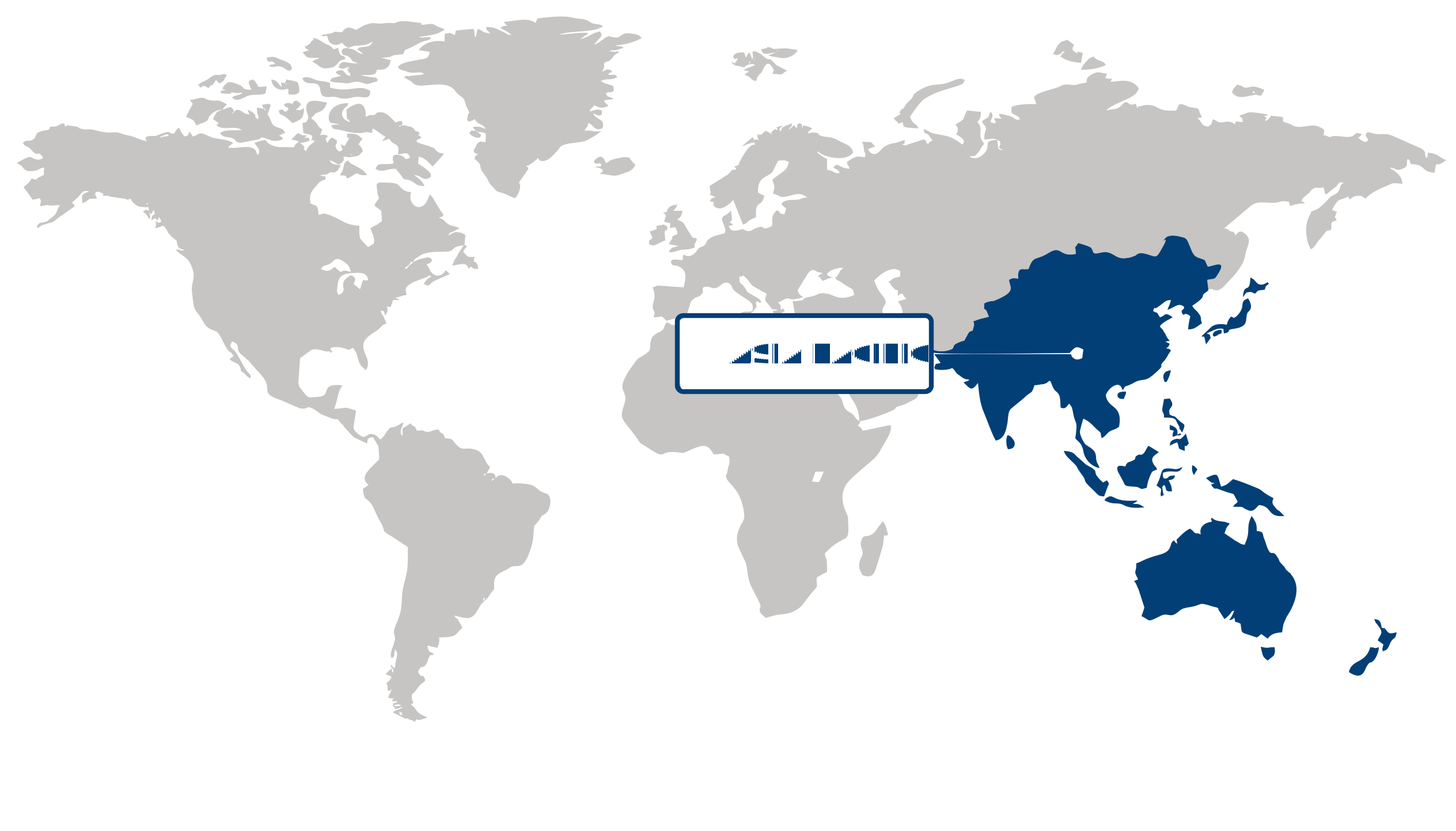
Asia Pacific (Largest Region)
Asia Pacific held the largest share of the cane chopper market at 40.07% in 2026, driven by the region’s substantial sugarcane cultivation, expanding agricultural mechanization, and strong demand for equipment that improves harvesting and crop-processing efficiency. The widespread presence of sugarcane farming across major agricultural economies creates a broad user base for mechanized chopping equipment, particularly as producers seek to reduce labor dependence and improve field productivity. Rising adoption of modern agricultural machinery, increasing farm commercialization, and improvements in rural infrastructure are supporting greater use of cane choppers. In addition, efforts to improve post-harvest handling and reduce crop losses are encouraging farmers and agricultural operators to invest in equipment that enables faster and more efficient processing of harvested cane.
North America (Fastest-Growing Region)
North America is anticipated to experience the fastest growth as agricultural producers increasingly adopt mechanized equipment to improve operational efficiency and address labor-related challenges. Technological advancements in agricultural machinery, greater use of precision farming practices, and increasing emphasis on reducing manual intervention are creating opportunities for specialized crop-processing equipment. Although the regional sugarcane cultivation base is more concentrated, modernization of agricultural operations and demand for equipment that can improve productivity and reduce processing time are supporting market expansion. Increasing integration of automated and digitally enabled machinery is also likely to strengthen demand for efficient cane-chopping solutions.
| Parameter | North America | Asia Pacific | Europe | Latin America | MEA |
|---|---|---|---|---|---|
| Innovation Hub i Scale Nascent Developing Advanced | |||||
| Cost-Sensitive Region i Scale Low Medium High | |||||
| Regulatory Environment i Scale Restrictive Neutral Supportive | |||||
| Demand Drivers i Scale Weak Moderate Strong | |||||
| Development Stage i Scale Emerging Developing Developed | |||||
| Adoption Rate i Scale Low Medium High | |||||
| New Entrants / Startups i Scale Sparse Moderate Dense | |||||
| Macro Indicators i Scale Weak Stable Strong |
Key Country Insights
United States 🇺🇸
Precision Harvest SolutionsThe U.S. cane chopper market emphasizes mechanized harvesting systems that improve labor efficiency and reduce crop losses. Buyers increasingly prioritize equipment compatibility with precision agriculture technologies and lower maintenance requirements for large-scale sugarcane operations.
Germany 🇩🇪
Engineering-Driven EquipmentGermany focuses on technologically advanced cane chopper components, emphasizing durability, precision cutting, and equipment efficiency. German manufacturers support the market through engineering expertise and innovations that enhance machine reliability in demanding harvesting conditions.
Japan 🇯🇵
Compact Mechanization FocusJapan prioritizes compact and efficient cane chopper equipment suited to specialized farming environments and operational precision. The country emphasizes automation, fuel efficiency, and equipment designs that simplify maintenance while supporting consistent harvesting performance.
South Korea 🇰🇷
Smart Machinery IntegrationSouth Korea advances the cane chopper market through smart agricultural machinery technologies and digital equipment integration. South Korean suppliers increasingly focus on sensor-enabled systems that improve operational monitoring, maintenance planning, and harvesting efficiency.
France 🇫🇷
Sustainable Harvest EquipmentFrance promotes cane chopper solutions that align with sustainable farming practices and efficient resource utilization. French buyers increasingly value machines capable of reducing crop waste while supporting environmentally conscious agricultural operations in overseas sugar-producing regions.
Italy 🇮🇹
Specialized Equipment DevelopmentItaly contributes to the cane chopper market through specialized agricultural machinery manufacturing and adaptable equipment designs. Italian companies emphasize modular configurations and component quality that enable flexible deployment across different harvesting environments.
Segment Leadership and Growth Trends
Cane Chopper Market Share (%), by Design, 2026
Go beyond the chart, access full insights & data tables
Request Free Sample ReportDesign Segment Analysis: Stationary Choppers (Largest Segment) vs Handheld Choppers (Fastest-Growing Segment)
The stationary choppers segment accounted for the largest market share of 63.17% in 2026 in the cane chopper market. Stationary cane choppers are widely used because they provide a stable operating platform for processing cane and can support consistent cutting performance during repeated operations. Their fixed configuration can facilitate more controlled processing and is well suited to users who conduct cane preparation in designated work areas. The established use of stationary equipment and its ability to support dependable operation contribute to strong demand. As users continue to prioritize efficiency and consistency in cane processing, stationary choppers retain a leading position.
The handheld choppers segment is expected to be the fastest-growing segment as users increasingly seek portable and flexible solutions for cane-cutting activities. Handheld cane choppers can be moved easily between locations and provide greater convenience for operations that require mobility or on-site processing. Their compact form can also make them suitable for users with limited space or those seeking equipment that can be deployed quickly. Growing demand for flexible tools that support convenient handling and localized cane preparation is encouraging adoption of handheld choppers.
Distribution Channel Segment Analysis: Direct (Largest & Fastest-Growing Segment)
The direct distribution channel segment dominated the cane chopper market and is also expected to be the fastest-growing segment in 2026. Direct purchasing enables customers to engage closely with manufacturers or specialized suppliers when selecting equipment suited to their cane-processing requirements. This channel can provide better access to product information, technical guidance, customization options, and after-sales support. Direct supplier relationships are particularly valuable for equipment buyers seeking clarity regarding operation, maintenance, and product suitability. As users increasingly seek reliable equipment and more personalized purchasing support, direct distribution continues to strengthen its market position.
Product Type Segment Analysis: Electric Cane Choppers (Largest & Fastest-Growing Segment)
The electric cane choppers segment held the largest share of the cane chopper market and is also projected to be the fastest-growing segment in 2026. Electric cane choppers provide a convenient alternative to fully manual processing by reducing physical effort and supporting more consistent cutting operations. Their ease of operation and suitability for users seeking improved productivity contribute to strong demand. Electric models can also offer greater convenience for repeated cane-processing activities while reducing dependence on manual labor. As users increasingly adopt powered equipment to improve efficiency and simplify routine operations, electric cane choppers continue to gain market traction.
| Segment | Sub-Segment | Largest Segment | Fastest Growing |
|---|---|---|---|
| Design | Handheld Choppers, Stationary Choppers | Stationary Choppers | Handheld Choppers |
| Distribution Channel | Direct, Indirect | Direct | Direct |
| Product Type | Manual Cane Choppers, Electric Cane Choppers, Tractor-Mounted Cane Choppers | Electric Cane Choppers | Electric Cane Choppers |
| Capacity | Small Capacity (Under 5 Tons/hour), Medium Capacity (5-10 Tons/hour), Large Capacity (10-20 Tons/hour), Heavy-Duty Capacity (Over 20 Tons/hour) | Large Capacity (10-20 Tons/hour) | Heavy-Duty Capacity (Over 20 Tons/hour) |
| End-User Industry | Sugar Mills, Agricultural Cooperatives, Large Commercial Farms, Small to Medium Farming Enterprises, Others | Sugar Mills | Large Commercial Farms |
Competitive Landscape and Market Positioning
Prominent players in the cane chopper market:
- John Deere (United States)
- CNH Industrial N.V. (United Kingdom)
- AGCO Corporation (United States)
- Mahindra & Mahindra Ltd. (India)
- Zoomlion Heavy Industry Science & Technology Co., Ltd. (China)
- Jacto, Inc. (Brazil)
- BMA Group (Germany)
- Saisidha Sugar Equipment & Engineering Co. (India)
- Ulka Industries Pvt. Ltd. (India)
- Tata Agrico (India)
Mechanization trends are reshaping competitive priorities as equipment manufacturers focus on improving harvesting efficiency, reducing crop losses, and supporting reliable operation across varying field conditions. Suppliers are differentiating through designs that balance durability with simplified maintenance, allowing operators to minimize downtime during intensive harvesting periods while adapting to different sugarcane cultivation practices. The market is also seeing stronger competition around equipment compatibility with modern harvesting systems and replacement parts availability, making lifecycle support and operational dependability increasingly important factors in purchasing decisions.
| Company | Market Share | Company Revenue | Revenue CAGR (%) | Product Portfolio | Geographic Presence | Innovation / R&D Focus | Strategic Developments |
|---|---|---|---|---|---|---|---|
| John Deere (United States) | |||||||
| CNH Industrial N.V. (United Kingdom) | |||||||
| AGCO Corporation (United States) | |||||||
| Mahindra & Mahindra Ltd. (India) | |||||||
| Zoomlion Heavy Industry Science & Technology Co. Ltd. (China) | |||||||
| Jacto Inc. (Brazil) | |||||||
| BMA Group (Germany) | |||||||
| Saisidha Sugar Equipment & Engineering Co. (India) | |||||||
| Ulka Industries Pvt. Ltd. (India) | |||||||
| Tata Agrico (India) |
Industry Development/News
| Company Name | Date | Key Development |
|---|---|---|
| CNH Industrial | Sep-25 | CNH Industrial completed a major commercial deployment of agricultural machinery in India, delivering 117 Case IH sugarcane harvesters and 234 New Holland tractors to a leading sugarcane producer in Maharashtra, expanding mechanized harvesting infrastructure in the region. |
| Mahindra & Mahindra | Apr-25 | Mahindra & Mahindra formed a strategic partnership with Gangamai Industries to integrate artificial intelligence-based harvesting planning and satellite monitoring for sugarcane crops in Maharashtra, optimizing crop health tracking and harvest timing to enhance sugar recovery. |
Customize Your Report
Explore examples of how this report can be tailored to different research needs, including custom segments, additional topics or chapters, and related reports. Click a section of the wheel or its numbered marker to explore the available options.
Cane Chopper Market — Custom Segments
| Segment | Sub-Segment |
|---|---|
| Automation Level | Manual, Semi-Automatic, Fully Automatic |
| Ownership Model | Owned Equipment, Leased Equipment, Contracted Chopping Services |
| Replacement Cycle | Less Than 5 Years, 5–10 Years, More Than 10 Years |
Cane Chopper Market — Custom TOC
| Custom Chapter | Custom Details |
|---|---|
| Mechanization Economics for Sugarcane Harvesting |
|
| Farmer Adoption and Equipment Financing Landscape |
|
| Aftermarket Service and Parts Opportunity |
|
Need a different cut of the data?
Request Custom ResearchHow large is the cane chopper market?
What is the anticipated CAGR of the cane chopper industry?
How is agricultural mechanization accelerating adoption of cane chopper equipment?
How are automation trends improving operational efficiency in sugarcane harvesting?
Why do stationary choppers lead the cane chopper market?
Which design segment is growing the fastest in the cane chopper market?
How does Asia Pacific maintain its leading position in the cane chopper market?
Why is North America expected to be the fastest-growing region for cane choppers?
Who holds a significant market share in the cane chopper landscape?
Our Clients
"The team at Fundamental Business Insights & Consulting demonstrated a commitment to excellence, not only in the quality of the report but also in their client-centric approach."
FANUC
"The level of detail in the market segmentation provided were particularly noteworthy. The detailed country-level insights were also very helpful."
B&R Industrial Automation GmbH
"The consultant took the time to understand our specific business objectives, ensuring that the reports were tailored to address our unique challenges and opportunities."
KUKA SE & Co. KGaA
Our Research Team & Methodology
Every Fundamental Business Insights report is built by a dedicated vertical research team, validated through a structured primary-and-secondary methodology, and reviewed for accuracy before it reaches you.
Research Team Overview
Prepared by the Industrial Automation & Equipment Research Team
Delivery
Published
Demand
Available
Support
Trust & Compliance
Research Domains
10 coverage areasResearch Intelligence
| Source | Reference |
|---|---|
| International Society of Automation (ISA) | www.isa.org |
| International Organization for Standardization (ISO) | www.iso.org |
| National Institute of Standards and Technology (NIST) | www.nist.gov |
| IEEE | www.ieee.org |
| VDMA (German Mechanical Engineering Industry Association) | www.vdma.org |
| Association for Advancing Automation (A3) | www.automate.org |
| International Federation of Robotics (IFR) | ifr.org |
| ASME (American Society of Mechanical Engineers) | www.asme.org |
| ASHRAE | www.ashrae.org |
| American Society of Heating, Refrigerating and Air-Conditioning Engineers (ASHRAE) | www.ashrae.org |
| Material Handling Industry (MHI) | www.mhi.org |
| OSHA (Occupational Safety and Health Administration) | www.osha.gov |
| National Fire Protection Association (NFPA) | www.nfpa.org |
| ASTM International | www.astm.org |
| International Electrotechnical Commission (IEC) | www.iec.ch |
| Open Process Automation Forum (The Open Group) | www.opengroup.org/open-process-automation-forum |
| AGMA (American Gear Manufacturers Association) | www.agma.org |
| Association of Equipment Manufacturers (AEM) | www.aem.org |
| Food and Agriculture Organization (FAO) | www.fao.org |
| International Labour Organization (ILO) | www.ilo.org |
Research Workflow & Quality Assurance
Data Collection
Verified information gathered through primary and secondary research.
Data Triangulation
Cross-validation using multiple independent data sources.
Forecast Modelling
Market estimates developed using historical trends and analytical models.
Analyst Validation
Findings reviewed by domain experts for accuracy and consistency.
Editorial & Quality Review
Final editorial, quality, and compliance checks before publication.
Final Publication
Released after successful completion of the internal review process.
Report Coverage
📊 Market Assessment
- Market Size & Forecast
- Market Segmentation
- Regional Analysis
- Growth Drivers & Challenges
- Market Dynamics
🏢 Competitive Intelligence
- Competitive Landscape
- Company Profiles
- Competitive Benchmarking
- Mergers & Acquisitions
- Market Share Analysis or Key Company Strategies
🔍 Strategic Analysis
- Value Chain Analysis
- Porter's Five Forces
- PESTLE Analysis
- Pricing Trends
- Supply-Demand Analysis
🚀 Future Outlook
- Technology Landscape
- Regulatory Landscape
- Investment & Funding Landscape
- Emerging Opportunities
- Future Market Outlook
Have a question about this report or need a custom scope?
Request Customization