Building Thermal Insulation Market Size & Growth Forecast 2027–2036, By Segments (End-use, Product, Application), Regional Demand Trends (North America, Asia Pacific, Europe), Key Country Insights (U.S., Japan, South Korea, Germany, France, Italy), and Competitive Landscape
Market Size and Growth Outlook
Building Thermal Insulation Market size was around USD 30 billion in 2026 and is slated to grow at a 5.7% CAGR from 2027 to 2036, crossing USD 52.22 billion by 2036. The industry revenue for 2027 is calculated at USD 31.44 billion.
Get more details on this report
Request Free Sample ReportBuilding Thermal Insulation Market Intelligence Snapshot
Regional Market Dynamics
- Europe held a 36.99% market share in 2026, supported by stringent energy performance standards, steady renovation activity, and widespread insulation use across new construction and retrofit projects.
- Asia Pacific is projected to grow at a 5.36% CAGR, driven by large-scale construction, increasing focus on energy-efficient buildings, and broader insulation adoption across rapidly urbanizing markets.
Segment Momentum
- Glass Wool held a 39.33% share in 2026, supported by its broad use across walls, roofs, and partitions where established installation practices and widespread availability drive consistent demand.
- Residential is the fastest-growing segment as homeowners and developers increasingly prioritize insulation in new construction and renovation projects to improve comfort and reduce household operating costs.
Market Expansion Drivers
- Favorable building energy efficiency regulations accelerating thermal insulation adoption across residential and commercial projects.
- Shift toward recyclable and eco-friendly insulation materials driven by restrictions on plastic foam usage.
- Rising residential renovation activity and urban housing expansion boosting building envelope insulation upgrades.
Leading Market Participants
- Prominent players in the building thermal insulation market include Saint-Gobain S.A. (France), Owens Corning (United States), BASF SE (Germany), Kingspan Group plc (Ireland), Knauf Insulation (Germany), Rockwool International A/S (Denmark), Dow Inc. (United States), Berkshire Hathaway Inc. (Johns Manville Corporation) (United States), GAF Materials Corporation (United States), Huntsman Corporation (United States).
Global Market Forecast Snapshot
Market Outlook
- 2026 Market Size: USD 30 billion
- 2027 Estimated Market Size: USD 31.44 billion.
- Projected Market Size: USD 52.22 billion by 2036
- Growth Forecast: 5.7% CAGR (2027-2036)
Regional and Segment Outlook
- Leading Regional Market: Europe
- High-Growth Regional Hub: Asia Pacific
- Core Revenue Segment: Residential (End-use) | Glass Wool (Product) | Walls (Application)
- Emerging Opportunity Segment: Residential (End-use) | EPS (Product) | Walls (Application)
Market Growth Drivers and Industry Trends
Favorable building energy efficiency regulations accelerating thermal insulation adoption across residential and commercial projects
Favorable energy-efficiency regulations will drive building thermal insulation market growth by requiring developers and building owners to improve the thermal performance of structures. Insulation helps reduce unwanted heat transfer through walls, roofs, floors, and other parts of the building envelope, supporting lower heating and cooling requirements and improved indoor comfort. As regulatory frameworks increasingly emphasize energy performance in both new construction and building upgrades, insulation becomes an important component of compliance-oriented construction and renovation projects.
Shift toward recyclable and eco-friendly insulation materials driven by restrictions on plastic foam usage
The shift toward sustainable construction materials is reshaping the building thermal insulation market as restrictions on certain plastic foam products encourage manufacturers and builders to consider recyclable and lower-impact alternatives. Materials designed with recycled content, improved recyclability, or reduced environmental footprints can help address sustainability requirements while retaining the thermal and acoustic performance expected from insulation systems. Growing attention to material sourcing, waste reduction, and the environmental impact of construction products is also influencing specification decisions among developers and building contractors.
Rising residential renovation activity and urban housing expansion boosting building envelope insulation upgrades
Rising renovation activity will boost building thermal insulation market demand as property owners seek to improve the energy performance and comfort of existing residential buildings. Insulation upgrades can address heat loss through poorly performing walls, roofs, and other envelope components without requiring complete structural replacement, making them suitable for retrofit projects. At the same time, urban housing expansion is increasing the need for effective insulation in newly constructed residential developments, particularly where energy performance and indoor environmental quality are important design considerations.
| Growth Driver | Impact on CAGR | Regulatory Influence | Geographic Relevance | Adoption Rate | Impact Timeline |
|---|---|---|---|---|---|
| Favorable building energy efficiency regulations accelerating thermal insulation adoption across residential and commercial projects | 2.30% | High | Europe, North America, Asia Pacific | High | Near Term |
| Shift toward recyclable and eco-friendly insulation materials driven by restrictions on plastic foam usage | 2.00% | High | Europe, North America | Medium | Mid Term |
| Rising residential renovation activity and urban housing expansion boosting building envelope insulation upgrades | 1.60% | Moderate | Asia Pacific, Middle East & Africa | Medium | Mid Term |
Unlock insights tailored to your business with our bespoke market research solutions.
Click to get your customized report now.
Regional Demand Dynamics
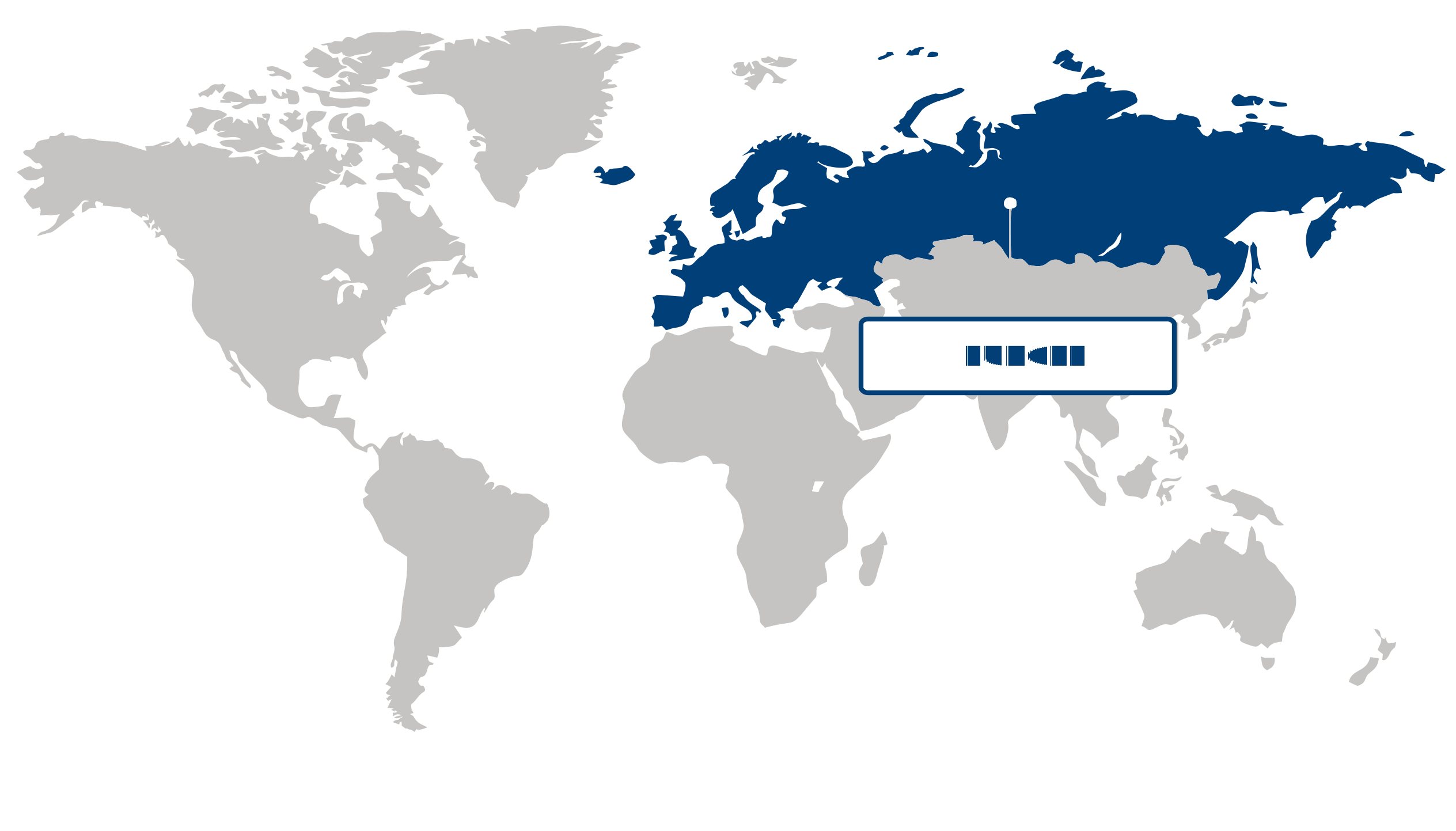
Europe (Largest Region)
Europe held the largest share of the building thermal insulation market, accounting for 36.99% share in 2026. The region's strong position is supported by stringent energy-efficiency requirements, established building standards, and sustained efforts to reduce energy consumption and carbon emissions across residential, commercial, and industrial structures. Growing emphasis on improving the energy performance of existing buildings is encouraging the adoption of insulation materials in renovation as well as new construction projects. In addition, increasing awareness of indoor thermal comfort and the economic benefits of reducing heating and cooling demand is strengthening demand for advanced insulation solutions. Favorable sustainability policies and the broader transition toward energy-efficient buildings further reinforce Europe's established market base.
Asia Pacific (Fastest-Growing Region)
Asia Pacific is emerging as the fastest-growing region in the building thermal insulation market, driven by rapid urbanization, expanding construction activity, and increasing investment in residential and commercial infrastructure. Rising energy demand and greater awareness of building energy efficiency are encouraging developers and property owners to incorporate thermal insulation into new structures. The expansion of cities, changing climatic conditions, and growing adoption of modern construction practices are also creating opportunities for higher-performance insulation materials. At the same time, government initiatives focused on energy conservation and sustainable development are supporting the gradual integration of insulation technologies across developing construction markets, strengthening the region's long-term growth potential.
| Parameter | North America | Asia Pacific | Europe | Latin America | MEA |
|---|---|---|---|---|---|
| Innovation Hub i Scale Nascent Developing Advanced | |||||
| Cost-Sensitive Region i Scale Low Medium High | |||||
| Regulatory Environment i Scale Restrictive Neutral Supportive | |||||
| Demand Drivers i Scale Weak Moderate Strong | |||||
| Development Stage i Scale Emerging Developing Developed | |||||
| Adoption Rate i Scale Low Medium High | |||||
| New Entrants / Startups i Scale Sparse Moderate Dense | |||||
| Macro Indicators i Scale Weak Stable Strong |
Key Country Insights
Germany 🇩🇪
Retrofit Performance SolutionsGermany emphasizes thermal insulation products that support building retrofits and compliance with rigorous energy efficiency standards. Demand centers on high-performance materials that reduce heat loss while contributing to long-term building sustainability objectives.
France 🇫🇷
Low-Carbon Building MaterialsFrance promotes building thermal insulation products that support low-carbon construction and renovation initiatives. Building owners increasingly invest in efficient insulation systems that reduce energy consumption while aligning with evolving environmental performance requirements.
Italy 🇮🇹
Renovation-Driven InsulationItaly strengthens demand for building thermal insulation through renovation projects targeting improved energy performance in residential and historic buildings. Contractors increasingly adopt adaptable insulation solutions that balance installation practicality with enhanced thermal efficiency.
Japan 🇯🇵
Space-Efficient InsulationJapan adopts building thermal insulation solutions that maximize energy efficiency while accommodating compact construction designs. Builders increasingly select advanced insulation materials that improve indoor comfort and support resilient, energy-conscious building practices.
South Korea 🇰🇷
High-Rise Efficiency FocusSouth Korea prioritizes building thermal insulation systems for residential towers, commercial developments, and energy-efficient construction. Developers favor materials that combine thermal performance, fire safety, and installation efficiency across modern building projects.
United States 🇺🇸
Energy Efficiency UpgradesThe U.S. building thermal insulation market benefits from renovation activity and stricter energy performance expectations across residential and commercial buildings. Project developers increasingly specify advanced insulation materials that improve operational efficiency and occupant comfort.
Segment Leadership and Growth Trends
Building Thermal Insulation Market Share (%), by End-use, 2026
Go beyond the chart, access full insights & data tables
Request Free Sample ReportEnd-use Segment Analysis: Residential (Largest & Fastest-Growing Segment)
The residential segment represented the largest share of the building thermal insulation market in 2026 and is also the fastest-growing end-use segment. Demand is being supported by increasing attention to household energy efficiency, indoor thermal comfort, and the reduction of heating and cooling requirements. Thermal insulation helps limit heat transfer through building envelopes, enabling homes to maintain more stable indoor temperatures while supporting lower energy consumption. Growing awareness of sustainable construction practices and the incorporation of energy-efficiency considerations into residential building design are further strengthening adoption.
Product Segment Analysis: Glass Wool (Largest Segment) vs EPS (Fastest-Growing Segment)
Glass wool accounted for the largest share of the building thermal insulation market in 2026, benefiting from its established use across walls, roofs, ceilings, and other building-envelope applications. Its thermal and acoustic insulation capabilities make it suitable for improving indoor comfort while supporting energy-efficient construction. Established installation practices and broad applicability across residential and other building projects continue to underpin demand for glass wool as builders place greater emphasis on effective thermal performance.
EPS is the fastest-growing product segment, supported by demand for lightweight and practical insulation materials in energy-efficient building construction. Its low weight, ease of handling, and thermal insulation properties make it attractive for applications where efficient installation and effective building-envelope performance are priorities. Increasing adoption of insulation in residential construction, combined with efforts to improve building energy performance and manage heating and cooling demand, is creating favorable conditions for EPS-based solutions.
| Segment | Sub-Segment | Largest Segment | Fastest Growing |
|---|---|---|---|
| End-use | Residential, Commercial | Residential | Residential |
| Product | Glass Wool, Mineral Wool, EPS, XPS, Cellulose, PIR, PUR, Others | Glass Wool | EPS |
| Application | Roof, Walls, Floor | Walls | Walls |
Competitive Landscape and Market Positioning
Leading companies in the building thermal insulation market:
1. Saint-Gobain S.A. (France)
2. Owens Corning (United States)
3. BASF SE (Germany)
4. Kingspan Group plc (Ireland)
5. Knauf Insulation (Germany)
6. Rockwool International A/S (Denmark)
7. Dow Inc. (United States)
8. Berkshire Hathaway Inc. (Johns Manville Corporation) (United States)
9. GAF Materials Corporation (United States)
10. Huntsman Corporation (United States)
The building thermal insulation market is evolving through increasing demand for energy-efficient construction materials. Continuous innovation in insulation materials is improving thermal performance and sustainability. Ongoing development of advanced building solutions is supporting regulatory compliance, while expanding green construction practices are strengthening adoption across infrastructure projects.
| Company | Market Share | Company Revenue | Revenue CAGR (%) | Product Portfolio | Geographic Presence | Innovation / R&D Focus | Strategic Developments |
|---|---|---|---|---|---|---|---|
| Saint-Gobain S.A. (France) | |||||||
| Owens Corning (United States) | |||||||
| BASF SE (Germany) | |||||||
| Kingspan Group plc (Ireland) | |||||||
| Knauf Insulation (Germany) | |||||||
| Rockwool International A/S (Denmark) | |||||||
| Dow Inc. (United States) | |||||||
| Berkshire Hathaway Inc. (Johns Manville Corporation) (United States) | |||||||
| GAF Materials Corporation (United States) | |||||||
| Huntsman Corporation (United States). |
Industry Development/News
| Company Name | Date | Key Development |
|---|---|---|
| Iproplan | Oct-25 | Iproplan signed a memorandum of understanding with Syria’s National Energy Research Center to modernize building thermal insulation codes. This strategic initiative involves providing technical consultancy for establishing energy-efficient construction standards, aiming to improve national building performance and long-term energy sustainability through modernized regulatory frameworks. |
| Holcim Poland | May-25 | Holcim Poland launched "TectorTherm," a comprehensive building insulation system engineered for high thermal efficiency and durability. The system integrates advanced materials to improve building energy profiles, strengthening Holcim’s commercial position in the thermal renovation and sustainable construction materials market by offering a high-performance solution for both new builds and residential retrofits. |
| Saint-Gobain S.A. | Sep-24 | Saint-Gobain completed the acquisition of CSR Limited for approximately $2.8 billion, significantly expanding its footprint in the Australian and Asia-Pacific construction markets. This acquisition integrates CSR’s extensive insulation and building materials portfolio into Saint-Gobain’s regional manufacturing network, reinforcing its capacity to provide sustainable building solutions in high-growth markets. |
| Owens Corning | May-24 | Owens Corning completed the $3.9 billion acquisition of Masonite International Corporation. This strategic move expanded Owens Corning’s integrated portfolio into residential and commercial doors while scaling its presence across the building materials value chain, enhancing its ability to provide comprehensive, energy-efficient building envelope solutions to residential and commercial contractors. |
| Knauf Gips KG | Jan-22 | Knauf Gips KG commissioned a new glass mineral wool thermal insulation plant in Central Romania. This expansion serves as a strategic manufacturing hub to address rising demand for energy-efficient materials in Romania, Eastern Europe, and the CIS region, shortening supply chains and increasing local production capacity for sustainable thermal insulation products. |
| Saint-Gobain S.A. | Dec-21 | Saint-Gobain entered into an agreement to acquire Rockwool India Pvt Ltd. from Alghanim Group. The acquisition strengthened Saint-Gobain’s regional manufacturing capabilities in India by integrating a specialized producer of stone wool insulation, facilitating the expansion of its portfolio for thermal, acoustic, and fire safety applications within the rapidly growing Indian construction sector. |
| Rockwool A/S | Jul-21 | Rockwool A/S expanded commercial stone wool production at its manufacturing facility in Jefferson County, West Virginia. This capacity expansion was strategically designed to meet the increasing demand for non-combustible and energy-efficient insulation across North America, enhancing the company’s ability to support large-scale industrial and commercial building projects with high-performance stone wool solutions. |
| Atlas Roofing Company | Apr-21 | Atlas Roofing Company introduced the "SureSlope" line of prefabricated tapered polyiso roof insulation. By offering factory-engineered slopes, the product reduces field cutting and installation time for contractors while minimizing job site material waste. This innovation reflects a strategic focus on improving installation efficiency and material sustainability in commercial roofing projects. |
| Owens Corning | Mar-21 | Owens Corning acquired vliepa GmbH, a specialist in coating and finishing nonwovens for the construction industry. This acquisition broadened Owens Corning’s portfolio of value-added surface materials, providing European customers with enhanced technology for insulation and building materials, while further integrating the company’s nonwovens supply chain for high-performance construction applications. |
Customize Your Report
Explore examples of how this report can be tailored to different research needs, including custom segments, additional topics or chapters, and related reports. Click a section of the wheel or its numbered marker to explore the available options.
Building Thermal Insulation Market — Custom Segments
| Segment | Sub-Segment |
|---|---|
| Installation Method | Cavity Installation, External Insulation, Internal Insulation, Loose-Fill Installation, Spray-Applied Installation |
| Construction Stage | New Construction, Renovation & Retrofit, Major Building Refurbishment |
| Climate Zone | Cold Climate, Temperate Climate, Hot & Humid Climate, Hot & Dry Climate |
Building Thermal Insulation Market — Custom TOC
| Custom Chapter | Custom Details |
|---|---|
| Energy Efficiency Retrofit Opportunity Assessment |
|
| Green Building Adoption Strategies |
|
| Building Code Impact Assessment |
|
Need a different cut of the data?
Request Custom ResearchHow big is the building thermal insulation market?
What is the expected industry size of building thermal insulation by 2036?
How are energy efficiency regulations influencing insulation material demand in construction projects?
How is renovation activity contributing to growth in the thermal insulation market?
Why is Glass Wool the largest product segment in the building thermal insulation market?
Why is Residential the fastest-growing end-use segment in the building thermal insulation market?
Why does Europe lead the building thermal insulation market?
What is fueling building thermal insulation market growth in Asia Pacific?
Who are the major participants shaping the building thermal insulation landscape?
Our Clients
"Your insights on workforce structures were spot-on. The analysis on mid-to-senior level roles validated some of our hiring decisions and highlighted gaps."
Ateliers De France
"The report gave us insights on competitors in the market. It helped our team refine our bidding strategy for upcoming contracts."
Clark Construction
"The reports provided a deep dive into market trends, and competitive landscape. The strategic insights and recommendations have been very helpful."
Rudolph and Sletten
Our Research Team & Methodology
Every Fundamental Business Insights report is built by a dedicated vertical research team, validated through a structured primary-and-secondary methodology, and reviewed for accuracy before it reaches you.
Research Team Overview
Prepared by the Construction & Manufacturing Research Team
Delivery
Published
Demand
Available
Support
Trust & Compliance
Research Domains
10 coverage areasResearch Intelligence
| Source | Reference |
|---|---|
| International Organization for Standardization (ISO) | www.iso.org |
| ASTM International | www.astm.org |
| National Institute of Standards and Technology (NIST) | www.nist.gov |
| International Code Council (ICC) | www.iccsafe.org |
| American Concrete Institute (ACI) | www.concrete.org |
| American Institute of Steel Construction (AISC) | www.aisc.org |
| Construction Industry Institute (CII) | www.construction-institute.org |
| Associated General Contractors of America (AGC) | www.agc.org |
| Association of Equipment Manufacturers (AEM) | www.aem.org |
| Building Owners and Managers Association (BOMA) | www.boma.org |
| American Society of Civil Engineers (ASCE) | www.asce.org |
| National Ready Mixed Concrete Association (NRMCA) | www.nrmca.org |
| International Facility Management Association (IFMA) | www.ifma.org |
| World Green Building Council (WorldGBC) | worldgbc.org |
| International Federation of Consulting Engineers (FIDIC) | fidic.org |
| International Labour Organization (ILO) | www.ilo.org |
| American Society of Mechanical Engineers (ASME) | www.asme.org |
| Society of Manufacturing Engineers (SME) | www.sme.org |
| National Association of Home Builders (NAHB) | www.nahb.org |
| European Construction Industry Federation (FIEC) | www.fiec.eu |
Research Workflow & Quality Assurance
Data Collection
Verified information gathered through primary and secondary research.
Data Triangulation
Cross-validation using multiple independent data sources.
Forecast Modelling
Market estimates developed using historical trends and analytical models.
Analyst Validation
Findings reviewed by domain experts for accuracy and consistency.
Editorial & Quality Review
Final editorial, quality, and compliance checks before publication.
Final Publication
Released after successful completion of the internal review process.
Report Coverage
📊 Market Assessment
- Market Size & Forecast
- Market Segmentation
- Regional Analysis
- Growth Drivers & Challenges
- Market Dynamics
🏢 Competitive Intelligence
- Competitive Landscape
- Company Profiles
- Competitive Benchmarking
- Mergers & Acquisitions
- Market Share Analysis or Key Company Strategies
🔍 Strategic Analysis
- Value Chain Analysis
- Porter's Five Forces
- PESTLE Analysis
- Pricing Trends
- Supply-Demand Analysis
🚀 Future Outlook
- Technology Landscape
- Regulatory Landscape
- Investment & Funding Landscape
- Emerging Opportunities
- Future Market Outlook
Have a question about this report or need a custom scope?
Request Customization