BTS Antenna Market Size & Forecasts 2026-2035, By Segments (Type, End-user, Installation Type, Technology), Growth Opportunities, Innovation Landscape, Regulatory Shifts, Strategic Regional Insights (U.S., Japan, China, South Korea, UK, Germany, France), and Competitive Dynamics (CommScope, Huawei, Kathrein, Amphenol, Rosenberger)
Market Size and Growth Outlook
BTS Antenna Market size is likely to expand from USD 8.11 billion in 2025 to USD 16.56 billion by 2035, posting a CAGR above 7.4% across 2026-2035. The industry’s revenue potential for 2026 is USD 8.64 billion.
Get more details on this report
Request Free Sample ReportBTS Antenna Market Intelligence Snapshot
Regional Market Dynamics
Segment Momentum
Market Expansion Drivers
Leading Market Participants
Global Market Forecast Snapshot
Market Outlook
Regional and Segment Outlook
Market Growth Drivers and Industry Trends
National broadband strategies and large-scale tower rollouts are accelerating demand for base station equipment, directly expanding the BTS antenna market as operators densify urban cells and extend rural coverage. Evidence of this trend appears in GSMA advocacy for increased infrastructure sharing and the World Bank’s financing programs for national broadband, which lower deployment barriers and shift operator procurement toward scalable antenna platforms. Established vendors can monetize retrofit and managed-services contracts, while towercos and new small‑cell specialists can enter via leasing and integration services. Given continuing public‑private funding and policy emphasis on universal connectivity, infrastructure-driven antenna demand will remain a structural growth pillar.
Global 5G Deployment
Operator-led 5G rollouts are changing antenna requirements—multi‑band, massive MIMO, and low‑latency designs—reshaping the BTS antenna market as service providers transition from 4G to 5G topology. Ericsson and Nokia announcements detailing live 5G deployments and the U.S. Federal Communications Commission’s spectrum allocation actions illustrate how network strategies and regulatory shifts create immediate procurement needs. Incumbent suppliers can capture value through end-to-end RAN upgrades and partner-managed deployments, while agile entrants can focus on niche 5G antenna modules and retrofit solutions. As operators continue densification and mid-band launches, 5G-driven specification complexity will drive differentiated product and service models.
Advancements in Antenna Design and Efficiency
Technical progress in beamforming, integrated phased arrays and low-loss materials is improving per‑site throughput and energy efficiency, influencing the BTS antenna market by enabling smaller sites and lower operational costs. Companies such as Qualcomm and research institutes like Fraunhofer have published work and product roadmaps demonstrating tighter integration of RF front-ends and digital beam control, which reduce power draw and site complexity. Legacy manufacturers can invest in modular, upgradable platforms, while semiconductor and software-focused entrants can offer differentiated, software‑defined antenna subsystems. Observable industry R&D and prototype commercialization point to steady adoption of higher-efficiency antenna architectures across deployments.
Industry Restraints:
Spectrum Allocation and Licensing Constraints: Limited and inconsistent spectrum assignments—especially for mid-band frequencies critical to 5G—constrain BTS antenna deployment by creating planning uncertainty, higher acquisition costs, and uneven technology choices across markets. The International Telecommunication Union (ITU) and GSMA have repeatedly highlighted the need for harmonized mid‑band spectrum, while the Federal Communications Commission (FCC) auction frameworks and national licensing regimes produce fragmentation that delays rollouts. Operators face higher capital intensity and slower site densification, incumbents with existing spectrum portfolios gain bargaining power, and new entrants encounter significant market-access barriers. Given ongoing regulatory reviews and periodic auctions by ITU member states and national regulators, spectrum-related friction will continue to shape where and how rapidly BTS antennas are deployed in the near to medium term.
Supply Chain and Component Geopolitics: Vulnerabilities in semiconductor supply, component lead times, and export controls introduce cost volatility and delivery risk for BTS antenna manufacturers and mobile operators. The U.S. Department of Commerce export controls, semiconductor shortages noted by Qualcomm, and supply-risk disclosures from Nokia and Ericsson illustrate how geopolitical policy and component constraints disrupt sourcing and deployment schedules. Established vendors must invest in dual sourcing and inventory buffers while challengers struggle to secure supplier commitments, complicating procurement and aftermarket support. As manufacturers pursue diversification and regionalization of supply chains, component geopolitics will remain a principal operational constraint that shapes supplier selection and capital allocation through the medium term.
| Growth Driver | Impact on CAGR | Regulatory Influence | Geographic Relevance | Adoption Rate | Impact Timeline |
|---|---|---|---|---|---|
| Growth of telecom infrastructure and mobile networks | 3.00% | Short term (≤ 2 yrs) | Asia Pacific (Primary), North America (Spillover) | High | Fast |
| Deployment of 5G networks globally | 2.50% | Medium term (2–5 yrs) | Europe, Asia Pacific | Medium | Moderate |
| Advancements in antenna design and efficiency | 1.90% | Long term (5+ yrs) | North America, Europe | Low | Moderate |
Unlock insights tailored to your business with our bespoke market research solutions.
Click to get your customized report now.
Regional Demand Dynamics
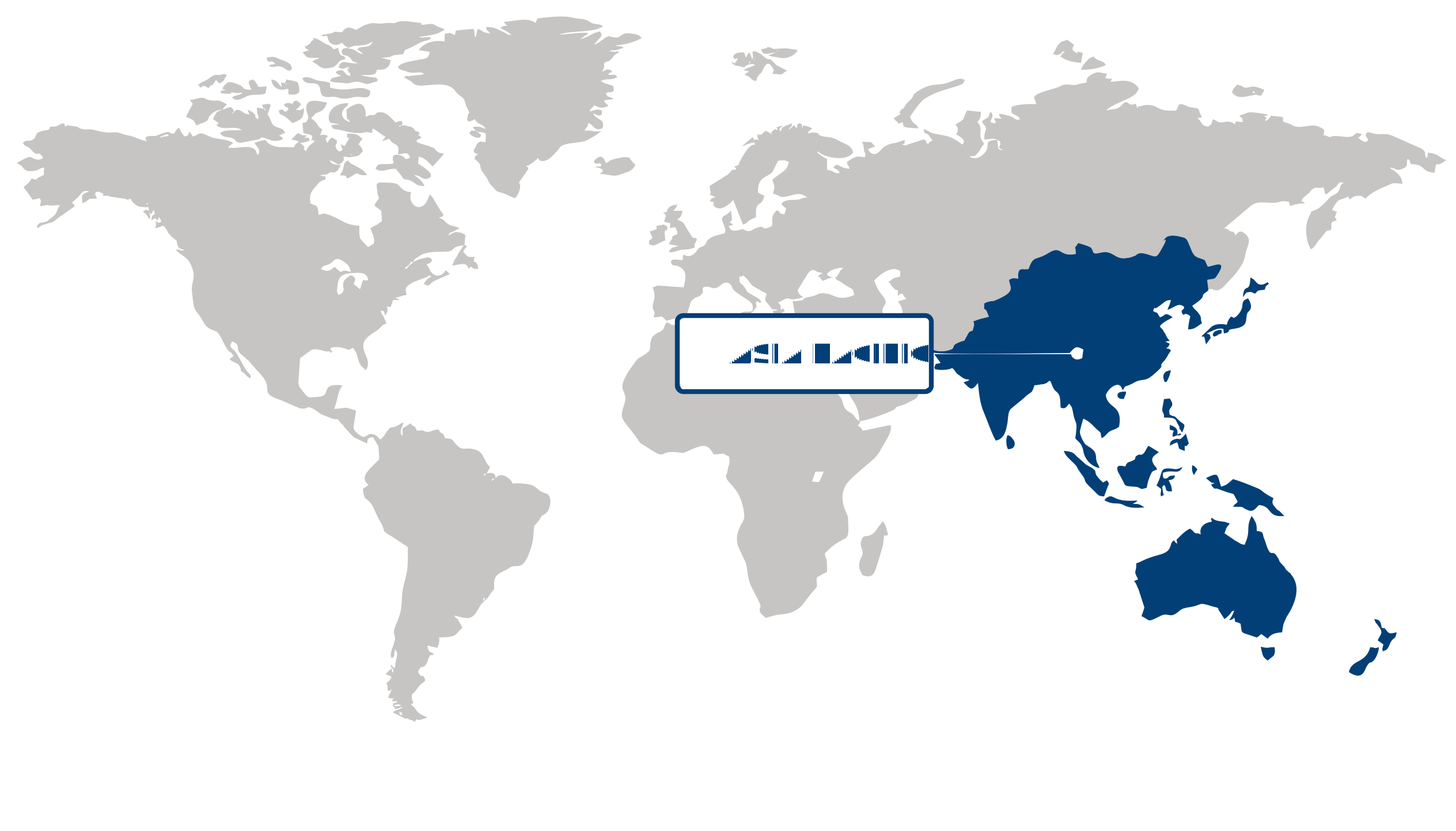
Asia Pacific captured over 67% of the global BTS antenna market in 2025, establishing it as the largest regional market driven primarily by China’s rapid 5G base‑station buildout and smart‑city investments. The scale of demand is evidenced by statements from the Ministry of Industry and Information Technology (MIIT) prioritizing 5G deployment, China Mobile and China Tower press releases on accelerated rollouts, and Huawei announcements on large‑scale RAN deliveries; Asian Development Bank and National Development and Reform Commission (NDRC) backing for urban digital infrastructure further underscores municipal procurement trends. This concentration creates opportunities in high‑density antenna solutions, multi‑antenna MIMO and integration services as operators modernize networks and cities digitize their services.
China anchors Asia Pacific, and the BTS antenna market there reflects state‑led, high‑volume deployments that favor standardized, scalable antenna platforms. MIIT guidance, China Mobile expansion notices and China Tower project disclosures show centralized site construction and operator co‑investment structures that accelerate equipment turnover; Huawei and ZTE press releases highlight integration of massive MIMO and edge capabilities. For vendors this means scale advantages, local supply‑chain integration and opportunities to supply retrofit and densification projects that feed the broader regional ecosystem.
Japan is positioned as a pivotal hub in Asia Pacific, where the BTS antenna market emphasizes densification, private 5G and advanced integration rather than pure scale. Ministry of Internal Affairs and Communications (MIC) policy on spectrum and NTT DOCOMO, SoftBank and Rakuten Mobile announcements on urban deployments and Open RAN trials illustrate a market for specialized, high‑performance antennas, indoor solutions and enterprise‑grade systems supporting smart‑health and industrial IoT pilots. Strategically, Japan offers higher‑margin opportunities for tailored antenna designs, field trials and technology validation that complement bulk opportunities emerging from China, reinforcing regional leadership.
Europe Market Analysis:
Europe emerged as the fastest-growing region in the BTS antenna market, registering a CAGR of 11.1%. The advance of 5G rollout and rapid adoption of energy‑efficient MIMO systems—the stated growth driver—has driven demand for high‑performance, low‑power antenna arrays across dense urban corridors and expanding suburban cells. Policy backing through the European Commission’s Digital Decade and strong operator commitments documented by GSMA Intelligence and Ericsson Mobility Report reinforce investment in Massive MIMO and site upgrades, while vendor announcements from Ericsson and Nokia show product roadmaps optimized for energy efficiency. These dynamics, combined with supply‑chain consolidation and sustainability mandates, position Europe for continued share gains as operators prioritize capacity and OPEX reduction.
Germany acts as a primary deployment hub in the BTS antenna market, led by aggressive 5G densification programs and operator modernization. Deutsche Telekom’s public network expansion plans and procurement activities with Ericsson and Nokia illustrate demand for multi‑band, energy‑efficient MIMO radios, while regulatory actions by Bundesnetzagentur on spectrum allocation have accelerated rollouts. German operators’ emphasis on industrial IoT and low‑latency enterprise services is driving dense small‑cell installs and higher antenna complexity; supplier case studies and press releases from Deutsche Telekom and Ericsson confirm pilot and large‑scale MIMO projects. Strategically, Germany serves as a testing ground for scalable, energy‑optimized antenna architectures that can be replicated across Europe.
France plays a strategic role in the BTS antenna market, where urban capacity pressures and green network targets shape procurement. Orange and Bouygues Telecom have publicly detailed Massive MIMO and energy‑saving initiatives, and regulator ARCEP’s policy signals on spectrum and network quality support accelerated 5G upgrades. French deployments prioritize compact, low‑power antenna systems for metro and suburban zones, with vendor collaborations—such as Orange trials with Nokia—highlighting integration of antenna and radio software for power management. This market’s focus on dense urban performance and sustainability creates opportunities for differentiated antenna designs and service contracts that reinforce Europe’s broader growth trajectory.
North America Market Trends:
North America maintained a significant share of the BTS antenna market, underpinned by accelerated 5G macro and small‑cell deployments, dense urban demand, and coordinated policy moves that favor mid‑band capacity expansion. Support from the Federal Communications Commission’s C‑band actions and CBRS framework, carrier investment programs detailed in AT&T and Verizon press releases, and vendor commitments from Ericsson and Nokia press releases illustrate strong commercial pull and supply‑side readiness. Concerns about resilient supply chains and energy efficiency have also shifted procurement to integrated, scalable antenna platforms, as highlighted by CTIA commentary. These dynamics position the region as a high‑value market for advanced antenna designs, system integration, and aftermarket services over the next investment cycle.
The U.S. serves as the leading market within North America for the BTS antenna market, driven by large‑scale carrier rollouts, private network trials, and regulatory spectrum clearances that accelerate densification. Federal Communications Commission spectrum auctions and CBRS rules enable enterprise and neutral‑host models, while AT&T, Verizon, and T‑Mobile press releases on 5G expansion and Ericsson and Nokia press releases on massive MIMO deployments provide concrete examples of demand and supplier activity. For investors and strategists, the U.S. market functions as a commercialization and innovation hub whose scale and standards adoption will cascade opportunities across the North American supply chain.
| Parameter | North America | Asia Pacific | Europe | Latin America | MEA |
|---|---|---|---|---|---|
| Innovation Hub i Scale Nascent Developing Advanced | |||||
| Cost-Sensitive Region i Scale Low Medium High | |||||
| Regulatory Environment i Scale Restrictive Neutral Supportive | |||||
| Demand Drivers i Scale Weak Moderate Strong | |||||
| Development Stage i Scale Emerging Developing Developed | |||||
| Adoption Rate i Scale Low Medium High | |||||
| New Entrants / Startups i Scale Sparse Moderate Dense | |||||
| Macro Indicators i Scale Weak Stable Strong |
Segment Leadership and Growth Trends
BTS Antenna Market Share (%), by Type, 2026
Go beyond the chart, access full insights & data tables
Request Free Sample ReportOmnidirectional dominated the BTS antenna market in 2025 as the largest share, driven by its 360‑degree coverage suited to broad-area mobile connectivity. This leadership reflects operator preference for fewer sites per coverage area and cost-effective maintenance, a dynamic underscored in the Ericsson Mobility Report and GSMA analyses on coverage strategy. Vendors including Huawei and Nokia have emphasized omnidirectional portfolios that simplify deployments, reduce energy use and support sustainability goals. The segment offers incumbents scale advantages through integrated active antenna systems and gives agile entrants room to compete with lightweight, software-tunable solutions. As 5G densification and ubiquitous IoT needs persist, omnidirectional solutions will remain central to near‑term network planning.
Analysis by End-user
Telecommunication Providers represented largest share of the BTS antenna market in 2025 due to massive infrastructure investments to meet rising mobile data demand. Operator capex plans and rollout announcements from AT&T and Verizon, together with insights from the Ericsson Mobility Report, explain sustained procurement momentum. Preference for vendor-certified, service-backed hardware and regulatory easing by the Federal Communications Commission on siting accelerate deployments and long-term service contracts. This creates scale opportunities for established OEMs and systems integrators, while niche offerings for private networks and edge deployments allow new entrants to capture specialized demand. Continued spectrum awards and operator-driven densification will keep this segment pivotal in the near to medium term.
Analysis by Installation Type
Rooftop held largest share in the BTS antenna market in 2025 as urban densification and 5G expansion favored elevated site deployments. Deployment case studies from Nokia and Ericsson highlight rooftops’ effectiveness for mid-band and mmWave coverage and capacity boosts in dense corridors. Changes in municipal zoning and Federal Communications Commission small-cell guidance have shortened deployment cycles, while rooftop leasing and green retrofit trends engage building owners and sustainability agendas. Tower companies and integrators can monetize rooftop portfolios, and innovative startups can supply low‑visual‑impact, rapid‑install systems. Given ongoing urban traffic concentration and spectrum-driven capacity needs, rooftop installations are expected to remain a strategic deployment choice.
| Segment | Sub-Segment | Largest Segment | Fastest Growing |
|---|---|---|---|
| Type | Omnidirectional, Directional | ||
| End-user | Telecommunication Providers, Enterprises, Government | ||
| Installation Type | Rooftop, Ground Mounted, Others | ||
| Technology | 2G, 3G, 4G/LTE, 5G |
Competitive Landscape and Market Positioning
Market competition is defined by portfolio refinement, selective consolidation, and deeper technical differentiation. Leading vendors have refreshed modular, multi‑band portfolios, extended in‑building and small‑cell offerings, and intensified materials and software investments to improve beam control and integration. Partnerships across vendors, operators and suppliers, along with targeted capability build-outs, are shifting battlegrounds from pure hardware to integrated antenna systems and deployment efficiency, reshaping supplier bargaining power and innovation pathways.
Strategic / Actionable Recommendations for Regional Players
Target large operators, enterprise campus accounts and suburban macro upgrades by combining scalable passive portfolios with flexible small‑cell and DAS options, and pursue selective collaborations to gain deployment scale and operator access.
Focus on rapid adaptation to dense urban, multi‑vendor environments by aligning manufacturing cost structures with high‑volume multi‑band products, deepening software and beamforming competencies, and partnering with system integrators to shorten time‑to‑rollout.
Leverage strong OEM relationships and regulatory familiarity to emphasize interoperable, sustainable in‑building and greenfield modernization offerings, strengthening certification pathways and joint pilot programs with operators and integrators to defend and expand share.
| Company | Market Share | Company Revenue | Revenue CAGR (%) | Product Portfolio | Geographic Presence | Innovation / R&D Focus | Strategic Developments |
|---|---|---|---|---|---|---|---|
| No companies available. | |||||||
Industry Development/News
| Company Name | Date | Key Development |
|---|
Customize Your Report
Explore examples of how this report can be tailored to different research needs, including custom segments, additional topics or chapters, and related reports. Click a section of the wheel or its numbered marker to explore the available options.
BTS Antenna Market — Custom Segments
| Segment | Sub-Segment |
|---|---|
| No segment data available. | |
BTS Antenna Market — Custom TOC
| Custom Chapter | Custom Details | ||
|---|---|---|---|
| No custom TOC data available. | |||
Need a different cut of the data?
Request Custom ResearchHow large is the BTS antenna market?
How will the BTS antenna industry grow in terms of size and CAGR by 2035?
What is the leading region in terms of BTS antenna market share?
Which region leads in terms of year-over-year growth for the BTS antenna sector?
What factors give omnidirectional segment a competitive edge in the BTS antenna sector?
Which is the largest sub-segment within the end-user segment for BTS antenna industry?
Why does rooftop sub-segment dominate the installation type segment of BTS antenna sector?
How does 5G segment fare in the BTS antenna industry?
Who holds a significant market share in the BTS antenna landscape?
Our Clients
"Working with FBI has been a good experience. The market report provided a holistic view, covering everything from emerging trends to potential risks."
Semtech Corporation
"The experience was highly positive. The team showcased remarkable flexibility in adapting to our specific needs and delivered report that perfectly aligned with all our requirements."
TSMC
"What really stood out to me was how clearly and promptly the Fundamental Business Insights team communicated throughout. It made the collaboration feel effortless."
NXP Semiconductors
Our Research Team & Methodology
Every Fundamental Business Insights report is built by a dedicated vertical research team, validated through a structured primary-and-secondary methodology, and reviewed for accuracy before it reaches you.
Research Team Overview
Prepared by the Electronics & Semiconductors Research Team
Delivery
Published
Demand
Available
Support
Trust & Compliance
Research Domains
10 coverage areasResearch Intelligence
| Source | Reference |
|---|---|
| Semiconductor Industry Association (SIA) | www.semiconductors.org |
| SEMI | www.semi.org |
| JEDEC Solid State Technology Association | www.jedec.org |
| IEEE | www.ieee.org |
| IPC – Association Connecting Electronics Industries | www.ipc.org |
| International Electrotechnical Commission (IEC) | www.iec.ch |
| International Organization for Standardization (ISO) | www.iso.org |
| U.S. Bureau of Industry and Security (BIS) | www.bis.gov |
| U.S. Patent and Trademark Office (USPTO) | www.uspto.gov |
| European Patent Office (EPO) | www.epo.org |
| Taiwan Semiconductor Industry Association (TSIA) | www.tsia.org.tw |
| World Semiconductor Trade Statistics (WSTS) | www.wsts.org |
| International Energy Agency (IEA) | www.iea.org |
| GSMA | www.gsma.com |
| 3GPP | www.3gpp.org |
| ITU (International Telecommunication Union) | www.itu.int |
| Omdia (public insights) | omdia.tech.informa.com |
| Display Supply Chain Consultants (DSCC) | www.displaysupplychain.com |
| U.S. Department of Energy (DOE) | www.energy.gov |
| NIST (National Institute of Standards and Technology) | www.nist.gov |
Research Workflow & Quality Assurance
Data Collection
Verified information gathered through primary and secondary research.
Data Triangulation
Cross-validation using multiple independent data sources.
Forecast Modelling
Market estimates developed using historical trends and analytical models.
Analyst Validation
Findings reviewed by domain experts for accuracy and consistency.
Editorial & Quality Review
Final editorial, quality, and compliance checks before publication.
Final Publication
Released after successful completion of the internal review process.
Report Coverage
📊 Market Assessment
- Market Size & Forecast
- Market Segmentation
- Regional Analysis
- Growth Drivers & Challenges
- Market Dynamics
🏢 Competitive Intelligence
- Competitive Landscape
- Company Profiles
- Competitive Benchmarking
- Mergers & Acquisitions
- Market Share Analysis or Key Company Strategies
🔍 Strategic Analysis
- Value Chain Analysis
- Porter's Five Forces
- PESTLE Analysis
- Pricing Trends
- Supply-Demand Analysis
🚀 Future Outlook
- Technology Landscape
- Regulatory Landscape
- Investment & Funding Landscape
- Emerging Opportunities
- Future Market Outlook
Have a question about this report or need a custom scope?
Request Customization