Bleaching Clay Market Size & Growth Forecast 2027–2036, By Segments (Application, Type, End Use Industry), Regional Demand Trends (North America, Asia Pacific, Europe), Key Country Insights (U.S., Japan, South Korea, Germany, France, Italy), and Competitive Landscape
Market Size and Growth Outlook
Bleaching Clay Market size was assessed at USD 1.34 Billion in 2026 and is poised to grow at 9.22% CAGR between 2027 and 2036, reaching USD 3.24 Billion by 2036. The industry revenue for 2027 is calculated at USD 1.44 Billion.
Get more details on this report
Request Free Sample ReportBleaching Clay Market Intelligence Snapshot
Regional Market Dynamics
- Asia Pacific leads through strong edible oil processing, refining activity, industrial manufacturing, and expanding demand for refined vegetable oil products.
- Regional growth is supported by expanding food processing capacity, refining investments, industrialization, and increasing emphasis on product quality and efficient processing.
Segment Momentum
- Industrial oil held a 39.96% share in 2026 as bleaching clay supports purification by removing impurities, improving oil clarity, and meeting quality requirements in refining operations.
- Activated clays are the fastest-growing type due to increasing demand for efficient purification materials across edible oils, specialty chemicals, and industrial product applications.
Market Expansion Drivers
- Expanding edible oil refining industry driving purification clay consumption
- Rising biodiesel production boosting clay-based purification processes
- Growth in industrial filtration applications improving adsorption material demand
Leading Market Participants
- Prominent players in the bleaching clay market include Oil-Dri Corporation of America (United States), Clariant AG (Switzerland), EP Minerals LLC (United States), Ashapura Group (India), Taiko Group of Companies (Malaysia), Mineral Technologies Inc. (United States), Musim Mas Holdings (Singapore), AMC (United Kingdom), Indian Clay & Mineral Co. (India), MANEK Active Clay Pvt. Ltd. (India)
Global Market Forecast Snapshot
Market Outlook
- 2026 Market Size: USD 1.34 Billion
- 2027 Estimated Market Size: USD 1.44 Billion
- Projected Market Size: USD 3.24 Billion by 2036
- Growth Forecast: 9.22% CAGR (2027-2036)
Regional and Segment Outlook
- Leading Regional Market: Asia Pacific
- High-Growth Regional Hub: Asia Pacific
- Core Revenue Segment: Industrial Oil (Application) | Activated Bauxite (Type) | Food and Beverage (End Use Industry)
- Emerging Opportunity Segment: Mineral Oil and Waxes (Application) | Activated Clays (Type) | Cosmetics and Personal Care (End Use Industry)
Market Growth Drivers and Industry Trends
Expanding edible oil refining industry driving purification clay consumption
The steady expansion of edible oil production and refining capacity across both developed and emerging economies is increasing the need for effective purification materials that improve oil quality and processing efficiency. The bleaching clay market will benefit from this trend as refiners rely on adsorption-based purification to remove pigments, oxidation products, trace metals, and other undesirable impurities before oils reach commercial distribution. Growing consumer demand for high-quality edible oils, combined with stricter quality standards and the diversification of vegetable oil processing, is encouraging refiners to adopt consistent purification practices that require reliable bleaching clay throughout multiple stages of production.
Rising biodiesel production boosting clay-based purification processes
Increasing biodiesel output is creating additional demand for purification technologies capable of improving fuel quality and supporting efficient downstream processing. Within the bleaching clay market, adsorption materials are widely utilized to remove residual contaminants, color bodies, and unwanted compounds that may affect biodiesel stability and performance. As governments and industries continue promoting renewable fuel alternatives, biodiesel producers are investing in optimized refining operations that incorporate clay-based purification systems to enhance process consistency while maintaining product specifications and operational efficiency.
Growth in industrial filtration applications improving adsorption material demand
Expanding industrial manufacturing activities are driving broader adoption of advanced filtration and adsorption solutions across chemical processing, food production, and other industrial sectors. The bleaching clay market is experiencing stronger demand as manufacturers seek dependable materials that efficiently capture impurities, improve product purity, and support consistent processing conditions. High adsorption capacity, operational reliability, and compatibility with diverse industrial applications make bleaching clay an important component in filtration systems designed to improve product quality while reducing contamination risks during production.
| Growth Driver | Impact on CAGR | Regulatory Influence | Geographic Relevance | Adoption Rate | Impact Timeline |
|---|---|---|---|---|---|
| Expanding edible oil refining industry driving purification clay consumption | 3.2% | High | Asia Pacific, North America | High | Near Term |
| Rising biodiesel production boosting clay-based purification processes | 3.1% | High | Europe, Asia Pacific | High | Mid Term |
| Growth in industrial filtration applications improving adsorption material demand | 3% | High | North America, Europe | High | Mid Term |
Unlock insights tailored to your business with our bespoke market research solutions.
Click to get your customized report now.
Regional Demand Dynamics
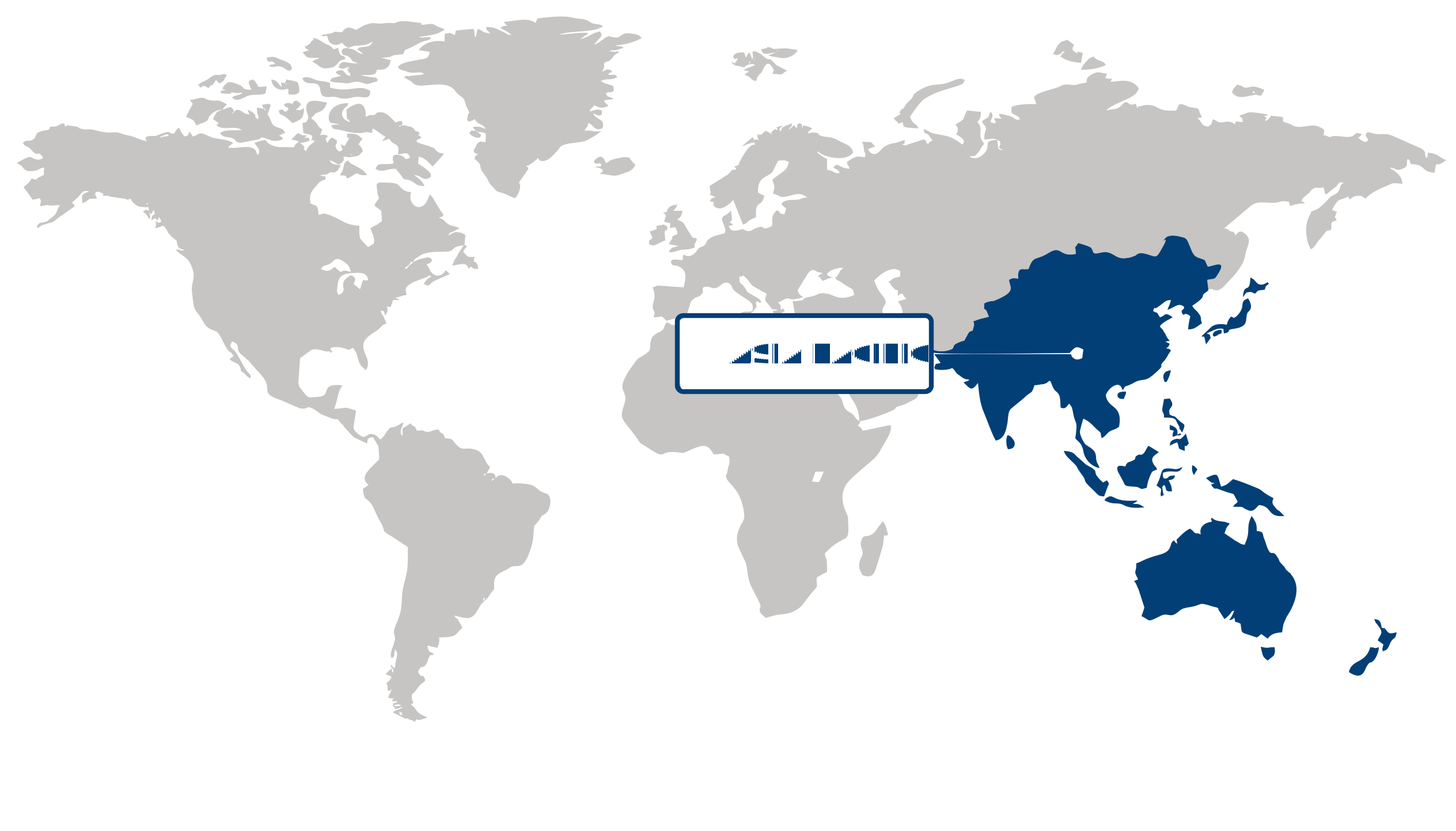
Asia Pacific (Largest & Fastest-Growing Region)
The Asia Pacific region held the largest share of the bleaching clay market in 2026 and is also positioned as the fastest-growing market, supported by the region’s strong edible oil processing, refining, and industrial manufacturing base. Extensive consumption of vegetable oils and increasing demand for refined products are driving the use of bleaching clay for impurity removal and color improvement during refining processes. Expanding food processing capacity, industrialization, and rising consumer demand for processed food products are further reinforcing regional consumption. At the same time, growing refining activities and investments in manufacturing infrastructure across developing economies are creating additional opportunities for bleaching clay suppliers, while increasing emphasis on product quality and efficient processing is supporting sustained market development.
| Parameter | North America | Asia Pacific | Europe | Latin America | MEA |
|---|---|---|---|---|---|
| Innovation Hub i Scale Nascent Developing Advanced | |||||
| Cost-Sensitive Region i Scale Low Medium High | |||||
| Regulatory Environment i Scale Restrictive Neutral Supportive | |||||
| Demand Drivers i Scale Weak Moderate Strong | |||||
| Development Stage i Scale Emerging Developing Developed | |||||
| Adoption Rate i Scale Low Medium High | |||||
| New Entrants / Startups i Scale Sparse Moderate Dense | |||||
| Macro Indicators i Scale Weak Stable Strong |
Key Country Insights
United States 🇺🇸
Refining Efficiency FocusThe U.S. bleaching clay market emphasizes consistent purification performance for edible oils and renewable fuel processing. Buyers in the U.S. increasingly prioritize high-activity grades that improve filtration efficiency while supporting operational cost optimization and sustainability objectives.
Germany 🇩🇪
Sustainable Processing StandardsGermany focuses on bleaching clay solutions that align with stringent environmental expectations and advanced refining operations. German processors increasingly seek materials with improved regeneration potential and lower waste generation while maintaining product quality across food and industrial applications.
Japan 🇯🇵
Precision Quality MaterialsJapan prioritizes premium bleaching clay products that deliver stable adsorption performance for high-value edible oil production. Manufacturers in Japan favor consistent mineral quality and process reliability to support strict product specifications and efficient refining operations.
South Korea 🇰🇷
Industrial Refining SupportSouth Korea continues to integrate advanced bleaching clay solutions into edible oil and specialty chemical refining processes. Local buyers value products that enhance filtration performance, reduce processing downtime, and support efficient manufacturing across diverse industrial applications.
France 🇫🇷
Food Processing AlignmentFrance emphasizes bleaching clay products that meet food processing quality requirements while supporting efficient vegetable oil refining. French processors increasingly evaluate suppliers based on product consistency, technical support, and compliance with evolving sustainability expectations.
Italy 🇮🇹
Specialty Oil ApplicationsItaly's bleaching clay market is shaped by demand from premium edible oil production, particularly specialty and olive oil processing. Italian refiners seek clay formulations that preserve product characteristics while improving color removal and filtration efficiency throughout refining operations.
Segment Leadership and Growth Trends
Bleaching Clay Market Share (%), by Application, 2026
Go beyond the chart, access full insights & data tables
Request Free Sample ReportApplication Segment Analysis: Industrial Oil (Largest Segment) vs Mineral Oil and Waxes (Fastest-Growing Segment)
The industrial oil application segment captured 39.96% of the market in 2026, making it the largest application. Bleaching clay is extensively used in industrial oil purification to remove color pigments, oxidation products, and impurities that can affect product quality and performance. Its effectiveness in improving oil clarity and stability has made it an essential processing aid across numerous industrial refining operations. Continued industrial production and increasing quality requirements are sustaining demand within this segment.
The mineral oil and waxes application is the fastest-growing segment in the bleaching clay market. Expanding utilization of refined mineral oils and specialty waxes across industrial manufacturing, cosmetics, pharmaceuticals, and technical applications has increased the need for efficient purification processes. The ability of bleaching clay to enhance product purity and meet stringent quality specifications continues to support stronger adoption in this application.
Type Segment Analysis: Activated Bauxite (Largest Segment) vs Activated Clays (Fastest-Growing Segment)
The activated bauxite segment held the largest market share of 41.58% in 2026. Activated bauxite is widely utilized because of its high adsorption capacity and effectiveness in removing unwanted contaminants during oil purification processes. Its consistent filtration performance, chemical stability, and suitability for demanding industrial applications have contributed to its widespread acceptance across refining operations. Growing emphasis on improving process efficiency continues to reinforce its market leadership.
In the bleaching clay market, the activated clays segment is emerging as the fastest-growing type. Rising demand for highly efficient purification materials capable of enhancing product quality while supporting diverse refining applications is driving greater adoption of activated clays. Ongoing advancements in activation processes and increasing use across edible oils, specialty chemicals, and industrial products are further strengthening growth prospects for this segment.
End Use Industry Segment Analysis: Food and Beverage (Largest Segment) vs Cosmetics and Personal Care (Fastest-Growing Segment)
The food and beverage end-use industry held the largest share of the market in 2026. Bleaching clay plays an important role in refining edible oils by removing pigments, trace contaminants, and undesirable compounds while preserving product quality. Rising demand for refined edible oils and stringent food quality standards have continued to support the widespread use of bleaching clay across food processing operations.
Within the bleaching clay market, the cosmetics and personal care industry represents the fastest-growing end-use segment. Increasing production of purified cosmetic ingredients and growing consumer demand for premium skincare and personal care products are encouraging greater use of bleaching clay in ingredient processing and formulation. The industry's focus on product purity, consistency, and quality is expected to further accelerate adoption in this segment.
| Segment | Sub-Segment | Largest Segment | Fastest Growing |
|---|---|---|---|
| Application | Industrial Oil, Mineral Oil and Waxes, Vegetable Oil and Animal Fats | Industrial Oil | Mineral Oil and Waxes |
| Type | Activated Bauxite, Activated Clays, Fuller's Earth | Activated Bauxite | Activated Clays |
| End Use Industry | Food and Beverage, Cosmetics and Personal Care, Chemicals, Others | Food and Beverage | Cosmetics and Personal Care |
Competitive Landscape and Market Positioning
Top players in the bleaching clay market:
- Oil-Dri Corporation of America (United States)
- Clariant AG (Switzerland)
- EP Minerals LLC (United States)
- Ashapura Group (India)
- Taiko Group of Companies (Malaysia)
- Mineral Technologies, Inc. (United States)
- Musim Mas Holdings (Singapore)
- AMC (United Kingdom)
- Indian Clay & Mineral Co. (India)
- MANEK Active Clay Pvt. Ltd. (India)
The bleaching clay market is seeing competitive differentiation emerge around processing efficiency, mineral quality, and the ability to serve specialized refining applications. Producers are strengthening their positions by improving consistency in adsorption performance and adapting products for evolving requirements across edible oils, industrial processing, and specialty applications. While established suppliers benefit from resource access and production expertise, newer participants are finding opportunities through regional supply advantages and tailored solutions that address specific customer performance needs.
| Company | Market Share | Company Revenue | Revenue CAGR (%) | Product Portfolio | Geographic Presence | Innovation / R&D Focus | Strategic Developments |
|---|---|---|---|---|---|---|---|
| Oil-Dri Corporation of America (United States) | |||||||
| Clariant AG (Switzerland) | |||||||
| EP Minerals LLC (United States) | |||||||
| Ashapura Group (India) | |||||||
| Taiko Group of Companies (Malaysia) | |||||||
| Mineral Technologies Inc. (United States) | |||||||
| Musim Mas Holdings (Singapore) | |||||||
| AMC (United Kingdom) | |||||||
| Indian Clay & Mineral Co. (India) | |||||||
| MANEK Active Clay Pvt. Ltd. (India) |
Industry Development/News
| Company Name | Date | Key Development |
|---|
Customize Your Report
Explore examples of how this report can be tailored to different research needs, including custom segments, additional topics or chapters, and related reports. Click a section of the wheel or its numbered marker to explore the available options.
Bleaching Clay Market — Custom Segments
| Segment | Sub-Segment |
|---|---|
| Physical Form | Powder, Granules, Pellets |
| Purity Grade | Industrial Grade, Food Grade, Pharmaceutical & Cosmetic Grade |
| Procurement Model | Direct Procurement, Distributor-based Procurement, Contract Supply |
Bleaching Clay Market — Custom TOC
| Custom Chapter | Custom Details |
|---|---|
| Refining Process Economics |
|
| Alternative Adsorbent Substitution |
|
| Feedstock & Raw Material Security |
|
Need a different cut of the data?
Request Custom ResearchWhat is the current revenue of the bleaching clay market?
How is the bleaching clay industry size expected to evolve during the forecast period?
How is expanding refining activity influencing bleaching clay demand?
Which industrial applications are strengthening demand for bleaching clay solutions?
Why does industrial oil remain the leading application for bleaching clay?
What is driving the growth of activated clays in the bleaching clay market?
Why does Asia Pacific lead the bleaching clay market?
How is Asia Pacific expected to sustain its bleaching clay market growth?
Which companies are driving growth in the bleaching clay landscape?
Our Clients
"The report helped us understand emerging consumer trends in our product category. It clarified where to focus innovation for the next product launch."
LyondellBasell
"The regional forecast section was incredibly useful. We were able to identify two new potential partners in Europe thanks to the vendor mapping you included."
SABIC
"We appreciated how actionable the recommendations were. It guided us to improve supply chain resilience."
Olin Corporation
Our Research Team & Methodology
Every Fundamental Business Insights report is built by a dedicated vertical research team, validated through a structured primary-and-secondary methodology, and reviewed for accuracy before it reaches you.
Research Team Overview
Prepared by the Chemicals & Materials Research Team
Delivery
Published
Demand
Available
Support
Trust & Compliance
Research Domains
10 coverage areasResearch Intelligence
| Source | Reference |
|---|---|
| American Chemistry Council (ACC) | www.americanchemistry.com |
| European Chemical Industry Council (Cefic) | cefic.org |
| International Council of Chemical Associations (ICCA) | icca-chem.org |
| European Chemicals Agency (ECHA) | echa.europa.eu |
| U.S. Environmental Protection Agency (EPA) | www.epa.gov |
| ASTM International | www.astm.org |
| International Organization for Standardization (ISO) | www.iso.org |
| National Institute of Standards and Technology (NIST) | www.nist.gov |
| Plastics Industry Association (PLASTICS) | www.plasticsindustry.org |
| European Biplastics | www.european-bioplastics.org |
| The Adhesive and Sealant Council (ASC) | www.ascouncil.org |
| National Association of Corrosion Engineers (AMPP) | www.ampp.org |
| Society of Plastics Engineers (SPE) | www.4spe.org |
| International Fertilizer Association (IFA) | www.fertilizer.org |
| CropLife International | croplife.org |
| Packaging Europe | packagingeurope.com |
| Flexible Packaging Association (FPA) | www.flexpack.org |
| Battery Council International (BCI) | batterycouncil.org |
| International Copper Association (ICA) | internationalcopper.org |
| World Steel Association | worldsteel.org |
Research Workflow & Quality Assurance
Data Collection
Verified information gathered through primary and secondary research.
Data Triangulation
Cross-validation using multiple independent data sources.
Forecast Modelling
Market estimates developed using historical trends and analytical models.
Analyst Validation
Findings reviewed by domain experts for accuracy and consistency.
Editorial & Quality Review
Final editorial, quality, and compliance checks before publication.
Final Publication
Released after successful completion of the internal review process.
Report Coverage
📊 Market Assessment
- Market Size & Forecast
- Market Segmentation
- Regional Analysis
- Growth Drivers & Challenges
- Market Dynamics
🏢 Competitive Intelligence
- Competitive Landscape
- Company Profiles
- Competitive Benchmarking
- Mergers & Acquisitions
- Market Share Analysis or Key Company Strategies
🔍 Strategic Analysis
- Value Chain Analysis
- Porter's Five Forces
- PESTLE Analysis
- Pricing Trends
- Supply-Demand Analysis
🚀 Future Outlook
- Technology Landscape
- Regulatory Landscape
- Investment & Funding Landscape
- Emerging Opportunities
- Future Market Outlook
Have a question about this report or need a custom scope?
Request Customization