Blast Monitoring Equipment Market Size & Growth Forecast 2027–2036, By Segments (Distribution Channel, End Use Industry, Product Type), Regional Demand Trends (North America, Asia Pacific, Europe), Key Country Insights (U.S., Japan, South Korea, Germany, France, Italy), and Competitive Landscape
Market Size and Growth Outlook
Blast Monitoring Equipment Market size stood at USD 311.64 Million in 2026 and is predicted to grow at 6.04% CAGR from 2027 to 2036, reaching USD 560.21 Million by 2036. The industry revenue for 2027 is estimated at USD 327.63 Million.
Get more details on this report
Request Free Sample ReportBlast Monitoring Equipment Market Intelligence Snapshot
Regional Market Dynamics
- Asia Pacific accounted for 40.5% in 2026, supported by extensive mining, quarrying, construction, infrastructure development, and growing emphasis on controlled blasting and safety.
- Continued infrastructure investment, resource extraction, and stronger attention to workplace safety, environmental compliance, and blast management are accelerating adoption.
Segment Momentum
- Mining & construction accounts for 52.36% share in 2026, supported by extensive blasting activities, safety requirements, and monitoring needs across infrastructure and quarrying operations.
- Real-time dust monitors lead with a 31.54% share in 2026 and are growing fastest due to rising focus on dust control, compliance, and worker safety.
Market Expansion Drivers
- Stringent environmental safety regulations driving adoption of blast monitoring systems across industries
- Rising industrial demand for efficient blasting operations improving monitoring system integration
- Increasing focus on operational safety and cost optimization driving advanced blast analytics adoption
Leading Market Participants
- Major players in the blast monitoring equipment market include Hexagon AB (Sweden), Orica Limited (Australia), Instantel (Canada), GeoSIG Ltd. (Switzerland), Campbell Scientific Inc. (USA), RST Instruments Ltd. (Canada), Syscom Instruments SA (Switzerland), Trolex Ltd. (UK), ACOEM (France), MREL (Canada)
Global Market Forecast Snapshot
Market Outlook
- 2026 Market Size: USD 311.64 Million
- 2027 Estimated Market Size: USD 327.63 Million
- Projected Market Size: USD 560.21 Million by 2036
- Growth Forecast: 6.04% CAGR (2027-2036)
Regional and Segment Outlook
- Leading Regional Market: Asia Pacific
- High-Growth Regional Hub: Asia Pacific
- Core Revenue Segment: Direct Sales (Distribution Channel) | Mining & Construction (End Use Industry) | Real-time Dust Monitors (Product Type)
- Emerging Opportunity Segment: Indirect Sales (Distribution Channel) | Chemicals (End Use Industry) | Real-time Dust Monitors (Product Type)
Market Growth Drivers and Industry Trends
Stringent environmental safety regulations driving adoption of blast monitoring systems across industries
Regulatory authorities are placing greater emphasis on controlling the environmental impact of blasting activities conducted in mining, construction, quarrying, and infrastructure development projects. The blast monitoring equipment market growth is driven by increasingly stringent environmental safety regulations that require continuous measurement of ground vibration, air overpressure, and other blast-related parameters to demonstrate compliance. Project operators are investing in advanced monitoring systems that provide reliable documentation, support regulatory reporting, and help minimize the effects of blasting on surrounding communities and critical infrastructure.
Rising industrial demand for efficient blasting operations improving monitoring system integration
Industries that rely on controlled blasting are seeking greater operational precision to improve productivity while reducing unnecessary material loss and operational disruptions. Rising industrial demand for optimized blasting practices will boost the blast monitoring equipment market demand by encouraging the integration of monitoring systems with planning and execution workflows. Real-time performance data enables engineers to evaluate blast effectiveness, refine blasting patterns, and maintain consistent operational outcomes across varying geological and project conditions.
Increasing focus on operational safety and cost optimization driving advanced blast analytics adoption
Organizations are increasingly leveraging digital technologies to improve workplace safety while maximizing resource utilization during blasting operations. As analytical capabilities become more sophisticated, the blast monitoring equipment market experiences stronger demand for advanced blast analytics that transform monitoring data into actionable operational insights. These systems support informed decision-making by identifying performance trends, improving blast design accuracy, reducing unnecessary operational risks, and enabling more efficient management of equipment and project resources.
| Growth Driver | Impact on CAGR | Regulatory Influence | Geographic Relevance | Adoption Rate | Impact Timeline |
|---|---|---|---|---|---|
| Stringent environmental safety regulations driving adoption of blast monitoring systems across industries | 2% | High | North America, Europe | High | Near Term |
| Rising industrial demand for efficient blasting operations improving monitoring system integration | 1.7% | Moderate | Asia Pacific, Latin America | High | Mid Term |
| Increasing focus on operational safety and cost optimization driving advanced blast analytics adoption | 1.5% | Moderate | North America, Asia Pacific | High | Mid Term |
Unlock insights tailored to your business with our bespoke market research solutions.
Click to get your customized report now.
Regional Demand Dynamics
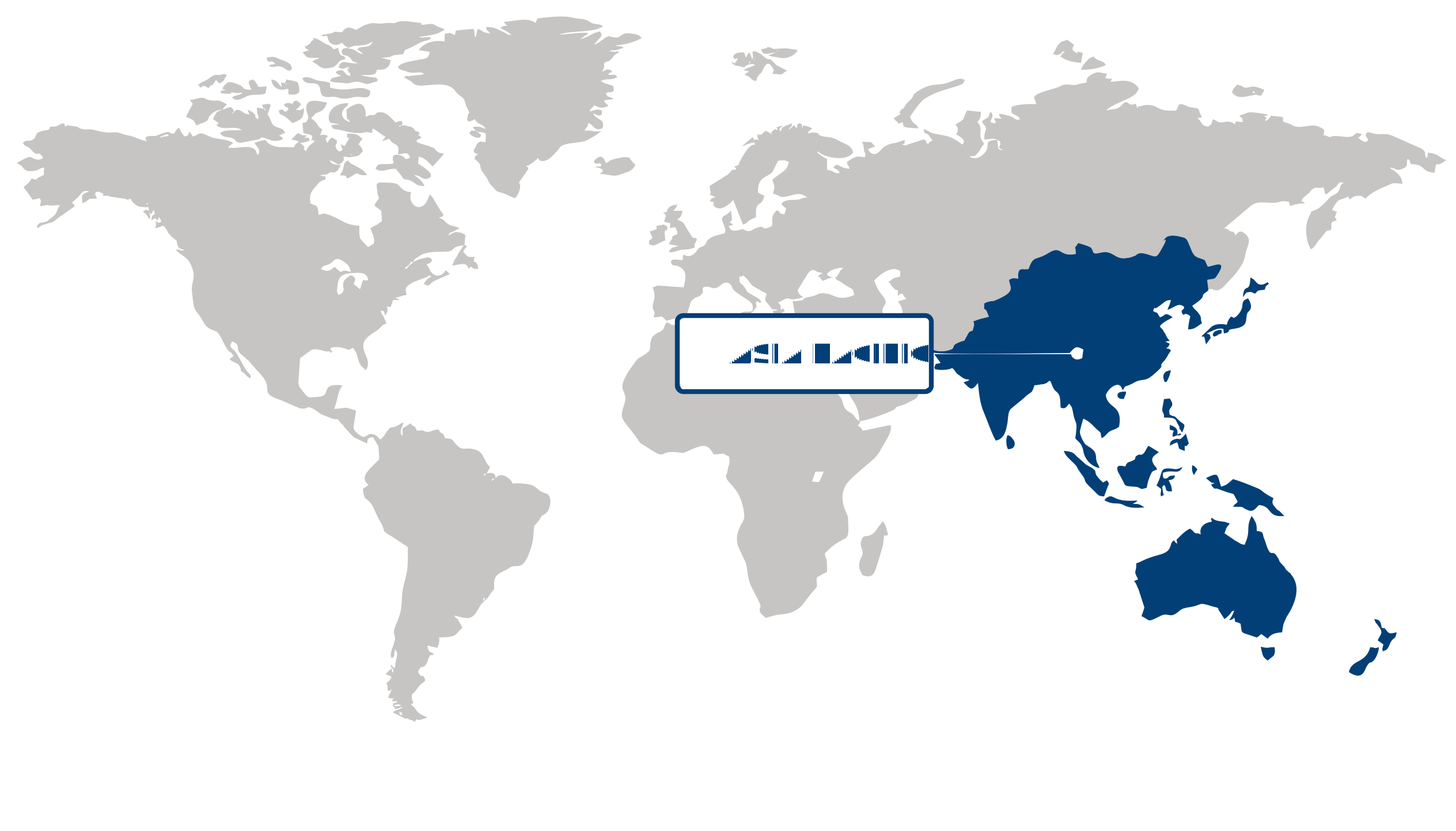
Asia Pacific (Largest & Fastest-Growing Region)
Asia Pacific held the largest share of the blast monitoring equipment market, accounting for 40.5% in 2026, and is also expected to experience the fastest growth. The region's position is supported by extensive mining, quarrying, construction, and infrastructure development activities that require controlled blasting and effective monitoring of ground vibration, air overpressure, and related environmental impacts. Expanding urban and industrial infrastructure is increasing the need for safer blasting practices near populated and sensitive areas, encouraging greater use of monitoring equipment. In addition, stricter attention to workplace safety, environmental compliance, and blast management is supporting adoption across mining and construction operations. Continued infrastructure investment and resource extraction activity are expected to sustain demand as operators increasingly prioritize controlled blasting, risk mitigation, and operational efficiency.
| Parameter | North America | Asia Pacific | Europe | Latin America | MEA |
|---|---|---|---|---|---|
| Innovation Hub i Scale Nascent Developing Advanced | |||||
| Cost-Sensitive Region i Scale Low Medium High | |||||
| Regulatory Environment i Scale Restrictive Neutral Supportive | |||||
| Demand Drivers i Scale Weak Moderate Strong | |||||
| Development Stage i Scale Emerging Developing Developed | |||||
| Adoption Rate i Scale Low Medium High | |||||
| New Entrants / Startups i Scale Sparse Moderate Dense | |||||
| Macro Indicators i Scale Weak Stable Strong |
Key Country Insights
United States 🇺🇸
Mining Compliance FocusThe U.S. prioritizes blast monitoring equipment that supports mining, quarrying, and infrastructure projects with reliable vibration and air overpressure measurements. Demand is reinforced by stricter environmental documentation and digital monitoring systems that simplify regulatory reporting across project sites.
Germany 🇩🇪
Precision Monitoring StandardsGermany emphasizes highly accurate blast monitoring equipment for tunneling, construction, and quarry operations where environmental compliance is closely monitored. Customers favor integrated systems with automated data logging that align with engineering quality and project documentation requirements.
Japan 🇯🇵
Urban Infrastructure MonitoringJapan adopts blast monitoring equipment suited for dense urban construction and transportation projects where vibration control is critical. Project operators seek compact, dependable systems that support continuous monitoring while minimizing disruption to surrounding communities.
South Korea 🇰🇷
Construction Safety IntegrationSouth Korea incorporates blast monitoring equipment into large-scale infrastructure and redevelopment projects to strengthen operational safety and regulatory compliance. Demand favors connected monitoring platforms capable of delivering real-time alerts and centralized project oversight.
France 🇫🇷
Environmental Compliance SupportFrance deploys blast monitoring equipment across quarrying and civil engineering activities with a strong emphasis on environmental protection. Buyers value systems that provide traceable measurement records to support permitting requirements and community engagement.
Italy 🇮🇹
Quarry Operations OptimizationItaly relies on blast monitoring equipment to improve operational control across quarrying and infrastructure development activities. Italian users increasingly prefer portable, easy-to-deploy instruments that balance regulatory compliance with efficient field operations.
Segment Leadership and Growth Trends
Blast Monitoring Equipment Market Share (%), by Distribution channel, 2026
Go beyond the chart, access full insights & data tables
Request Free Sample ReportDistribution Channel Segment Analysis: Direct Sales (Largest Segment) vs Indirect Sales (Fastest-Growing Segment)
The direct sales segment dominated the blast monitoring equipment market with a 73.25% share in 2026. Its leadership is largely attributed to the technical nature of blast monitoring solutions, which often require direct engagement between manufacturers and end users for product customization, installation support, calibration services, and after-sales assistance. Industries operating in high-risk environments typically prefer direct procurement channels to ensure equipment reliability, regulatory compliance, and access to specialized expertise.
The indirect sales segment is emerging as the fastest-growing distribution channel as manufacturers expand their geographic reach through distributors, resellers, and regional partners. Growing demand from developing markets and smaller end-user industries is encouraging the adoption of indirect sales networks that can provide localized support and faster market penetration. This approach enables broader product availability while reducing the complexity of establishing direct sales operations in every region.
End Use Industry Segment Analysis: Mining & Construction (Largest Segment) vs Chemicals (Fastest-Growing Segment)
Holding the largest share of 52.36% in 2026, the mining & construction end-use industry segment represented the primary source of demand for blast monitoring equipment. Extensive blasting activities in mining operations, quarrying sites, tunneling projects, and large-scale infrastructure developments require continuous monitoring of vibration, dust, and environmental impacts. Regulatory requirements and increasing emphasis on worker safety further support the widespread deployment of monitoring systems across these industries.
The chemicals end-use industry segment is anticipated to witness the fastest growth as facilities increasingly prioritize operational safety and environmental risk management. Chemical processing environments often involve potentially hazardous operations where precise monitoring is essential for maintaining safe working conditions and minimizing the impact of industrial activities. Rising investments in industrial safety technologies are expected to accelerate adoption within this segment.
Product Type Segment Analysis: Real-time Dust Monitors (Largest & Fastest-Growing Segment)
In the blast monitoring equipment market, the real-time dust monitors segment accounted for the largest share of 31.54% in 2026 and also emerged as the fastest-growing product type. The segment's strong position is driven by growing concerns regarding airborne particulate emissions generated during blasting operations. Real-time monitoring capabilities enable operators to immediately assess dust levels, improve environmental compliance, and implement corrective measures when required. Increasing regulatory scrutiny related to air quality and occupational health is further strengthening demand for real-time dust monitoring solutions. Organizations are placing greater emphasis on protecting workers, nearby communities, and surrounding ecosystems from dust exposure, making these systems an increasingly important component of modern blast management strategies.
| Segment | Sub-Segment | Largest Segment | Fastest Growing |
|---|---|---|---|
| Distribution Channel | Direct Sales, Indirect Sales | Direct Sales | Indirect Sales |
| End Use Industry | Mining & Construction, Defence, Chemicals, Oil & Gas, Others | Mining & Construction | Chemicals |
| Product Type | Seismic Monitoring Equipment, Blast Indicators, Blast Cameras, Blast Monitors, Real-time Dust Monitors, Dust Samplers, Visibility Monitors, Others | Real-time Dust Monitors | Real-time Dust Monitors |
Competitive Landscape and Market Positioning
Top players in the blast monitoring equipment market:
- Hexagon AB (Sweden)
- Orica Limited (Australia)
- Instantel (Canada)
- GeoSIG Ltd. (Switzerland)
- Campbell Scientific, Inc. (USA)
- RST Instruments Ltd. (Canada)
- Syscom Instruments SA (Switzerland)
- Trolex Ltd. (UK)
- ACOEM (France)
- MREL (Canada)
The blast monitoring equipment market is becoming more technology-driven as users demand greater accuracy, remote visibility, and improved safety oversight across mining, construction, and infrastructure activities. Equipment providers are competing through the integration of advanced sensing capabilities, digital data collection, and real-time monitoring features that help operators manage vibration, air pressure, and environmental impacts more effectively. Regulatory scrutiny around controlled blasting practices is encouraging buyers to prioritize systems that provide stronger documentation and operational transparency. As project environments become more complex, vendors that combine durable field equipment with analytics-driven monitoring platforms are strengthening their position in the market.
| Company | Market Share | Company Revenue | Revenue CAGR (%) | Product Portfolio | Geographic Presence | Innovation / R&D Focus | Strategic Developments |
|---|---|---|---|---|---|---|---|
| Hexagon AB (Sweden) | |||||||
| Orica Limited (Australia) | |||||||
| Instantel (Canada) | |||||||
| GeoSIG Ltd. (Switzerland) | |||||||
| Campbell Scientific Inc. (USA) | |||||||
| RST Instruments Ltd. (Canada) | |||||||
| Syscom Instruments SA (Switzerland) | |||||||
| Trolex Ltd. (UK) | |||||||
| ACOEM (France) | |||||||
| MREL (Canada) |
Industry Development/News
| Company Name | Date | Key Development |
|---|---|---|
| Orica Limited | Jun-22 | Orica Limited unveiled the Fortis Protect Series of explosives, which are specifically engineered to minimize nitrate leakage during blast operations, thereby enhancing operational efficiency and environmental safety standards within the industry. |
| Trolex Ltd | Apr-22 | Trolex Ltd debuted the Air XS Silica Monitor, a real-time dust monitoring device engineered specifically for construction and mining activities to provide robust, accurate, and durable particulate monitoring capabilities. |
Customize Your Report
Explore examples of how this report can be tailored to different research needs, including custom segments, additional topics or chapters, and related reports. Click a section of the wheel or its numbered marker to explore the available options.
Blast Monitoring Equipment Market — Custom Segments
| Segment | Sub-Segment |
|---|---|
| Monitoring Purpose | Blast Performance Monitoring, Structural Impact Monitoring, Environmental Compliance Monitoring, Worker Safety Monitoring |
| Deployment Environment | Surface Mining & Quarrying, Underground Mining, Construction & Demolition, Oil & Gas & Industrial Sites |
| Technology Integration | Standalone Systems, Connected Monitoring Systems, Automated & Remote Monitoring Systems |
Blast Monitoring Equipment Market — Custom TOC
| Custom Chapter | Custom Details |
|---|---|
| End-User Procurement and Buying Criteria Assessment |
|
| Digital Blasting Ecosystem Outlook |
|
| Aftermarket Service and Calibration Landscape |
|
Need a different cut of the data?
Request Custom ResearchHow big is the blast monitoring equipment market?
What is the anticipated CAGR of the blast monitoring equipment industry?
How are regulatory requirements accelerating adoption of blast monitoring systems?
How are digital analytics improving blasting operations?
Why does the mining & construction segment dominate the blast monitoring equipment market?
How is the real-time dust monitors segment driving growth in the blast monitoring equipment market?
What makes Asia Pacific the leading market for blast monitoring equipment?
Why is Asia Pacific expected to remain the fastest-growing region for blast monitoring equipment?
Who are the major participants shaping the blast monitoring equipment landscape?
Our Clients
"The team at Fundamental Business Insights & Consulting demonstrated a commitment to excellence, not only in the quality of the report but also in their client-centric approach."
FANUC
"The level of detail in the market segmentation provided were particularly noteworthy. The detailed country-level insights were also very helpful."
B&R Industrial Automation GmbH
"The consultant took the time to understand our specific business objectives, ensuring that the reports were tailored to address our unique challenges and opportunities."
KUKA SE & Co. KGaA
Our Research Team & Methodology
Every Fundamental Business Insights report is built by a dedicated vertical research team, validated through a structured primary-and-secondary methodology, and reviewed for accuracy before it reaches you.
Research Team Overview
Prepared by the Industrial Automation & Equipment Research Team
Delivery
Published
Demand
Available
Support
Trust & Compliance
Research Domains
10 coverage areasResearch Intelligence
| Source | Reference |
|---|---|
| International Society of Automation (ISA) | www.isa.org |
| International Organization for Standardization (ISO) | www.iso.org |
| National Institute of Standards and Technology (NIST) | www.nist.gov |
| IEEE | www.ieee.org |
| VDMA (German Mechanical Engineering Industry Association) | www.vdma.org |
| Association for Advancing Automation (A3) | www.automate.org |
| International Federation of Robotics (IFR) | ifr.org |
| ASME (American Society of Mechanical Engineers) | www.asme.org |
| ASHRAE | www.ashrae.org |
| American Society of Heating, Refrigerating and Air-Conditioning Engineers (ASHRAE) | www.ashrae.org |
| Material Handling Industry (MHI) | www.mhi.org |
| OSHA (Occupational Safety and Health Administration) | www.osha.gov |
| National Fire Protection Association (NFPA) | www.nfpa.org |
| ASTM International | www.astm.org |
| International Electrotechnical Commission (IEC) | www.iec.ch |
| Open Process Automation Forum (The Open Group) | www.opengroup.org/open-process-automation-forum |
| AGMA (American Gear Manufacturers Association) | www.agma.org |
| Association of Equipment Manufacturers (AEM) | www.aem.org |
| Food and Agriculture Organization (FAO) | www.fao.org |
| International Labour Organization (ILO) | www.ilo.org |
Research Workflow & Quality Assurance
Data Collection
Verified information gathered through primary and secondary research.
Data Triangulation
Cross-validation using multiple independent data sources.
Forecast Modelling
Market estimates developed using historical trends and analytical models.
Analyst Validation
Findings reviewed by domain experts for accuracy and consistency.
Editorial & Quality Review
Final editorial, quality, and compliance checks before publication.
Final Publication
Released after successful completion of the internal review process.
Report Coverage
📊 Market Assessment
- Market Size & Forecast
- Market Segmentation
- Regional Analysis
- Growth Drivers & Challenges
- Market Dynamics
🏢 Competitive Intelligence
- Competitive Landscape
- Company Profiles
- Competitive Benchmarking
- Mergers & Acquisitions
- Market Share Analysis or Key Company Strategies
🔍 Strategic Analysis
- Value Chain Analysis
- Porter's Five Forces
- PESTLE Analysis
- Pricing Trends
- Supply-Demand Analysis
🚀 Future Outlook
- Technology Landscape
- Regulatory Landscape
- Investment & Funding Landscape
- Emerging Opportunities
- Future Market Outlook
Have a question about this report or need a custom scope?
Request Customization