Bio-polybutadiene Market Size & Growth Forecast 2027–2036, By Segments (Application, Product), Regional Demand Trends (North America, Asia Pacific, Europe), Key Country Insights (U.S., Japan, South Korea, Germany, France, Italy), and Competitive Landscape
Market Size and Growth Outlook
Bio-polybutadiene Market size was over USD 882.1 million in 2026 and is likely to grow at a 19.1% CAGR between 2027 and 2036, exceeding USD 5.07 billion by 2036. The industry revenue for 2027 is estimated at USD 1.02 billion.
Get more details on this report
Request Free Sample ReportBio-polybutadiene Market Intelligence Snapshot
Regional Market Dynamics
- Asia Pacific leads the market through its strong rubber and polymer manufacturing base, established industrial processing capacity, and efficient integration of bio-based materials into existing production systems.
- Asia Pacific is projected to grow at a 22.29% CAGR, driven by active downstream demand, expanding manufacturing capacity, and greater adoption of bio-based feedstocks across industrial production.
Segment Momentum
- High cis polybutadiene led the market with a 61.11% share in 2026, supported by strong elasticity, dependable mechanical performance, and buyer preference for consistent materials suited to high-volume industrial applications.
- High trans polybutadiene is growing fastest because buyers increasingly seek grades with specialized performance characteristics, supporting emerging formulation strategies beyond traditional high-volume material preferences.
Market Expansion Drivers
- Growing sustainability initiatives increasing demand for bio-based alternatives to fossil-fuel-derived polymers.
- Expanding automotive tire manufacturing driving adoption of eco-friendly elastomer materials.
- Advances in biotechnology and process engineering improving commercial scalability of bio-polybutadiene production.
Leading Market Participants
- Key companies in the bio-polybutadiene market include LANXESS AG (Germany), Kuraray Co., Ltd. (Japan), Kraton Corporation (United States), JSR Corporation (Japan), Zeon Corporation (Japan), China Petroleum & Chemical Corporation (China), LG Chem Ltd. (South Korea), Versalis S.p.A. (Italy).
Global Market Forecast Snapshot
Market Outlook
- 2026 Market Size: USD 882.1 million
- 2027 Estimated Market Size: USD 1.02 billion.
- Projected Market Size: USD 5.07 billion by 2036
- Growth Forecast: 19.1% CAGR (2027-2036)
Regional and Segment Outlook
- Leading Regional Market: Asia Pacific
- High-Growth Regional Hub: Asia Pacific
- Core Revenue Segment: Tire Manufacturing (Application) | High Cis Polybutadiene (Product)
- Emerging Opportunity Segment: Tire Manufacturing (Application) | High Trans Polybutadiene (Product)
Market Growth Drivers and Industry Trends
Growing sustainability initiatives increasing demand for bio-based alternatives to fossil-fuel-derived polymers
Corporate sustainability strategies, environmental regulations, and increasing interest in reducing dependence on fossil-based raw materials are encouraging manufacturers to explore renewable polymer feedstocks. Bio-based alternatives can support the bio-polybutadiene market as material producers and downstream industries seek solutions with a lower reliance on conventional petrochemical inputs while maintaining the performance characteristics required in demanding applications. Growing attention to circularity and resource efficiency is also encouraging research into renewable carbon sources and improved production pathways for synthetic elastomers. As sustainability becomes increasingly integrated into material procurement and product development decisions, bio-derived polymer technologies are gaining consideration in applications where environmental attributes complement established material performance.
Expanding automotive tire manufacturing driving adoption of eco-friendly elastomer materials
The automotive industry's continued requirement for high-performance tire materials is creating opportunities for elastomers produced from alternative feedstocks. Expansion of tire manufacturing will strengthen the bio-polybutadiene market as producers explore renewable material options that can contribute to sustainability objectives without compromising properties such as elasticity, abrasion resistance, durability, and traction. Tire manufacturers are increasingly evaluating material formulations across different performance and environmental criteria, creating demand for innovative elastomer technologies that can be incorporated into established production processes. The combination of vehicle demand, ongoing tire replacement requirements, and efforts to improve the environmental profile of automotive components supports greater interest in bio-derived rubber materials.
Advances in biotechnology and process engineering improving commercial scalability of bio-polybutadiene production
Progress in biotechnology, feedstock development, catalyst design, and polymerization processes is improving the technical feasibility of producing synthetic elastomers from renewable resources. These advances will support the bio-polybutadiene market by helping manufacturers address challenges associated with consistent feedstock quality, production efficiency, material performance, and integration with existing polymer processing infrastructure. Improved process control can also contribute to more predictable polymer characteristics and greater compatibility with downstream applications. As research moves from laboratory-scale development toward more commercially viable manufacturing approaches, process engineering improvements are enabling producers to evaluate larger-scale production with greater attention to yield, consistency, and resource utilization.
| Growth Driver | Impact on CAGR | Regulatory Influence | Geographic Relevance | Adoption Rate | Impact Timeline |
|---|---|---|---|---|---|
| Growing sustainability initiatives increasing demand for bio-based alternatives to fossil-fuel-derived polymers | 1.90% | High | North America, Europe, Asia Pacific | High | Near Term |
| Expanding automotive tire manufacturing driving adoption of eco-friendly elastomer materials | 1.70% | Moderate | North America, Asia Pacific | Medium | Mid Term |
| Advances in biotechnology and process engineering improving commercial scalability of bio-polybutadiene production | 1.50% | Moderate | Europe, North America | Emerging | Long Term |
Unlock insights tailored to your business with our bespoke market research solutions.
Click to get your customized report now.
Regional Demand Dynamics
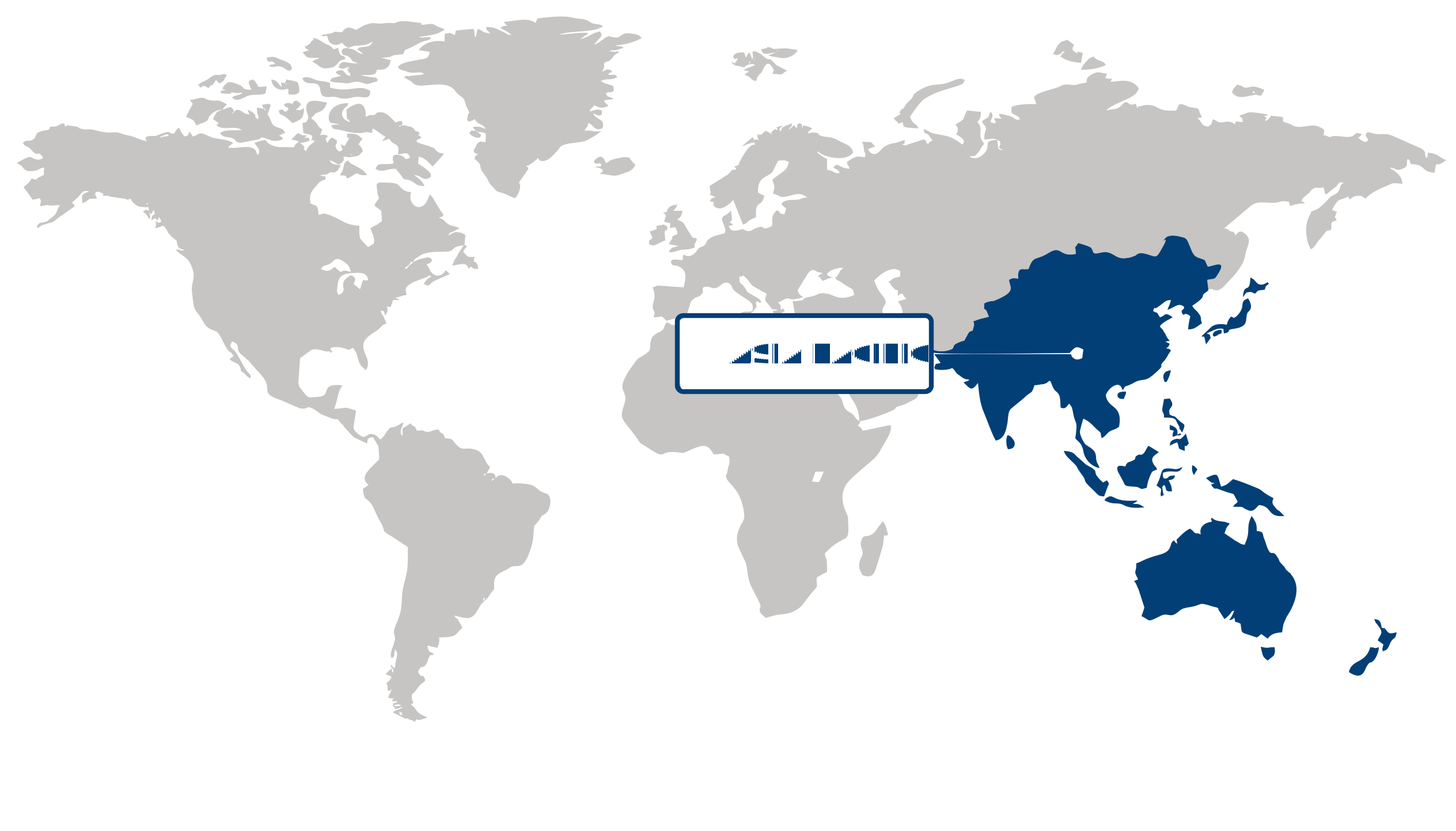
Asia Pacific (Largest & Fastest-Growing Region)
Asia Pacific led the bio-polybutadiene market in 2026 and is also expected to remain the fastest-growing regional market. The region’s strong manufacturing base, expanding polymer and rubber industries, and growing focus on sustainable material alternatives are supporting market development. Increasing industrial demand and efforts to integrate bio-based feedstocks into material production are encouraging adoption, while expanding sustainability initiatives and investments in advanced materials are creating further opportunities for regional growth.
| Parameter | North America | Asia Pacific | Europe | Latin America | MEA |
|---|---|---|---|---|---|
| Innovation Hub i Scale Nascent Developing Advanced | |||||
| Cost-Sensitive Region i Scale Low Medium High | |||||
| Regulatory Environment i Scale Restrictive Neutral Supportive | |||||
| Demand Drivers i Scale Weak Moderate Strong | |||||
| Development Stage i Scale Emerging Developing Developed | |||||
| Adoption Rate i Scale Low Medium High | |||||
| New Entrants / Startups i Scale Sparse Moderate Dense | |||||
| Macro Indicators i Scale Weak Stable Strong |
Key Country Insights
Germany 🇩🇪
Circular Materials IntegrationGermany is integrating bio-polybutadiene into advanced rubber manufacturing to align with sustainability objectives in automotive and industrial sectors. Manufacturers are evaluating bio-based feedstocks while maintaining strict product quality and processing standards.
France 🇫🇷
Renewable Feedstock FocusFrance is encouraging the use of renewable feedstocks for bio-polybutadiene as industrial users pursue lower-carbon material alternatives. Chemical producers are aligning innovation efforts with sustainability initiatives across transportation and manufacturing sectors.
Italy 🇮🇹
Specialty Rubber ApplicationsItaly is expanding bio-polybutadiene use in specialty rubber products where manufacturers value sustainable material options without compromising product quality. Industrial partnerships are supporting gradual integration into established production processes.
Japan 🇯🇵
Precision Material DevelopmentJapan is focusing on bio-polybutadiene formulations that deliver consistent mechanical performance for premium tires and specialty rubber products. Domestic producers continue investing in process optimization and partnerships that improve production efficiency.
South Korea 🇰🇷
Industrial Supply ExpansionSouth Korea is strengthening bio-polybutadiene production capabilities through investments in advanced petrochemical infrastructure and sustainable materials. Local manufacturers are working with downstream rubber processors to broaden commercial applications across mobility industries.
United States 🇺🇸
Sustainable Tire InnovationThe U.S. is emphasizing bio-polybutadiene for tire manufacturing and industrial rubber applications as producers seek renewable raw materials with established performance characteristics. Collaboration between chemical companies and automotive suppliers is supporting commercial adoption and supply chain development.
Segment Leadership and Growth Trends
Bio-polybutadiene Market Share (%), by Application, 2026
Go beyond the chart, access full insights & data tables
Request Free Sample ReportApplication Segment Analysis: Tire Manufacturing (Largest & Fastest-Growing Segment)
Tire manufacturing represented the largest and fastest-growing application in the bio-polybutadiene market, accounting for 72% share in 2026. Polybutadiene is valued in tire formulations for its contribution to properties such as abrasion resistance, elasticity, and overall tire performance, making tire production a major outlet for bio-based alternatives. The increasing focus on reducing the environmental footprint of materials used in automotive manufacturing is creating additional interest in bio-derived rubber components. As tire producers pursue more sustainable material strategies without compromising functional performance, demand for bio-polybutadiene in tire applications continues to strengthen.
Product Segment Analysis: High Cis Polybutadiene (Largest Segment) vs High Trans Polybutadiene (Fastest-Growing Segment)
High cis polybutadiene held the largest share of the bio-polybutadiene market at 61.11% in 2026, reflecting its favorable combination of elasticity, resilience, and wear-related performance characteristics. These properties make high cis materials particularly suitable for demanding rubber applications, especially where durability and dynamic performance are important. Its established functional advantages and compatibility with tire and other rubber formulations support continued preference for this product type.
High trans polybutadiene is gaining momentum as material developers and manufacturers explore broader performance profiles within bio-based rubber technologies. Its distinct structural characteristics can provide opportunities for tailoring properties according to application requirements, supporting greater formulation flexibility. Continued innovation in sustainable polymer production and efforts to expand the range of bio-derived rubber materials are creating opportunities for increased adoption of high trans polybutadiene.
| Segment | Sub-Segment | Largest Segment | Fastest Growing |
|---|---|---|---|
| Application | Tire Manufacturing, Polymer Modification, Industrial Rubber Manufacturing | Tire Manufacturing | Tire Manufacturing |
| Product | High Cis Polybutadiene, Low Cis Polybutadiene, High Vinyl Polybutadiene, High Trans Polybutadiene | High Cis Polybutadiene | High Trans Polybutadiene |
Competitive Landscape and Market Positioning
Key companies in the bio-polybutadiene market:
1. LANXESS AG (Germany)
2. Kuraray Co. Ltd. (Japan)
3. Kraton Corporation (United States)
4. JSR Corporation (Japan)
5. Zeon Corporation (Japan)
6. China Petroleum & Chemical Corporation (China)
7. LG Chem Ltd. (South Korea)
8. Versalis S.p.A. (Italy)
The bio-polybutadiene market is gaining momentum due to increasing focus on sustainable material alternatives. R&D efforts are enhancing bio-based production efficiency and performance characteristics. New product developments are expanding application potential across industrial uses. Market expansion is supported by rising adoption of eco-friendly polymer solutions.
| Company | Market Share | Company Revenue | Revenue CAGR (%) | Product Portfolio | Geographic Presence | Innovation / R&D Focus | Strategic Developments |
|---|---|---|---|---|---|---|---|
| LANXESS AG (Germany) | |||||||
| Kuraray Co. Ltd. (Japan) | |||||||
| Kraton Corporation (United States) | |||||||
| JSR Corporation (Japan) | |||||||
| Zeon Corporation (Japan) | |||||||
| China Petroleum & Chemical Corporation (China) | |||||||
| LG Chem Ltd. (South Korea) | |||||||
| Versalis S.p.A. (Italy). |
Industry Development/News
| Company Name | Date | Key Development |
|---|---|---|
| Bio-polybutadiene Manufacturers | 2025 | Adoption of sustainable polymer blends incorporating bio-polybutadiene increased, accounting for nearly 25% of new rubber application product launches. This trend indicates accelerating integration of bio-based materials into commercial rubber formulations, reinforcing sustainability-driven product development across the industry. |
| Multiple Companies | 2025 | Sustainable polymer blends incorporating bio-polybutadiene gained wider industrial adoption, contributing to nearly 25% of new product launches in rubber applications. This reflects increasing integration of bio-based feedstocks into mainstream elastomer and tire manufacturing ecosystems. |
| Bio-polybutadiene Manufacturers | 2024 | Bio-polybutadiene formulations tailored for electric vehicle tires were introduced, improving durability by approximately 15%. This development reflects growing integration of bio-based elastomers into next-generation mobility applications, enhancing performance characteristics required for EV-specific tire demand. |
| Bio-polybutadiene Manufacturers | 2024 | Catalytic process innovations reduced production costs by around 10%, improving commercial viability of bio-polybutadiene manufacturing. These advancements support broader adoption by lowering cost barriers and strengthening competitiveness versus conventional fossil-based polybutadiene alternatives. |
| Multiple Companies | 2024 | Bio-polybutadiene saw formulation advancements for electric vehicle tire applications, improving durability by nearly 15%. In parallel, catalytic process innovations reduced production costs by approximately 10%, enhancing commercial viability and supporting broader adoption across high-performance rubber and mobility applications. |
| Bio-polybutadiene Manufacturers | 2023 | Industry adoption of biomass-based production technologies improved manufacturing yield efficiency by around 20%, enabling more scalable bio-polybutadiene production. This advancement supports broader commercialization of bio-based elastomers by improving output efficiency and strengthening supply-side viability across industrial rubber applications. |
| Bio-polybutadiene Manufacturers | 2023 | Strategic collaborations between tire manufacturers and chemical producers increased, representing nearly 30% of new sustainability initiatives. These partnerships support integration of bio-polybutadiene into tire formulations, reinforcing supply chain alignment between raw material producers and downstream mobility applications. |
| Multiple Companies | 2023 | Industry-wide advancements in biomass-based production technologies improved yield efficiency by approximately 20%, enabling scaled bio-polybutadiene manufacturing. Concurrently, increased collaboration between tire manufacturers and chemical producers accounted for nearly 30% of sustainability initiatives, indicating stronger integration across the bio-based rubber value chain. |
| Evonik Industries AG | Jul-22 | Evonik Industries AG launched a sustainable bio-based liquid polybutadiene (POLYVEST eCO) at its Marl, Germany facility, significantly reducing reliance on fossil raw materials by approximately 99.9%. The development strengthens bio-based elastomer offerings and supports the shift toward low-carbon polymer production in high-performance rubber and industrial applications. |
Customize Your Report
Explore examples of how this report can be tailored to different research needs, including custom segments, additional topics or chapters, and related reports. Click a section of the wheel or its numbered marker to explore the available options.
Bio-polybutadiene Market — Custom Segments
| Segment | Sub-Segment |
|---|---|
| Feedstock Source | Biomass-Derived Feedstocks, Bio-Based Chemical Intermediates, Waste-Derived Feedstocks |
| Buyer Type | Tire Manufacturers, Rubber & Polymer Producers, Industrial Component Manufacturers |
| Sustainability Requirement | Conventional-Compatible Bio-Based, Reduced-Carbon Bio-Based, High Renewable-Content Bio-Based |
Bio-polybutadiene Market — Custom TOC
| Custom Chapter | Custom Details |
|---|---|
| Sustainable Rubber Transition Analysis |
|
| Bio-based Feedstock Opportunity Assessment |
|
| Circular Economy Opportunities in Rubber Materials |
|
Need a different cut of the data?
Request Custom ResearchWhat is the market valuation of bio-polybutadiene?
What are the growth projections for the bio-polybutadiene industry?
How are corporate sustainability requirements reshaping procurement decisions in the bio-polybutadiene market?
Why is tire manufacturing emerging as the primary growth channel for bio-polybutadiene adoption at scale?
Which product segment held the largest share of the bio-polybutadiene market?
Why is high trans polybutadiene the fastest-growing product segment in the bio-polybutadiene market?
Why is Asia Pacific the leading region in the bio-polybutadiene market?
What is supporting the rapid expansion of the bio-polybutadiene market in Asia Pacific?
Which companies dominate the bio-polybutadiene landscape?
Our Clients
"The report helped us understand emerging consumer trends in our product category. It clarified where to focus innovation for the next product launch."
LyondellBasell
"The regional forecast section was incredibly useful. We were able to identify two new potential partners in Europe thanks to the vendor mapping you included."
SABIC
"We appreciated how actionable the recommendations were. It guided us to improve supply chain resilience."
Olin Corporation
Our Research Team & Methodology
Every Fundamental Business Insights report is built by a dedicated vertical research team, validated through a structured primary-and-secondary methodology, and reviewed for accuracy before it reaches you.
Research Team Overview
Prepared by the Chemicals & Materials Research Team
Delivery
Published
Demand
Available
Support
Trust & Compliance
Research Domains
10 coverage areasResearch Intelligence
| Source | Reference |
|---|---|
| American Chemistry Council (ACC) | www.americanchemistry.com |
| European Chemical Industry Council (Cefic) | cefic.org |
| International Council of Chemical Associations (ICCA) | icca-chem.org |
| European Chemicals Agency (ECHA) | echa.europa.eu |
| U.S. Environmental Protection Agency (EPA) | www.epa.gov |
| ASTM International | www.astm.org |
| International Organization for Standardization (ISO) | www.iso.org |
| National Institute of Standards and Technology (NIST) | www.nist.gov |
| Plastics Industry Association (PLASTICS) | www.plasticsindustry.org |
| European Biplastics | www.european-bioplastics.org |
| The Adhesive and Sealant Council (ASC) | www.ascouncil.org |
| National Association of Corrosion Engineers (AMPP) | www.ampp.org |
| Society of Plastics Engineers (SPE) | www.4spe.org |
| International Fertilizer Association (IFA) | www.fertilizer.org |
| CropLife International | croplife.org |
| Packaging Europe | packagingeurope.com |
| Flexible Packaging Association (FPA) | www.flexpack.org |
| Battery Council International (BCI) | batterycouncil.org |
| International Copper Association (ICA) | internationalcopper.org |
| World Steel Association | worldsteel.org |
Research Workflow & Quality Assurance
Data Collection
Verified information gathered through primary and secondary research.
Data Triangulation
Cross-validation using multiple independent data sources.
Forecast Modelling
Market estimates developed using historical trends and analytical models.
Analyst Validation
Findings reviewed by domain experts for accuracy and consistency.
Editorial & Quality Review
Final editorial, quality, and compliance checks before publication.
Final Publication
Released after successful completion of the internal review process.
Report Coverage
📊 Market Assessment
- Market Size & Forecast
- Market Segmentation
- Regional Analysis
- Growth Drivers & Challenges
- Market Dynamics
🏢 Competitive Intelligence
- Competitive Landscape
- Company Profiles
- Competitive Benchmarking
- Mergers & Acquisitions
- Market Share Analysis or Key Company Strategies
🔍 Strategic Analysis
- Value Chain Analysis
- Porter's Five Forces
- PESTLE Analysis
- Pricing Trends
- Supply-Demand Analysis
🚀 Future Outlook
- Technology Landscape
- Regulatory Landscape
- Investment & Funding Landscape
- Emerging Opportunities
- Future Market Outlook
Have a question about this report or need a custom scope?
Request Customization