Bicycle Mechanical Disc Brake Market Size & Growth Forecast 2027–2036, By Segments (Brake, Distribution Channel, Application, Offering), Regional Demand Trends (North America, Asia Pacific, Europe), Key Country Insights (U.S., Japan, South Korea, Germany, France, Italy), and Competitive Landscape
Market Size and Growth Outlook
Bicycle Mechanical Disc Brake Market size was valued at USD 542.04 Million in 2026 and is anticipated to grow at 4.32% CAGR from 2027 to 2036, crossing USD 827.38 Million by 2036. The industry revenue for 2027 is calculated at USD 561.55 Million.
Get more details on this report
Request Free Sample ReportBicycle Mechanical Disc Brake Market Intelligence Snapshot
Regional Market Dynamics
- Asia Pacific led in 2026, supported by strong bicycle manufacturing, widespread cycling activity, established supply chains, and rising demand for reliable upgraded braking components.
- Europe is the fastest-growing region, supported by cycling adoption, environmental awareness, active-transport policies, and increasing demand for dependable, low-maintenance bicycle components.
Segment Momentum
- OEM held 69.12% of the market share in 2026 as bicycle manufacturers increasingly install mechanical disc brakes during production to deliver reliable braking performance and compatibility across modern bicycle models.
- Gravel bikes are the fastest-growing application due to rising interest in adventure riding and mixed-surface cycling, increasing demand for dependable mechanical disc brakes that perform consistently across varied riding conditions.
Market Expansion Drivers
- Rising global bicycle adoption driving demand for reliable mechanical braking systems
- Government cycling infrastructure investments boosting urban mobility and safety component demand
- Environmental sustainability trends accelerating shift toward eco-friendly transportation solutions
Leading Market Participants
- Leading companies in the bicycle mechanical disc brake market include Shimano Inc. (Japan), SRAM LLC (United States), Tektro Technology Corporation (Taiwan), Magura (Germany), Hayes Performance Systems (United States), Campagnolo S.r.l. (Italy), Hope Technology Ltd. (United Kingdom), Jagwire (United States), TRP (Tektro Racing Products) (Taiwan), Galfer (Spain)
Global Market Forecast Snapshot
Market Outlook
- 2026 Market Size: USD 542.04 Million
- 2027 Estimated Market Size: USD 561.55 Million
- Projected Market Size: USD 827.38 Million by 2036
- Growth Forecast: 4.32% CAGR (2027-2036)
Regional and Segment Outlook
- Leading Regional Market: Asia Pacific
- High-Growth Regional Hub: Europe
- Core Revenue Segment: Front Disc Brake (Brake) | OEM (Distribution Channel) | Mountain Bike (Application) | Single Piston (Offering)
- Emerging Opportunity Segment: Front Disc Brake (Brake) | Aftermarket (Distribution Channel) | Gravel Bikes (Application) | Dual Piston (Offering)
Market Growth Drivers and Industry Trends
Rising global bicycle adoption driving demand for reliable mechanical braking systems
Growing interest in cycling for commuting, recreation, fitness, and outdoor activities is expanding the installed base of bicycles across developed and emerging markets. This trend will drive the bicycle mechanical disc brake market growth as riders increasingly seek dependable braking systems that deliver consistent stopping performance under varying weather and terrain conditions. Mechanical disc brakes offer an attractive balance of durability, affordability, and ease of maintenance, making them suitable for urban bicycles, mountain bikes, and entry-level performance models. Their compatibility with a wide range of bicycle configurations also supports broader adoption among manufacturers and aftermarket customers looking for practical and reliable braking solutions.
Government cycling infrastructure investments boosting urban mobility and safety component demand
Public investments in dedicated cycling lanes, bicycle-sharing programs, and urban mobility initiatives are encouraging more people to adopt cycling as a regular mode of transportation. The bicycle mechanical disc brake market benefits from these infrastructure developments as bicycle manufacturers prioritize dependable safety components that improve rider confidence in increasingly busy urban environments. Enhanced braking performance is particularly important for commuting routes involving frequent stops, changing road conditions, and mixed traffic, leading to greater demand for mechanical disc brake systems that provide reliable control while remaining cost-effective for large-scale bicycle production.
Environmental sustainability trends accelerating shift toward eco-friendly transportation solutions
Growing awareness of environmental sustainability is encouraging consumers and governments to promote low-emission transportation alternatives that reduce dependence on conventional vehicles. This transition will propel the bicycle mechanical disc brake market growth as cycling gains wider acceptance as an environmentally responsible mobility option for short-distance travel and daily commuting. The resulting increase in bicycle ownership supports demand for durable braking technologies that require minimal maintenance and provide long-term operational reliability, aligning with consumer preferences for efficient, practical, and sustainable transportation equipment.
| Growth Driver | Impact on CAGR | Regulatory Influence | Geographic Relevance | Adoption Rate | Impact Timeline |
|---|---|---|---|---|---|
| Rising global bicycle adoption driving demand for reliable mechanical braking systems | 1.8% | Low | Asia Pacific, Europe | High | Near Term |
| Government cycling infrastructure investments boosting urban mobility and safety component demand | 1.5% | High | Europe, North America | High | Mid Term |
| Environmental sustainability trends accelerating shift toward eco-friendly transportation solutions | 1.3% | Moderate | Europe, Asia Pacific | Medium | Mid Term |
Unlock insights tailored to your business with our bespoke market research solutions.
Click to get your customized report now.
Regional Demand Dynamics
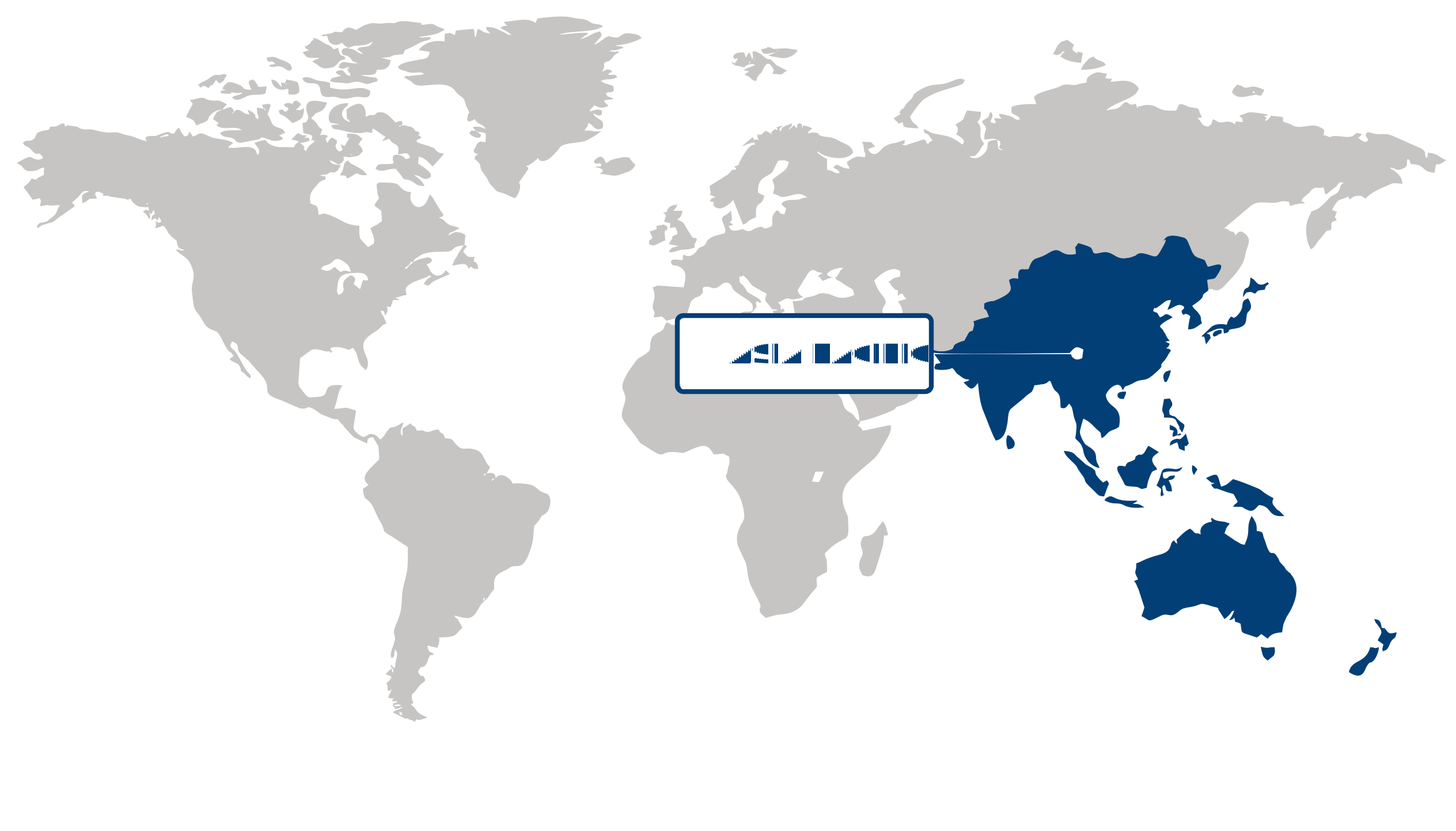
Asia Pacific (Largest Region)
The bicycle mechanical disc brake market was largest in Asia Pacific in 2026, benefiting from strong bicycle manufacturing capabilities, widespread cycling activity, and growing demand for reliable braking systems. Increasing interest in recreational cycling, commuting, and performance-oriented bicycles is supporting the adoption of disc brake technologies that offer consistent stopping performance across varied riding conditions. The region’s established bicycle supply chain and expanding consumer interest in upgraded bicycle components further contribute to its leading market position.
Europe (Fastest-Growing Region)
Europe is projected to register the fastest growth, supported by increasing cycling adoption, strong environmental awareness, and policies encouraging low-emission and active transportation. Growing demand for bicycles for commuting, leisure, and fitness is creating favorable conditions for improved braking systems. The increasing preference for bicycles equipped with dependable and low-maintenance components is also supporting opportunities for mechanical disc brakes across the European market.
| Parameter | North America | Asia Pacific | Europe | Latin America | MEA |
|---|---|---|---|---|---|
| Innovation Hub i Scale Nascent Developing Advanced | |||||
| Cost-Sensitive Region i Scale Low Medium High | |||||
| Regulatory Environment i Scale Restrictive Neutral Supportive | |||||
| Demand Drivers i Scale Weak Moderate Strong | |||||
| Development Stage i Scale Emerging Developing Developed | |||||
| Adoption Rate i Scale Low Medium High | |||||
| New Entrants / Startups i Scale Sparse Moderate Dense | |||||
| Macro Indicators i Scale Weak Stable Strong |
Key Country Insights
United States 🇺🇸
Performance Cycling DemandThe U.S. bicycle mechanical disc brake market benefits from sustained demand across mountain, gravel, and recreational cycling segments. Manufacturers focus on dependable braking performance, simplified maintenance, and compatibility with a broad range of bicycle platforms.
Germany 🇩🇪
Premium Cycling ComponentsGermany emphasizes durable bicycle mechanical disc brake systems that support commuter, touring, and performance bicycles. German manufacturers and consumers value engineering quality, braking consistency, and long-term product reliability across diverse riding conditions.
Japan 🇯🇵
Urban Mobility SolutionsJapan supports demand for bicycle mechanical disc brakes through urban mobility, compact bicycle designs, and recreational cycling. The market values lightweight, space-efficient braking systems that deliver dependable performance with minimal maintenance requirements.
South Korea 🇰🇷
Recreational Cycling SupportSouth Korea continues expanding bicycle mechanical disc brake adoption alongside growing participation in recreational and fitness cycling. Local demand favors efficient braking systems that combine durability, rider confidence, and straightforward servicing.
France 🇫🇷
Outdoor Cycling ApplicationsFrance maintains demand for bicycle mechanical disc brakes through road, gravel, and leisure cycling activities. French consumers seek braking systems that provide consistent control across varied terrain while supporting affordable bicycle maintenance.
Italy 🇮🇹
Value-Oriented Component SupplyItaly supports the bicycle mechanical disc brake market through established bicycle manufacturing and component integration. Italian producers emphasize practical, reliable braking solutions suited to commuter bicycles, touring models, and entry-level performance segments.
Segment Leadership and Growth Trends
Bicycle Mechanical Disc Brake Market Share (%), by Brake, 2026
Go beyond the chart, access full insights & data tables
Request Free Sample ReportBrake Segment Analysis: Front Disc Brake (Largest & Fastest-Growing Segment)
The front disc brake segment dominated the bicycle mechanical disc brake market, accounting for 63.6% in 2026, while also emerging as the fastest-growing segment. Its leadership is driven by the critical role of front braking systems in providing stronger stopping power, enhanced rider control, and improved braking performance across varying terrain and weather conditions. Increasing consumer preference for safer and more reliable braking systems, particularly in performance-oriented and recreational bicycles, continues to strengthen adoption. Ongoing improvements in brake design and durability further support the segment's sustained growth.
Distribution Channel Segment Analysis: OEM (Largest Segment) vs Aftermarket (Fastest-Growing Segment)
The OEM distribution channel held the largest share of 69.12% in 2026, supported by the increasing integration of mechanical disc brake systems during bicycle manufacturing. Bicycle manufacturers continue to equip a wide range of models with factory-installed disc brakes to meet growing consumer expectations for dependable braking performance, product quality, and compatibility with modern bicycle designs. Strong production of mountain, hybrid, and commuter bicycles further reinforces the segment's leading position.
The aftermarket distribution channel is expected to witness the fastest growth over the forecast period. Rising interest in bicycle upgrades, replacement components, and customization is encouraging consumers to purchase aftermarket mechanical disc brake systems. Growing participation in cycling for recreation, commuting, and fitness, along with increased awareness of maintenance and performance enhancements, continues to drive expansion of the aftermarket segment.
Application Segment Analysis: Mountain Bike (Largest Segment) vs Gravel Bikes (Fastest-Growing Segment)
The mountain bike application segment held the largest share in 2026, reflecting the widespread use of mechanical disc brakes in off-road cycling environments where reliable stopping power and consistent braking performance are essential. Mountain bikes frequently operate under challenging terrain and changing weather conditions, making durable and responsive braking systems a key requirement for rider safety and control.
The bicycle mechanical disc brake market is experiencing the fastest growth in the gravel bikes segment. The increasing popularity of gravel cycling, adventure riding, and mixed-surface biking is creating greater demand for braking systems capable of delivering dependable performance across diverse riding conditions. As riders seek versatile bicycles that combine road efficiency with off-road capability, adoption of mechanical disc brakes in gravel bikes continues to expand.
| Segment | Sub-Segment | Largest Segment | Fastest Growing |
|---|---|---|---|
| Brake | Front Disc Brake, Rear Disc Brake | Front Disc Brake | Front Disc Brake |
| Distribution Channel | OEM, Aftermarket | OEM | Aftermarket |
| Application | Road Bike, Mountain Bike, Racing Bike, Gravel Bikes | Mountain Bike | Gravel Bikes |
| Offering | Single Piston, Dual Piston, Four Piston, Multi-piston | Single Piston | Dual Piston |
Competitive Landscape and Market Positioning
Key companies in the bicycle mechanical disc brake market:
- Shimano, Inc. (Japan)
- SRAM LLC (United States)
- Tektro Technology Corporation (Taiwan)
- Magura (Germany)
- Hayes Performance Systems (United States)
- Campagnolo S.r.l. (Italy)
- Hope Technology Ltd. (United Kingdom)
- Jagwire (United States)
- TRP (Tektro Racing Products) (Taiwan)
- Galfer (Spain)
Product refinement rather than fundamental design changes is driving competitive evolution in the bicycle mechanical disc brake market, where manufacturers are focused on improving braking consistency, durability, and ease of maintenance. Suppliers are differentiating through lightweight materials, enhanced cable actuation mechanisms, and components engineered for reliable performance under varied riding conditions. Growing interest from recreational and commuter cycling segments is encouraging broader product portfolios that accommodate different bicycle categories and user preferences without sacrificing serviceability. Distribution strength, replacement part availability, and compatibility with evolving bicycle platforms are becoming increasingly influential in shaping competitive positioning.
| Company | Market Share | Company Revenue | Revenue CAGR (%) | Product Portfolio | Geographic Presence | Innovation / R&D Focus | Strategic Developments |
|---|---|---|---|---|---|---|---|
| Shimano Inc. (Japan) | |||||||
| SRAM LLC (United States) | |||||||
| Tektro Technology Corporation (Taiwan) | |||||||
| Magura (Germany) | |||||||
| Hayes Performance Systems (United States) | |||||||
| Campagnolo S.r.l. (Italy) | |||||||
| Hope Technology Ltd. (United Kingdom) | |||||||
| Jagwire (United States) | |||||||
| TRP (Tektro Racing Products) (Taiwan) | |||||||
| Galfer (Spain) |
Industry Development/News
| Company Name | Date | Key Development |
|---|
Customize Your Report
Explore examples of how this report can be tailored to different research needs, including custom segments, additional topics or chapters, and related reports. Click a section of the wheel or its numbered marker to explore the available options.
Bicycle Mechanical Disc Brake Market — Custom Segments
| Segment | Sub-Segment |
|---|---|
| Bicycle Propulsion Type | Conventional Bicycles, Electric Bicycles |
| Bicycle Price Tier | Entry-Level, Mid-Range, Premium |
| Rider Segment | Commuter & Utility Riders, Recreational Riders, Performance & Competitive Riders |
Bicycle Mechanical Disc Brake Market — Custom TOC
| Custom Chapter | Custom Details |
|---|---|
| OEM Specification and Sourcing Priorities |
|
| E-Bike Adoption Impact |
|
| Premiumization and Product Upgrade Opportunities |
|
Need a different cut of the data?
Request Custom ResearchHow big is the bicycle mechanical disc brake market?
How will the bicycle mechanical disc brake industry grow in terms of size and CAGR by 2036?
What market trends are increasing demand for bicycle mechanical disc brakes?
How are urban mobility and sustainability initiatives influencing the bicycle mechanical disc brake market?
Why does the OEM distribution channel dominate the bicycle mechanical disc brake market?
Why are gravel bikes the fastest-growing application in the bicycle mechanical disc brake market?
Why does Asia Pacific lead the bicycle mechanical disc brake market?
How is Europe driving growth in bicycle mechanical disc brakes?
Who are the major participants shaping the bicycle mechanical disc brake landscape?
Our Clients
"The team surpassed our expectations with the report depth. The actionable insights provided proved crucial in navigating market challenges."
Tata Motors
"We found the report to be very informative. The expertise and attention to market nuances significantly influenced our business direction."
DENSO Corporation
"The consumer survey findings were quite good. We now have a clearer picture of the customer churning and retention strategy."
HL Mando
Our Research Team & Methodology
Every Fundamental Business Insights report is built by a dedicated vertical research team, validated through a structured primary-and-secondary methodology, and reviewed for accuracy before it reaches you.
Research Team Overview
Prepared by the Automotive & Transportation Research Team
Delivery
Published
Demand
Available
Support
Trust & Compliance
Research Domains
10 coverage areasResearch Intelligence
| Source | Reference |
|---|---|
| International Organization of Motor Vehicle Manufacturers (OICA) | www.oica.net |
| SAE International | www.sae.org |
| International Energy Agency (IEA) | www.iea.org |
| International Transport Forum (ITF) | www.itf-oecd.org |
| International Road Federation (IRF) | www.irf.global |
| International Organization for Standardization (ISO) | www.iso.org |
| United Nations Economic Commission for Europe (UNECE) | unece.org |
| National Highway Traffic Safety Administration (NHTSA) | www.nhtsa.gov |
| U.S. Department of Transportation (USDOT) | www.transportation.gov |
| European Automobile Manufacturers' Association (ACEA) | www.acea.auto |
| Society of Indian Automobile Manufacturers (SIAM) | www.siam.in |
| International Air Transport Association (IATA) | www.iata.org |
| International Civil Aviation Organization (ICAO) | www.icao.int |
| International Maritime Organization (IMO) | www.imo.org |
| International Union of Railways (UIC) | uic.org |
| American Public Transportation Association (APTA) | www.apta.com |
| International Federation of Robotics (IFR) | ifr.org |
| CharIN | www.charin.global |
| World Shipping Council | www.worldshipping.org |
| International Federation of Freight Forwarders Associations (FIATA) | fiata.org |
Research Workflow & Quality Assurance
Data Collection
Verified information gathered through primary and secondary research.
Data Triangulation
Cross-validation using multiple independent data sources.
Forecast Modelling
Market estimates developed using historical trends and analytical models.
Analyst Validation
Findings reviewed by domain experts for accuracy and consistency.
Editorial & Quality Review
Final editorial, quality, and compliance checks before publication.
Final Publication
Released after successful completion of the internal review process.
Report Coverage
📊 Market Assessment
- Market Size & Forecast
- Market Segmentation
- Regional Analysis
- Growth Drivers & Challenges
- Market Dynamics
🏢 Competitive Intelligence
- Competitive Landscape
- Company Profiles
- Competitive Benchmarking
- Mergers & Acquisitions
- Market Share Analysis or Key Company Strategies
🔍 Strategic Analysis
- Value Chain Analysis
- Porter's Five Forces
- PESTLE Analysis
- Pricing Trends
- Supply-Demand Analysis
🚀 Future Outlook
- Technology Landscape
- Regulatory Landscape
- Investment & Funding Landscape
- Emerging Opportunities
- Future Market Outlook
Have a question about this report or need a custom scope?
Request Customization