Bicycle Disc Brake Rotor Market Size & Growth Forecast 2027–2036, By Segments (Mounting System, Material, Size, Application), Regional Demand Trends (North America, Asia Pacific, Europe), Key Country Insights (U.S., Japan, South Korea, Germany, France, Italy), and Competitive Landscape
Market Size and Growth Outlook
Bicycle Disc Brake Rotor Market size was valued at USD 160.08 Million in 2026 and is anticipated to grow at 4.86% CAGR from 2027 to 2036, surpassing USD 257.3 Million by 2036. The industry revenue for 2027 is calculated at USD 166.56 Million.
Get more details on this report
Request Free Sample ReportBicycle Disc Brake Rotor Market Intelligence Snapshot
Regional Market Dynamics
- Asia Pacific led in 2026, supported by strong bicycle manufacturing, established component supply networks, and rising demand for recreational, sports, and premium bicycles.
- Recreational and performance cycling, expanding e-bike demand, and greater interest in safety and higher-specification components are supporting faster adoption of advanced disc braking systems.
Segment Momentum
- The 6-bolt mounting system held 69.89% of the market share in 2026 due to its broad compatibility, reliable rotor attachment, ease of maintenance, and widespread use across multiple bicycle categories.
- Composite materials are expected to grow the fastest as manufacturers prioritize lighter components with improved thermal efficiency, braking consistency, and performance for premium and high-performance bicycles.
Market Expansion Drivers
- Rising popularity of e-bikes and mountain bikes boosting disc brake rotor adoption
- Advancements in lightweight braking materials improving performance and heat resistance
- Increasing safety regulations promoting standardized disc brake systems in bicycles
Leading Market Participants
- Key companies in the bicycle disc brake rotor market include Shimano Inc. (Japan), SRAM LLC (United States), Magura GmbH & Co. KG (Germany), Hope Technology Ltd. (United Kingdom), Galfer (Spain), Hayes Performance Systems (United States), SwissStop (Switzerland), Formula S.r.l. (Italy), Tektro Technology Corporation (Taiwan), Ashima Ltd. (Taiwan)
Global Market Forecast Snapshot
Market Outlook
- 2026 Market Size: USD 160.08 Million
- 2027 Estimated Market Size: USD 166.56 Million
- Projected Market Size: USD 257.3 Million by 2036
- Growth Forecast: 4.86% CAGR (2027-2036)
Regional and Segment Outlook
- Leading Regional Market: Asia Pacific
- High-Growth Regional Hub: North America
- Core Revenue Segment: 6-Bolt (Mounting System) | Stainless Steel (Material) | Small (160mm and Below) (Size) | Mountain Bikes (MTBs) (Application)
- Emerging Opportunity Segment: Centerlock (Mounting System) | Composite Materials (Material) | Large (200mm and Above) (Size) | E-bikes (Application)
Market Growth Drivers and Industry Trends
Rising popularity of e-bikes and mountain bikes boosting disc brake rotor adoption
The growing appeal of electric bicycles and mountain bikes is increasing demand for braking systems capable of delivering consistent stopping performance under varying riding conditions. The bicycle disc brake rotor market growth is driven by the widespread adoption of disc brake rotors that provide superior braking efficiency, improved control, and dependable performance on steep descents and uneven terrain. E-bikes, with their higher speeds and additional weight, require robust braking components that can withstand greater thermal and mechanical loads during prolonged use. Similarly, mountain biking enthusiasts prioritize reliable braking systems that enhance rider confidence and maneuverability across challenging trails and diverse weather conditions.
Advancements in lightweight braking materials improving performance and heat resistance
Continuous innovation in material engineering is enabling manufacturers to develop braking components that balance strength, durability, and reduced weight. Advancements in lightweight braking materials will propel the bicycle disc brake rotor market growth by improving heat dissipation, minimizing brake fade, and enhancing overall riding performance during demanding cycling applications. High-performance rotor designs are increasingly optimized to deliver consistent braking under repeated use while reducing unnecessary rotational weight that can affect acceleration and handling. These technological improvements are attracting both competitive cyclists and recreational riders seeking enhanced reliability and long-term component performance.
Increasing safety regulations promoting standardized disc brake systems in bicycles
Evolving safety expectations across the cycling industry are encouraging greater emphasis on dependable braking technologies for a broad range of bicycle categories. Increasing safety regulations will boost the bicycle disc brake rotor market by supporting the adoption of standardized disc brake systems that offer predictable stopping performance and improved operational consistency. Manufacturers are aligning product designs with evolving quality and safety requirements while enhancing compatibility across different bicycle platforms. Standardized braking solutions also contribute to simplified maintenance, greater consumer confidence, and improved reliability in both everyday commuting and high-performance cycling environments.
| Growth Driver | Impact on CAGR | Regulatory Influence | Geographic Relevance | Adoption Rate | Impact Timeline |
|---|---|---|---|---|---|
| Rising popularity of e-bikes and mountain bikes boosting disc brake rotor adoption | 1.9% | Low | Europe, Asia Pacific, North America | High | Near Term |
| Advancements in lightweight braking materials improving performance and heat resistance | 1.7% | Low | Europe, North America | High | Mid Term |
| Increasing safety regulations promoting standardized disc brake systems in bicycles | 1.5% | High | Europe, North America, Asia Pacific | High | Near Term |
Unlock insights tailored to your business with our bespoke market research solutions.
Click to get your customized report now.
Regional Demand Dynamics
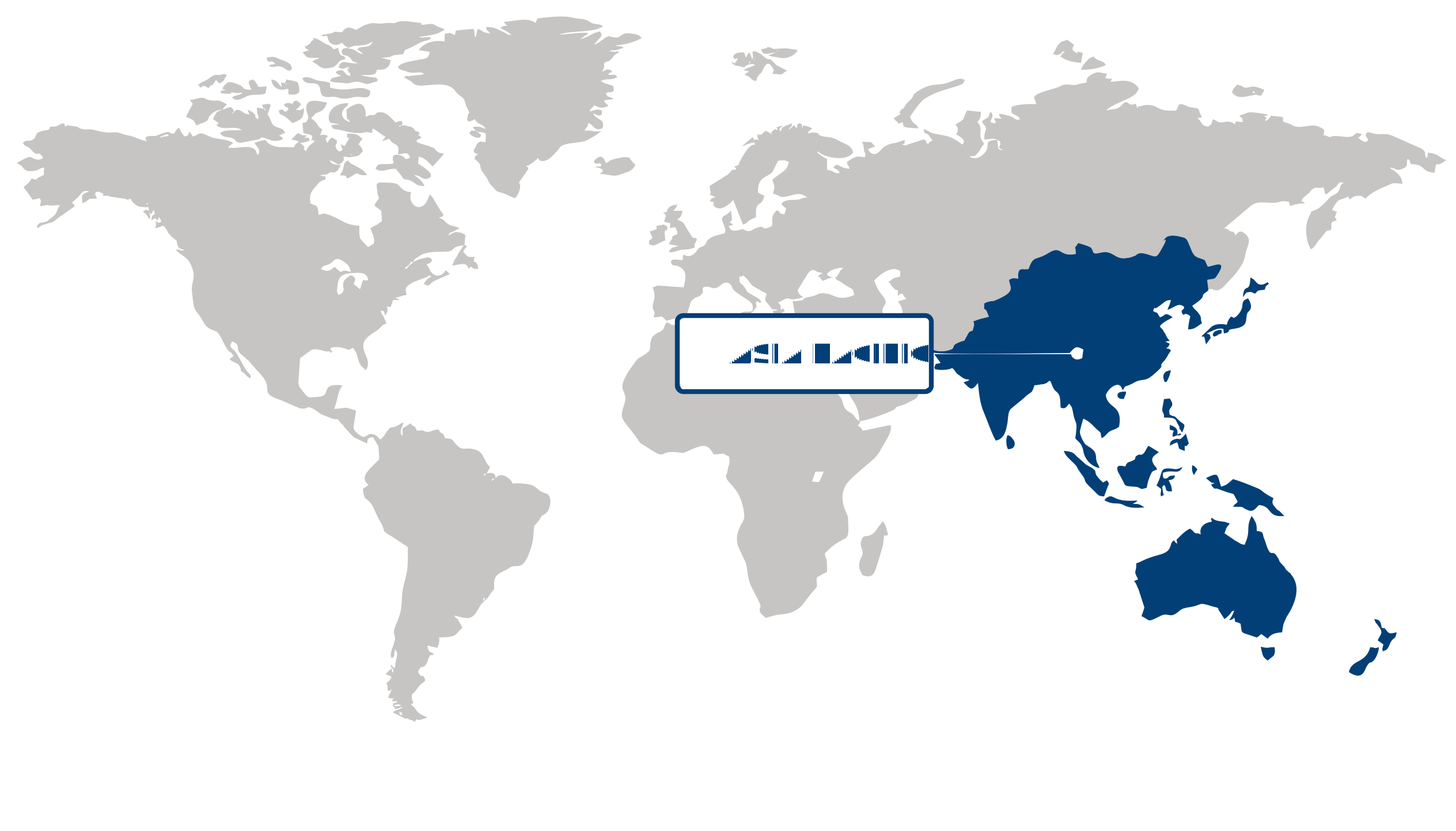
Asia Pacific (Largest Region)
Asia Pacific represented the largest position in the bicycle disc brake rotor market in 2026, supported by strong bicycle manufacturing capabilities, extensive component supply networks, and growing demand for performance-oriented cycling equipment. The region's large production base provides manufacturers with access to established metalworking, machining, and bicycle-component ecosystems, facilitating efficient production of braking components. Rising interest in recreational cycling, sports bicycles, and premium bicycle models is also encouraging demand for disc brake systems. Furthermore, increasing urban cycling and the development of cycling infrastructure in several countries are supporting broader adoption of bicycles equipped with advanced braking technologies.
North America (Fastest-Growing Region)
North America is anticipated to experience the fastest growth in the bicycle disc brake rotor market, supported by increasing participation in recreational and performance cycling and growing consumer interest in higher-specification bicycle components. Demand for mountain bikes, road bikes, and electric bicycles is creating opportunities for disc brake rotor adoption because of their braking performance and reliability across varied riding conditions. The expanding e-bike market is also contributing to demand for robust braking systems capable of supporting heavier and higher-performance bicycle configurations. In addition, greater consumer awareness of bicycle safety and component quality is encouraging upgrades toward advanced braking technologies.
| Parameter | North America | Asia Pacific | Europe | Latin America | MEA |
|---|---|---|---|---|---|
| Innovation Hub i Scale Nascent Developing Advanced | |||||
| Cost-Sensitive Region i Scale Low Medium High | |||||
| Regulatory Environment i Scale Restrictive Neutral Supportive | |||||
| Demand Drivers i Scale Weak Moderate Strong | |||||
| Development Stage i Scale Emerging Developing Developed | |||||
| Adoption Rate i Scale Low Medium High | |||||
| New Entrants / Startups i Scale Sparse Moderate Dense | |||||
| Macro Indicators i Scale Weak Stable Strong |
Key Country Insights
United States 🇺🇸
Performance Cycling DemandThe U.S. market for bicycle disc brake rotors is supported by strong demand across mountain, gravel, and performance road cycling. Manufacturers are emphasizing lightweight materials, heat management, and compatibility with modern braking systems.
Germany 🇩🇪
Precision Component EngineeringGermany prioritizes bicycle disc brake rotors that deliver consistent braking performance and long service life. Domestic manufacturers focus on precision machining, material optimization, and compatibility with premium bicycle platforms.
Japan 🇯🇵
Lightweight Braking SolutionsJapan emphasizes lightweight bicycle disc brake rotors that improve efficiency without compromising braking reliability. Product development centers on advanced metallurgy and compact designs suited to high-performance cycling applications.
South Korea 🇰🇷
Cycling Component InnovationSouth Korea is expanding bicycle disc brake rotor production with attention to durability, thermal stability, and manufacturing efficiency. Suppliers are aligning products with growing demand for premium bicycles and electric bicycle applications.
France 🇫🇷
Recreational Cycling SupportFrance maintains demand for bicycle disc brake rotors through recreational cycling, competitive sports, and urban mobility. Component suppliers are introducing rotor designs that balance braking consistency with reduced maintenance requirements.
Italy 🇮🇹
Premium Bicycle ComponentsItaly integrates high-quality bicycle disc brake rotors into premium road and performance bicycles. Manufacturers prioritize refined rotor designs that complement lightweight frames while delivering reliable braking under varied riding conditions.
Segment Leadership and Growth Trends
Bicycle Disc Brake Rotor Market Share (%), by Mounting System, 2026
Go beyond the chart, access full insights & data tables
Request Free Sample ReportMounting System Segment Analysis: 6-Bolt (Largest Segment) vs Centerlock (Fastest-Growing Segment)
The 6-bolt mounting system segment dominated the bicycle disc brake rotor market and accounted for a 69.89% share in 2026. Its widespread adoption is supported by broad compatibility across different bicycle models, dependable rotor attachment, and ease of maintenance. The mounting system is extensively used in mountain bikes, gravel bikes, and commuter bicycles because it offers a reliable and durable braking solution under varied riding conditions. Strong availability of compatible components and familiarity among cyclists and service technicians further reinforce the segment's dominant position.
The centerlock mounting system is expected to witness the fastest growth as demand increases for lightweight, high-performance braking systems with simplified installation. Centerlock designs enable faster rotor replacement and improved alignment, making them increasingly attractive for performance-oriented road, gravel, and cross-country cycling applications. Continued innovation in premium bicycle components and the growing popularity of advanced drivetrain systems are supporting rapid adoption of this mounting technology.
Material Segment Analysis: Stainless Steel (Largest Segment) vs Composite Materials (Fastest-Growing Segment)
Stainless steel held the largest share in 2026 due to its excellent balance of braking performance, durability, corrosion resistance, and cost-effectiveness. The material performs consistently under varying weather and riding conditions while providing reliable heat management during repeated braking. Its broad compatibility across multiple bicycle categories and proven long-term reliability continue to make stainless steel the preferred material for disc brake rotors.
Composite materials are anticipated to record the fastest growth as manufacturers focus on reducing component weight while improving thermal efficiency and braking consistency. Advanced composite rotor designs help enhance overall bicycle performance by optimizing heat dissipation and reducing rotational mass, making them particularly attractive for competitive and high-performance cycling. Ongoing advancements in materials engineering are further expanding the use of composite materials in premium braking systems.
Size Segment Analysis: Small (160mm and Below) (Largest Segment) vs Large (200mm and Above) (Fastest-Growing Segment)
The small-size segment (160mm and below) represented the largest share in 2026. These rotors are widely used across road bikes, hybrid bicycles, and many recreational cycling applications because they provide an effective balance between braking efficiency, weight, and maneuverability. Their suitability for everyday riding conditions and broad compatibility with a wide range of bicycle models continue to support their strong market position.
In the bicycle disc brake rotor market, the large-size segment (200mm and above) is projected to experience the fastest growth. Larger rotors provide greater braking power, improved heat dissipation, and enhanced control during demanding downhill, enduro, electric bicycle, and cargo bike applications. Increasing consumer preference for high-performance bicycles capable of handling more challenging terrain is driving the adoption of larger rotor sizes.
| Segment | Sub-Segment | Largest Segment | Fastest Growing |
|---|---|---|---|
| Mounting System | Centerlock, 6-Bolt | 6-Bolt | Centerlock |
| Material | Stainless Steel, Aluminum, Composite Materials | Stainless Steel | Composite Materials |
| Size | Small (160mm and Below), Medium (180mm), Large (200mm and Above) | Small (160mm and Below) | Large (200mm and Above) |
| Application | Mountain Bikes (MTBs), Road Bikes, Gravel Bikes, E-bikes | Mountain Bikes (MTBs) | E-bikes |
Competitive Landscape and Market Positioning
Top players in the bicycle disc brake rotor market:
- Shimano, Inc. (Japan)
- SRAM LLC (United States)
- Magura GmbH & Co. KG (Germany)
- Hope Technology Ltd. (United Kingdom)
- Galfer (Spain)
- Hayes Performance Systems (United States)
- SwissStop (Switzerland)
- Formula S.r.l. (Italy)
- Tektro Technology Corporation (Taiwan)
- Ashima Ltd. (Taiwan)
Product refinement has become a more influential competitive driver in the bicycle disc brake rotor market as manufacturers pursue improvements in braking consistency, thermal management, and weight optimization across different riding disciplines. Rather than competing primarily on manufacturing scale, suppliers are differentiating through material selection, rotor geometry, and engineering approaches that enhance performance under demanding conditions while maintaining durability. Growing expectations for compatibility with a wider range of bicycle platforms are also encouraging greater design flexibility, prompting manufacturers to balance performance innovation with ease of integration for both original equipment and aftermarket channels.
| Company | Market Share | Company Revenue | Revenue CAGR (%) | Product Portfolio | Geographic Presence | Innovation / R&D Focus | Strategic Developments |
|---|---|---|---|---|---|---|---|
| Shimano Inc. (Japan) | |||||||
| SRAM LLC (United States) | |||||||
| Magura GmbH & Co. KG (Germany) | |||||||
| Hope Technology Ltd. (United Kingdom) | |||||||
| Galfer (Spain) | |||||||
| Hayes Performance Systems (United States) | |||||||
| SwissStop (Switzerland) | |||||||
| Formula S.r.l. (Italy) | |||||||
| Tektro Technology Corporation (Taiwan) | |||||||
| Ashima Ltd. (Taiwan) |
Industry Development/News
| Company Name | Date | Key Development |
|---|---|---|
| Galfer USA | Dec-24 | Galfer USA launched the 2024 Floating Wave Rotor for mountain, road, and gravel bikes, utilizing motorcycle braking technology to enhance thermal resistance and braking stability. The two-piece, lightweight rotor features a six-bolt pattern, stainless steel blades, a black steel center carrier, and sizing options of 180mm and 203mm. |
| Zeno | Apr-24 | Zeno unveiled the ReactionEX Floating Brake Rotor, featuring a fence clip-based mechanism with leaf springs that permits true lateral movement of both structural parts to prevent rotational eccentricity. The design controls thermal expansion to mitigate warping during high-performance applications, supporting sizes from 140mm to 203mm for six-bolt and Center lock configurations. |
Customize Your Report
Explore examples of how this report can be tailored to different research needs, including custom segments, additional topics or chapters, and related reports. Click a section of the wheel or its numbered marker to explore the available options.
Bicycle Disc Brake Rotor Market — Custom Segments
| Segment | Sub-Segment |
|---|---|
| OEM vs. Aftermarket | OEM, Aftermarket |
| Price Tier | Economy, Mid-Range, Premium |
| Sales Channel | Bicycle Specialty Stores, Sporting Goods Stores, Online Retail |
Bicycle Disc Brake Rotor Market — Custom TOC
| Custom Chapter | Custom Details |
|---|---|
| E-Bike Performance Requirements |
|
| OEM Specification & Sourcing Trends |
|
| Aftermarket Replacement Opportunity |
|
Need a different cut of the data?
Request Custom ResearchHow big is the bicycle disc brake rotor market?
What is the anticipated CAGR of the bicycle disc brake rotor industry?
How is e-bike adoption reshaping demand for bicycle disc brake rotors?
Why are advanced rotor materials gaining importance in the bicycle disc brake rotor market?
Why is the 6-bolt mounting system the largest segment in the bicycle disc brake rotor market?
Which material segment is expected to grow the fastest in the bicycle disc brake rotor market?
How does Asia Pacific maintain its leadership in bicycle disc brake rotors?
Why is North America expected to grow fastest in bicycle disc brake rotors?
Who are the major participants shaping the bicycle disc brake rotor landscape?
Our Clients
"The report provided us with a clear direction, and the level of detail was beyond what we expected. I would definitely recommend their services to others."
Haier Appliances
"The collaboration with Fundamental Business Insights has added significant value to our decision-making process, and we look forward to continuing this partnership for our future market research requirements."
Luxottica Group S.p.A.
"The team at FBI delivered an exceptional research report. The insights on industry innovations were particularly impressive and added a lot of value to the overall report."
Nike
Our Research Team & Methodology
Every Fundamental Business Insights report is built by a dedicated vertical research team, validated through a structured primary-and-secondary methodology, and reviewed for accuracy before it reaches you.
Research Team Overview
Prepared by the Consumer Goods & Services Research Team
Delivery
Published
Demand
Available
Support
Trust & Compliance
Research Domains
10 coverage areasResearch Intelligence
| Source | Reference |
|---|---|
| International Organization for Standardization (ISO) | www.iso.org |
| ASTM International | www.astm.org |
| U.S. Consumer Product Safety Commission (CPSC) | www.cpsc.gov |
| European Commission – Consumer Safety | ec.europa.eu/safety-gate |
| Consumer Technology Association (CTA) | www.cta.tech |
| National Retail Federation (NRF) | nrf.com |
| World Retail Congress | www.worldretailcongress.com |
| World Travel & Tourism Council (WTTC) | wttc.org |
| UN Tourism | www.unwto.org |
| Personal Care Products Council (PCPC) | www.personalcarecouncil.org |
| Cosmetics Europe | cosmeticseurope.eu |
| International Housewares Association (IHA) | www.housewares.org |
| American Apparel & Footwear Association (AAFA) | www.aafaglobal.org |
| World Federation of the Sporting Goods Industry (WFSGI) | wfsgi.org |
| Juvenile Products Manufacturers Association (JPMA) | www.jpma.org |
| Pet Industry Joint Advisory Council (PIJAC) | pijac.org |
| International Council of Toy Industries (ICTI) | www.toy-icti.org |
| International Association of Amusement Parks and Attractions (IAAPA) | iaapa.org |
| Organisation for Economic Co-operation and Development (OECD) | www.oecd.org |
| World Bank Data | data.worldbank.org |
Research Workflow & Quality Assurance
Data Collection
Verified information gathered through primary and secondary research.
Data Triangulation
Cross-validation using multiple independent data sources.
Forecast Modelling
Market estimates developed using historical trends and analytical models.
Analyst Validation
Findings reviewed by domain experts for accuracy and consistency.
Editorial & Quality Review
Final editorial, quality, and compliance checks before publication.
Final Publication
Released after successful completion of the internal review process.
Report Coverage
📊 Market Assessment
- Market Size & Forecast
- Market Segmentation
- Regional Analysis
- Growth Drivers & Challenges
- Market Dynamics
🏢 Competitive Intelligence
- Competitive Landscape
- Company Profiles
- Competitive Benchmarking
- Mergers & Acquisitions
- Market Share Analysis or Key Company Strategies
🔍 Strategic Analysis
- Value Chain Analysis
- Porter's Five Forces
- PESTLE Analysis
- Pricing Trends
- Supply-Demand Analysis
🚀 Future Outlook
- Technology Landscape
- Regulatory Landscape
- Investment & Funding Landscape
- Emerging Opportunities
- Future Market Outlook
Have a question about this report or need a custom scope?
Request Customization