Bicycle Accessories Market Size & Forecasts 2026-2035, By Segments (Product, Sales Channel, Type, Bicycle Type), Growth Opportunities, Innovation Landscape, Regulatory Shifts, Strategic Regional Insights (U.S., Japan, China, South Korea, UK, Germany, France), and Competitive Dynamics (Shimano, SRAM, Fox Factory, Garmin, Lezyne)
Market Size and Growth Outlook
Bicycle Accessories Market size is predicted to expand from USD 15.49 billion in 2025 to USD 33.13 billion by 2035, with growth underpinned by a CAGR above 7.9% between 2026 and 2035. The industry revenue outlook for 2026 is USD 16.56 billion.
Get more details on this report
Request Free Sample ReportBicycle Accessories Market Intelligence Snapshot
Regional Market Dynamics
Segment Momentum
Market Expansion Drivers
Leading Market Participants
Global Market Forecast Snapshot
Market Outlook
Regional and Segment Outlook
Market Growth Drivers and Industry Trends
Rising participation as a fitness and commuting choice is reconfiguring demand profiles and purchase frequency across the bicycle accessories market: public-health advocacy from the World Health Organization and modal-share analysis by the European Cyclists’ Federation signal sustained policy and cultural support for cycling, while municipal travel surveys from the U.S. Census Bureau document commuter shifts. That mix is driving demand for safety, comfort, and storage accessories tailored to daily users rather than occasional riders. Established brands can leverage broad retail and service networks to bundle commuter solutions, while nimble entrants can capture niche segments (e.g., cargo conversions, ergonomic saddles). As health campaigns and commuting patterns persist, accessory portfolios will increasingly align to everyday use and durability requirements.
Growing adoption of premium and smart bicycle accessories
The growing appetite for premium and connected products—evidenced by Garmin’s continued rollouts of cycling head units and Varia safety devices and Shimano’s promotion of electronic drivetrain technologies—reshapes consumer expectations and revenue models in the bicycle accessories market. Premiumization raises average selling prices and opens recurring-revenue opportunities through firmware, app integration, and accessory ecosystems promoted by companies like Specialized. Incumbents can monetize brand and distribution scale with bundled hardware-software offerings; startups can differentiate with rapid innovation in sensors, low-cost retrofits, and vertical software stacks. Given ongoing product announcements from Garmin and Shimano and consumer adoption of smart wearables, accessory portfolios will converge on integrated, service-enabled offerings.
Long-term expansion of urban mobility programs
Expansion of municipal and regional mobility programs—visible in Transport for London’s cycling strategy, Paris’s Vélib’ evolution, and C40 Cities’ urban mobility commitments—creates steady institutional demand that reshapes procurement and design criteria across the bicycle accessories market. Public tenders and shared-mobility contracts prioritize robustness, low-maintenance components, and interoperability with payment and fleet-management systems highlighted in World Bank urban transport project documentation. Large suppliers can pursue framework agreements and retrofit contracts; new entrants can offer modular, service-oriented solutions that meet procurement standards and lifecycle management needs. As cities formalize bike networks and procurement practices, supplier strategies will trend toward partnership models and durable, fleet-grade innovations.
Industry Restraints:
Supply Chain Vulnerabilities
Global concentration of component production and episodic freight disruptions materially slow product availability and raise input costs, constraining assortment expansion and promotional agility. Evidence from Maersk’s public shipping updates and reporting by Reuters on post‑pandemic bicycle and parts shortages show prolonged lead times for frames, drivetrains, lights, and electronic accessories, while Drewry’s container indices documented elevated freight volatility that compresses margins. For incumbents this forces higher inventory carrying costs and squeezed promotional windows; for new entrants it raises capital requirements and risks of stockouts. Expect continued emphasis on multi‑sourcing, higher working capital, and selective nearshoring over the near‑to‑medium term, sustaining higher unit costs and slower rollouts.
Regulatory and Safety Standards Fragmentation
Divergent national and regional standards increase certification burden and delay market entry, particularly for helmets, lighting systems, and electrically assisted components. The U.S. Consumer Product Safety Commission (CPSC) and the European Committee for Standardization (CEN, EN 1078 helmet standard) maintain different testing protocols and disclosure rules, and frequent enforcement actions require iterative redesigns and additional lab testing. Legacy manufacturers with compliance teams gain advantage through faster approvals; smaller brands face disproportionate cost and timing penalties. Absent rapid regulatory harmonization, manufacturers will continue to prioritize region‑specific SKUs and phased launches, preserving complexity and elevating compliance spend in the near to medium term.
| Growth Driver | Impact on CAGR | Regulatory Influence | Geographic Relevance | Adoption Rate | Impact Timeline |
|---|---|---|---|---|---|
| Rising cycling participation for fitness and commuting | 1.20% | Short term (≤ 2 yrs) | Europe (Primary), North America (Spillover) | Low | Fast |
| Growing adoption of premium and smart bicycle accessories | 1.00% | Medium term (2–5 yrs) | Asia Pacific (Primary), Europe (Spillover) | Medium | Moderate |
| Long-term expansion of urban mobility programs | 0.80% | Long term (5+ yrs) | North America (Primary), Latin America (Spillover) | Medium | Moderate |
Explore Growth Opportunities
Request Free Sample ReportRegional Demand Dynamics
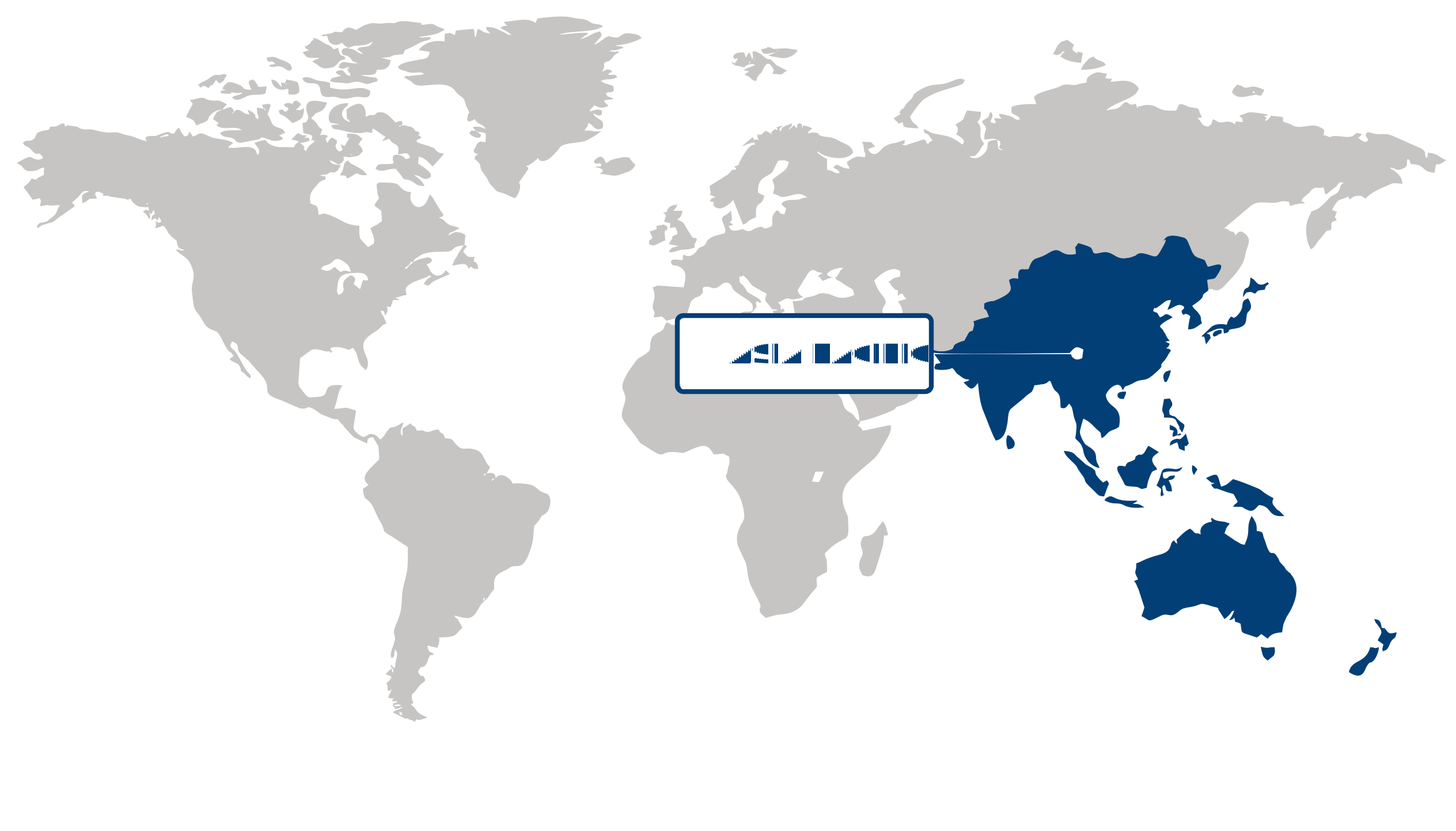
Asia Pacific captured approximately 49.65% of the global bicycle accessories market in 2025, making it the largest regional contributor driven by widespread bicycle use as primary transport and concentrated manufacturing capacity. High commuter cycling penetration across dense urban corridors and strong OEM and aftermarket output—evidenced by production and trade data from the National Bureau of Statistics of China and major component leadership from Shimano Co., Ltd.—sustain scale and rapid product turnover. Policy signals from the Ministry of Transport of the People’s Republic of China and cycling-support initiatives by the Ministry of Land, Infrastructure, Transport and Tourism (Japan) have reinforced last-mile infrastructure and safety upgrades, supporting premium and utility accessory demand. Given manufacturing depth, urban mobility trends, and strong local brands, Asia Pacific offers extensive opportunities for scalable, cost-competitive and innovation-led accessory plays.
Japan is positioned as a pivotal hub in the Asia Pacific bicycle accessories market, where demand skews to high-margin, technology-led components and aftermarket services. Domestic consumer preferences for reliability and advanced components favor suppliers such as Shimano Co., Ltd., and government initiatives by the Ministry of Land, Infrastructure, Transport and Tourism (MLIT) to improve cycling networks and safety have stimulated accessory uptake for e‑bikes and touring markets. Japan’s aging population and growing cycle-tourism segments create steady demand for comfort, safety and electric-assist accessories, encouraging premiumization and specialized product development. Strategically, Japan serves as an R&D and brand-validation base that regional manufacturers can leverage to introduce premium accessories across Asia Pacific.
China anchors the Asia Pacific bicycle accessories market through vast urban ridership and exceptionally high manufacturing output that lowers unit costs and accelerates product availability. National-scale manufacturing statistics from the National Bureau of Statistics of China and transport planning from the Ministry of Transport of the People’s Republic of China underpin a massive supply ecosystem; leading regional manufacturers and assemblers (including large OEM partners and e‑bike firms such as Yadea Group Holdings Ltd.) amplify aftermarket channels. Urban commuting patterns and fleet-style bike sharing have expanded demand for durable, low-cost accessories and replacement parts, while export-oriented production supports competitive pricing for regional and global markets. For investors and strategists, China’s scale and supply-chain depth present low-cost sourcing, rapid prototyping and distribution advantages that complement Japan’s premium focus to strengthen Asia Pacific’s overall market leadership.
Europe Market Analysis:
Europe emerged as the fastest-growing region in the bicycle accessories market, registering a robust CAGR of 9.48%. This acceleration is rooted in expanding cycling networks and sustained government push for green mobility: the European Commission’s Sustainable and Smart Mobility Strategy and NextGenerationEU recovery funds have directed capital to urban cycling projects, while the European Cyclists’ Federation documents rising modal share across major cities. Industry players such as Bosch eBike Systems and Decathlon are scaling accessory ecosystems (lighting, racks, connected locks) to serve rapid e‑bike adoption. With policy alignment, funding flows, and retail/tech investment converging, Europe offers outsized opportunity for premium, safety, and connected accessory segments that complement infrastructure upgrades and fleet electrification.
Germany anchors the region as a technology- and infrastructure-led market in the bicycle accessories market, driven by national programs and strong OEM activity. The Federal Ministry of Transport and Digital Infrastructure’s National Cycling Plan 3.0 and cycling advocacy data from ADFC have spurred municipal lane builds and secure parking, raising demand for locks, lighting, and integrated mounting systems. German suppliers such as ABUS and SKS Germany and suppliers to Bosch eBike Systems are expanding higher-margin, safety-focused accessories and connected solutions. The combination of engineering capability, dense urban cycling uptake, and established retail channels makes Germany a testbed for premium, standards-compliant accessories that scale across Europe.
France is a high-adoption market for the bicycle accessories market where public incentives and urban policy amplify demand for everyday and e‑bike accessories. The French government’s Plan Vélo, actions from the Ministère de la Transition écologique, and programs promoted by ADEME have supported infrastructure, repair networks, and purchase incentives, fueling aftermarket sales of helmets, child seats, and electric-drive compatible accessories. Large retailers such as Decathlon have broadened accessory assortments and service offerings to meet increased commuter and leisure cycling. France’s policy-driven adoption and dense retail/service ecosystem create strategic openings for products emphasizing durability, safety certification, and serviceable design that reinforce Europe’s broader growth trajectory.
North America Market Trends:
North America held a substantial share of the bicycle accessories market, propelled by broad shifts toward commuting and recreational cycling across metropolitan and suburban corridors. Evidence includes targeted infrastructure funding from the U.S. Department of Transportation under federal programs that favor active-transport projects, Statistics Canada reporting higher post-pandemic cycling participation in major cities, and the National Association of City Transportation Officials’ continued adoption of bike-priority street designs; commercial signals include Trek Bicycle Corporation and Specialized Bicycle Components press releases announcing expanded e-bike and safety accessory ranges and commentary from the Bicycle Product Suppliers Association on inventory realignments. These combined demand and supply signals—plus strong e-commerce and connected-product adoption—position North America for significant aftermarket and premiumization opportunities.
The U.S. remained the largest national market within North America for the bicycle accessories market, driven by concentrated consumer spending, sizable urban-rural cycling mixes, and policy tailwinds. U.S.-specific indicators include IIJA-related project pipelines cited by the U.S. Department of Transportation that stimulate local accessory demand, Strava trend data showing sustained ride volumes in U.S. cities, and product launches highlighted in Trek Bicycle Corporation and Specialized Bicycle Components press releases targeting e-bike batteries, racks, and smart lighting; the Bicycle Product Suppliers Association has also flagged U.S. distribution adjustments that affect lead times. Strategically, the U.S. scale and institutional support make it the primary launchpad to validate premium accessory concepts before broader North American rollouts.
| Parameter | North America | Asia Pacific | Europe | Latin America | MEA |
|---|---|---|---|---|---|
| Innovation Hub i Scale Nascent Developing Advanced | |||||
| Cost-Sensitive Region i Scale Low Medium High | |||||
| Regulatory Environment i Scale Restrictive Neutral Supportive | |||||
| Demand Drivers i Scale Weak Moderate Strong | |||||
| Development Stage i Scale Emerging Developing Developed | |||||
| Adoption Rate i Scale Low Medium High | |||||
| New Entrants / Startups i Scale Sparse Moderate Dense | |||||
| Macro Indicators i Scale Weak Stable Strong |
Segment Leadership and Growth Trends
Bicycle Accessories Market Share (%), by Product, 2026
Go beyond the chart, access full insights & data tables
Request Free Sample ReportComponents dominated the bicycle accessories market in 2025 as the largest share within the product segments. This leadership is driven by rising demand for replacement and upgrade bicycle parts, with manufacturers and aftermarket specialists focusing on modular, serviceable components to extend bike lifecycles; Shimano product announcements and Bosch eBike Systems roadmaps illustrate sustained investment in upgradeable drivetrains and e‑bike parts, while Park Tool’s maintenance resources reflect rising DIY and shop-led repair activity. Implicitly, consumer preference for performance upgrades, tighter sustainability expectations, and improving parts supply chains favor component-centric models. Established OEMs can leverage branded service networks and premium parts, while challengers can pursue niche, sustainable materials and retrofit kits. Given aging bicycle fleets, the proliferation of e‑bikes, and regulatory emphasis on repairability, components should remain strategically relevant near to medium term.
Analysis by Sales Channel
Offline represented largest share in the bicycle accessories market in 2025 among sales channel segments. The segment’s strength stems from a robust physical retail footprint and consumer trust in in‑store purchases—evidence includes REI’s bike shop services and Decathlon’s experiential retail formats, and Halfords’ integrated fitting and repair offerings that validate purchase decisions. Beyond immediate sales, brick‑and‑mortar stores support last‑mile supply resilience, technician employment, and brand demonstration that online channels struggle to replicate. For incumbents, deepening in‑store service, exclusive product assortments and loyalty programs protect margins; newcomers can partner with local shops or deploy pop‑ups to build trust. With consumers valuing hands‑on fitting, local service networks, and omnichannel convenience, offline distribution will remain a keystone channel in the near to medium term.
Analysis by Type
Aftermarket held largest share in the bicycle accessories market in 2025 among type segments. This dominance is anchored in the increasing need for customizations and maintenance of existing bicycles, supported by specialist resources such as Park Tool’s technical guidance and reporting in Bicycle Retailer and Industry News on aftermarket demand trends. The aftermarket benefits from riders’ customization preferences, a growing DIY culture, and circular‑economy pressures that favor repair over replacement, while diversified supplier networks improve parts availability. Strategic opportunities include subscription maintenance models, digital platforms linking shops and consumers, and specialized upgrade kits for e‑bikes and gravel bikes. Given persistent customization demand, fleet aging, and policy interest in reuse and repairability, the aftermarket segment is poised to remain a central element in the near to medium term.
| Segment | Sub-Segment | Largest Segment | Fastest Growing |
|---|---|---|---|
| Product | Components, Apparels | ||
| Sales Channel | Online, Offline | ||
| Type | Aftermarket, Original Equipment Manufacturers (OEM) | ||
| Bicycle Type | Road Bikes, Hybrid Bikes, Cargo Bikes, Mountain Bikes, Others |
Unlock insights tailored to your business with our bespoke market research solutions.
Click to get your customized report now.
Competitive Landscape and Market Positioning
The competitive landscape is marked by intensified portfolio-building, cross-industry linkages, and accelerated product renewal among these incumbents. Some firms are extending capabilities into connected systems and sensor-laden accessories while others deepen materials and suspension know-how into adjacent product lines, reshaping perceived category boundaries. Distribution plays a parallel role: established brands are broadening routes to consumer—strengthening direct channels and selective retail partnerships—raising the bar for service, warranty, and brand experience. These moves collectively favor players that can combine engineering depth with agile go-to-market execution, forcing rivals to differentiate via specialization, brand storytelling, or operational scale.
Strategic / Actionable Recommendations for Regional Players
North America: Focus on partnering with consumer-electronics and platform players to embed connectivity and app-driven services into accessories, while leveraging strong specialty retail networks and e-commerce to test modular, subscription-friendly offerings. Prioritize collaborations that accelerate integration with popular bike ecosystems and aftersales services to counter moves by vertically integrated competitors.
Asia Pacific: Capitalize on regional manufacturing and supply-chain strengths to introduce cost-efficient innovations—particularly in lighting, pumps, and multifunction tools—into export channels. Cultivate closer ties with bike OEMs and component houses to co-develop tailored accessories and scale quickly across both domestic urban markets and global distribution partners.
Europe: Build on premium craftsmanship and sustainability credentials to serve urban mobility and lifestyle segments, emphasizing durable materials, repairability, and circular-service propositions. Seek alliances with mobility and tourism operators to bundle accessories with experiential offerings, and refine high-end lines that play to heritage positioning while meeting tighter regulatory and environmental expectations.
| Company | Market Share | Company Revenue | Revenue CAGR (%) | Product Portfolio | Geographic Presence | Innovation / R&D Focus | Strategic Developments |
|---|---|---|---|---|---|---|---|
| No companies available. | |||||||
Customize Your Report
Explore examples of how this report can be tailored to different research needs, including custom segments, additional topics or chapters, and related reports. Click a section of the wheel or its numbered marker to explore the available options.
Bicycle Accessories Market — Custom Segments
| Segment | Sub-Segment |
|---|---|
| No segment data available. | |
Bicycle Accessories Market — Custom TOC
| Custom Chapter | Chapter Details | ||
|---|---|---|---|
| No custom TOC data available. | |||
Need a different cut of the data?
Request Custom ResearchWhat is the market valuation of bicycle accessories?
What are the growth projections for the bicycle accessories industry?
What is the leading region in terms of bicycle accessories market share?
Which region has emerged as the fastest-growing for the bicycle accessories sector?
Why does components sub-segment dominate the product segment of bicycle accessories sector?
How does offline segment fare in the bicycle accessories industry?
What share does aftermarket segment hold in the bicycle accessories sector as of 2025?
Where is the mountain bikes segment seeing the strongest adoption within the bicycle accessories industry?
Which companies dominate the bicycle accessories landscape?
Our Clients
"The report provided us with a clear direction, and the level of detail was beyond what we expected. I would definitely recommend their services to others."
Haier Appliances
"The collaboration with Fundamental Business Insights has added significant value to our decision-making process, and we look forward to continuing this partnership for our future market research requirements."
Luxottica Group S.p.A.
"The team at FBI delivered an exceptional research report. The insights on industry innovations were particularly impressive and added a lot of value to the overall report."
Nike
Our Research Team & Methodology
Every Fundamental Business Insights report is built by a dedicated vertical research team, validated through a structured primary-and-secondary methodology, and reviewed for accuracy before it reaches you.
Research Team Overview
Prepared by the Consumer Goods & Services Research Team
Delivery
Published
Demand
Available
Support
Trust & Compliance
Research Intelligence
| Source | Reference |
|---|---|
| International Organization for Standardization (ISO) | www.iso.org |
| ASTM International | www.astm.org |
| U.S. Consumer Product Safety Commission (CPSC) | www.cpsc.gov |
| European Commission – Consumer Safety | ec.europa.eu/safety-gate |
| Consumer Technology Association (CTA) | www.cta.tech |
| National Retail Federation (NRF) | nrf.com |
| World Retail Congress | www.worldretailcongress.com |
| World Travel & Tourism Council (WTTC) | wttc.org |
| UN Tourism | www.unwto.org |
| Personal Care Products Council (PCPC) | www.personalcarecouncil.org |
| Cosmetics Europe | cosmeticseurope.eu |
| International Housewares Association (IHA) | www.housewares.org |
| American Apparel & Footwear Association (AAFA) | www.aafaglobal.org |
| World Federation of the Sporting Goods Industry (WFSGI) | wfsgi.org |
| Juvenile Products Manufacturers Association (JPMA) | www.jpma.org |
| Pet Industry Joint Advisory Council (PIJAC) | pijac.org |
| International Council of Toy Industries (ICTI) | www.toy-icti.org |
| International Association of Amusement Parks and Attractions (IAAPA) | iaapa.org |
| Organisation for Economic Co-operation and Development (OECD) | www.oecd.org |
| World Bank Data | data.worldbank.org |
Research Workflow & Quality Assurance
Data Collection
Verified information gathered through primary and secondary research.
Data Triangulation
Cross-validation using multiple independent data sources.
Forecast Modelling
Market estimates developed using historical trends and analytical models.
Analyst Validation
Findings reviewed by domain experts for accuracy and consistency.
Editorial & Quality Review
Final editorial, quality, and compliance checks before publication.
Final Publication
Released after successful completion of the internal review process.
Report Coverage
📊 Market Assessment
- Market Size & Forecast
- Market Segmentation
- Regional Analysis
- Growth Drivers & Challenges
- Market Dynamics
🏢 Competitive Intelligence
- Competitive Landscape
- Company Profiles
- Competitive Benchmarking
- Mergers & Acquisitions
- Market Share Analysis or Key Company Strategies
🔍 Strategic Analysis
- Value Chain Analysis
- Porter's Five Forces
- PESTLE Analysis
- Pricing Trends
- Supply-Demand Analysis
🚀 Future Outlook
- Technology Landscape
- Regulatory Landscape
- Investment & Funding Landscape
- Emerging Opportunities
- Future Market Outlook
Have a question about this report or need a custom scope?
Request Customization