Battery Thermal Management System Market Size & Growth Forecast 2027–2036, By Segments (Vehicle, Offering, Propulsion, Battery), Regional Demand Trends (North America, Asia Pacific, Europe), Key Country Insights (U.S., Japan, South Korea, Germany, France, Italy), and Competitive Landscape
Market Size and Growth Outlook
Battery Thermal Management System Market size was worth USD 4.37 Billion in 2026 and is poised to grow at 13.21% CAGR between 2027 and 2036, reaching USD 15.11 Billion by 2036. The industry revenue for 2027 is assessed at USD 4.87 Billion.
Get more details on this report
Request Free Sample ReportBattery Thermal Management System Market Intelligence Snapshot
Regional Market Dynamics
- Asia Pacific held 37.8% of the market in 2026, supported by EV manufacturing, expanding battery production, electrification, and demand for safer, consistent performance.
- Continued investment in battery technologies, electrification infrastructure, and automotive manufacturing is accelerating demand for efficient solutions that regulate battery temperature and improve safety.
Segment Momentum
- Active systems held a 47.7% market share in 2026 by providing precise battery temperature control that improves efficiency, extends battery life, enhances safety, and supports fast-charging performance.
- Commercial vehicles are expected to witness the fastest growth as the electrification of buses, trucks, and delivery fleets increases demand for advanced thermal management to improve battery reliability and reduce maintenance costs.
Market Expansion Drivers
- Rapid electric vehicle adoption driving demand for advanced battery cooling and thermal regulation systems
- Increasing high-capacity battery pack integration requiring efficient thermal stability solutions
- Technological advancements in phase-change and liquid cooling systems improving battery efficiency and safety
Leading Market Participants
- Major players in the battery thermal management system market include Robert Bosch GmbH (Germany), Denso Corporation (Japan), Continental AG (Germany), BorgWarner Inc. (United States), Valeo SE (France), MAHLE GmbH (Germany), Hanon Systems (South Korea), Hitachi Astemo, Ltd. (Japan), Dana Incorporated (United States), Modine Manufacturing Company (United States)
Global Market Forecast Snapshot
Market Outlook
- 2026 Market Size: USD 4.37 Billion
- 2027 Estimated Market Size: USD 4.87 Billion
- Projected Market Size: USD 15.11 Billion by 2036
- Growth Forecast: 13.21% CAGR (2027-2036)
Regional and Segment Outlook
- Leading Regional Market: Asia Pacific
- High-Growth Regional Hub: Asia Pacific
- Core Revenue Segment: Passenger Vehicles (Vehicle) | Active System (Offering) | Battery Electric Vehicles (BEV) (Propulsion) | Lithium-ion Battery (Battery)
- Emerging Opportunity Segment: Commercial Vehicles (Vehicle) | Hybrid System (Offering) | Battery Electric Vehicles (BEV) (Propulsion) | Solid-state Battery (Battery)
Market Growth Drivers and Industry Trends
Rapid electric vehicle adoption driving demand for advanced battery cooling and thermal regulation systems
The accelerating transition toward electric mobility is expected to drive the battery thermal management system market growth as vehicle manufacturers prioritize effective temperature control to maximize battery performance and operational reliability. Battery packs operate most efficiently within specific temperature ranges, making advanced thermal regulation essential for maintaining consistent energy delivery across diverse driving conditions. Efficient cooling and heating systems help reduce thermal stress, support stable charging performance, and improve battery durability during repeated operating cycles. These requirements are becoming increasingly important as electric vehicles are deployed across varying climates and demanding usage environments.
Increasing high-capacity battery pack integration requiring efficient thermal stability solutions
Growing deployment of larger battery packs is reinforcing the battery thermal management system market by increasing the complexity of maintaining uniform temperatures across multiple interconnected cells. High-capacity battery systems generate greater amounts of heat during charging and discharging, making efficient thermal distribution essential for preventing localized hotspots and performance imbalances. Effective thermal stability solutions contribute to consistent battery operation while supporting reliable energy output under varying load conditions. Manufacturers are therefore integrating advanced temperature management technologies into battery pack designs to improve operational consistency and extend usable service life.
Technological advancements in phase-change and liquid cooling systems improving battery efficiency and safety
Continuous innovation in thermal management technologies will propel the battery thermal management system market growth by enabling more effective heat dissipation for increasingly advanced battery systems. Phase-change materials and liquid cooling solutions provide improved thermal control compared with conventional air-based approaches, allowing batteries to operate within optimal temperature ranges during high-performance applications. These technologies enhance charging efficiency, reduce the likelihood of thermal imbalance, and support safer battery operation by managing rapid temperature fluctuations. Their integration into modern battery architectures reflects the industry's emphasis on combining higher performance with dependable thermal protection across a wide range of vehicle platforms.
| Growth Driver | Impact on CAGR | Regulatory Influence | Geographic Relevance | Adoption Rate | Impact Timeline |
|---|---|---|---|---|---|
| Rapid electric vehicle adoption driving demand for advanced battery cooling and thermal regulation systems | 2% | High | Asia Pacific, Europe, North America | High | Near Term |
| Increasing high-capacity battery pack integration requiring efficient thermal stability solutions | 1.8% | High | Asia Pacific, North America | High | Near Term |
| Technological advancements in phase-change and liquid cooling systems improving battery efficiency and safety | 1.6% | Moderate | Europe, North America | Medium | Mid Term |
Explore Growth Opportunities
Request Free Sample ReportRegional Demand Dynamics
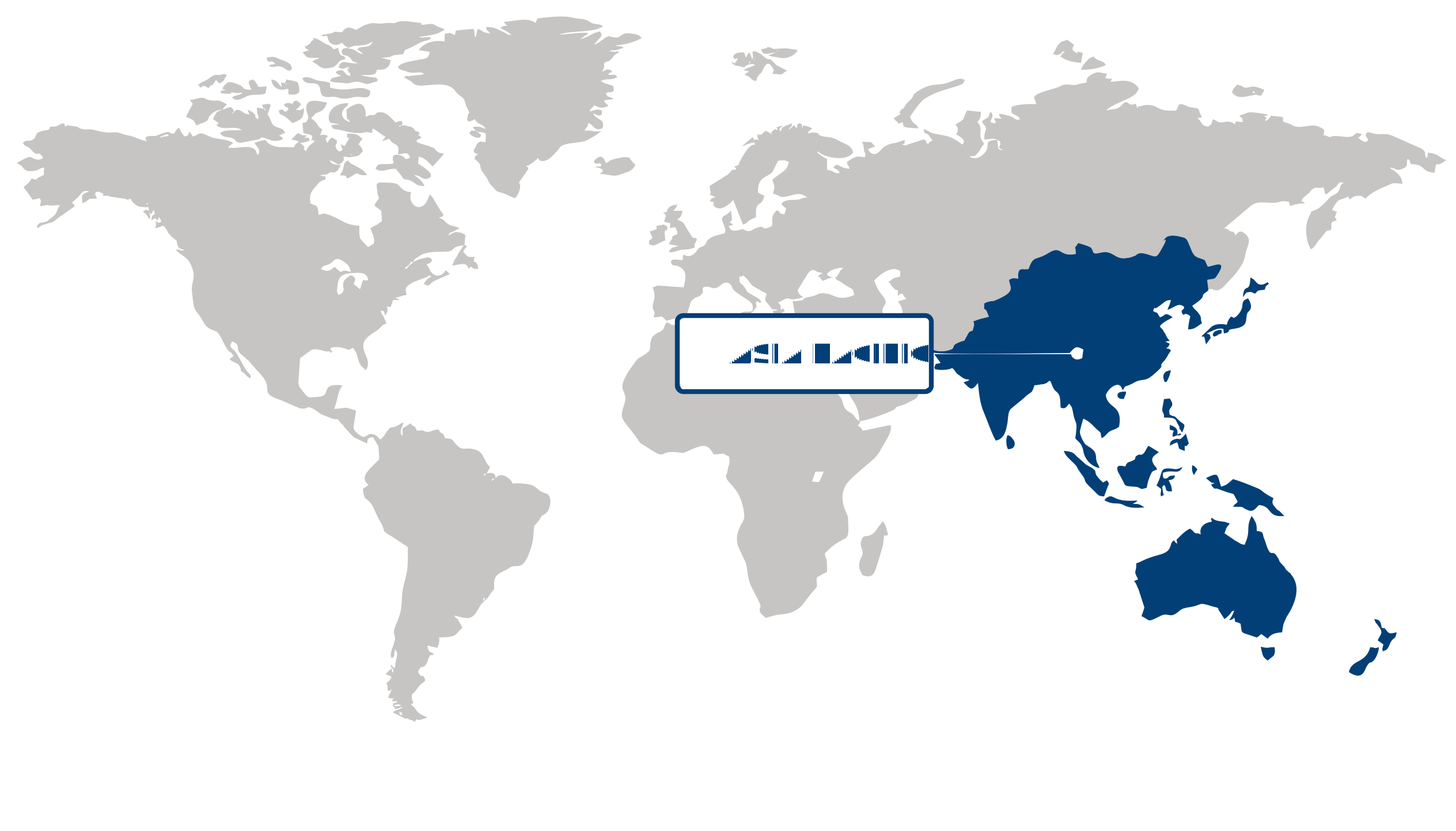
Asia Pacific (Largest & Fastest-Growing Region)
Asia Pacific held the largest share of the battery thermal management system market at 37.8% in 2026 and is also expected to register the fastest growth, supported by the region’s strong electric vehicle manufacturing ecosystem and expanding battery production capabilities. Increasing adoption of electric mobility is driving demand for efficient thermal management solutions that can regulate battery temperature, improve safety, and support consistent vehicle performance. Continued investments in battery technologies, electrification infrastructure, and automotive manufacturing are further strengthening the regional market outlook.
| Parameter | North America | Asia Pacific | Europe | Latin America | MEA |
|---|---|---|---|---|---|
| Innovation Hub i Scale Nascent Developing Advanced | |||||
| Cost-Sensitive Region i Scale Low Medium High | |||||
| Regulatory Environment i Scale Restrictive Neutral Supportive | |||||
| Demand Drivers i Scale Weak Moderate Strong | |||||
| Development Stage i Scale Emerging Developing Developed | |||||
| Adoption Rate i Scale Low Medium High | |||||
| New Entrants / Startups i Scale Sparse Moderate Dense | |||||
| Macro Indicators i Scale Weak Stable Strong |
Key Country Insights
United States 🇺🇸
Advanced EV CoolingThe U.S. battery thermal management system market is emphasizing high-performance cooling solutions for electric vehicles and commercial fleets. Manufacturers are investing in liquid cooling technologies, thermal simulation, and integrated battery pack designs to improve safety, charging performance, and battery longevity.
Germany 🇩🇪
Engineering-Driven IntegrationGermany is advancing battery thermal management through close integration with automotive engineering and premium EV platforms. Companies are focusing on efficient thermal control architectures that support fast charging, extended battery life, and consistent vehicle performance.
Japan 🇯🇵
Compact Thermal InnovationJapan is prioritizing compact and energy-efficient battery thermal management systems for passenger vehicles and hybrid applications. Manufacturers are refining lightweight cooling technologies that enhance battery reliability without increasing vehicle complexity.
South Korea 🇰🇷
Battery Manufacturing SynergySouth Korea benefits from strong battery manufacturing capabilities that encourage advanced thermal management development. Companies are integrating intelligent cooling systems with next-generation battery technologies to improve operational stability and production efficiency.
France 🇫🇷
Sustainable Mobility FocusFrance is expanding battery thermal management adoption alongside electric mobility initiatives and vehicle electrification. Automotive suppliers are prioritizing efficient thermal regulation systems that improve battery durability while supporting evolving environmental and safety requirements.
Italy 🇮🇹
Vehicle Platform OptimizationItaly is incorporating battery thermal management solutions into electric vehicle platform development and component manufacturing. Companies are emphasizing adaptable cooling technologies that balance thermal efficiency, packaging flexibility, and vehicle performance.
Segment Leadership and Growth Trends
Battery Thermal Management System Market Share (%), by Vehicle, 2026
Go beyond the chart, access full insights & data tables
Request Free Sample ReportVehicle Segment Analysis: Passenger Vehicles (Largest Segment) vs Commercial Vehicles (Fastest-Growing Segment)
Passenger vehicles accounted for the largest share of 71.04% in 2026. The growing production of electric passenger cars, combined with rising consumer demand for extended driving range and improved battery durability, has accelerated the adoption of advanced thermal management systems. Automakers are increasingly integrating efficient temperature control technologies to enhance battery performance, maintain safety under varying operating conditions, and improve overall vehicle efficiency.
The commercial vehicle segment is expected to witness the fastest growth due to the rapid electrification of buses, trucks, and delivery fleets. These vehicles typically operate under heavier loads and longer duty cycles, creating greater thermal management requirements. As fleet operators seek improved battery reliability and reduced maintenance costs, demand for advanced battery thermal management solutions continues to expand.
Offering Segment Analysis: Active System (Largest Segment) vs Hybrid System (Fastest-Growing Segment)
The active system segment led the battery thermal management system market with a 47.7% share in 2026. Active systems provide precise temperature regulation through dedicated cooling and heating mechanisms, helping batteries operate within optimal thermal ranges across diverse environmental conditions. Their ability to improve battery efficiency, extend service life, and support fast-charging capabilities has reinforced their widespread adoption among vehicle manufacturers.
Hybrid systems are projected to be the fastest-growing offering segment as manufacturers seek to combine the strengths of active and passive thermal management approaches. These systems deliver improved energy efficiency, better thermal stability, and enhanced adaptability to different vehicle platforms, making them increasingly attractive for next-generation electric mobility solutions.
Propulsion Segment Analysis: Battery Electric Vehicles (BEV) (Largest & Fastest-Growing Segment)
The battery electric vehicles (BEV) segment dominated the battery thermal management system market in 2026 and also represents the fastest-growing propulsion segment. As BEVs rely entirely on high-capacity battery packs, maintaining optimal battery temperature is essential for maximizing driving range, charging performance, operational safety, and battery lifespan. Continuous advancements in battery technology, expanding charging infrastructure, and increasing production of fully electric vehicles are further strengthening demand for sophisticated thermal management systems specifically designed for BEV platforms.
| Segment | Sub-Segment | Largest Segment | Fastest Growing |
|---|---|---|---|
| Vehicle | Passenger Vehicles, Commercial Vehicles | Passenger Vehicles | Commercial Vehicles |
| Offering | Active System, Passive System, Hybrid System | Active System | Hybrid System |
| Propulsion | Battery Electric Vehicles (BEV), Plug-in Hybrid Electric Vehicles (PHEV), Hybrid Electric Vehicles (HEV) | Battery Electric Vehicles (BEV) | Battery Electric Vehicles (BEV) |
| Battery | Lithium-ion Battery, Nickel-Metal Hydride (NiMH) Battery, Lead-acid Battery, Solid-state Battery | Lithium-ion Battery | Solid-state Battery |
Unlock insights tailored to your business with our bespoke market research solutions.
Click to get your customized report now.
Competitive Landscape and Market Positioning
Leading companies in the battery thermal management system market:
- Robert Bosch GmbH (Germany)
- Denso Corporation (Japan)
- Continental AG (Germany)
- BorgWarner, Inc. (United States)
- Valeo SE (France)
- MAHLE GmbH (Germany)
- Hanon Systems (South Korea)
- Hitachi Astemo Ltd. (Japan)
- Dana Incorporated (United States)
- Modine Manufacturing Company (United States)
The growing performance demands placed on electric vehicle batteries are intensifying competition around thermal management solutions that balance temperature control, energy efficiency, and packaging constraints. Manufacturers are moving beyond conventional cooling strategies by refining integrated system designs that improve thermal uniformity while minimizing weight and energy consumption. Differentiation is also emerging through intelligent control algorithms capable of adjusting thermal performance according to operating conditions, supporting battery longevity and consistent vehicle performance across varied environments. As battery platforms become more sophisticated, suppliers are increasingly competing on engineering integration and lifecycle optimization rather than individual cooling components alone.
| Company | Market Share | Company Revenue | Revenue CAGR (%) | Product Portfolio | Geographic Presence | Innovation / R&D Focus | Strategic Developments |
|---|---|---|---|---|---|---|---|
| Robert Bosch GmbH (Germany) | |||||||
| Denso Corporation (Japan) | |||||||
| Continental AG (Germany) | |||||||
| BorgWarner Inc. (United States) | |||||||
| Valeo SE (France) | |||||||
| MAHLE GmbH (Germany) | |||||||
| Hanon Systems (South Korea) | |||||||
| Hitachi Astemo Ltd. (Japan) | |||||||
| Dana Incorporated (United States) | |||||||
| Modine Manufacturing Company (United States) |
Industry Development/News
| Company Name | Date | Key Development |
|---|---|---|
| Tata Motors | Jun-26 | Tata Motors introduced the Sierra EV, utilizing its Acti.ev architecture. The vehicle incorporates sophisticated battery management refinements and thermal system optimizations derived from 15 billion kilometers of operational data, demonstrating a strategic focus on efficiency and performance through advanced, software-tuned thermal control in next-generation electric vehicle platforms. |
| BYD | Jun-26 | BYD filed a patent for an advanced battery thermal management system that utilizes GPS navigation data to preemptively optimize thermal control. By integrating predictive routing with battery cooling and heating, the technology enhances energy efficiency and range, representing a strategic move toward intelligence-linked thermal management for electric vehicles. |
| HD Hyundai XiteSolution | May-25 | HD Hyundai XiteSolution unveiled its first electric heavy-duty forklifts with nine-ton lifting capacities. This expansion into industrial material handling equipment highlights the increasing requirement for robust, industrial-grade battery thermal management systems capable of maintaining performance under the demanding load and duty cycles of heavy-duty electrified machinery. |
| Robert Bosch | Mar-25 | Robert Bosch launched a comprehensive battery thermal management platform featuring high-efficiency liquid cooling modules and integrated heat exchangers linked directly to the Battery Management System (BMS). This modular solution is designed for global deployment, aiming to improve thermal stability, energy efficiency, and safety across passenger and commercial electric vehicle segments. |
| Denso Corporation | Feb-25 | Denso Corporation expanded its thermal management portfolio with the introduction of compact liquid and air-cooling modules featuring integrated sensor-based control units. The platform is designed for broad OEM compatibility, focusing on enhancing battery performance, extending cycle life, and providing scalable thermal solutions for diverse fleet and passenger vehicle requirements. |
| MTA | Feb-25 | MTA signed an agreement to acquire a 60% stake in EFI Technology. This strategic acquisition strengthens MTA’s technical capabilities in the development and production of advanced electrification components, enhancing its footprint in the market for sophisticated power and thermal management systems for the automotive sector. |
| BorgWarner | Jan-25 | BorgWarner upgraded its battery thermal management suite, introducing high-performance cooling modules and hybrid-compatible heat exchangers with intelligent BMS-linked control systems. This initiative targets large-scale OEM integration, emphasizing optimized energy efficiency and operational reliability for both passenger and commercial electric vehicle platforms. |
| Valeo | Dec-24 | Valeo introduced an advanced thermal management platform that integrates high-efficiency liquid cooling with predictive, AI-driven thermal control. By reducing thermal degradation and improving safety, the solution supports global passenger and commercial vehicle platforms, reinforcing the market trend toward highly integrated and intelligent hardware-software thermal systems. |
| MAHLE | Oct-24 | MAHLE, in coordination with partners Hanon Systems and Dana Limited, launched integrated battery thermal management solutions combining liquid and air-cooling modules with AI-enabled thermal monitoring. This collaboration emphasizes battery longevity and operational reliability, providing OEMs with seamless, high-performance systems for passenger and light commercial electric vehicles. |
| Serck Heat Exchange | Jan-24 | Serck Heat Exchange secured eight-figure financing to expand the manufacturing of specialized cooling, heating, and air-conditioning systems for electric vehicles. The investment directly increases production capacity for essential thermal management components, supporting the growing demand for robust heat exchange hardware in the electrified transportation market. |
Customize Your Report
Explore examples of how this report can be tailored to different research needs, including custom segments, additional topics or chapters, and related reports. Click a section of the wheel or its numbered marker to explore the available options.
Battery Thermal Management System Market — Custom Segments
| Segment | Sub-Segment |
|---|---|
| Thermal Management Medium | Air-Based, Liquid-Based, Refrigerant-Based, Phase Change Material-Based |
| Vehicle Voltage Architecture | Low-Voltage Systems, 400V-Class Systems, 800V-Class Systems, Ultra-High-Voltage Systems |
| Battery Capacity Class | Up to 50 kWh, 51–100 kWh, 101–150 kWh, Above 150 kWh |
Battery Thermal Management System Market — Custom TOC
| Custom Chapter | Custom Details |
|---|---|
| Thermal Management Technology Roadmap |
|
| Battery Safety & Thermal Risk Assessment |
|
| OEM Adoption & Integration Landscape |
|
Need a different cut of the data?
Request Custom ResearchWhat is the current size of the battery thermal management system market?
How much is the battery thermal management system industry expected to grow by 2036?
How is rapid electric vehicle adoption increasing demand for advanced battery thermal management?
Why are phase-change and liquid cooling technologies gaining importance in battery systems?
Why do active systems lead the battery thermal management system market?
Which vehicle segment is growing the fastest in the battery thermal management system market?
How is Asia Pacific shaping the battery thermal management system market?
Why is Asia Pacific expected to grow fastest in battery thermal management?
Who are the leading players in the battery thermal management system landscape?
Our Clients
"The team surpassed our expectations with the report depth. The actionable insights provided proved crucial in navigating market challenges."
Tata Motors
"We found the report to be very informative. The expertise and attention to market nuances significantly influenced our business direction."
DENSO Corporation
"The consumer survey findings were quite good. We now have a clearer picture of the customer churning and retention strategy."
HL Mando
Our Research Team & Methodology
Every Fundamental Business Insights report is built by a dedicated vertical research team, validated through a structured primary-and-secondary methodology, and reviewed for accuracy before it reaches you.
Research Team Overview
Prepared by the Automotive & Transportation Research Team
Delivery
Published
Demand
Available
Support
Trust & Compliance
Research Intelligence
Research Workflow & Quality Assurance
Data Collection
Verified information gathered through primary and secondary research.
Data Triangulation
Cross-validation using multiple independent data sources.
Forecast Modelling
Market estimates developed using historical trends and analytical models.
Analyst Validation
Findings reviewed by domain experts for accuracy and consistency.
Editorial & Quality Review
Final editorial, quality, and compliance checks before publication.
Final Publication
Released after successful completion of the internal review process.
Report Coverage
📊 Market Assessment
- Market Size & Forecast
- Market Segmentation
- Regional Analysis
- Growth Drivers & Challenges
- Market Dynamics
🏢 Competitive Intelligence
- Competitive Landscape
- Company Profiles
- Competitive Benchmarking
- Mergers & Acquisitions
- Market Share Analysis or Key Company Strategies
🔍 Strategic Analysis
- Value Chain Analysis
- Porter's Five Forces
- PESTLE Analysis
- Pricing Trends
- Supply-Demand Analysis
🚀 Future Outlook
- Technology Landscape
- Regulatory Landscape
- Investment & Funding Landscape
- Emerging Opportunities
- Future Market Outlook
Have a question about this report or need a custom scope?
Request Customization