Battery Test Equipment Market Size & Growth Forecast 2027–2036, By Segments (Type, Function Type, Battery Test Equipment Market), Regional Demand Trends (North America, Asia Pacific, Europe), Key Country Insights (U.S., Japan, South Korea, Germany, France, Italy), and Competitive Landscape
Market Size and Growth Outlook
Battery Test Equipment Market size was valued at USD 1.34 Billion in 2026 and is anticipated to grow at 6.89% CAGR from 2027 to 2036, exceeding USD 2.61 Billion by 2036. The industry revenue for 2027 is calculated at USD 1.42 Billion.
Get more details on this report
Request Free Sample ReportBattery Test Equipment Market Intelligence Snapshot
Regional Market Dynamics
- Asia Pacific held the largest share in 2026, supported by its strong battery manufacturing base, expanding EV ecosystem, energy storage deployment, and testing requirements.
- Continued investment in battery manufacturing and technological innovation is increasing demand for advanced testing across research, production, quality assurance, and process validation.
Segment Momentum
- Cell testing held the largest share at 61.8% in 2026, as it is essential for evaluating battery performance, durability, safety, and efficiency during development, research, and manufacturing.
- Pack testing is growing quickly as more complex battery systems require comprehensive performance validation, safety evaluation, and operational reliability testing across electric vehicles, energy storage, and advanced electronics.
Market Expansion Drivers
- EV adoption growth driving demand for advanced battery performance testing systems
- Expansion of energy storage systems increasing validation and safety testing requirements
- Rising R&D in rechargeable battery chemistries driving precision testing equipment demand
Leading Market Participants
- Prominent players in the battery test equipment market include AMETEK Inc. (United States), Keysight Technologies Inc. (United States), Chroma ATE Inc. (Taiwan), Arbin Instruments Inc. (United States), Maccor Inc. (United States), Digatron Power Electronics GmbH (Germany), Bio-Logic Science Instruments (France), Cadex Electronics Inc. (Canada), Hioki E.E. Corporation (Japan), Bitrode Corporation (United States)
Global Market Forecast Snapshot
Market Outlook
- 2026 Market Size: USD 1.34 Billion
- 2027 Estimated Market Size: USD 1.42 Billion
- Projected Market Size: USD 2.61 Billion by 2036
- Growth Forecast: 6.89% CAGR (2027-2036)
Regional and Segment Outlook
- Leading Regional Market: Asia Pacific
- High-Growth Regional Hub: Asia Pacific
- Core Revenue Segment: Stationary (Type) | Cell Testing (Function Type) | Capacity Tester (Battery Test Equipment Market)
- Emerging Opportunity Segment: Portable (Type) | Pack Testing (Function Type) | Safety Testing Equipment (Battery Test Equipment Market)
Market Growth Drivers and Industry Trends
EV adoption growth driving demand for advanced battery performance testing systems
The rapid expansion of electric vehicle manufacturing has intensified the need for reliable battery validation throughout development and production. Growing demand for safer, longer-lasting battery packs will propel the battery test equipment market growth as manufacturers require sophisticated systems capable of evaluating charging behavior, thermal performance, lifecycle durability, and operational reliability under diverse conditions. Comprehensive testing has become essential for verifying battery quality before commercial deployment while supporting continuous improvements in vehicle performance and safety standards.
Expansion of energy storage systems increasing validation and safety testing requirements
Grid-scale and distributed energy storage installations rely on battery systems that must operate consistently under varying load conditions over extended service periods. This trend is boosting the battery test equipment market demand because developers and system integrators require extensive validation to assess performance, safety, efficiency, and operational stability before deployment. Testing solutions are increasingly used to simulate real-world operating environments, identify potential failure modes, and verify compliance with evolving safety and reliability requirements across stationary energy storage applications.
Rising R&D in rechargeable battery chemistries driving precision testing equipment demand
Continuous innovation in rechargeable battery technologies has expanded research activities involving new materials, cell architectures, and manufacturing processes. As laboratories and battery developers evaluate emerging chemistries, the battery test equipment market is supported by rising demand for highly accurate instruments capable of measuring electrical behavior, degradation characteristics, and performance consistency under tightly controlled testing conditions. Advanced analytical capabilities allow researchers to compare experimental designs, optimize battery configurations, and generate repeatable data throughout product development programs.
| Growth Driver | Impact on CAGR | Regulatory Influence | Geographic Relevance | Adoption Rate | Impact Timeline |
|---|---|---|---|---|---|
| EV adoption growth driving demand for advanced battery performance testing systems | 2% | High | Asia Pacific, Europe | High | Near Term |
| Expansion of energy storage systems increasing validation and safety testing requirements | 1.7% | Moderate | North America, Asia Pacific | High | Near Term |
| Rising R&D in rechargeable battery chemistries driving precision testing equipment demand | 1.5% | Moderate | Europe, Asia Pacific | Medium | Mid Term |
Unlock insights tailored to your business with our bespoke market research solutions.
Click to get your customized report now.
Regional Demand Dynamics
Asia Pacific (Largest & Fastest-Growing Region)
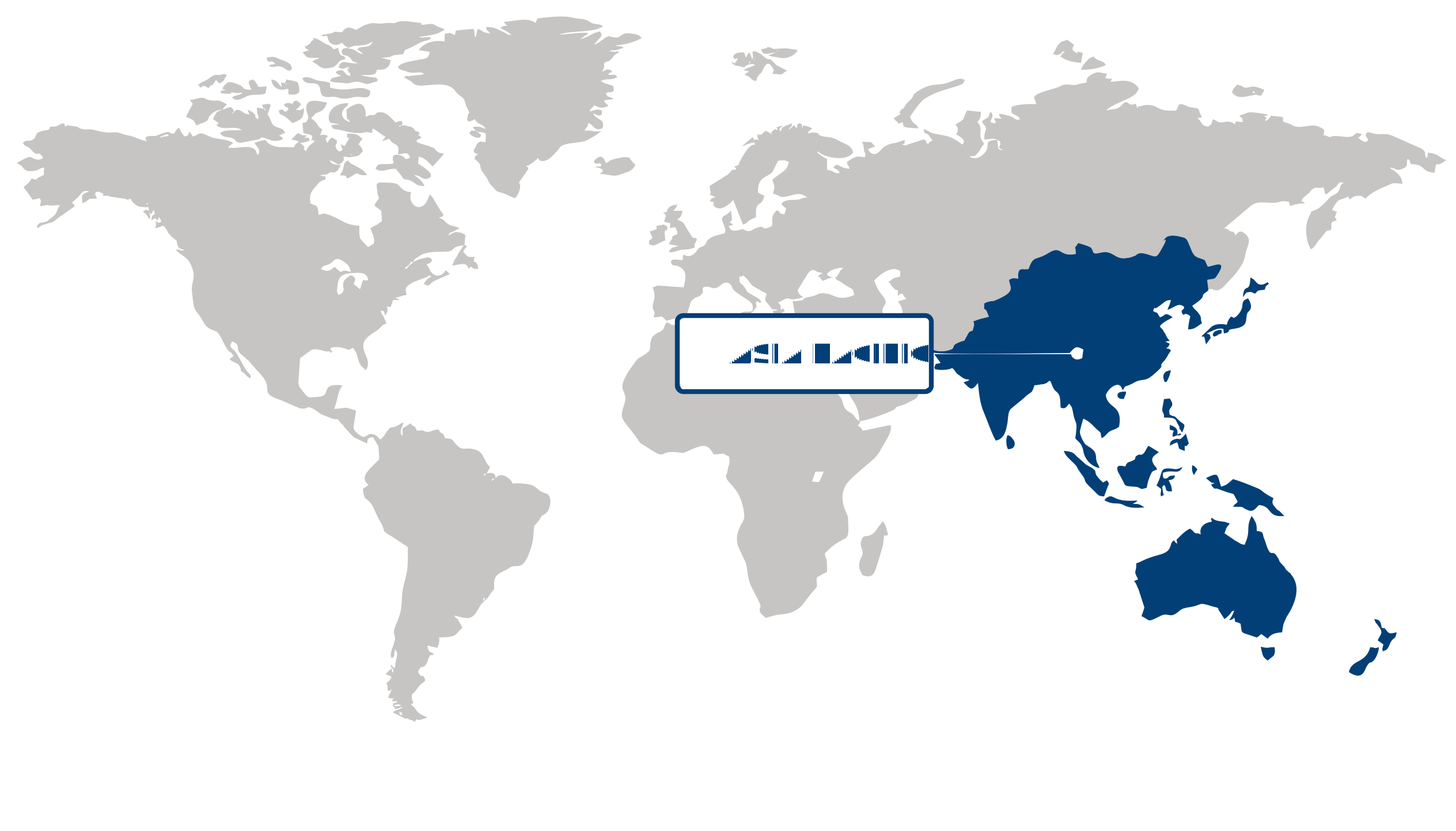
Asia Pacific led the battery test equipment market and represented the largest regional market in 2026, while also emerging as the fastest-growing region. The region's strong battery manufacturing base, expanding electric vehicle ecosystem, and growing deployment of energy storage systems are generating substantial requirements for testing solutions that evaluate battery performance, safety, reliability, and durability. Manufacturers are placing greater emphasis on quality control and process validation as battery technologies become more sophisticated, increasing the need for advanced testing throughout research, development, production, and quality-assurance stages. Continued investment in battery manufacturing facilities and technological innovation is expected to further strengthen demand for testing equipment across the regional value chain.
| Parameter | North America | Asia Pacific | Europe | Latin America | MEA |
|---|---|---|---|---|---|
| Innovation Hub i Scale Nascent Developing Advanced | |||||
| Cost-Sensitive Region i Scale Low Medium High | |||||
| Regulatory Environment i Scale Restrictive Neutral Supportive | |||||
| Demand Drivers i Scale Weak Moderate Strong | |||||
| Development Stage i Scale Emerging Developing Developed | |||||
| Adoption Rate i Scale Low Medium High | |||||
| New Entrants / Startups i Scale Sparse Moderate Dense | |||||
| Macro Indicators i Scale Weak Stable Strong |
Key Country Insights
United States 🇺🇸
Advanced Validation ProgramsThe U.S. battery test equipment market is driven by intensive product validation across electric vehicles, energy storage, and industrial applications. Laboratories and manufacturers in the U.S. continue investing in automated testing platforms that improve accuracy, throughput, and compliance with evolving performance requirements.
Germany 🇩🇪
Precision Testing StandardsGermany emphasizes highly accurate battery testing to support demanding automotive and industrial quality expectations. Battery manufacturers in Germany increasingly adopt sophisticated test equipment capable of evaluating safety, durability, and long-cycle performance under diverse operating conditions.
Japan 🇯🇵
Reliability Assessment FocusJapan prioritizes battery reliability verification, encouraging widespread deployment of advanced testing equipment throughout product development and manufacturing. Companies in Japan increasingly focus on precise performance measurement to support consistent product quality and extended battery lifespan.
South Korea 🇰🇷
High-Volume Quality ControlSouth Korea continues strengthening battery production capabilities through expanded investment in automated testing infrastructure. Manufacturers in South Korea seek battery test equipment that enables rapid inspection, consistent quality control, and efficient validation across large-scale production environments.
France 🇫🇷
Research-Centered EvaluationFrance supports battery innovation through research institutions and industrial testing programs requiring flexible evaluation platforms. Demand in France increasingly favors battery test equipment capable of supporting prototype development alongside standardized performance and safety verification.
Italy 🇮🇹
Industrial Process VerificationItaly is expanding battery testing capabilities to support manufacturing quality and industrial electrification initiatives. Companies across Italy increasingly require adaptable battery test equipment that accommodates multiple battery chemistries while improving production consistency and product qualification processes.
Segment Leadership and Growth Trends
Battery Test Equipment Market Share (%), by Type, 2026
Go beyond the chart, access full insights & data tables
Request Free Sample ReportType Segment Analysis: Stationary (Largest Segment) vs Portable (Fastest-Growing Segment)
Stationary segment dominated the battery test equipment market, accounting for the largest share of 67.2% in 2026. Stationary battery testing systems are widely utilized in laboratories, manufacturing facilities, and quality control environments where detailed and repeated battery performance evaluation is required. These systems provide high accuracy, stability, and comprehensive testing capabilities, making them suitable for analyzing battery characteristics throughout development and production processes. The growing demand for reliable battery validation, performance assessment, and quality assurance is supporting the strong adoption of stationary testing equipment.
Portable segment is experiencing faster growth as industries increasingly require flexible testing solutions that can be deployed across different locations and operational environments. Portable battery test equipment enables convenient field inspections, maintenance activities, and on-site diagnostics without requiring dedicated testing infrastructure. The rising need for quick battery health assessments and efficient monitoring of battery-powered systems is contributing to the increasing adoption of portable solutions.
Function Type Segment Analysis: Cell Testing (Largest Segment) vs Pack Testing (Fastest-Growing Segment)
Cell testing segment held the largest share of the battery test equipment market, accounting for 61.8% in 2026. Battery cell testing is a critical stage in battery development and manufacturing as it helps evaluate performance, durability, safety, and efficiency at the fundamental component level. The increasing focus on improving battery quality and optimizing energy storage performance has driven the widespread use of cell testing equipment across research, development, and production environments.
Pack testing segment is witnessing rapid growth due to the increasing complexity of battery systems used in electric vehicles, energy storage solutions, and advanced electronic applications. Battery pack testing enables comprehensive evaluation of assembled battery systems, including performance validation, safety checks, and operational reliability. The growing emphasis on ensuring complete battery system efficiency and safety is accelerating demand for pack testing solutions.
Battery Test Equipment Market Segment Analysis: Capacity Tester (Largest Segment) vs Safety Testing Equipment (Fastest-Growing Segment)
Capacity tester segment accounted for the largest share of the battery test equipment market in 2026, supported by its essential role in measuring battery performance, energy storage capability, and operational efficiency. Capacity testing is widely used across battery development, manufacturing, and maintenance processes to determine whether batteries meet required performance standards. The increasing demand for accurate battery evaluation and quality control continues to drive adoption of capacity testing equipment.
Safety testing equipment segment is expanding rapidly as battery manufacturers and users place greater emphasis on preventing failures and ensuring secure battery operation. Safety testing solutions help identify potential risks related to battery performance, thermal behavior, and operational conditions. The growing focus on battery reliability, user safety, and compliance with stringent quality requirements is supporting the rising adoption of safety testing equipment.
| Segment | Sub-Segment | Largest Segment | Fastest Growing |
|---|---|---|---|
| Type | Portable, Stationary | Stationary | Portable |
| Function Type | Cell Testing, Module Testing, Pack Testing | Cell Testing | Pack Testing |
| Battery Test Equipment Market | Resistance Tester, Voltage Monitor, Fault Tracker, Temperature Tester, Capacity Tester, Safety Testing Equipment | Capacity Tester | Safety Testing Equipment |
Competitive Landscape and Market Positioning
Top players in the battery test equipment market:
- AMETEK, Inc. (United States)
- Keysight Technologies, Inc. (United States)
- Chroma ATE, Inc. (Taiwan)
- Arbin Instruments, Inc. (United States)
- Maccor, Inc. (United States)
- Digatron Power Electronics GmbH (Germany)
- Bio-Logic Science Instruments (France)
- Cadex Electronics, Inc. (Canada)
- Hioki E.E. Corporation (Japan)
- Bitrode Corporation (United States)
Rapid advances in battery chemistry and manufacturing methods are reshaping competitive positioning, shifting vendor differentiation beyond measurement accuracy toward the ability to support diverse cell formats, higher energy densities, and evolving validation protocols. Equipment providers are expanding integrated testing environments that combine automation, data analytics, and flexible software architectures, enabling manufacturers to shorten qualification cycles while maintaining traceable performance records across research and production settings. Competitive pressure is also increasing from suppliers capable of delivering modular platforms that can be upgraded alongside changing battery technologies, reducing replacement costs for customers and strengthening long-term service relationships in an industry where testing requirements continue to evolve with electrification and energy storage applications.
| Company | Market Share | Company Revenue | Revenue CAGR (%) | Product Portfolio | Geographic Presence | Innovation / R&D Focus | Strategic Developments |
|---|---|---|---|---|---|---|---|
| AMETEK Inc. (United States) | |||||||
| Keysight Technologies Inc. (United States) | |||||||
| Chroma ATE Inc. (Taiwan) | |||||||
| Arbin Instruments Inc. (United States) | |||||||
| Maccor Inc. (United States) | |||||||
| Digatron Power Electronics GmbH (Germany) | |||||||
| Bio-Logic Science Instruments (France) | |||||||
| Cadex Electronics Inc. (Canada) | |||||||
| Hioki E.E. Corporation (Japan) | |||||||
| Bitrode Corporation (United States) |
Industry Development/News
| Company Name | Date | Key Development |
|---|---|---|
| Emerson Electric Co. | Jul-26 | Emerson Electric advanced the integration of its NI platform for automated test workflows. This development enhances battery validation efficiency and industrial measurement precision, supporting the industry-wide shift toward high-throughput, automated testing environments for electric vehicle battery development and manufacturing. |
| Polaris Battery Labs | Jan-26 | Polaris Battery Labs conducted independent validation testing of Enovix’s AI1 battery, confirming a 12% increase in energy density over leading competitors. This development highlights the growing strategic importance of impartial third-party testing and benchmarking in demonstrating the performance of next-generation battery chemistries for commercial adoption. |
| Geely Auto | Dec-25 | Geely Auto inaugurated a major safety testing facility capable of conducting 27 distinct test types, including powertrain and battery-specific evaluations. This significant infrastructure investment underscores the escalating demand for comprehensive, in-house validation capabilities to ensure reliability and regulatory compliance for high-performance electric and hybrid vehicle platforms. |
| Seres Automobile | Dec-25 | Seres Automobile partnered with Tsinghua University to establish a joint research centre for battery innovation. The facility focuses on advanced testing of emerging chemistries, aiming to accelerate the development and validation of high-performance, efficient, and safe battery systems for future electric vehicle models. |
| UL Solutions Inc. | Aug-24 | UL Solutions opened a dedicated battery testing and research laboratory in Auburn Hills, Michigan. The facility expands the company's regional capacity for testing, validation, and certification, providing critical support for automotive OEMs and energy storage developers aiming to meet stringent safety and performance standards in the North American market. |
| Chroma ATE | Mar-24 | Chroma ATE launched next-generation battery test systems featuring AI-based fault detection and automated calibration. Designed for high-throughput electric vehicle battery manufacturing, these systems enhance production line efficiency and testing accuracy, addressing the industry's need for faster, more reliable quality assurance during large-scale assembly. |
| Neware Technology | Jan-24 | Neware Technology established a dedicated innovation center in Shenzhen to focus on ultra-fast testing systems for sodium-ion and semi-solid battery chemistries. This strategic move aligns with emerging market trends, enabling more agile validation cycles for next-generation battery technologies beyond traditional lithium-ion solutions. |
| Bitrode Corp. | Jan-24 | Bitrode Corp. secured a multi-year supply agreement with a major North American energy storage firm to provide grid-scale battery testing infrastructure. This partnership supports the expansion of utility-scale energy storage projects, highlighting the rising demand for specialized, high-capacity testing solutions outside of the traditional automotive sector. |
| Digatron | Dec-23 | Digatron introduced a compact, mobile battery testing unit specifically designed for aftermarket EV service centers. The system enables on-site diagnostics, charge/discharge profiling, and thermal analysis, facilitating the growth of essential maintenance infrastructure as the global population of electric vehicles matures and requires long-term lifecycle management. |
| Arbin Instruments | Nov-23 | Arbin Instruments expanded its international presence by opening a regional sales and service hub in Germany. This investment strengthens the company's ability to serve the robust automotive and academic R&D sectors in Europe, reflecting the need for localized technical support as European battery testing requirements continue to intensify. |
Customize Your Report
Explore examples of how this report can be tailored to different research needs, including custom segments, additional topics or chapters, and related reports. Click a section of the wheel or its numbered marker to explore the available options.
Battery Test Equipment Market — Custom Segments
| Segment | Sub-Segment |
|---|---|
| Automation Level | Manual, Semi-Automated, Fully Automated |
| Battery Chemistry Compatibility | Lithium-Ion, Lead-Acid, Nickel-Based, Sodium-Ion, Other Chemistries |
| End-Use Industry | Automotive, Consumer Electronics, Energy Storage, Aerospace & Defense, Industrial |
Battery Test Equipment Market — Custom TOC
| Custom Chapter | Custom Details |
|---|---|
| Battery Manufacturing Quality Assurance |
|
| Testing Automation & Workflow Transformation |
|
| Second-Life Battery Qualification |
|
Need a different cut of the data?
Request Custom ResearchHow large is the battery test equipment market?
What is the expected industry size of battery test equipment by 2036?
How is EV manufacturing growth reshaping battery testing requirements?
Why is battery chemistry innovation increasing demand for precision test equipment?
Which function type accounts for the largest share of the battery test equipment market?
Why is pack testing the fastest-growing function segment?
Why does Asia Pacific lead the battery test equipment market?
What is driving battery test equipment growth in Asia Pacific?
Who holds a significant market share in the battery test equipment landscape?
Our Clients
"The team at Fundamental Business Insights & Consulting demonstrated a commitment to excellence, not only in the quality of the report but also in their client-centric approach."
FANUC
"The level of detail in the market segmentation provided were particularly noteworthy. The detailed country-level insights were also very helpful."
B&R Industrial Automation GmbH
"The consultant took the time to understand our specific business objectives, ensuring that the reports were tailored to address our unique challenges and opportunities."
KUKA SE & Co. KGaA
Our Research Team & Methodology
Every Fundamental Business Insights report is built by a dedicated vertical research team, validated through a structured primary-and-secondary methodology, and reviewed for accuracy before it reaches you.
Research Team Overview
Prepared by the Industrial Automation & Equipment Research Team
Delivery
Published
Demand
Available
Support
Trust & Compliance
Research Domains
10 coverage areasResearch Intelligence
| Source | Reference |
|---|---|
| International Society of Automation (ISA) | www.isa.org |
| International Organization for Standardization (ISO) | www.iso.org |
| National Institute of Standards and Technology (NIST) | www.nist.gov |
| IEEE | www.ieee.org |
| VDMA (German Mechanical Engineering Industry Association) | www.vdma.org |
| Association for Advancing Automation (A3) | www.automate.org |
| International Federation of Robotics (IFR) | ifr.org |
| ASME (American Society of Mechanical Engineers) | www.asme.org |
| ASHRAE | www.ashrae.org |
| American Society of Heating, Refrigerating and Air-Conditioning Engineers (ASHRAE) | www.ashrae.org |
| Material Handling Industry (MHI) | www.mhi.org |
| OSHA (Occupational Safety and Health Administration) | www.osha.gov |
| National Fire Protection Association (NFPA) | www.nfpa.org |
| ASTM International | www.astm.org |
| International Electrotechnical Commission (IEC) | www.iec.ch |
| Open Process Automation Forum (The Open Group) | www.opengroup.org/open-process-automation-forum |
| AGMA (American Gear Manufacturers Association) | www.agma.org |
| Association of Equipment Manufacturers (AEM) | www.aem.org |
| Food and Agriculture Organization (FAO) | www.fao.org |
| International Labour Organization (ILO) | www.ilo.org |
Research Workflow & Quality Assurance
Data Collection
Verified information gathered through primary and secondary research.
Data Triangulation
Cross-validation using multiple independent data sources.
Forecast Modelling
Market estimates developed using historical trends and analytical models.
Analyst Validation
Findings reviewed by domain experts for accuracy and consistency.
Editorial & Quality Review
Final editorial, quality, and compliance checks before publication.
Final Publication
Released after successful completion of the internal review process.
Report Coverage
📊 Market Assessment
- Market Size & Forecast
- Market Segmentation
- Regional Analysis
- Growth Drivers & Challenges
- Market Dynamics
🏢 Competitive Intelligence
- Competitive Landscape
- Company Profiles
- Competitive Benchmarking
- Mergers & Acquisitions
- Market Share Analysis or Key Company Strategies
🔍 Strategic Analysis
- Value Chain Analysis
- Porter's Five Forces
- PESTLE Analysis
- Pricing Trends
- Supply-Demand Analysis
🚀 Future Outlook
- Technology Landscape
- Regulatory Landscape
- Investment & Funding Landscape
- Emerging Opportunities
- Future Market Outlook
Have a question about this report or need a custom scope?
Request Customization