Battery Raw Materials Market Size & Growth Forecast 2027–2036, By Segments (Battery Type, Application, Material Type), Regional Demand Trends (North America, Asia Pacific, Europe), Key Country Insights (U.S., Japan, South Korea, Germany, France, Italy), and Competitive Landscape
Market Size and Growth Outlook
Battery Raw Materials Market size was around USD 67.66 billion in 2026 and is slated to grow at a 9.03% CAGR from 2027 to 2036, reaching USD 160.62 billion by 2036. The industry revenue for 2027 is assessed at USD 72.8 billion.
Get more details on this report
Request Free Sample ReportBattery Raw Materials Market Intelligence Snapshot
Regional Market Dynamics
- Asia Pacific held a 37.63% market share in 2026, supported by integrated refining, processing, and battery manufacturing networks that improve supply reliability and sustain high raw material procurement volumes.
- North America is projected to grow at a 10.06% CAGR, fueled by domestic battery supply chain expansion, localized processing investments, and increasing battery plant development supporting long-term upstream demand.
Segment Momentum
- Lead-Acid accounted for 64.6% of the market in 2026, supported by its extensive use in automotive and industrial applications, established recycling systems, and stable replacement-driven raw material demand.
- Grid Storage is the fastest-growing application as increasing deployment of stationary energy storage systems strengthens demand for battery raw materials used in large-scale power balancing and reliability projects.
Market Expansion Drivers
- Surging electric vehicle lithium-ion battery demand accelerating raw material consumption.
- Expansion of renewable energy storage systems driving battery material requirements.
- Adoption of sustainable and green mining technologies improving supply chain efficiency.
Leading Market Participants
- Key players in the battery raw materials market include BASF SE (Germany), Umicore N.V. (Belgium), Mitsubishi Chemical Group Corporation (Japan), DuPont de Nemours, Inc. (United States), Hitachi, Ltd. (Japan), NICHIA Corporation (Japan), Celgard, LLC (United States), ENTEK International LLC (United States), Targray Technology International Inc. (Canada), NEI Corporation (United States).
Global Market Forecast Snapshot
Market Outlook
- 2026 Market Size: USD 67.66 billion
- 2027 Estimated Market Size: USD 72.8 billion.
- Projected Market Size: USD 160.62 billion by 2036
- Growth Forecast: 9.03% CAGR (2027-2036)
Regional and Segment Outlook
- Leading Regional Market: Asia Pacific
- High-Growth Regional Hub: North America
- Core Revenue Segment: Lead-Acid (Battery Type) | Automotive (Application) | Electrodes (Material Type)
- Emerging Opportunity Segment: Lithium-Ion (Battery Type) | Grid Storage (Application) | Cathode Materials (Material Type)
Market Growth Drivers and Industry Trends
Surging electric vehicle lithium-ion battery demand accelerating raw material consumption
Rapid expansion of electric mobility is increasing requirements for the minerals and processed materials used in lithium-ion battery manufacturing, strengthening the battery raw materials market throughout the battery supply chain. As electric vehicles become more widely adopted, manufacturers require consistent access to critical inputs used in battery cells and associated components, including lithium, nickel, cobalt, graphite, and other specialized materials depending on battery chemistry. Changes in battery design and chemistry are also influencing the composition and sourcing requirements of raw materials, encouraging suppliers and processors to develop greater flexibility in production. Increasing battery manufacturing capacity consequently creates additional pressure for secure mineral extraction, refining, processing, and long-term material supply arrangements.
Expansion of renewable energy storage systems driving battery material requirements
Growing deployment of solar and wind power is increasing the importance of energy storage systems that can balance variable electricity generation and support reliable grid operation. This development is benefiting the battery raw materials market because stationary storage installations require substantial quantities of battery materials to manufacture cells and storage modules. Utility-scale projects, commercial energy storage, and distributed systems can each generate demand for battery technologies suited to different duration, cost, safety, and performance requirements. As electricity networks incorporate greater shares of intermittent renewable generation, the need to store excess power and release it when required is encouraging continued deployment of rechargeable battery systems.
Adoption of sustainable and green mining technologies improving supply chain efficiency
Pressure to secure critical minerals while limiting the environmental impact of extraction is encouraging mining operators and material processors to adopt more efficient and sustainable production techniques. The battery raw materials market is supported by technologies designed to improve resource recovery, reduce water and energy consumption, optimize processing operations, and limit waste generated during mineral extraction. Digital monitoring, automation, improved ore processing, and lower-impact extraction methods can also increase operational efficiency while strengthening visibility across raw material supply chains. Greater emphasis on responsible sourcing is encouraging producers to integrate environmental considerations into exploration, extraction, processing, and material-handling activities.
| Growth Driver | Impact on CAGR | Regulatory Influence | Geographic Relevance | Adoption Rate | Impact Timeline |
|---|---|---|---|---|---|
| Surging electric vehicle lithium-ion battery demand accelerating raw material consumption | 2.10% | Moderate | Asia Pacific, Europe | High | Near Term |
| Expansion of renewable energy storage systems driving battery material requirements | 2.00% | High | North America, Asia Pacific | High | Mid Term |
| Adoption of sustainable and green mining technologies improving supply chain efficiency | 1.70% | Moderate | Europe, Latin America | Emerging | Mid Term |
Unlock insights tailored to your business with our bespoke market research solutions.
Click to get your customized report now.
Regional Demand Dynamics
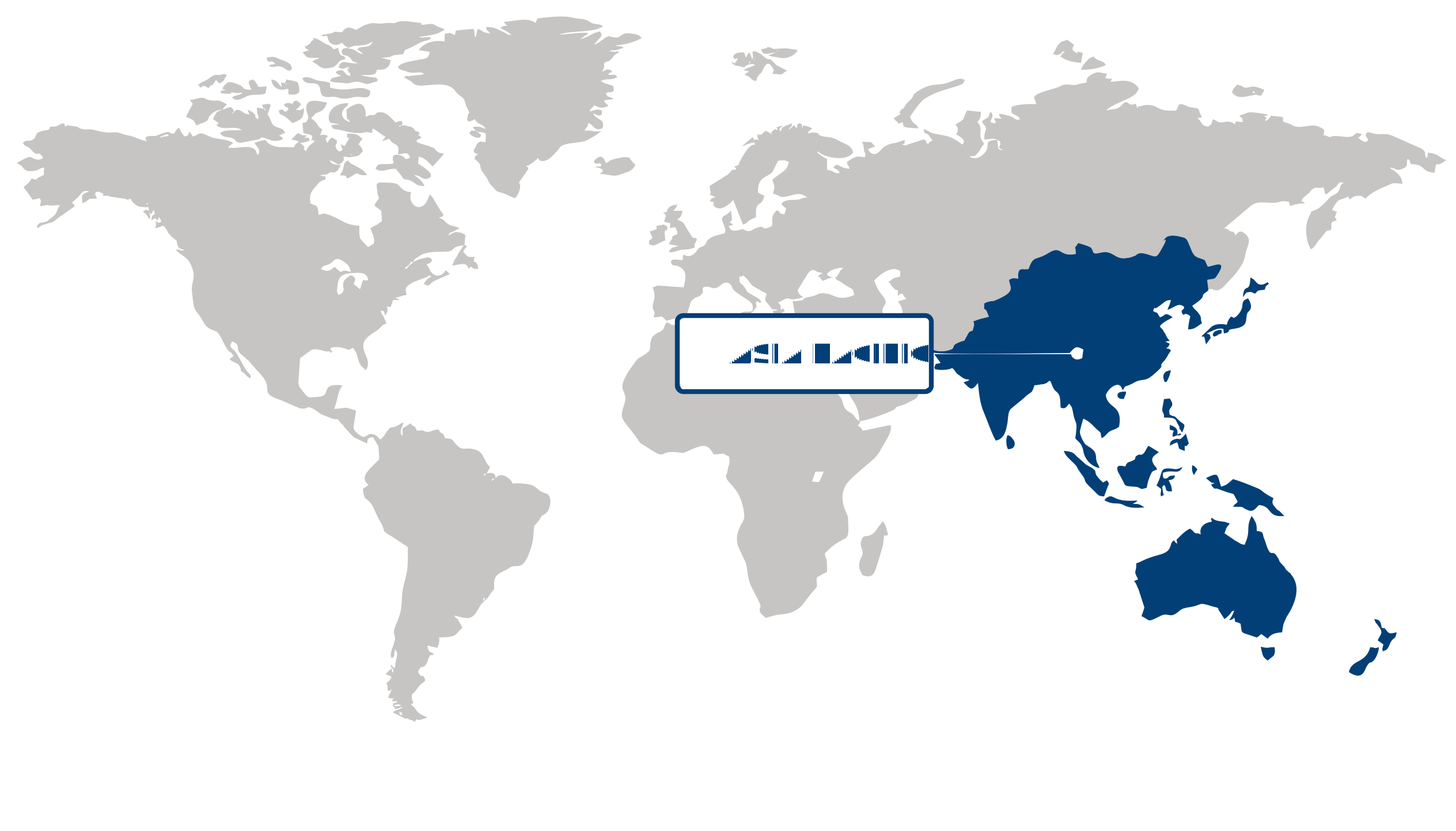
Asia Pacific (Largest Region)
Asia Pacific accounted for the largest share of the battery raw materials market at 37.63% in 2026, supported by its extensive battery manufacturing ecosystem, established electronics supply chains, and strong demand for materials used in energy storage applications. The region's concentration of battery production and processing capabilities creates sustained requirements for critical raw materials across the value chain. Expanding electric mobility, renewable energy storage, and consumer electronics manufacturing are further strengthening material demand. Investments in battery supply chain infrastructure, material processing, and manufacturing capacity are supporting regional market development and reinforcing Asia Pacific's strategic position.
North America (Fastest-Growing Region)
North America is the fastest-growing region, supported by increasing investment in domestic battery supply chains, electric vehicle manufacturing, and energy storage infrastructure. Growing efforts to strengthen local access to critical materials are encouraging development of regional processing and sourcing capabilities. Demand for battery materials is also being reinforced by the expansion of clean energy technologies and electrification across transportation and industrial applications. Greater focus on supply chain resilience, resource security, and localized battery production is creating favorable conditions for investment throughout the regional raw materials ecosystem.
| Parameter | North America | Asia Pacific | Europe | Latin America | MEA |
|---|---|---|---|---|---|
| Innovation Hub i Scale Nascent Developing Advanced | |||||
| Cost-Sensitive Region i Scale Low Medium High | |||||
| Regulatory Environment i Scale Restrictive Neutral Supportive | |||||
| Demand Drivers i Scale Weak Moderate Strong | |||||
| Development Stage i Scale Emerging Developing Developed | |||||
| Adoption Rate i Scale Low Medium High | |||||
| New Entrants / Startups i Scale Sparse Moderate Dense | |||||
| Macro Indicators i Scale Weak Stable Strong |
Key Country Insights
Germany 🇩🇪
Battery Manufacturing InputsGermany prioritizes reliable battery raw material supply to support expanding cell manufacturing and automotive electrification. Companies are strengthening sourcing partnerships while increasing interest in recycled materials to improve resource security and sustainability.
France 🇫🇷
Circular Materials StrategyFrance is encouraging battery raw material development through recycling, sustainable sourcing, and regional battery value chain investments. Industry participants are improving recovery technologies to reduce dependence on primary raw material imports.
Italy 🇮🇹
Local Processing ExpansionItaly is expanding battery raw material processing capabilities to support domestic battery manufacturing and industrial electrification. Businesses are exploring partnerships across the European supply chain while increasing emphasis on material recovery and responsible sourcing.
Japan 🇯🇵
Advanced Material ProcessingJapan emphasizes high-purity battery raw materials required for advanced battery chemistries and premium manufacturing standards. Producers are enhancing material processing capabilities while expanding recycling efforts to improve long-term resource availability.
South Korea 🇰🇷
Cathode Supply IntegrationSouth Korea continues to strengthen battery raw material procurement for its globally integrated battery manufacturing sector. Companies are investing in refining, precursor production, and strategic sourcing partnerships to support consistent material availability.
United States 🇺🇸
Supply Chain DiversificationThe U.S. battery raw materials market focuses on securing domestic and diversified sources of lithium, nickel, graphite, and critical minerals. Investments in refining capacity and recycling initiatives are strengthening supply resilience for electric vehicle and energy storage manufacturing.
Segment Leadership and Growth Trends
Battery Raw Materials Market Share (%), by Battery Type, 2026
Go beyond the chart, access full insights & data tables
Request Free Sample ReportBattery Type Segment Analysis: Lead-Acid (Largest Segment) vs Lithium-Ion (Fastest-Growing Segment)
The lead-acid segment dominated the battery raw materials market in 2026 and accounted for the largest share of 64.6%. Its established position is supported by widespread use across automotive, backup power, and other energy storage applications, where proven reliability, cost efficiency, and established recycling infrastructure remain important purchasing considerations. The mature manufacturing ecosystem and familiarity among end users further reinforce demand for lead-acid battery raw materials, particularly in applications where affordability and dependable power delivery are prioritized.
The lithium-ion segment is expected to register the fastest growth during the forecast period, supported by the accelerating shift toward electrification and advanced energy storage technologies. Rising adoption of electric mobility and expanding requirements for efficient, high-performance energy storage are strengthening demand for lithium-ion battery materials. The segment is also benefiting from growing emphasis on energy density, charging performance, and scalable storage solutions, positioning lithium-ion as an increasingly important area of raw material demand.
Application Segment Analysis: Automotive (Largest Segment) vs Grid Storage (Fastest-Growing Segment)
The automotive segment held the largest share of the battery raw materials market in 2026, accounting for 59.54%. Its leading position reflects the extensive use of batteries across conventional and electrified vehicles, creating sustained requirements for key battery inputs. Increasing vehicle electrification, continued demand for dependable starting and power systems, and the need to support evolving automotive energy architectures are reinforcing the automotive segment's importance within overall battery raw material consumption.
Grid storage is projected to be the fastest-growing segment as electricity systems increasingly require flexible storage capacity to balance supply and demand. The expansion of renewable power generation is creating greater demand for storage technologies capable of managing intermittency and improving grid reliability. Investments in energy infrastructure and the broader transition toward more flexible, resilient power networks are therefore supporting stronger demand for battery raw materials used in grid-scale storage applications.
| Segment | Sub-Segment | Largest Segment | Fastest Growing |
|---|---|---|---|
| Battery Type | Lithium-Ion, Lead-Acid, Others | Lead-Acid | Lithium-Ion |
| Application | Consumer Electronics, Automotive, Grid Storage, UPS, Telecom, Others | Automotive | Grid Storage |
| Material Type | Cathode Materials, Anode Materials, Separator, Electrolyte, Electrodes, Packaging, Others | Electrodes | Cathode Materials |
Competitive Landscape and Market Positioning
Top players in the battery raw materials market:
1. BASF SE (Germany)
2. Umicore N.V. (Belgium)
3. Mitsubishi Chemical Group Corporation (Japan)
4. DuPont de Nemours Inc. (United States)
5. Hitachi Ltd. (Japan)
6. NICHIA Corporation (Japan)
7. Celgard LLC (United States)
8. ENTEK International LLC (United States)
9. Targray Technology International Inc. (Canada)
10. NEI Corporation (United States)
The battery raw materials market is undergoing strategic transformation driven by rising energy storage demand. Efforts to improve extraction efficiency and material processing are increasing. Supply chain strengthening is becoming a critical focus area. The battery raw materials market is expanding alongside the global shift toward electrification.
| Company | Market Share | Company Revenue | Revenue CAGR (%) | Product Portfolio | Geographic Presence | Innovation / R&D Focus | Strategic Developments |
|---|---|---|---|---|---|---|---|
| BASF SE (Germany) | |||||||
| Umicore N.V. (Belgium) | |||||||
| Mitsubishi Chemical Group Corporation (Japan) | |||||||
| DuPont de Nemours Inc. (United States) | |||||||
| Hitachi Ltd. (Japan) | |||||||
| NICHIA Corporation (Japan) | |||||||
| Celgard LLC (United States) | |||||||
| ENTEK International LLC (United States) | |||||||
| Targray Technology International Inc. (Canada) | |||||||
| NEI Corporation (United States). |
Industry Development/News
| Company Name | Date | Key Development |
|---|---|---|
| International Graphite & Alkeemia | May-26 | International Graphite and Alkeemia formed a joint venture to develop battery-grade graphite processing capacity in Italy. This strategic initiative aims to establish a localized European supply chain for critical anode materials, reducing reliance on imported refined graphite and enhancing regional security for battery manufacturing. |
| NextSource Materials | May-26 | NextSource Materials secured final investment approval for its Abu Dhabi anode facility, marking a significant advancement in non-Asian active anode material production. Supported by Japanese capital, the project serves as a key development in diversifying global battery-grade anode supply chains to meet growing market demand. |
| CATL | May-26 | CATL is scaling sodium battery production capacity, supported by an order pipeline of approximately 60 GWh. This expansion signals a material shift in battery chemistry diversification, reflecting accelerated industrial adoption of sodium-based energy storage as a viable, large-scale alternative to traditional lithium-ion systems. |
| BMW Group & Encory | Feb-26 | BMW Group and Encory launched a battery recycling competence center in Bavaria to scale direct recycling technologies. The facility focuses on recovering raw materials from production scrap for reintegration into pilot cell manufacturing, directly advancing closed-loop supply chain capabilities for critical battery inputs. |
| Volkswagen PowerCo | Dec-25 | Volkswagen’s PowerCo secured a multi-year supply agreement with synthetic graphite producer Novonix. The partnership aims to ensure long-term access to critical anode materials, supporting PowerCo’s strategic objective to build a secure, localized battery supply chain starting in 2027. |
| Mercedes-Benz Group | Oct-24 | Mercedes-Benz Group commissioned a dedicated battery recycling plant capable of recovering critical raw materials to support the production of thousands of EV batteries annually. This investment reinforces in-house circular supply chain capabilities and mitigates dependence on primary raw material sourcing through recovered material utilization. |
| Hyundai Steel | Sep-24 | Hyundai Steel entered the battery materials market by supplying iron powder for the production of lithium iron phosphate (LFP) cathodes in South Korea. This strategic diversification marks the company's entry into the upstream battery raw material segment, supporting the localized manufacture of next-generation cathode materials. |
| GFCL EV Products Ltd | Feb-24 | GFCL EV Products Ltd commenced commercial production of lithium hexafluorophosphate (LiPF6), a primary electrolyte component for lithium-ion batteries. This facility expansion represents a significant increase in domestic production capacity for critical battery chemicals, strengthening the regional supply chain for essential battery components. |
| KPIT Technologies | Dec-23 | KPIT Technologies launched proprietary sodium-ion (Na-ion) battery technology intended to reduce reliance on imported core battery materials. By offering improved cycle life and charging speeds compared to lithium-ion counterparts, the technology provides a strategic alternative for battery material sourcing in energy storage applications. |
| ENTEK | Feb-23 | ENTEK partnered with Brückner Group USA to expand production capacity for lithium-ion battery separator film. This investment addresses the surging demand for battery components in U.S. electric vehicle and energy storage markets, providing critical manufacturing infrastructure to support domestic battery supply chain growth. |
Customize Your Report
Explore examples of how this report can be tailored to different research needs, including custom segments, additional topics or chapters, and related reports. Click a section of the wheel or its numbered marker to explore the available options.
Battery Raw Materials Market — Custom Segments
| Segment | Sub-Segment |
|---|---|
| Processing Stage | Raw Mineral Feedstock, Refined Battery-Grade Materials, Precursor Materials, Battery-Ready Materials |
| Supply Chain Position | Mining and Extraction Companies, Refiners and Processors, Battery Material Manufacturers, Battery Cell and Component Manufacturers |
| Customer Type | Battery Cell Manufacturers, Cathode and Anode Material Producers, Battery Component Manufacturers, Battery Recycling Companies |
Battery Raw Materials Market — Custom TOC
| Custom Chapter | Custom Details |
|---|---|
| Critical Mineral Supply Risk Assessment |
|
| Battery Chemistry Transition Impact Assessment |
|
| Battery Material Recycling Opportunity Analysis |
|
Need a different cut of the data?
Request Custom ResearchWhat is the market valuation of battery raw materials?
What is the projected value of the battery raw materials industry by 2036?
How is electric vehicle expansion reshaping demand for battery raw materials across global supply chains?
What is driving the growing importance of battery raw materials in grid-scale energy storage deployment?
Why does the Lead-Acid battery type hold the largest share of the battery raw materials market?
Which application segment is growing the fastest in the battery raw materials market?
Why does Asia Pacific lead the battery raw materials market?
What is driving North America's rapid growth in the battery raw materials market?
Which companies dominate the battery raw materials landscape?
Our Clients
"The information presented in the report was genuinely insightful. The data was clear and easy to understand, which made it much easier to interpret the findings."
Amara Raja Group
"The responsiveness and professionalism exhibited by the team were exemplary. They were readily available to address queries, provide clarifications, and offer additional insights."
ONGC
"The reports offered a comprehensive analysis of various segments within the market. The detailed insights into market trends, and regulatory landscapes were excellent."
TotalEnergies
Our Research Team & Methodology
Every Fundamental Business Insights report is built by a dedicated vertical research team, validated through a structured primary-and-secondary methodology, and reviewed for accuracy before it reaches you.
Research Team Overview
Prepared by the Energy & Power Research Team
Delivery
Published
Demand
Available
Support
Trust & Compliance
Research Domains
10 coverage areasResearch Intelligence
| Source | Reference |
|---|---|
| International Energy Agency (IEA) | www.iea.org |
| U.S. Energy Information Administration (EIA) | www.eia.gov |
| International Renewable Energy Agency (IRENA) | www.irena.org |
| International Electrotechnical Commission (IEC) | www.iec.ch |
| International Organization for Standardization (ISO) | www.iso.org |
| IEEE | www.ieee.org |
| CIGRE (International Council on Large Electric Systems) | www.cigre.org |
| World Energy Council (WEC) | www.worldenergy.org |
| U.S. Department of Energy (DOE) | www.energy.gov |
| International Atomic Energy Agency (IAEA) | www.iaea.org |
| American Petroleum Institute (API) | www.api.org |
| Society of Petroleum Engineers (SPE) | www.spe.org |
| Hydrogen Council | hydrogencouncil.com |
| Battery Council International (BCI) | batterycouncil.org |
| Global Wind Energy Council (GWEC) | gwec.net |
| SolarPower Europe | www.solarpowereurope.org |
| World Bioenergy Association (WBA) | worldbioenergy.org |
| International Hydropower Association (IHA) | www.hydropower.org |
| Edison Electric Institute (EEI) | www.eei.org |
| National Renewable Energy Laboratory (NREL) | www.nrel.gov |
Research Workflow & Quality Assurance
Data Collection
Verified information gathered through primary and secondary research.
Data Triangulation
Cross-validation using multiple independent data sources.
Forecast Modelling
Market estimates developed using historical trends and analytical models.
Analyst Validation
Findings reviewed by domain experts for accuracy and consistency.
Editorial & Quality Review
Final editorial, quality, and compliance checks before publication.
Final Publication
Released after successful completion of the internal review process.
Report Coverage
📊 Market Assessment
- Market Size & Forecast
- Market Segmentation
- Regional Analysis
- Growth Drivers & Challenges
- Market Dynamics
🏢 Competitive Intelligence
- Competitive Landscape
- Company Profiles
- Competitive Benchmarking
- Mergers & Acquisitions
- Market Share Analysis or Key Company Strategies
🔍 Strategic Analysis
- Value Chain Analysis
- Porter's Five Forces
- PESTLE Analysis
- Pricing Trends
- Supply-Demand Analysis
🚀 Future Outlook
- Technology Landscape
- Regulatory Landscape
- Investment & Funding Landscape
- Emerging Opportunities
- Future Market Outlook
Have a question about this report or need a custom scope?
Request Customization