Battery Electric Buses Market Size & Growth Forecast 2027–2036, By Segments (Application, Battery, Bus), Regional Demand Trends (North America, Asia Pacific, Europe), Key Country Insights (U.S., Japan, South Korea, Germany, France, Italy), and Competitive Landscape
Market Size and Growth Outlook
Battery Electric Buses Market size was assessed at USD 49.66 Billion in 2026 and is poised to grow at 16.74% CAGR between 2027 and 2036, surpassing USD 233.46 Billion by 2036. The industry revenue for 2027 is calculated at USD 56.86 Billion.
Get more details on this report
Request Free Sample ReportBattery Electric Buses Market Intelligence Snapshot
Regional Market Dynamics
- Asia Pacific leads through rapid urbanization, rising public transportation needs, government electrification initiatives, and expanding charging infrastructure supporting cleaner urban mobility.
- Investments in electric mobility infrastructure, sustainable transportation programs, and growing demand for efficient mass transit are accelerating regional adoption.
Segment Momentum
- The Li-ion battery segment is both the largest and fastest-growing, supported by high energy density, longer driving range, faster charging, and improved durability, making it the preferred choice for next-generation electric bus fleets.
- Private fleet applications are expanding as businesses adopt electric buses for employee transport and shuttle services, benefiting from lower operating costs while advancing sustainable transportation goals.
Market Expansion Drivers
- Government subsidies and electrification policies accelerating large-scale electric bus deployment
- Rising urban air pollution and emission mandates driving diesel bus replacement cycles
- Declining battery costs and efficiency improvements enhancing total cost of ownership advantage
Leading Market Participants
- Key companies in the battery electric buses market include BYD Company Limited (China), Yutong Bus Co., Ltd. (China), Volvo Group (Sweden), Daimler Truck AG (Germany), MAN Truck & Bus SE (Germany), Scania AB (Sweden), New Flyer Industries Inc. (Canada), Zhongtong Bus Holding Co., Ltd. (China), Alexander Dennis Limited (UK), Tata Motors Limited (India)
Global Market Forecast Snapshot
Market Outlook
- 2026 Market Size: USD 49.66 Billion
- 2027 Estimated Market Size: USD 56.86 Billion
- Projected Market Size: USD 233.46 Billion by 2036
- Growth Forecast: 16.74% CAGR (2027-2036)
Regional and Segment Outlook
- Leading Regional Market: Asia Pacific
- High-Growth Regional Hub: Asia Pacific
- Core Revenue Segment: Public Transit (Application) | Li-ion (Battery) | Standard Electric Bus (Bus)
- Emerging Opportunity Segment: Private Fleet (Application) | Li-ion (Battery) | Articulated Electric Bus (Bus)
Market Growth Drivers and Industry Trends
Government subsidies and electrification policies accelerating large-scale electric bus deployment
National and regional authorities are introducing supportive policies to accelerate the transition toward low-emission public transportation, encouraging transit agencies to replace conventional fleets with electric alternatives. The battery electric buses market growth is driven by financial incentives, procurement programs, and regulatory frameworks that reduce adoption barriers while supporting investments in charging infrastructure and fleet electrification. Public transport operators are increasingly aligning fleet renewal strategies with long-term sustainability objectives, creating sustained demand for battery-powered buses across urban and regional transit networks.
Rising urban air pollution and emission mandates driving diesel bus replacement cycles
Growing concerns over deteriorating urban air quality are prompting governments and transport authorities to implement stricter emission standards for public transportation systems. These regulatory measures will propel the battery electric buses market growth by encouraging operators to phase out aging diesel fleets in favor of zero-emission alternatives that help meet environmental compliance requirements. Municipal transit agencies are also prioritizing cleaner mobility solutions to improve public health outcomes while supporting broader climate and sustainable transportation initiatives.
Declining battery costs and efficiency improvements enhancing total cost of ownership advantage
Continuous advancements in battery technology are improving vehicle range, charging performance, and operational reliability while reducing lifecycle operating expenses for fleet owners. As ownership economics become increasingly attractive, the battery electric buses market benefits from stronger adoption among public and private transport operators seeking cost-efficient long-term fleet solutions. Higher energy efficiency, lower maintenance requirements, and improved battery durability also enable operators to optimize fleet utilization across a wide range of passenger transport applications.
| Growth Driver | Impact on CAGR | Regulatory Influence | Geographic Relevance | Adoption Rate | Impact Timeline |
|---|---|---|---|---|---|
| Government subsidies and electrification policies accelerating large-scale electric bus deployment | 2% | High | Asia Pacific, Europe | High | Near Term |
| Rising urban air pollution and emission mandates driving diesel bus replacement cycles | 1.8% | High | Europe, Asia Pacific | High | Near Term |
| Declining battery costs and efficiency improvements enhancing total cost of ownership advantage | 1.5% | Moderate | North America, Asia Pacific | High | Mid Term |
Unlock insights tailored to your business with our bespoke market research solutions.
Click to get your customized report now.
Regional Demand Dynamics
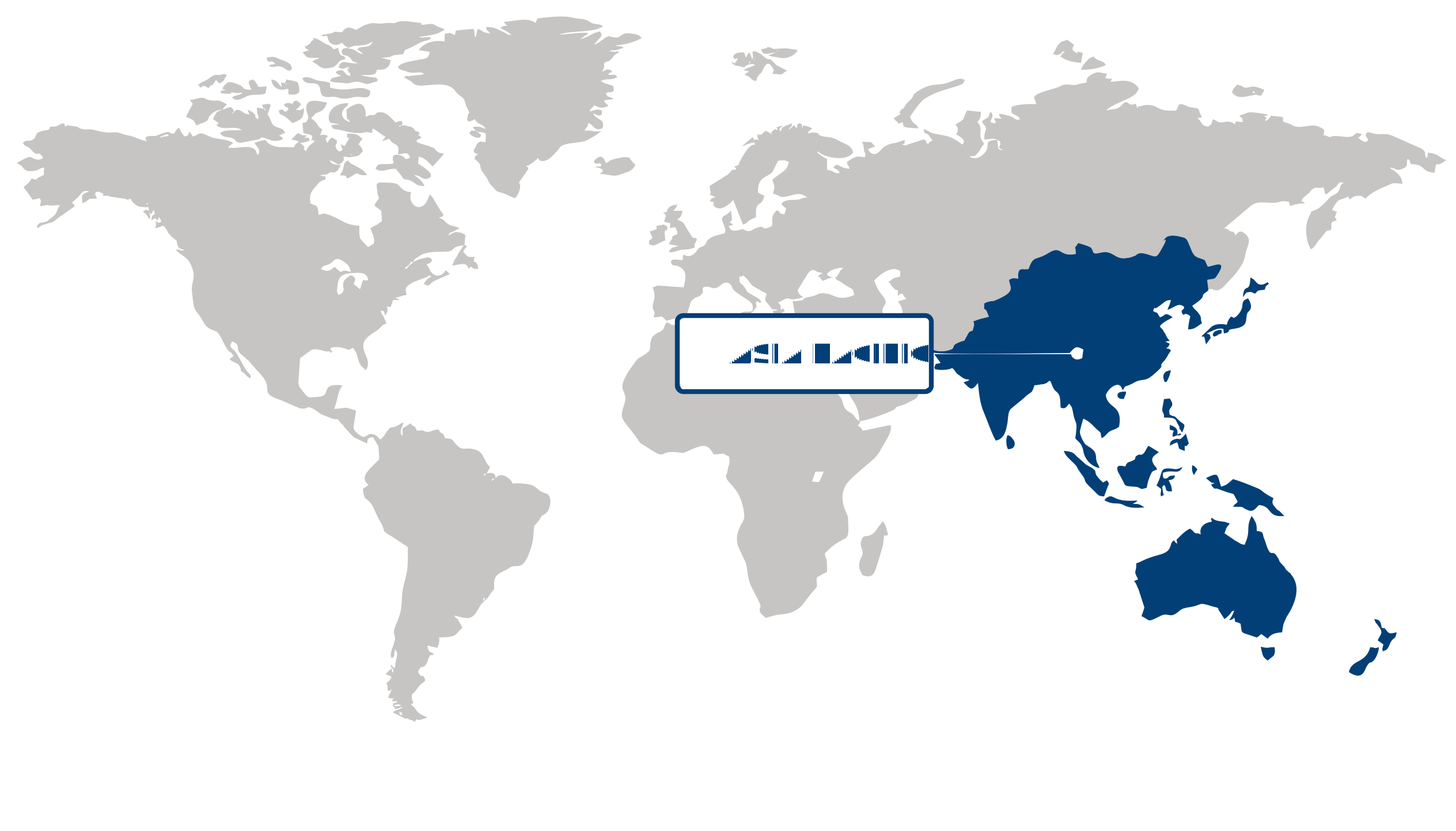
Asia Pacific (Largest & Fastest-Growing Region)
Asia Pacific led the battery electric buses market in 2026 and is also expected to remain the fastest-growing regional market, supported by rapid urbanization, rising public transportation requirements, and increasing efforts to reduce emissions from road transport. Growing investment in electric mobility infrastructure is encouraging transit operators to transition toward cleaner bus technologies. The region's expanding urban population and increasing demand for efficient mass transportation are creating favorable conditions for battery electric buses. Government-supported electrification initiatives, improvements in charging infrastructure, and growing emphasis on sustainable urban mobility are further accelerating adoption.
| Parameter | North America | Asia Pacific | Europe | Latin America | MEA |
|---|---|---|---|---|---|
| Innovation Hub i Scale Nascent Developing Advanced | |||||
| Cost-Sensitive Region i Scale Low Medium High | |||||
| Regulatory Environment i Scale Restrictive Neutral Supportive | |||||
| Demand Drivers i Scale Weak Moderate Strong | |||||
| Development Stage i Scale Emerging Developing Developed | |||||
| Adoption Rate i Scale Low Medium High | |||||
| New Entrants / Startups i Scale Sparse Moderate Dense | |||||
| Macro Indicators i Scale Weak Stable Strong |
Key Country Insights
United States 🇺🇸
Fleet Electrification ProgramsThe U.S. is accelerating battery electric bus deployment through transit fleet replacement initiatives and charging infrastructure investments. Transit agencies are prioritizing vehicle reliability, battery performance, and lifecycle cost optimization to support long-term electrification strategies.
Germany 🇩🇪
Sustainable Transit IntegrationGermany is expanding battery electric bus adoption within public transport modernization programs. Transit operators are focusing on depot charging, energy management, and operational efficiency to support reliable zero-emission urban mobility services.
Japan 🇯🇵
Urban Fleet ModernizationJapan is advancing battery electric buses to reduce emissions across municipal transportation networks. Bus operators are evaluating compact vehicle designs, charging flexibility, and dependable battery technologies suited to dense urban operating conditions.
South Korea 🇰🇷
Domestic Technology DeploymentSouth Korea combines strong domestic manufacturing capabilities with expanding battery electric bus adoption. Public transit operators are integrating advanced battery systems, smart fleet management, and charging infrastructure to improve operational efficiency and environmental performance.
France 🇫🇷
Low-Emission Transit PlanningFrance continues to expand battery electric buses as cities pursue cleaner public transportation systems. Municipal authorities are investing in charging infrastructure, fleet renewal, and operational planning to improve service sustainability and passenger experience.
Italy 🇮🇹
Municipal Fleet TransitionItaly is incorporating battery electric buses into urban transit modernization initiatives aimed at reducing transport emissions. Transit authorities are prioritizing dependable charging solutions, fleet integration, and efficient vehicle operation across diverse municipal transport networks.
Segment Leadership and Growth Trends
Battery Electric Buses Market Share (%), by Application, 2026
Go beyond the chart, access full insights & data tables
Request Free Sample ReportApplication Segment Analysis: Public Transit (Largest Segment) vs Private Fleet (Fastest-Growing Segment)
The public transit application segment held the largest position in 2026. Municipal transit authorities have accelerated the deployment of battery electric buses to modernize public transportation systems, improve urban air quality, and reduce dependence on conventional fuel-powered fleets. Continued investment in sustainable mobility infrastructure and large-scale fleet replacement initiatives has strengthened the segment's leadership.
In the battery electric buses market, the private fleet application segment is expected to experience the fastest growth as commercial organizations increasingly adopt electric buses for employee transportation, institutional mobility, and shuttle operations. Businesses are prioritizing sustainable transportation strategies while benefiting from lower operating costs and improved environmental performance, supporting greater adoption of battery electric fleets.
Battery Segment Analysis: Li-ion (Largest & Fastest-Growing Segment)
The li-ion battery segment dominated the battery electric buses market and held the largest position in 2026, while also representing the fastest-growing battery category. Its leadership is supported by high energy density, extended driving range, faster charging capability, and longer operational life compared with conventional battery technologies. Continuous improvements in battery performance, safety, and durability are encouraging manufacturers and fleet operators to prioritize lithium-ion solutions for next-generation electric bus deployments.
Bus Segment Analysis: Standard Electric Bus (Largest Segment) vs Articulated Electric Bus (Fastest-Growing Segment)
Holding the largest position in 2026, the standard electric bus segment remains the backbone of battery electric bus deployment across urban and suburban transit systems. Its broad route compatibility, balanced passenger capacity, and operational flexibility make it suitable for a wide variety of public transportation applications. Transit agencies continue to favor standard electric buses because they integrate efficiently into existing fleet operations while supporting sustainable mobility objectives.
The articulated electric bus segment is projected to witness the fastest growth in the battery electric buses market as cities expand high-capacity public transportation corridors to accommodate increasing passenger volumes. The ability to transport more passengers per trip while maintaining zero-emission operation makes articulated electric buses an attractive solution for densely populated urban routes and bus rapid transit systems.
| Segment | Sub-Segment | Largest Segment | Fastest Growing |
|---|---|---|---|
| Application | Public Transit, Private Fleet, Others | Public Transit | Private Fleet |
| Battery | Nickel-cadmium, Li-ion, Lead Acid, Others | Li-ion | Li-ion |
| Bus | Standard Electric Bus, Articulated Electric Bus, Shuttle Electric Bus, Midi Electric Bus, Double-decker Electric Bus, Others | Standard Electric Bus | Articulated Electric Bus |
Competitive Landscape and Market Positioning
Leading companies in the battery electric buses market:
- BYD Company Limited (China)
- Yutong Bus Co., Ltd. (China)
- Volvo Group (Sweden)
- Daimler Truck AG (Germany)
- MAN Truck & Bus SE (Germany)
- Scania AB (Sweden)
- New Flyer Industries, Inc. (Canada)
- Zhongtong Bus Holding Co., Ltd. (China)
- Alexander Dennis Limited (UK)
- Tata Motors Limited (India)
The Battery Electric Buses market is shifting from a vehicle replacement cycle toward a broader contest around electrification ecosystems and long-term operational value. Manufacturers are differentiating through battery efficiency, charging compatibility, fleet integration capabilities, and solutions that address the practical requirements of public transportation operators. Traditional bus producers are adapting by strengthening electric platforms and service capabilities, while specialized entrants are advancing with focused approaches around zero-emission mobility. Competitive positioning is increasingly determined by the ability to support complete fleet transitions, including energy management, maintenance optimization, and infrastructure coordination.
| Company | Market Share | Company Revenue | Revenue CAGR (%) | Product Portfolio | Geographic Presence | Innovation / R&D Focus | Strategic Developments |
|---|---|---|---|---|---|---|---|
| BYD Company Limited (China) | |||||||
| Yutong Bus Co. Ltd. (China) | |||||||
| Volvo Group (Sweden) | |||||||
| Daimler Truck AG (Germany) | |||||||
| MAN Truck & Bus SE (Germany) | |||||||
| Scania AB (Sweden) | |||||||
| New Flyer Industries Inc. (Canada) | |||||||
| Zhongtong Bus Holding Co. Ltd. (China) | |||||||
| Alexander Dennis Limited (UK) | |||||||
| Tata Motors Limited (India) |
Industry Development/News
| Company Name | Date | Key Development |
|---|---|---|
| Scania | Apr-26 | Scania signed a commercial agreement with Swedish transport operator VR to supply 91 Fencer f1 battery-electric buses for Södertälje. The high-capacity vehicles feature 445 kWh batteries and are scheduled to enter passenger service in June 2027, marking one of Sweden's largest electric bus contracts. |
| MBTA | Mar-26 | MBTA proposed a $380 million capital allocation for the design and construction of the Arborway bus facility. The infrastructure asset is engineered to accommodate up to 200 battery-electric buses, establishing the operational foundation required to execute the transit agency's long-term fleet electrification strategy. |
| De Lijn | Dec-25 | De Lijn awarded procurement contracts valued at 400 million EUR to Daimler Buses Belgium and BYD Europe for over 300 electric buses. The agreements outline deliveries commencing in 2027, including up to 500 Daimler eCitaro buses and 268 BYD B12B units, significantly scaling the operator's zero-emission regional transit fleet. |
| Deutsche Bahn | Dec-25 | Deutsche Bahn finalized framework agreements exceeding 1 billion EUR for over 3,000 electric and hybrid buses. MAN Truck & Bus secured 95% of the primary allocations, while BYD was contracted to supply approximately 150 battery-electric intercity buses for deployment across Germany between 2027 and 2032. |
| Alexandria Transit Company (DASH) | Nov-25 | Alexandria Transit Company expanded its operational footprint by constructing a specialized fleet facility equipped with up to 24 overhead chargers. The infrastructure expansion integrates advanced in-route charging capabilities to support the continuous scaling and daily deployment of its battery-electric bus fleet. |
| HY-X | Oct-25 | HY-X and Singapore-based Wisdom Motor established a joint venture entity in Germany dedicated to hydrogen and battery-electric commercial vehicles. The strategic partnership focuses on accelerating the deployment of zero-emission heavy transit solutions and expanding manufacturing reach within the German market. |
| Rheinbahn | Sep-25 | Rheinbahn completed and inaugurated a dedicated electric bus depot in Düsseldorf featuring automated charging infrastructure capable of servicing 60 vehicles simultaneously. The facility expansion directly enhances the operator's capacity to manage and maintain its growing battery-electric urban transit fleet. |
| Scania | Apr-25 | Scania expanded its commercial product portfolio through the launch of a new three-axle battery-electric bus chassis. This engineering advancement broadens available vehicle configurations, allowing transit operators to deploy zero-emission solutions in higher-capacity public transportation applications. |
| NFI Group | Feb-25 | NFI Group secured a follow-on order from the New York MTA for 265 Xcelsior CHARGE NG battery-electric buses. This large-scale vehicle procurement supports the transit authority's long-term strategic mandate to fully transition its 5,800-bus fleet to zero-emission operations by 2040. |
| GILLIG | Mar-24 | GILLIG finalized a five-year framework agreement with King County Metro to supply up to 89 Low Floor battery-electric buses. Initial deployments of 40-foot vehicles with a 240–280 mile range will commence operations from the upgraded Tukwila Base, which supports up to 120 electric buses. |
Customize Your Report
Explore examples of how this report can be tailored to different research needs, including custom segments, additional topics or chapters, and related reports. Click a section of the wheel or its numbered marker to explore the available options.
Battery Electric Buses Market — Custom Segments
| Segment | Sub-Segment |
|---|---|
| Charging Infrastructure Type | Depot Charging, Opportunity Charging, On-route Charging |
| Fleet Deployment Scale | Small Fleets, Medium Fleets, Large Fleets |
| Ownership & Financing Model | Direct Fleet Ownership, Lease-based Ownership, Pay-per-use/Service-based Model |
Battery Electric Buses Market — Custom TOC
| Custom Chapter | Custom Details |
|---|---|
| Fleet Electrification Roadmap Assessment |
|
| Charging Infrastructure Deployment Outlook |
|
| Battery Lifecycle and Second-Life Strategy |
|
Need a different cut of the data?
Request Custom ResearchHow much is the battery electric buses market worth?
How will the battery electric buses industry grow in terms of size and CAGR by 2036?
How are government policies accelerating large-scale battery electric bus deployment?
Why are improving battery economics strengthening electric bus adoption?
Why does the Li-ion battery segment lead the battery electric buses market?
Why is the private fleet application segment growing rapidly in the battery electric buses market?
Why does Asia Pacific lead the battery electric buses market?
What is driving continued battery electric bus growth across Asia Pacific?
What are the key competitors in the battery electric buses landscape?
Our Clients
"The team surpassed our expectations with the report depth. The actionable insights provided proved crucial in navigating market challenges."
Tata Motors
"We found the report to be very informative. The expertise and attention to market nuances significantly influenced our business direction."
DENSO Corporation
"The consumer survey findings were quite good. We now have a clearer picture of the customer churning and retention strategy."
HL Mando
Our Research Team & Methodology
Every Fundamental Business Insights report is built by a dedicated vertical research team, validated through a structured primary-and-secondary methodology, and reviewed for accuracy before it reaches you.
Research Team Overview
Prepared by the Automotive & Transportation Research Team
Delivery
Published
Demand
Available
Support
Trust & Compliance
Research Domains
10 coverage areasResearch Intelligence
| Source | Reference |
|---|---|
| International Organization of Motor Vehicle Manufacturers (OICA) | www.oica.net |
| SAE International | www.sae.org |
| International Energy Agency (IEA) | www.iea.org |
| International Transport Forum (ITF) | www.itf-oecd.org |
| International Road Federation (IRF) | www.irf.global |
| International Organization for Standardization (ISO) | www.iso.org |
| United Nations Economic Commission for Europe (UNECE) | unece.org |
| National Highway Traffic Safety Administration (NHTSA) | www.nhtsa.gov |
| U.S. Department of Transportation (USDOT) | www.transportation.gov |
| European Automobile Manufacturers' Association (ACEA) | www.acea.auto |
| Society of Indian Automobile Manufacturers (SIAM) | www.siam.in |
| International Air Transport Association (IATA) | www.iata.org |
| International Civil Aviation Organization (ICAO) | www.icao.int |
| International Maritime Organization (IMO) | www.imo.org |
| International Union of Railways (UIC) | uic.org |
| American Public Transportation Association (APTA) | www.apta.com |
| International Federation of Robotics (IFR) | ifr.org |
| CharIN | www.charin.global |
| World Shipping Council | www.worldshipping.org |
| International Federation of Freight Forwarders Associations (FIATA) | fiata.org |
Research Workflow & Quality Assurance
Data Collection
Verified information gathered through primary and secondary research.
Data Triangulation
Cross-validation using multiple independent data sources.
Forecast Modelling
Market estimates developed using historical trends and analytical models.
Analyst Validation
Findings reviewed by domain experts for accuracy and consistency.
Editorial & Quality Review
Final editorial, quality, and compliance checks before publication.
Final Publication
Released after successful completion of the internal review process.
Report Coverage
📊 Market Assessment
- Market Size & Forecast
- Market Segmentation
- Regional Analysis
- Growth Drivers & Challenges
- Market Dynamics
🏢 Competitive Intelligence
- Competitive Landscape
- Company Profiles
- Competitive Benchmarking
- Mergers & Acquisitions
- Market Share Analysis or Key Company Strategies
🔍 Strategic Analysis
- Value Chain Analysis
- Porter's Five Forces
- PESTLE Analysis
- Pricing Trends
- Supply-Demand Analysis
🚀 Future Outlook
- Technology Landscape
- Regulatory Landscape
- Investment & Funding Landscape
- Emerging Opportunities
- Future Market Outlook
Have a question about this report or need a custom scope?
Request Customization