Barium Titanate Market Size & Growth Forecast 2027–2036, By Segments (Form, Application, End User), Regional Demand Trends (North America, Asia Pacific, Europe), Key Country Insights (U.S., Japan, South Korea, Germany, France, Italy), and Competitive Landscape
Market Size and Growth Outlook
Barium Titanate Market size was worth USD 2.04 Billion in 2026 and is expected to grow at 5.41% CAGR between 2027 and 2036, attaining USD 3.46 Billion by 2036. The industry revenue for 2027 is estimated at USD 2.13 Billion.
Get more details on this report
Request Free Sample ReportBarium Titanate Market Intelligence Snapshot
Regional Market Dynamics
- Asia Pacific held 40.39% in 2026, supported by its electronics manufacturing ecosystem, consumer electronics production, and demand for advanced dielectric materials.
- Europe is growing rapidly as advanced electronics, electrification, and high-performance applications across automotive, industrial, energy, and communications sectors expand.
Segment Momentum
- The capacitor segment accounted for 37.8% of the market in 2026, driven by extensive use of barium titanate as a dielectric material in multilayer ceramic capacitors for electronics, automotive, and industrial applications.
- Automotive demand is increasing as vehicles incorporate more electronic systems, battery management technologies, advanced driver assistance systems, and onboard electronics, creating stronger demand for high-performance barium titanate materials.
Market Expansion Drivers
- Rising MLCC demand from consumer electronics increasing dielectric material consumption
- Expansion of 5G infrastructure boosting demand for high-frequency ceramic components
- Electric vehicle electronics growth increasing demand for high-performance capacitors
Leading Market Participants
- Leading players in the barium titanate market include Merck KGaA (Germany), Sakai Chemical Industry Co., Ltd. (Japan), Nippon Chemical Industrial Co., Ltd. (Japan), Fuji Titanium Industry Co., Ltd. (Japan), Shandong Sinocera Functional Materials Co., Ltd. (China), Vibrantz Technologies (United States), Murata Manufacturing Co., Ltd. (Japan), TDK Corporation (Japan), Kyocera Corporation (Japan), Samsung Electro-Mechanics Co., Ltd. (South Korea)
Global Market Forecast Snapshot
Market Outlook
- 2026 Market Size: USD 2.04 Billion
- 2027 Estimated Market Size: USD 2.13 Billion
- Projected Market Size: USD 3.46 Billion by 2036
- Growth Forecast: 5.41% CAGR (2027-2036)
Regional and Segment Outlook
- Leading Regional Market: Asia Pacific
- High-Growth Regional Hub: Europe
- Core Revenue Segment: Powder (Form) | Capacitors (Application) | Electronics and Semiconductors (End User)
- Emerging Opportunity Segment: Nanoparticles (Form) | PTC Thermistor (Application) | Automotive (End User)
Market Growth Drivers and Industry Trends
Rising MLCC demand from consumer electronics increasing dielectric material consumption
Growing production of smartphones, wearable devices, computing equipment, and other compact electronic products is increasing the need for multilayer ceramic capacitors with high electrical performance and miniaturized designs. The barium titanate market will drive growth by supplying a critical dielectric material used in the manufacture of these capacitors, supporting higher component density and reliable electrical characteristics. As electronic devices continue to incorporate more advanced functionality within smaller form factors, manufacturers require materials that deliver consistent dielectric performance while enabling efficient high-volume production.
Expansion of 5G infrastructure boosting demand for high-frequency ceramic components
The ongoing deployment of next-generation communication networks is creating greater demand for electronic components capable of operating reliably at higher frequencies and under demanding signal transmission conditions. The barium titanate market growth is driven by the increasing use of ceramic materials in components that support stable electrical properties, signal integrity, and efficient performance within telecommunications infrastructure. Network equipment manufacturers are also prioritizing advanced dielectric materials to meet the performance requirements of increasingly sophisticated wireless communication systems.
Electric vehicle electronics growth increasing demand for high-performance capacitors
The expanding integration of electronic systems in electric vehicles is increasing the requirement for capacitors capable of supporting power management, control systems, and onboard electronic functions. The barium titanate market will boost demand by providing an essential material for high-performance capacitors that operate reliably under varying electrical and thermal conditions. As vehicle architectures become more electronically intensive, component manufacturers are focusing on dielectric materials that enable improved durability, compact designs, and dependable performance across critical automotive applications.
| Growth Driver | Impact on CAGR | Regulatory Influence | Geographic Relevance | Adoption Rate | Impact Timeline |
|---|---|---|---|---|---|
| Rising MLCC demand from consumer electronics increasing dielectric material consumption | 2% | Moderate | Asia Pacific, Global | High | Near Term |
| Expansion of 5G infrastructure boosting demand for high-frequency ceramic components | 1.8% | Moderate | North America, Asia Pacific | High | Mid Term |
| Electric vehicle electronics growth increasing demand for high-performance capacitors | 1.6% | Moderate | Europe, Asia Pacific | High | Mid Term |
Explore Growth Opportunities
Request Free Sample ReportRegional Demand Dynamics
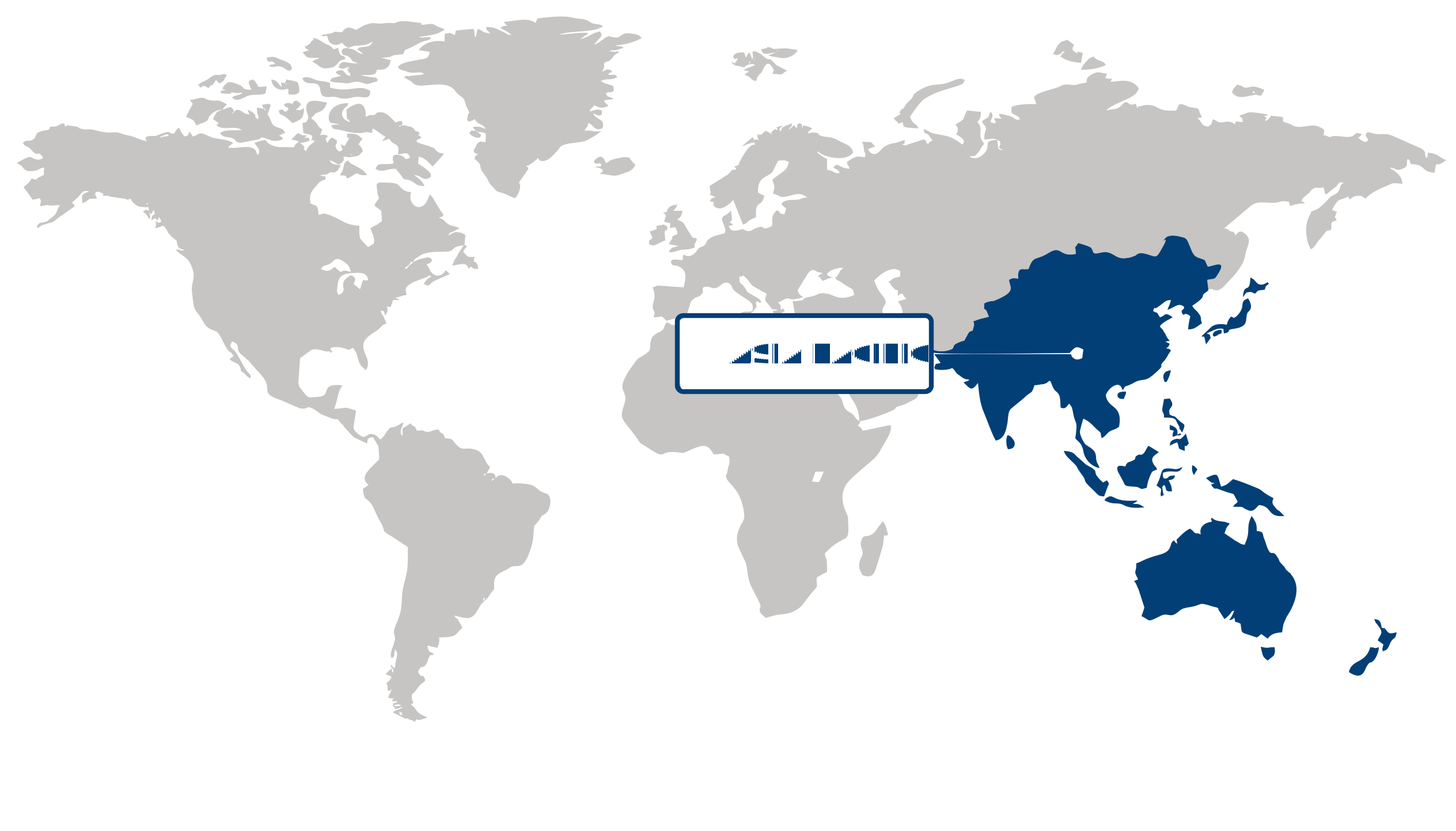
Asia Pacific (Largest Region)
Asia Pacific held the largest share of 40.39% in the barium titanate market in 2026, driven by the region’s strong electronics manufacturing ecosystem and broad demand for advanced dielectric materials. Barium titanate is widely relevant to electronic components requiring high dielectric performance, making its demand closely linked to the production of capacitors and other electronic devices. The concentration of electronics manufacturing, expanding consumer electronics production, and continued development of advanced electrical and electronic systems are supporting regional consumption and strengthening the position of Asia Pacific in the market.
Europe (Fastest-Growing Region)
Europe is anticipated to be the fastest-growing region, supported by increasing emphasis on advanced electronics, electrification, and high-performance materials for modern electrical systems. Growing demand for electronic components across automotive, industrial, energy, and communications applications is creating opportunities for dielectric materials such as barium titanate. The region’s focus on technological advancement, energy-efficient systems, and the development of sophisticated electronic applications is further supporting demand for materials that can contribute to compact and high-performance component designs.
| Parameter | North America | Asia Pacific | Europe | Latin America | MEA |
|---|---|---|---|---|---|
| Innovation Hub i Scale Nascent Developing Advanced | |||||
| Cost-Sensitive Region i Scale Low Medium High | |||||
| Regulatory Environment i Scale Restrictive Neutral Supportive | |||||
| Demand Drivers i Scale Weak Moderate Strong | |||||
| Development Stage i Scale Emerging Developing Developed | |||||
| Adoption Rate i Scale Low Medium High | |||||
| New Entrants / Startups i Scale Sparse Moderate Dense | |||||
| Macro Indicators i Scale Weak Stable Strong |
Key Country Insights
United States 🇺🇸
Advanced Electronics MaterialsThe U.S. is increasing demand for barium titanate in multilayer ceramic capacitors, advanced electronics, and specialized energy storage applications. Manufacturers emphasize material consistency, high dielectric performance, and reliable supply for next-generation electronic components.
Germany 🇩🇪
Precision Ceramic ProductionGermany is strengthening barium titanate utilization across automotive electronics, industrial equipment, and advanced ceramic manufacturing. Producers prioritize high-purity formulations and consistent electrical properties to support demanding component specifications.
Japan 🇯🇵
High-Performance CapacitorsJapan continues to advance barium titanate applications through its established electronic component manufacturing ecosystem. Companies focus on improving dielectric characteristics, miniaturization compatibility, and material quality for compact, high-reliability electronic devices.
South Korea 🇰🇷
Electronics Manufacturing SupplySouth Korea is expanding barium titanate consumption alongside semiconductor and electronic component production. Material suppliers are enhancing product quality, processing consistency, and supply chain reliability to meet the performance requirements of advanced electronic devices.
France 🇫🇷
Functional Materials DevelopmentFrance is supporting barium titanate applications in electronic ceramics, sensors, and research-driven materials innovation. Market participants prioritize specialty formulations that improve electrical performance while meeting stringent manufacturing and quality standards.
Italy 🇮🇹
Industrial Ceramics IntegrationItaly is incorporating barium titanate into industrial ceramics and electronic component manufacturing serving diverse industrial sectors. Producers emphasize process optimization, dependable material characteristics, and compatibility with precision ceramic production technologies.
Segment Leadership and Growth Trends
Barium Titanate Market Share (%), by Form, 2026
Go beyond the chart, access full insights & data tables
Request Free Sample ReportForm Segment Analysis: Powder (Largest Segment) vs Nanoparticles (Fastest-Growing Segment)
The powder form dominated the barium titanate market, accounting for 48.12% in 2026. Powder remains the most widely utilized form due to its suitability for manufacturing electronic ceramics, multilayer ceramic capacitors, and piezoelectric components. Its excellent processability, uniform particle distribution, and compatibility with conventional ceramic fabrication techniques make it the preferred choice for large-scale industrial production. Growing demand for high-performance electronic devices and consistent dielectric materials continues to reinforce the leading position of the powder segment.
Nanoparticles are anticipated to register the fastest growth during the forecast period owing to their superior electrical and ferroelectric characteristics compared with conventional material forms. Their increasing use in advanced sensors, energy storage devices, miniaturized electronic components, and emerging nanotechnology applications is driving adoption across research and commercial sectors. Continued innovation in high-performance electronics and functional materials is expected to accelerate the expansion of this segment.
Application Segment Analysis: Capacitors (Largest Segment) vs PTC Thermistor (Fastest-Growing Segment)
The capacitor application segment accounted for the largest share of the barium titanate market, capturing 37.8% in 2026. Barium titanate is extensively used as a dielectric material in multilayer ceramic capacitors because of its high dielectric constant and reliable electrical performance. Increasing production of consumer electronics, communication equipment, automotive electronics, and industrial control systems continues to sustain demand for capacitor-grade materials. The ongoing trend toward compact and high-efficiency electronic devices further strengthens the segment's market leadership.
The PTC thermistor application is expected to experience the fastest growth over the forecast period, supported by rising demand for temperature sensing and circuit protection technologies. Barium titanate-based PTC thermistors are increasingly integrated into electric vehicles, household appliances, industrial equipment, and power management systems due to their self-regulating electrical properties. Expanding adoption of intelligent electronic systems and enhanced equipment safety requirements is expected to fuel growth in this application segment.
End User Segment Analysis: Electronics and Semiconductors (Largest Segment) vs Automotive (Fastest-Growing Segment)
The electronics and semiconductors end-user segment led the barium titanate market in 2026. Demand from this industry is driven by the widespread use of barium titanate in capacitors, sensors, actuators, transducers, and other electronic components that require stable dielectric and piezoelectric properties. Continuous advancements in semiconductor manufacturing, increasing production of electronic devices, and growing demand for high-performance electronic materials continue to support the dominance of this segment.
The automotive end-user segment is projected to witness the fastest growth during the forecast period as vehicles incorporate an increasing number of electronic systems and advanced electrical components. The expansion of electric mobility, advanced driver assistance systems, battery management technologies, and onboard electronics is creating higher demand for high-quality ceramic materials with reliable electrical performance. These industry developments are expected to accelerate the adoption of barium titanate across automotive applications.
| Segment | Sub-Segment | Largest Segment | Fastest Growing |
|---|---|---|---|
| Form | Powder, Nanoparticles, Crystals, Thin Films | Powder | Nanoparticles |
| Application | Capacitors, PTC Thermistor, Electronic Ceramics, Reinforcement of Composite, Others | Capacitors | PTC Thermistor |
| End User | Electronics and Semiconductors, Automotive, Telecommunications, Medical Devices, Aerospace and Defense, Energy and Power, Research and Academia | Electronics and Semiconductors | Automotive |
Unlock insights tailored to your business with our bespoke market research solutions.
Click to get your customized report now.
Competitive Landscape and Market Positioning
Top players in the barium titanate market:
- Merck KGaA (Germany)
- Sakai Chemical Industry Co., Ltd. (Japan)
- Nippon Chemical Industrial Co., Ltd. (Japan)
- Fuji Titanium Industry Co., Ltd. (Japan)
- Shandong Sinocera Functional Materials Co., Ltd. (China)
- Vibrantz Technologies (United States)
- Murata Manufacturing Co., Ltd. (Japan)
- TDK Corporation (Japan)
- Kyocera Corporation (Japan)
- Samsung Electro-Mechanics Co., Ltd. (South Korea)
Material performance has become the principal arena of competition in the barium titanate market as downstream manufacturers demand increasingly consistent dielectric characteristics for advanced electronic components. Producers are refining particle morphology, purity levels, and processing techniques to support high-performance ceramic applications where manufacturing precision directly influences end-product reliability. Competitive differentiation is also emerging through application-specific material grades tailored to evolving requirements in electronics, energy storage, and specialty ceramics, rewarding suppliers that can maintain uniform quality while adapting production processes to increasingly sophisticated industrial specifications.
| Company | Market Share | Company Revenue | Revenue CAGR (%) | Product Portfolio | Geographic Presence | Innovation / R&D Focus | Strategic Developments |
|---|---|---|---|---|---|---|---|
| Merck KGaA (Germany) | |||||||
| Sakai Chemical Industry Co. Ltd. (Japan) | |||||||
| Nippon Chemical Industrial Co. Ltd. (Japan) | |||||||
| Fuji Titanium Industry Co. Ltd. (Japan) | |||||||
| Shandong Sinocera Functional Materials Co. Ltd. (China) | |||||||
| Vibrantz Technologies (United States) | |||||||
| Murata Manufacturing Co. Ltd. (Japan) | |||||||
| TDK Corporation (Japan) | |||||||
| Kyocera Corporation (Japan) | |||||||
| Samsung Electro-Mechanics Co. Ltd. (South Korea) |
Industry Development/News
| Company Name | Date | Key Development |
|---|---|---|
| Veeco Instruments | Jan-26 | Veeco Instruments and research hub imec developed a 300 mm high-volume-manufacturing-compatible process to integrate barium titanate on silicon photonics platforms. The manufacturing-ready breakthrough enables scalable production and accelerates commercialization of barium titanate-based photonic devices. |
| MF Material Co., Ltd. | Sep-23 | Murata Manufacturing, Ishihara Sangyo, and Fuji Titanium established a joint venture, MF Material Co., Ltd., to strengthen the barium titanate supply chain. The venture includes building a new manufacturing plant in Nobeoka, Miyazaki Prefecture, aimed at expanding production capacity by 2027. |
Customize Your Report
Explore examples of how this report can be tailored to different research needs, including custom segments, additional topics or chapters, and related reports. Click a section of the wheel or its numbered marker to explore the available options.
Barium Titanate Market — Custom Segments
| Segment | Sub-Segment |
|---|---|
| Purity Grade | Standard Grade, High-Purity Grade, Electronic Grade |
| Manufacturing Process | Solid-State Processing, Hydrothermal Processing, Sol-Gel Processing, Other Chemical Synthesis |
| Procurement Model | Direct Manufacturer Procurement, Distributor Procurement, Contract Supply |
Barium Titanate Market — Custom TOC
| Custom Chapter | Custom Details |
|---|---|
| Raw Material Security & Supply Resilience |
|
| Electronics Industry Qualification Pathways |
|
| Sustainable Production & Environmental Risk Management |
|
Need a different cut of the data?
Request Custom ResearchHow big is the barium titanate market?
How is the barium titanate industry projected to perform over the next decade?
How is growing electronics manufacturing influencing demand for barium titanate?
Why is electric vehicle electrification creating new opportunities for the barium titanate market?
Which application segment leads the barium titanate market?
Why is the automotive end-user segment expected to grow the fastest?
Why does Asia Pacific lead the barium titanate market?
What is driving faster growth of barium titanate in Europe?
Who are the major participants shaping the barium titanate landscape?
Our Clients
"The report helped us understand emerging consumer trends in our product category. It clarified where to focus innovation for the next product launch."
LyondellBasell
"The regional forecast section was incredibly useful. We were able to identify two new potential partners in Europe thanks to the vendor mapping you included."
SABIC
"We appreciated how actionable the recommendations were. It guided us to improve supply chain resilience."
Olin Corporation
Our Research Team & Methodology
Every Fundamental Business Insights report is built by a dedicated vertical research team, validated through a structured primary-and-secondary methodology, and reviewed for accuracy before it reaches you.
Research Team Overview
Prepared by the Chemicals & Materials Research Team
Delivery
Published
Demand
Available
Support
Trust & Compliance
Research Intelligence
Research Workflow & Quality Assurance
Data Collection
Verified information gathered through primary and secondary research.
Data Triangulation
Cross-validation using multiple independent data sources.
Forecast Modelling
Market estimates developed using historical trends and analytical models.
Analyst Validation
Findings reviewed by domain experts for accuracy and consistency.
Editorial & Quality Review
Final editorial, quality, and compliance checks before publication.
Final Publication
Released after successful completion of the internal review process.
Report Coverage
📊 Market Assessment
- Market Size & Forecast
- Market Segmentation
- Regional Analysis
- Growth Drivers & Challenges
- Market Dynamics
🏢 Competitive Intelligence
- Competitive Landscape
- Company Profiles
- Competitive Benchmarking
- Mergers & Acquisitions
- Market Share Analysis or Key Company Strategies
🔍 Strategic Analysis
- Value Chain Analysis
- Porter's Five Forces
- PESTLE Analysis
- Pricing Trends
- Supply-Demand Analysis
🚀 Future Outlook
- Technology Landscape
- Regulatory Landscape
- Investment & Funding Landscape
- Emerging Opportunities
- Future Market Outlook
Have a question about this report or need a custom scope?
Request Customization