Bamboo Furniture Market Size & Growth Forecast 2027–2036, By Segments (End-use, Type), Regional Demand Trends (North America, Asia Pacific, Europe), Key Country Insights (U.S., Japan, South Korea, Germany, France, Italy), and Competitive Landscape
Market Size and Growth Outlook
Bamboo Furniture Market size was valued at USD 13.9 billion in 2026 and is projected to grow at a 6.56% CAGR from 2027 to 2036, attaining USD 26.24 billion by 2036. The industry revenue for 2027 is estimated at USD 14.67 billion.
Get more details on this report
Request Free Sample ReportBamboo Furniture Market Intelligence Snapshot
Regional Market Dynamics
- Asia Pacific leads with 59.46% share due to strong bamboo supply, established manufacturing networks, and cost-efficient production systems linking sourcing, processing, and large-scale furniture output.
- North America is growing at 7.91% CAGR, driven by rising preference for sustainable furnishings and increased consumer shift toward renewable, eco-conscious home and commercial furniture choices.
Segment Momentum
- Residential leads with 71.33% share due to broad household demand across living spaces, where bamboo furniture is preferred for lightweight design, natural aesthetics, and frequent replacement cycles in home furnishing.
- Commercial is growing faster as hotels, cafés, offices, and restaurants adopt bamboo furniture to enhance interior aesthetics, improve customer experience, and refresh spaces with natural, design-led furnishing choices.
Market Expansion Drivers
- Rising sustainability awareness and deforestation concerns boosting eco-friendly furniture adoption.
- Government incentives promoting green building materials and sustainable furniture manufacturing.
- Urban minimalist interior design trends increasing demand for lightweight aesthetic furniture.
Leading Market Participants
- Major players in the bamboo furniture market include IKEA Systems B.V. (Netherlands), MOSO International B.V. (Netherlands), Greenington LLC (United States), Zhenghe Ruichang Industrial Art Co., Ltd. (China), Tine K Home A/S (Denmark), Haiku Designs LLC (United States), Zoco Home S.L. (Spain), Bamboo Village Company Ltd. (Vietnam), Lene Bjerre Design A/S (Denmark), Bamboo Australia Pty Ltd. (Australia).
Global Market Forecast Snapshot
Market Outlook
- 2026 Market Size: USD 13.9 billion
- 2027 Estimated Market Size: USD 14.67 billion.
- Projected Market Size: USD 26.24 billion by 2036
- Growth Forecast: 6.56% CAGR (2027-2036)
Regional and Segment Outlook
- Leading Regional Market: Asia Pacific
- High-Growth Regional Hub: North America
- Core Revenue Segment: Residential (End-use) | Stools (Type)
- Emerging Opportunity Segment: Commercial (End-use) | Chair & Tables (Type)
Market Growth Drivers and Industry Trends
Rising sustainability awareness and deforestation concerns boosting eco-friendly furniture adoption
Growing concern over deforestation, resource depletion, and the environmental effects associated with conventional furniture materials is shifting consumer attention toward renewable alternatives. The bamboo furniture market will gain from this transition as bamboo is increasingly viewed as a rapidly renewable material suitable for a range of residential and commercial furniture applications. Consumers seeking environmentally responsible furnishings are showing greater interest in materials that support sustainable consumption, while the natural appearance and versatility of bamboo allow manufacturers to address both ecological preferences and contemporary furniture requirements.
Government incentives promoting green building materials and sustainable furniture manufacturing
Public policies supporting sustainable construction and resource-efficient manufacturing are creating a favorable environment for renewable materials in furniture applications. Government incentives and programs encouraging the use of green building materials can strengthen the bamboo furniture market by improving awareness of sustainable material options and supporting manufacturers adopting environmentally responsible production practices. Integration of bamboo-based furnishings into green building projects, environmentally conscious commercial spaces, and sustainable residential developments can also expand its application beyond individual consumer purchases.
Urban minimalist interior design trends increasing demand for lightweight aesthetic furniture
Urban living environments are increasingly favoring furniture that combines functional design, compact proportions, and natural aesthetics, particularly where available space is limited. This trend is supporting the bamboo furniture market because bamboo products can offer lightweight construction and a distinctive natural appearance suited to minimalist interiors. Demand is being reinforced by consumers seeking furniture that complements uncluttered residential spaces, neutral design themes, and contemporary décor, while the material's flexibility enables applications across seating, tables, storage solutions, and decorative furnishings.
| Growth Driver | Impact on CAGR | Regulatory Influence | Geographic Relevance | Adoption Rate | Impact Timeline |
|---|---|---|---|---|---|
| Rising sustainability awareness and deforestation concerns boosting eco-friendly furniture adoption | 2.30% | High | Asia Pacific, Europe, North America | High | Near Term |
| Government incentives promoting green building materials and sustainable furniture manufacturing | 1.60% | High | Asia Pacific, Europe | Medium | Mid Term |
| Urban minimalist interior design trends increasing demand for lightweight aesthetic furniture | 1.40% | Low | Global | High | Near Term |
Unlock insights tailored to your business with our bespoke market research solutions.
Click to get your customized report now.
Regional Demand Dynamics
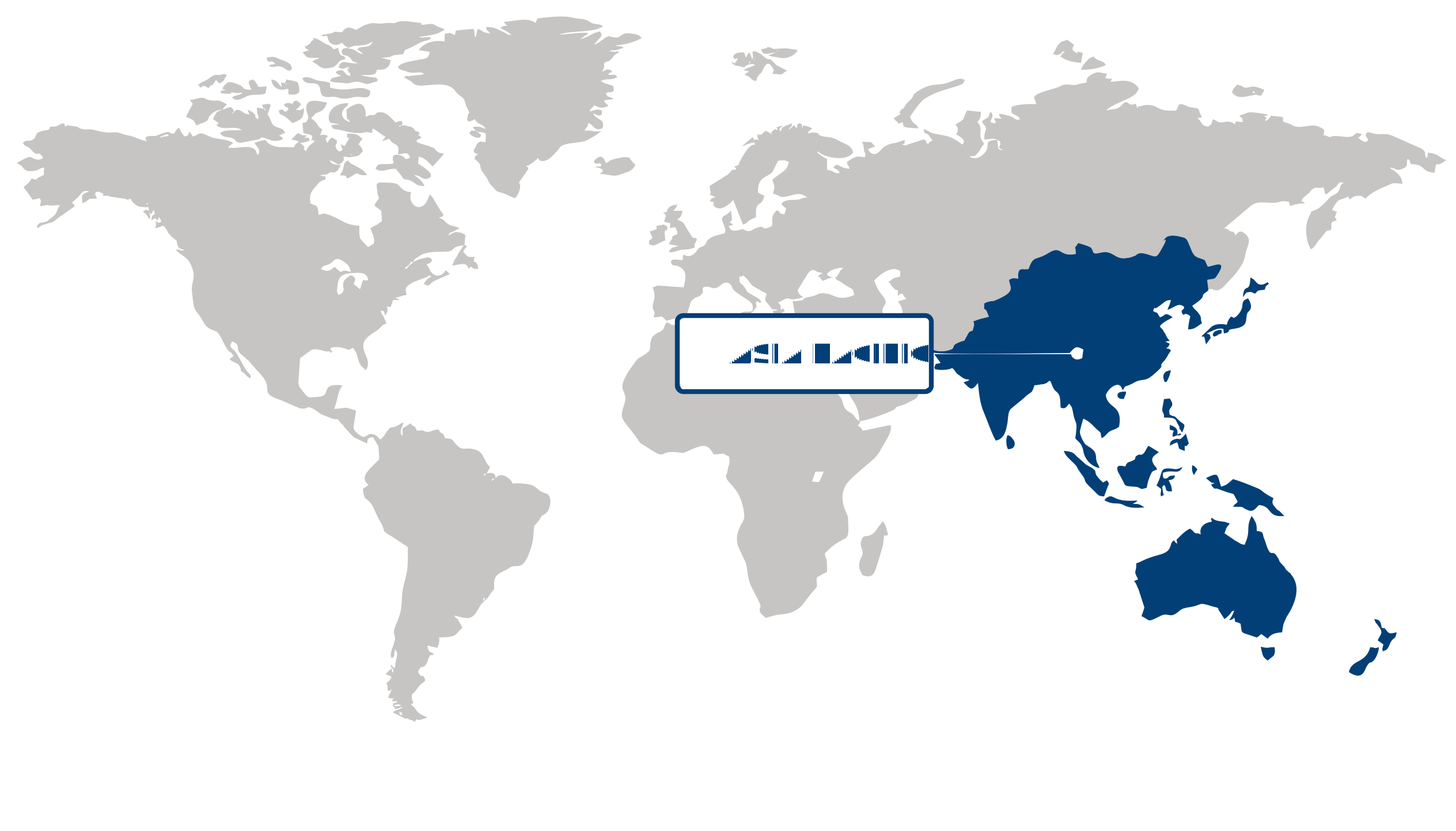
Asia Pacific (Largest Region)
In the bamboo furniture market, Asia Pacific held the largest share in 2026, accounting for 59.46% share, reflecting the region's strong bamboo cultivation base, established processing capabilities, and longstanding familiarity with bamboo-based products. Abundant raw material availability supports furniture manufacturing, while growing interest in sustainable and renewable materials is expanding the appeal of bamboo beyond traditional applications. Urban residential development, hospitality projects, and evolving interior design preferences are also creating opportunities for contemporary bamboo furniture. Improvements in product finishing, durability, and design are helping manufacturers position bamboo furniture as both a functional and environmentally conscious furnishing option.
North America (Fastest-Growing Region)
North America is the fastest-growing region, supported by increasing consumer interest in sustainable home furnishings and environmentally responsible material choices. Demand is gaining traction as homeowners, interior designers, and commercial buyers seek alternatives to conventional furniture materials without compromising aesthetics or functionality. The expansion of online furniture retail is making bamboo products more accessible and allowing consumers to compare a broader range of styles and applications. Growing adoption of minimalist and nature-inspired interiors, together with heightened awareness of renewable materials, is further creating favorable conditions for bamboo furniture penetration across residential and commercial settings.
| Parameter | North America | Asia Pacific | Europe | Latin America | MEA |
|---|---|---|---|---|---|
| Innovation Hub i Scale Nascent Developing Advanced | |||||
| Cost-Sensitive Region i Scale Low Medium High | |||||
| Regulatory Environment i Scale Restrictive Neutral Supportive | |||||
| Demand Drivers i Scale Weak Moderate Strong | |||||
| Development Stage i Scale Emerging Developing Developed | |||||
| Adoption Rate i Scale Low Medium High | |||||
| New Entrants / Startups i Scale Sparse Moderate Dense | |||||
| Macro Indicators i Scale Weak Stable Strong |
Key Country Insights
Germany 🇩🇪
Certified Material PreferenceGermany places strong emphasis on sustainably certified materials and durable furniture construction. German buyers increasingly seek bamboo furniture that meets environmental standards and integrates with minimalist interior design trends in residential and hospitality settings.
France 🇫🇷
Natural Lifestyle FurnishingsFrance favors bamboo furniture that complements natural and artisanal interior themes. French retailers are incorporating bamboo products into premium home décor assortments, with attention on sustainable materials and handcrafted finishes.
Italy 🇮🇹
Artisan Material IntegrationItaly's furniture sector is exploring bamboo as an alternative material for contemporary and designer collections. Italian manufacturers are integrating bamboo into premium product lines that emphasize craftsmanship, aesthetics, and environmentally responsible material choices.
Japan 🇯🇵
Compact Living SolutionsJapan's bamboo furniture market benefits from demand for lightweight and space-efficient products suited to smaller urban homes. Manufacturers in Japan are focusing on multifunctional bamboo pieces that combine traditional aesthetics with modern living requirements.
South Korea 🇰🇷
Design-Led Eco FurnishingsSouth Korea is seeing growing interest in bamboo furniture that combines sustainability with premium interior styling. Local brands are introducing bamboo collections targeting younger consumers seeking environmentally conscious and visually distinctive home furnishings.
United States 🇺🇸
Sustainable Home Décor DemandThe U.S. bamboo furniture market is shaped by consumer interest in eco-friendly furnishings and multifunctional home products. Retailers in the U.S. are expanding bamboo-based indoor and outdoor collections that align with sustainable sourcing and contemporary design preferences.
Segment Leadership and Growth Trends
Bamboo Furniture Market Share (%), by End-use, 2026
Go beyond the chart, access full insights & data tables
Request Free Sample ReportEnd-use Segment Analysis: Residential (Largest Segment) vs Commercial (Fastest-Growing Segment)
The residential segment accounted for the largest share of the bamboo furniture market in 2026, reaching 71.33%, supported by growing consumer interest in natural materials, sustainable interiors, and furniture with distinctive visual appeal. Bamboo furniture fits a range of residential settings because of its lightweight characteristics, renewable material profile, and suitability for contemporary as well as traditional décor. Increasing attention to environmentally conscious home furnishing is further reinforcing its relevance among households seeking alternatives to conventional furniture materials.
Commercial applications are gaining momentum as businesses increasingly incorporate natural materials and sustainability-oriented design into hospitality, office, retail, and leisure spaces. Bamboo furniture can provide a combination of aesthetic differentiation, functional utility, and an environmentally focused design proposition, making it attractive for commercial environments seeking distinctive interiors while aligning with broader sustainable furnishing trends.
Type Segment Analysis: Stools (Largest Segment) vs Chair & Tables (Fastest-Growing Segment)
Stools represented the leading type in the bamboo furniture market in 2026, with a 46.11% share, owing to their versatile functionality, compact footprint, and suitability across residential and light commercial environments. Bamboo stools can serve as seating, occasional furniture, or complementary décor pieces, while their relatively simple construction supports broad design flexibility and easy integration into different interior styles.
Demand for bamboo chairs and tables is expanding as consumers and commercial users seek coordinated furniture solutions rather than individual accent pieces. These products offer greater utility across dining, living, workspace, hospitality, and outdoor settings, while the combination of natural aesthetics and sustainability credentials is encouraging broader adoption of bamboo-based furniture collections.
| Segment | Sub-Segment | Largest Segment | Fastest Growing |
|---|---|---|---|
| End-use | Residential, Commercial | Residential | Commercial |
| Type | Chair & Tables, Stools, Beds, Others | Stools | Chair & Tables |
Competitive Landscape and Market Positioning
Prominent players in the bamboo furniture market:
1. IKEA Systems B.V. (Netherlands)
2. MOSO International B.V. (Netherlands)
3. Greenington LLC (United States)
4. Zhenghe Ruichang Industrial Art Co. Ltd. (China)
5. Tine K Home A/S (Denmark)
6. Haiku Designs LLC (United States)
7. Zoco Home S.L. (Spain)
8. Bamboo Village Company Ltd. (Vietnam)
9. Lene Bjerre Design A/S (Denmark)
10. Bamboo Australia Pty Ltd. (Australia)
Rising demand for environmentally responsible home furnishings is supporting growth in the bamboo furniture market. Product differentiation is increasingly centered on sustainable sourcing, modern designs, and improved manufacturing techniques that enhance durability while appealing to eco-conscious consumers.
| Company | Market Share | Company Revenue | Revenue CAGR (%) | Product Portfolio | Geographic Presence | Innovation / R&D Focus | Strategic Developments |
|---|---|---|---|---|---|---|---|
| IKEA Systems B.V. (Netherlands) | |||||||
| MOSO International B.V. (Netherlands) | |||||||
| Greenington LLC (United States) | |||||||
| Zhenghe Ruichang Industrial Art Co. Ltd. (China) | |||||||
| Tine K Home A/S (Denmark) | |||||||
| Haiku Designs LLC (United States) | |||||||
| Zoco Home S.L. (Spain) | |||||||
| Bamboo Village Company Ltd. (Vietnam) | |||||||
| Lene Bjerre Design A/S (Denmark) | |||||||
| Bamboo Australia Pty Ltd. (Australia). |
Industry Development/News
| Company Name | Date | Key Development |
|---|---|---|
| Duffy London | Jan-26 | Duffy London advanced its sustainability-oriented design strategy by developing bamboo-electric Voltis prototypes alongside a solar boat initiative. The developments indicate a strategic shift toward integrating bamboo-based materials with electric mobility and experimental manufacturing applications, reflecting diversification into alternative material innovation within design-led production environments. |
| Odisha government | Dec-25 | The Odisha government announced a bamboo policy and ‘Odisha Bamboo’ branding initiative to strengthen state-level bamboo production systems. The program aims to build structured supply ecosystems, improve livelihoods, and enhance industrial linkage opportunities for downstream bamboo-based manufacturing, including furniture applications. |
| MOSO | 2024 | MOSO participated in major construction and architecture trade events, including Material District Utrecht and Architect@Work, to promote its bamboo product portfolio. The company used these platforms to engage architects and designers, strengthen commercial relationships, and reinforce its positioning in eco-friendly bamboo-based building and interior solutions. |
Customize Your Report
Explore examples of how this report can be tailored to different research needs, including custom segments, additional topics or chapters, and related reports. Click a section of the wheel or its numbered marker to explore the available options.
Bamboo Furniture Market — Custom Segments
| Segment | Sub-Segment |
|---|---|
| Price Range | Economy, Mid-Range, Premium, Luxury |
| Furniture Style | Contemporary, Traditional, Rustic, Minimalist |
| Material Composition | Solid Bamboo, Bamboo with Wood, Bamboo with Metal, Bamboo with Glass/Other Materials |
Bamboo Furniture Market — Custom TOC
| Custom Chapter | Custom Details |
|---|---|
| Circular Furniture Business Model Assessment |
|
| Sustainable Furniture Adoption Assessment |
|
| Hospitality Sector Demand Assessment |
|
Need a different cut of the data?
Request Custom ResearchWhat is the current revenue of the bamboo furniture market?
What are the growth projections for the bamboo furniture industry?
How is sustainability-driven procurement reshaping bamboo furniture adoption across consumer and commercial buyers?
How are policy incentives and urban design trends accelerating bamboo furniture integration?
Why does the residential segment dominate the bamboo furniture market?
What is driving faster growth in commercial bamboo furniture adoption?
Why does Asia Pacific lead the bamboo furniture market?
What is driving North America’s growth in bamboo furniture demand?
Which companies are driving growth in the bamboo furniture landscape?
Our Clients
"The report provided us with a clear direction, and the level of detail was beyond what we expected. I would definitely recommend their services to others."
Haier Appliances
"The collaboration with Fundamental Business Insights has added significant value to our decision-making process, and we look forward to continuing this partnership for our future market research requirements."
Luxottica Group S.p.A.
"The team at FBI delivered an exceptional research report. The insights on industry innovations were particularly impressive and added a lot of value to the overall report."
Nike
Our Research Team & Methodology
Every Fundamental Business Insights report is built by a dedicated vertical research team, validated through a structured primary-and-secondary methodology, and reviewed for accuracy before it reaches you.
Research Team Overview
Prepared by the Consumer Goods & Services Research Team
Delivery
Published
Demand
Available
Support
Trust & Compliance
Research Domains
10 coverage areasResearch Intelligence
| Source | Reference |
|---|---|
| International Organization for Standardization (ISO) | www.iso.org |
| ASTM International | www.astm.org |
| U.S. Consumer Product Safety Commission (CPSC) | www.cpsc.gov |
| European Commission – Consumer Safety | ec.europa.eu/safety-gate |
| Consumer Technology Association (CTA) | www.cta.tech |
| National Retail Federation (NRF) | nrf.com |
| World Retail Congress | www.worldretailcongress.com |
| World Travel & Tourism Council (WTTC) | wttc.org |
| UN Tourism | www.unwto.org |
| Personal Care Products Council (PCPC) | www.personalcarecouncil.org |
| Cosmetics Europe | cosmeticseurope.eu |
| International Housewares Association (IHA) | www.housewares.org |
| American Apparel & Footwear Association (AAFA) | www.aafaglobal.org |
| World Federation of the Sporting Goods Industry (WFSGI) | wfsgi.org |
| Juvenile Products Manufacturers Association (JPMA) | www.jpma.org |
| Pet Industry Joint Advisory Council (PIJAC) | pijac.org |
| International Council of Toy Industries (ICTI) | www.toy-icti.org |
| International Association of Amusement Parks and Attractions (IAAPA) | iaapa.org |
| Organisation for Economic Co-operation and Development (OECD) | www.oecd.org |
| World Bank Data | data.worldbank.org |
Research Workflow & Quality Assurance
Data Collection
Verified information gathered through primary and secondary research.
Data Triangulation
Cross-validation using multiple independent data sources.
Forecast Modelling
Market estimates developed using historical trends and analytical models.
Analyst Validation
Findings reviewed by domain experts for accuracy and consistency.
Editorial & Quality Review
Final editorial, quality, and compliance checks before publication.
Final Publication
Released after successful completion of the internal review process.
Report Coverage
📊 Market Assessment
- Market Size & Forecast
- Market Segmentation
- Regional Analysis
- Growth Drivers & Challenges
- Market Dynamics
🏢 Competitive Intelligence
- Competitive Landscape
- Company Profiles
- Competitive Benchmarking
- Mergers & Acquisitions
- Market Share Analysis or Key Company Strategies
🔍 Strategic Analysis
- Value Chain Analysis
- Porter's Five Forces
- PESTLE Analysis
- Pricing Trends
- Supply-Demand Analysis
🚀 Future Outlook
- Technology Landscape
- Regulatory Landscape
- Investment & Funding Landscape
- Emerging Opportunities
- Future Market Outlook
Have a question about this report or need a custom scope?
Request Customization