Autonomous Train Market Size & Growth Forecast 2027–2036, By Segments (Automation Grade, Application, Train Type), Regional Demand Trends (North America, Asia Pacific, Europe), Key Country Insights (U.S., Japan, South Korea, Germany, France, Italy), and Competitive Landscape
Market Size and Growth Outlook
Autonomous Train Market size stood at USD 11.4 billion in 2026 and is predicted to grow at a 5.61% CAGR from 2027 to 2036, surpassing USD 19.68 billion by 2036. The industry revenue for 2027 is assessed at USD 11.94 billion.
Get more details on this report
Request Free Sample ReportAutonomous Train Market Intelligence Snapshot
Regional Market Dynamics
- Asia Pacific captured a 49.04% market share in 2026, supported by extensive rail modernization, expanding metro infrastructure, and sustained investment in automated train control technologies.
- Europe is expected to grow at a 6.78% CAGR as operators prioritize signaling integration, rail network digitalization, and operational efficiency improvements across mature urban and intercity systems.
Segment Momentum
- GoA 2 leads with a 40.42% share due to its balanced automation with operator oversight, ensuring compatibility with existing rail systems while improving operational reliability and service consistency.
- Freight is the fastest-growing segment as operators automate logistics routes to improve efficiency, reduce manual intervention, and enhance predictability in cargo movement across standardized rail corridors.
Market Expansion Drivers
- Government-backed smart mobility initiatives driving autonomous rail adoption for safer transportation systems.
- Advanced LiDAR and sensor fusion technologies enhancing real-time train perception and control systems.
- Smart city metro expansion and rail modernization programs accelerating driverless train deployment.
Leading Market Participants
- Top players in the autonomous train market include Siemens AG (Germany), Alstom SA (France), Hitachi Rail Ltd. (United Kingdom), CRRC Corporation Limited (China), Wabtec Corporation (United States), Thales Group (France), Kawasaki Heavy Industries, Ltd. (Japan), Mitsubishi Heavy Industries, Ltd. (Japan), Hyundai Rotem Company (South Korea), Toshiba Infrastructure Systems & Solutions Corporation (Japan).
Global Market Forecast Snapshot
Market Outlook
- 2026 Market Size: USD 11.4 billion
- 2027 Estimated Market Size: USD 11.94 billion.
- Projected Market Size: USD 19.68 billion by 2036
- Growth Forecast: 5.61% CAGR (2027-2036)
Regional and Segment Outlook
- Leading Regional Market: Asia Pacific
- High-Growth Regional Hub: Europe
- Core Revenue Segment: GoA 2 (Automation Grade) | Passenger (Application) | Metro/Monorail (Train Type)
- Emerging Opportunity Segment: GoA 4 (Automation Grade) | Freight (Application) | High-speed Rail (Train Type)
Market Growth Drivers and Industry Trends
Government-backed smart mobility initiatives driving autonomous rail adoption for safer transportation systems
Government support for smart mobility is creating a favorable environment for the adoption of automated rail technologies focused on improving transportation safety. The autonomous train market will benefit as public-sector mobility programs encourage rail operators to consider autonomous systems as part of broader efforts to modernize transportation infrastructure and operational practices.
Advanced LiDAR and sensor fusion technologies enhancing real-time train perception and control systems
Advances in LiDAR and sensor fusion are improving the ability of trains to interpret their surroundings and respond to changing operating conditions. These technologies are strengthening the autonomous train market by enabling more sophisticated real-time perception and control capabilities, which are important for autonomous rail systems operating with reduced dependence on manual intervention.
Smart city metro expansion and rail modernization programs accelerating driverless train deployment
Expansion of smart city metro networks is creating additional opportunities for driverless rail solutions as urban transportation systems undergo modernization. The autonomous train market is gaining from rail programs that incorporate automated operating capabilities into new and upgraded metro infrastructure, supporting deployment of driverless trains within increasingly technology-enabled urban transit networks.
| Growth Driver | Impact on CAGR | Regulatory Influence | Geographic Relevance | Adoption Rate | Impact Timeline |
|---|---|---|---|---|---|
| Government-backed smart mobility initiatives driving autonomous rail adoption for safer transportation systems | 2.10% | High | Asia Pacific, Europe, North America | High | Near Term |
| Advanced LiDAR and sensor fusion technologies enhancing real-time train perception and control systems | 1.90% | Moderate | Europe, Asia Pacific | Medium | Mid Term |
| Smart city metro expansion and rail modernization programs accelerating driverless train deployment | 1.80% | High | Asia Pacific, Europe | Medium | Long Term |
Unlock insights tailored to your business with our bespoke market research solutions.
Click to get your customized report now.
Regional Demand Dynamics
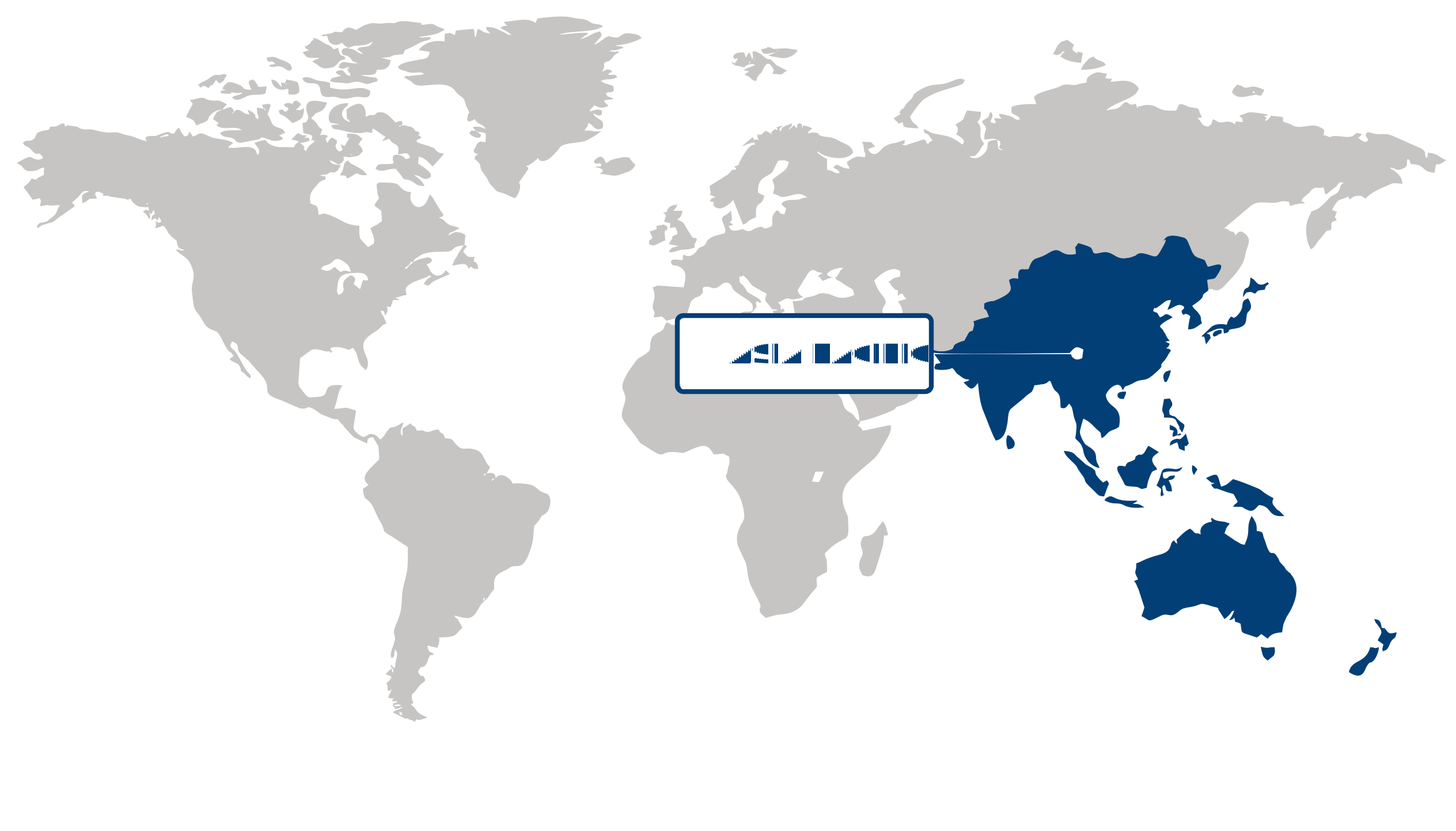
Asia Pacific (Largest Region)
Asia Pacific dominated the autonomous train market with a 49.04% share in 2026, supported by extensive rail networks, high passenger volumes, and substantial investment in railway modernization and intelligent transportation infrastructure. Major urban centers are increasingly adopting automated and digitally managed rail systems to improve operational efficiency, safety, service reliability, and network capacity. Rapid urbanization is creating additional pressure to expand mass-transit systems while limiting congestion, making autonomous rail technologies attractive for metro and urban rail applications. Strong capabilities in automation, signaling, communications, and railway engineering further support the region's leading position.
Europe (Fastest-Growing Region)
Europe is the fastest-growing regional market, driven by railway modernization, sustainability objectives, and increasing emphasis on efficient public transportation. Rail operators and infrastructure authorities are pursuing digital signaling, automated train control, and intelligent traffic-management technologies to improve network utilization and operational safety. The region's focus on reducing transportation emissions is also strengthening the role of rail as a sustainable mobility option, creating favorable conditions for autonomous systems. Investments in smart mobility infrastructure and the integration of advanced control technologies are supporting broader adoption across urban and regional rail networks.
| Parameter | North America | Asia Pacific | Europe | Latin America | MEA |
|---|---|---|---|---|---|
| Innovation Hub i Scale Nascent Developing Advanced | |||||
| Cost-Sensitive Region i Scale Low Medium High | |||||
| Regulatory Environment i Scale Restrictive Neutral Supportive | |||||
| Demand Drivers i Scale Weak Moderate Strong | |||||
| Development Stage i Scale Emerging Developing Developed | |||||
| Adoption Rate i Scale Low Medium High | |||||
| New Entrants / Startups i Scale Sparse Moderate Dense | |||||
| Macro Indicators i Scale Weak Stable Strong |
Key Country Insights
Germany 🇩🇪
Intelligent Rail OperationsGermany integrates autonomous train technologies with digital signaling and rail infrastructure modernization initiatives. German rail operators prioritize automation that enhances scheduling accuracy, operational safety, and network capacity across passenger and freight services.
France 🇫🇷
Automated Urban MobilityFrance is strengthening autonomous train capabilities through upgrades to metropolitan rail systems and signaling technologies. French transportation authorities focus on automation solutions that improve service continuity while supporting efficient network management.
Italy 🇮🇹
Rail Digital TransformationItaly is gradually incorporating autonomous train technologies into rail modernization projects emphasizing safety and operational efficiency. Italian infrastructure investments increasingly support digital traffic management and automated train control across selected rail corridors.
Japan 🇯🇵
Precision Transit AutomationJapan continues expanding autonomous train technologies within highly automated rail networks known for operational precision. Railway operators in Japan invest in intelligent control systems that improve efficiency while maintaining consistent passenger service standards.
South Korea 🇰🇷
Smart Metro DeploymentSouth Korea is accelerating autonomous train adoption through smart city initiatives and investments in advanced metro infrastructure. Rail operators in South Korea emphasize integrated digital control platforms that optimize operations and passenger experience.
United States 🇺🇸
Urban Transit ModernizationThe U.S. autonomous train market is centered on modernizing urban rail systems with advanced automation, signaling, and operational control technologies. Transit agencies across the U.S. increasingly evaluate autonomous capabilities to improve network efficiency and service reliability.
Segment Leadership and Growth Trends
Autonomous Train Market Share (%), by Automation Grade, 2026
Go beyond the chart, access full insights & data tables
Request Free Sample ReportAutomation Grade Segment Analysis: GoA 2 (Largest Segment) vs GoA 4 (Fastest-Growing Segment)
The autonomous train market was led by the GoA 2 segment, which accounted for a 40.42% share in 2026, reflecting the practical balance it offers between automated train operation and continued human supervision. GoA 2 systems can support automated acceleration, braking, and operational functions while retaining driver involvement for specific tasks, making them suitable for rail networks transitioning toward higher levels of automation. Their compatibility with existing operational frameworks and comparatively manageable integration requirements support adoption among railway operators seeking to improve efficiency, consistency, and service reliability without immediately moving to fully unattended operations.
GoA 4 is expected to witness the fastest growth as railway operators increasingly explore fully automated and unattended train operations. This automation grade can reduce dependence on onboard operational personnel while enabling highly consistent train movements, centralized supervision, and optimized resource utilization. Advances in signaling, communications, artificial intelligence, and real-time monitoring are improving the feasibility of autonomous operations. Growing emphasis on operational efficiency, safety, service frequency, and long-term workforce optimization is strengthening interest in higher automation grades across modern rail systems.
Application Segment Analysis: Passenger (Largest Segment) vs Freight (Fastest-Growing Segment)
Passenger applications held the largest share of the autonomous train market in 2026, supported by the strong suitability of automation for high-frequency urban and metropolitan rail services. Automated passenger trains can improve service consistency, support efficient scheduling, and enhance network capacity through precise train control. The increasing focus on urban mobility, congestion reduction, and reliable public transportation is encouraging investment in automated rail infrastructure. Passenger-focused automation also benefits from established deployment environments such as metro and mass-transit systems, where controlled routes and frequent operations can facilitate autonomous technologies.
Freight applications are emerging as the fastest-growing area as rail operators seek greater efficiency, operational consistency, and improved asset utilization in cargo transportation. Autonomous technologies can support repetitive freight movements, reduce operational constraints, and enable more consistent train handling across suitable routes. Increasing attention to supply-chain resilience and the efficiency advantages of rail freight is creating additional opportunities for automation. Progress in signaling, remote supervision, and autonomous control is further supporting the integration of advanced train technologies into freight operations.
| Segment | Sub-Segment | Largest Segment | Fastest Growing |
|---|---|---|---|
| Automation Grade | GoA 1, GoA 2, GoA 3, GoA 4 | GoA 2 | GoA 4 |
| Application | Passenger, Freight | Passenger | Freight |
| Train Type | Metro/Monorail, High-speed Rail, Light Rail | Metro/Monorail | High-speed Rail |
Competitive Landscape and Market Positioning
Major players in the autonomous train market:
1. Siemens AG (Germany)
2. Alstom SA (France)
3. Hitachi Rail Ltd. (United Kingdom)
4. CRRC Corporation Limited (China)
5. Wabtec Corporation (United States)
6. Thales Group (France)
7. Kawasaki Heavy Industries Ltd. (Japan)
8. Mitsubishi Heavy Industries Ltd. (Japan)
9. Hyundai Rotem Company (South Korea)
10. Toshiba Infrastructure Systems & Solutions Corporation (Japan)
Rail transportation systems are increasingly shifting toward automated and intelligent control frameworks. The autonomous train market is evolving through integration of AI-driven navigation and safety optimization systems. Continuous technological advancement is improving operational efficiency and transport reliability.
| Company | Market Share | Company Revenue | Revenue CAGR (%) | Product Portfolio | Geographic Presence | Innovation / R&D Focus | Strategic Developments |
|---|---|---|---|---|---|---|---|
| Siemens AG (Germany) | |||||||
| Alstom SA (France) | |||||||
| Hitachi Rail Ltd. (United Kingdom) | |||||||
| CRRC Corporation Limited (China) | |||||||
| Wabtec Corporation (United States) | |||||||
| Thales Group (France) | |||||||
| Kawasaki Heavy Industries Ltd. (Japan) | |||||||
| Mitsubishi Heavy Industries Ltd. (Japan) | |||||||
| Hyundai Rotem Company (South Korea) | |||||||
| Toshiba Infrastructure Systems & Solutions Corporation (Japan). |
Industry Development/News
| Company Name | Date | Key Development |
|---|---|---|
| Hyundai Rotem | Jan-26 | Hyundai Rotem reorganized its corporate structure to intensify focus on robotics, artificial intelligence, and hydrogen technologies. This strategic shift is designed to accelerate the development of next-generation transportation systems, signaling a prioritized commitment to integrating advanced autonomous and intelligent technologies into its future railway product portfolio. |
| AŽD Praha | Aug-25 | AŽD Praha initiated testing of Europe’s inaugural driverless train on an open rail line in the Czech Republic. By managing traction, braking, and speed autonomously without onboard personnel, this project represents a critical step forward in the commercial validation and technical feasibility of autonomous rail operations in public network environments. |
| Israel Aerospace Industries | Mar-25 | ELTA Systems, a subsidiary of Israel Aerospace Industries, and DCX Systems established NIART Systems to develop long-range obstacle detection technology. This strategic partnership aims to enhance the safety and operational reliability of rail networks, directly supporting the technical infrastructure required for the deployment of intelligent, autonomous train systems. |
| Alstom | Nov-24 | Alstom deployed its first fully automated Metropolis train for Taiwan’s Light Green Line metro project. The integration of driverless technology is designed to improve overall network throughput and reduce transit times, demonstrating the ongoing commercial adoption of autonomous urban rail transit solutions to meet increasing passenger demand and operational requirements. |
| CRRC | Aug-24 | The Indonesian Ministry of Transportation commenced physical testing of a trackless Autonomous Rail Transit train developed by CRRC. This deployment for the new national capital project serves as a strategic evaluation of autonomous, rail-based transit solutions, testing the capability of CRRC’s technology to provide scalable and efficient transportation in a developing urban infrastructure context. |
| Bengaluru Metro Rail Corporation | Jul-24 | The Bengaluru Metro Rail Corporation Limited initiated dynamic signaling tests for driverless trains on the Namma Metro Yellow Line. Covering a 19-kilometer route, this trial represents a significant move toward implementing autonomous urban transit technology in India, focused on optimizing network efficiency and service frequency through automated operations. |
| Alstom SA | Nov-22 | Alstom SA, in partnership with Lineas and ProRail, successfully demonstrated GoA4 automation on a shunting locomotive in the Netherlands. This achievement enables fully autonomous operation, including starting, movement, and obstacle handling, representing a high-level technological benchmark for autonomous freight and yard operations without the need for onboard staff. |
Customize Your Report
Explore examples of how this report can be tailored to different research needs, including custom segments, additional topics or chapters, and related reports. Click a section of the wheel or its numbered marker to explore the available options.
Autonomous Train Market — Custom Segments
| Segment | Sub-Segment |
|---|---|
| Level of Retrofit | New-Build Autonomous Trains, Partial Retrofit, Full Retrofit |
| Operating Environment | Urban Transit Networks, Mainline Rail Networks, Industrial Rail Networks, Mining Rail Networks |
| Ownership Model | Publicly Owned Railways, Private Rail Operators, Public-Private Rail Systems |
Autonomous Train Market — Custom TOC
| Custom Chapter | Custom Details |
|---|---|
| Rail Automation Deployment Assessment |
|
| Infrastructure Readiness Evaluation |
|
| Safety and Regulatory Approval Landscape |
|
Need a different cut of the data?
Request Custom ResearchHow large is the autonomous train market?
How is the autonomous train industry projected to perform over the next decade?
How are government smart mobility initiatives influencing investment in the autonomous train market?
What role do advanced sensing technologies play in accelerating autonomous train deployment?
Why does GoA 2 lead the autonomous train market automation grades?
Why is freight emerging as the fastest-growing application in autonomous trains?
Why is Asia Pacific the leading region in the autonomous train market?
Why is Europe the fastest-growing autonomous train market?
Who holds a significant market share in the autonomous train landscape?
Our Clients
"The team surpassed our expectations with the report depth. The actionable insights provided proved crucial in navigating market challenges."
Tata Motors
"We found the report to be very informative. The expertise and attention to market nuances significantly influenced our business direction."
DENSO Corporation
"The consumer survey findings were quite good. We now have a clearer picture of the customer churning and retention strategy."
HL Mando
Our Research Team & Methodology
Every Fundamental Business Insights report is built by a dedicated vertical research team, validated through a structured primary-and-secondary methodology, and reviewed for accuracy before it reaches you.
Research Team Overview
Prepared by the Automotive & Transportation Research Team
Delivery
Published
Demand
Available
Support
Trust & Compliance
Research Domains
10 coverage areasResearch Intelligence
| Source | Reference |
|---|---|
| International Organization of Motor Vehicle Manufacturers (OICA) | www.oica.net |
| SAE International | www.sae.org |
| International Energy Agency (IEA) | www.iea.org |
| International Transport Forum (ITF) | www.itf-oecd.org |
| International Road Federation (IRF) | www.irf.global |
| International Organization for Standardization (ISO) | www.iso.org |
| United Nations Economic Commission for Europe (UNECE) | unece.org |
| National Highway Traffic Safety Administration (NHTSA) | www.nhtsa.gov |
| U.S. Department of Transportation (USDOT) | www.transportation.gov |
| European Automobile Manufacturers' Association (ACEA) | www.acea.auto |
| Society of Indian Automobile Manufacturers (SIAM) | www.siam.in |
| International Air Transport Association (IATA) | www.iata.org |
| International Civil Aviation Organization (ICAO) | www.icao.int |
| International Maritime Organization (IMO) | www.imo.org |
| International Union of Railways (UIC) | uic.org |
| American Public Transportation Association (APTA) | www.apta.com |
| International Federation of Robotics (IFR) | ifr.org |
| CharIN | www.charin.global |
| World Shipping Council | www.worldshipping.org |
| International Federation of Freight Forwarders Associations (FIATA) | fiata.org |
Research Workflow & Quality Assurance
Data Collection
Verified information gathered through primary and secondary research.
Data Triangulation
Cross-validation using multiple independent data sources.
Forecast Modelling
Market estimates developed using historical trends and analytical models.
Analyst Validation
Findings reviewed by domain experts for accuracy and consistency.
Editorial & Quality Review
Final editorial, quality, and compliance checks before publication.
Final Publication
Released after successful completion of the internal review process.
Report Coverage
📊 Market Assessment
- Market Size & Forecast
- Market Segmentation
- Regional Analysis
- Growth Drivers & Challenges
- Market Dynamics
🏢 Competitive Intelligence
- Competitive Landscape
- Company Profiles
- Competitive Benchmarking
- Mergers & Acquisitions
- Market Share Analysis or Key Company Strategies
🔍 Strategic Analysis
- Value Chain Analysis
- Porter's Five Forces
- PESTLE Analysis
- Pricing Trends
- Supply-Demand Analysis
🚀 Future Outlook
- Technology Landscape
- Regulatory Landscape
- Investment & Funding Landscape
- Emerging Opportunities
- Future Market Outlook
Have a question about this report or need a custom scope?
Request Customization