Automotive Image Sensors Market Size & Growth Forecast 2027–2036, By Segments (Technology, Vehicle Type), Regional Demand Trends (North America, Asia Pacific, Europe), Key Country Insights (U.S., Japan, South Korea, Germany, France, Italy), and Competitive Landscape
Market Size and Growth Outlook
Automotive Image Sensors Market size was estimated at USD 4.7 billion in 2026 and is projected to grow at a 11.02% CAGR from 2027 to 2036, attaining USD 13.37 billion by 2036. The industry revenue for 2027 is assessed at USD 5.14 billion.
Get more details on this report
Request Free Sample ReportAutomotive Image Sensors Market Intelligence Snapshot
Regional Market Dynamics
- Asia Pacific held a 55.65% share in 2026, driven by its large automotive manufacturing base, strong electronics production, and widespread integration of camera-based vehicle systems.
- North America is forecast to grow at a 12.88% CAGR as advanced driver assistance systems and camera-intensive vehicle architectures increase image sensor deployment per vehicle.
Segment Momentum
- CMOS Image Sensors accounted for 75.84% of the market in 2026 due to their cost efficiency, compact integration, and suitability for high-volume deployment across vehicle safety, visibility, and driver assistance systems.
- Commercial Vehicles are the fastest-growing segment as fleet operators increasingly adopt camera-based systems to improve visibility, driver awareness, maneuvering support, and operational safety across larger vehicles.
Market Expansion Drivers
- Safety feature integration driving ADAS camera and image sensor deployment in vehicles.
- Autonomous vehicle development accelerating demand for high-resolution automotive imaging systems.
- In-cabin driver monitoring and digital cockpit expansion boosting sensor integration.
Leading Market Participants
- Major players in the automotive image sensors market include Samsung Electronics Co., Ltd. (South Korea), Sony Group Corporation (Japan), onsemi (United States), Infineon Technologies AG (Germany), STMicroelectronics N.V. (Switzerland), DENSO Corporation (Japan), Continental AG (Germany), OmniVision Technologies, Inc. (United States), Toshiba Corporation (Japan), Panasonic Holdings Corporation (Japan).
Global Market Forecast Snapshot
Market Outlook
- 2026 Market Size: USD 4.7 billion
- 2027 Estimated Market Size: USD 5.14 billion.
- Projected Market Size: USD 13.37 billion by 2036
- Growth Forecast: 11.02% CAGR (2027-2036)
Regional and Segment Outlook
- Leading Regional Market: Asia Pacific
- High-Growth Regional Hub: North America
- Core Revenue Segment: CMOS Image Sensors (Technology) | Passenger Vehicles (Vehicle Type)
- Emerging Opportunity Segment: CMOS Image Sensors (Technology) | Commercial Vehicles (Vehicle Type)
Market Growth Drivers and Industry Trends
Safety feature integration driving ADAS camera and image sensor deployment in vehicles
Integration of advanced safety features into modern vehicles is driving the automotive image sensors market growth as manufacturers increasingly incorporate camera-based systems into advanced driver assistance systems. Image sensors enable vehicles to capture and interpret visual information needed for functions such as lane detection, object recognition, traffic sign identification, pedestrian awareness, and collision avoidance. As vehicle safety architectures become more sophisticated, the ability to provide reliable visual input under varying road and driving conditions becomes increasingly important. The broader incorporation of ADAS technologies across vehicle categories is therefore encouraging automakers and system developers to integrate image sensors capable of supporting multiple safety and driver-assistance functions.
Autonomous vehicle development accelerating demand for high-resolution automotive imaging systems
Autonomous vehicle development is creating stronger demand in the automotive image sensors market because automated driving systems require detailed visual information to understand road environments and identify surrounding objects. High-resolution imaging can support the detection of vehicles, pedestrians, road markings, traffic signals, and other environmental features that influence vehicle decision-making. As automation technologies progress, imaging systems must increasingly deliver accurate visual data across different lighting, weather, and traffic conditions. This requirement is encouraging development of automotive-grade sensors with improved image quality, dynamic range, sensitivity, and processing compatibility for increasingly complex vehicle perception architectures.
In-cabin driver monitoring and digital cockpit expansion boosting sensor integration
The expansion of digital cockpits and driver monitoring capabilities is creating additional applications for image sensors within vehicle interiors, supporting the automotive image sensors market. In-cabin cameras can monitor driver attention, head position, eye movement, and other behavioral indicators to help assess whether a driver remains attentive to the driving environment. At the same time, camera-based interfaces can support personalized cockpit functions and interaction with increasingly digital vehicle systems. As manufacturers add more connected displays, intelligent interfaces, and occupant-focused technologies, image sensors are becoming an increasingly integrated component of the vehicle interior electronics architecture.
| Growth Driver | Impact on CAGR | Regulatory Influence | Geographic Relevance | Adoption Rate | Impact Timeline |
|---|---|---|---|---|---|
| Growing adoption of automotive image sensors | 3.80% | Short term (≤ 2 yrs) | North America, Europe | Medium | Fast |
| Technological improvements in sensor performance | 3.90% | Medium term (2–5 yrs) | North America, Asia Pacific | Low | Moderate |
| Expansion of automotive manufacturing in emerging markets | 3.80% | Long term (5+ yrs) | Asia Pacific, Latin America | Low | Slow |
| Safety feature integration driving ADAS camera and image sensor deployment in vehicles | 2.00% | High | Asia Pacific, North America | High | Near Term |
| Autonomous vehicle development accelerating demand for high-resolution automotive imaging systems | 2.20% | High | North America, Europe, Asia Pacific | Medium | Mid Term |
| In-cabin driver monitoring and digital cockpit expansion boosting sensor integration | 1.60% | Moderate | Asia Pacific, Europe | High | Near Term |
Unlock insights tailored to your business with our bespoke market research solutions.
Click to get your customized report now.
Regional Demand Dynamics
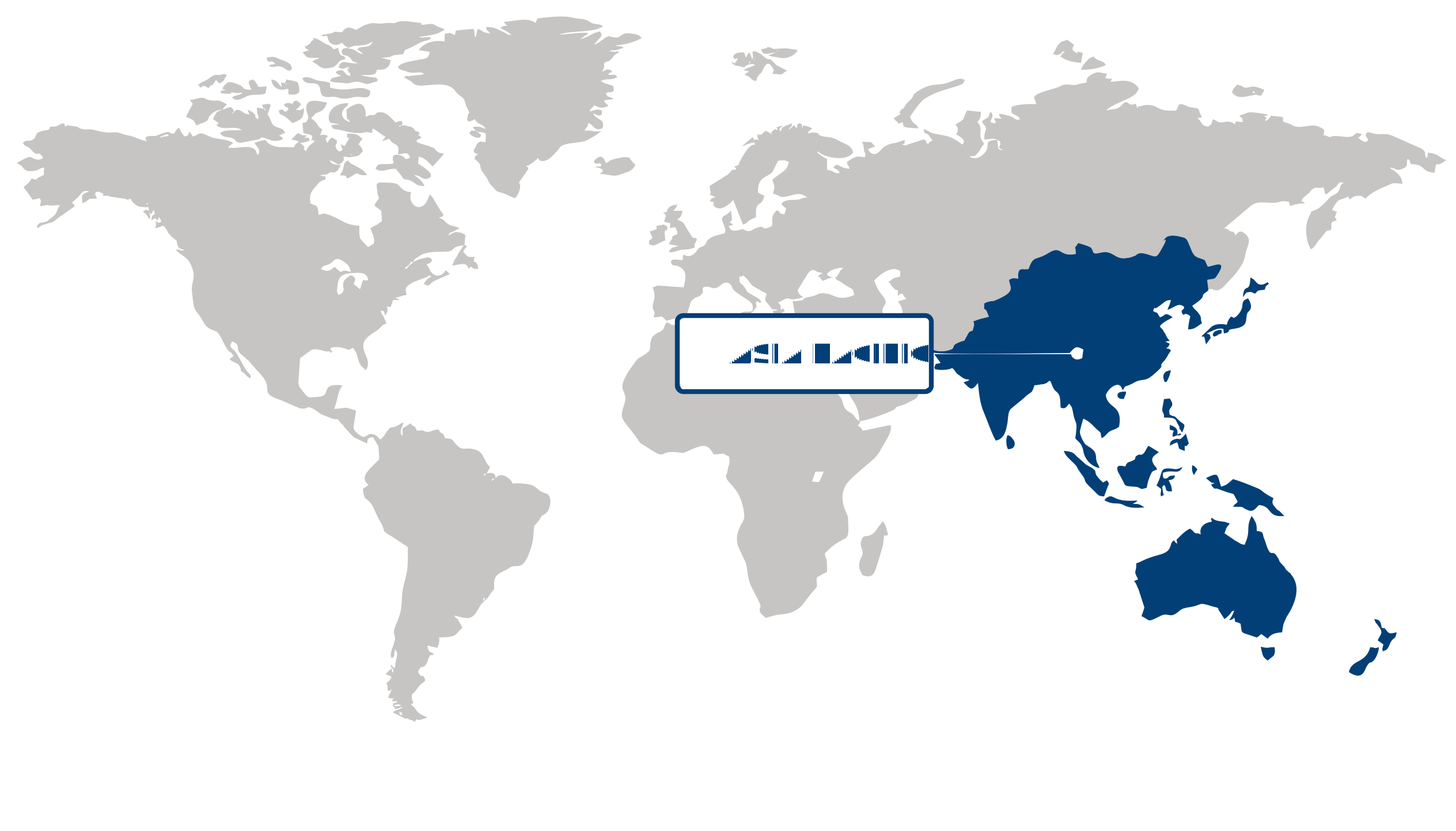
Asia Pacific (Largest Region)
Asia Pacific dominated the automotive image sensors market with a 55.65% share in 2026, reflecting its strong automotive manufacturing ecosystem, expanding vehicle production capabilities, and increasing integration of advanced sensing technologies into modern vehicles. The region’s manufacturing depth and focus on automotive electronics provide a strong foundation for continued adoption of image sensors across safety, driver assistance, and vehicle monitoring applications.
North America (Fastest-Growing Region)
North America represents the fastest-growing region, supported by increasing emphasis on vehicle safety, advanced driver assistance technologies, and the integration of intelligent sensing systems into automotive platforms. Continued investment in automotive technology and demand for enhanced vehicle perception capabilities are strengthening the adoption of image sensors across next-generation mobility applications.
| Parameter | North America | Asia Pacific | Europe | Latin America | MEA |
|---|---|---|---|---|---|
| Innovation Hub i Scale Nascent Developing Advanced | |||||
| Cost-Sensitive Region i Scale Low Medium High | |||||
| Regulatory Environment i Scale Restrictive Neutral Supportive | |||||
| Demand Drivers i Scale Weak Moderate Strong | |||||
| Development Stage i Scale Emerging Developing Developed | |||||
| Adoption Rate i Scale Low Medium High | |||||
| New Entrants / Startups i Scale Sparse Moderate Dense | |||||
| Macro Indicators i Scale Weak Stable Strong |
Key Country Insights
Germany 🇩🇪
Automotive OEM Integration DepthGermany’s automotive image sensors market is defined by deep integration within established OEM ecosystems, where sensor adoption is closely tied to premium vehicle platforms. In Germany, engineering rigor and supplier collaboration drive deployment of high-performance imaging systems across safety and automated driving functions.
France 🇫🇷
Automotive Electronics Validation FocusFrance’s automotive image sensors market is characterized by strong validation and testing frameworks within automotive electronics development. In France, regulatory emphasis on safety compliance and system reliability shapes adoption of imaging technologies across passenger and commercial vehicle platforms.
Italy 🇮🇹
Tier-2 Supplier Adoption BaseItaly’s automotive image sensors market is supported by a broad network of Tier-2 suppliers integrating imaging components into vehicle subsystems. In Italy, adoption is driven by incremental upgrades in safety and driver assistance features across mid-range automotive production lines.
Japan 🇯🇵
Sensor Miniaturization EcosystemJapan’s automotive image sensors market emphasizes miniaturization and high-precision imaging technologies embedded within compact vehicle architectures. In Japan, strong electronics manufacturing capabilities support continuous refinement of sensor accuracy and durability for advanced safety and driver assistance applications.
South Korea 🇰🇷
Smart Mobility Electronics ClusterSouth Korea’s automotive image sensors market benefits from a concentrated electronics and mobility innovation ecosystem, where automotive and semiconductor industries collaborate closely. In South Korea, rapid commercialization of smart vehicle technologies supports widespread adoption of advanced imaging systems.
United States 🇺🇸
ADAS Innovation EcosystemThe U.S. automotive image sensors market is shaped by advanced driver-assistance system development across technology firms and automotive OEM collaborations. In the United States, demand is driven by integration of vision-based safety features, with strong emphasis on software-hardware convergence and rapid testing of autonomous driving capabilities.
Segment Leadership and Growth Trends
Automotive Image Sensors Market Share (%), by Technology, 2026
Go beyond the chart, access full insights & data tables
Request Free Sample ReportTechnology Segment Analysis: CMOS Image Sensors (Largest & Fastest-Growing Segment)
CMOS image sensors held a 75.84% share in 2026, making them both the largest and fastest-growing technology segment in the automotive image sensors market. Their strong position is supported by their suitability for advanced vehicle vision applications, including driver assistance, parking systems, object detection, and surrounding-area monitoring. CMOS technology combines fast image capture, compact integration, and efficient digital processing, making it well suited to increasingly software-defined and sensor-intensive vehicles. The continued expansion of safety and automated driving features is further strengthening demand for CMOS-based imaging systems across automotive platforms.
Vehicle Type Segment Analysis: Passenger Vehicles (Largest Segment) vs Commercial Vehicles (Fastest-Growing Segment)
Passenger vehicles dominated the automotive image sensors market by vehicle type, accounting for a 66.93% share in 2026. The segment benefits from the broad integration of camera-based safety and convenience features into passenger vehicles, including collision awareness, parking assistance, lane monitoring, and driver monitoring. Increasing consumer expectations for advanced safety technologies are encouraging automakers to incorporate more imaging capabilities into vehicle designs. The continued evolution of vehicle electronics and growing emphasis on automated driving functions are supporting sustained demand for image sensors in passenger vehicles.
Commercial vehicles represent the fastest-growing vehicle type segment as fleet operators and vehicle manufacturers increasingly prioritize safety, visibility, and operational efficiency. Image sensors support applications such as blind-spot monitoring, surround-view systems, driver assistance, and object detection, which are particularly valuable for larger vehicles operating in complex traffic and logistics environments. Rising adoption of advanced safety systems in commercial transportation and increasing deployment of technology-enabled fleet solutions are creating stronger opportunities for automotive image sensors in this segment.
| Segment | Sub-Segment | Largest Segment | Fastest Growing |
|---|---|---|---|
| Technology | CCD Image Sensors, CMOS Image Sensors | CMOS Image Sensors | CMOS Image Sensors |
| Vehicle Type | Passenger Vehicles, Commercial Vehicles | Passenger Vehicles | Commercial Vehicles |
Competitive Landscape and Market Positioning
Prominent players in the automotive image sensors market:
1. Samsung Electronics Co. Ltd. (South Korea)
2. Sony Group Corporation (Japan)
3. onsemi (United States)
4. Infineon Technologies AG (Germany)
5. STMicroelectronics N.V. (Switzerland)
6. DENSO Corporation (Japan)
7. Continental AG (Germany)
8. OmniVision Technologies Inc. (United States)
9. Toshiba Corporation (Japan)
10. Panasonic Holdings Corporation (Japan)
The automotive image sensors market is advancing due to growing integration of advanced driver assistance and autonomous driving technologies. Sensor innovation is improving object detection accuracy under complex driving conditions. The automotive image sensors market is also witnessing increased adoption of multi-sensor fusion systems for enhanced safety and reliability. Continuous improvements in resolution and processing speed are shaping next-generation mobility systems.
| Company | Market Share | Company Revenue | Revenue CAGR (%) | Product Portfolio | Geographic Presence | Innovation / R&D Focus | Strategic Developments |
|---|---|---|---|---|---|---|---|
| Samsung Electronics Co. Ltd. (South Korea) | |||||||
| Sony Group Corporation (Japan) | |||||||
| onsemi (United States) | |||||||
| Infineon Technologies AG (Germany) | |||||||
| STMicroelectronics N.V. (Switzerland) | |||||||
| DENSO Corporation (Japan) | |||||||
| Continental AG (Germany) | |||||||
| OmniVision Technologies Inc. (United States) | |||||||
| Toshiba Corporation (Japan) | |||||||
| Panasonic Holdings Corporation (Japan). |
Industry Development/News
| Company Name | Date | Key Development |
|---|---|---|
| Samsung Electronics | Jun-26 | Samsung Electronics restructured its CMOS image sensor production strategy by positioning a key manufacturing line under its System LSI division. The organizational shift reflects a broader industry debate over maintaining in-house fabrication versus outsourcing to external foundries, amid intensifying competition across automotive, smartphone, and AI-driven imaging applications. |
| OMNIVISION | Jan-26 | OMNIVISION integrated its TheiaCel image sensors, including OX08D10 and OX03H10, into the NVIDIA DRIVE Hyperion platform. The integration enhances automotive vision capabilities through improved low-light performance, extended detection range, and reduced flicker, strengthening ecosystem alignment between sensor hardware and autonomous driving compute platforms. |
| onsemi | May-23 | onsemi introduced the Hyperlux automotive image sensor family featuring 2.1 µm pixel architecture, 150dB ultra-high dynamic range, and LED Flicker Mitigation across full automotive temperature ranges. The product is designed to support advanced driver assistance systems by improving imaging performance in complex lighting conditions and enhancing sensor reliability for next-generation automotive applications. |
Customize Your Report
Explore examples of how this report can be tailored to different research needs, including custom segments, additional topics or chapters, and related reports. Click a section of the wheel or its numbered marker to explore the available options.
Automotive Image Sensors Market — Custom Segments
| Segment | Sub-Segment |
|---|---|
| Application | Advanced Driver Assistance Systems, Surround View & Parking, Driver Monitoring, Night Vision, In-Cabin Sensing |
| Level of Vehicle Automation | Level 0–1, Level 2, Level 3, Level 4–5 |
| Sensor Deployment Location | Front, Rear, Side, Interior |
Automotive Image Sensors Market — Custom TOC
| Custom Chapter | Custom Details |
|---|---|
| OEM Sourcing Strategy Assessment |
|
| Next-Generation Vehicle Perception Trends |
|
| Automotive Sensor Integration Roadmap |
|
Need a different cut of the data?
Request Custom ResearchWhat is the current revenue of the automotive image sensors market?
What is the projected value of the automotive image sensors industry by 2036?
Which market trends are accelerating image sensor deployment in modern vehicles?
How is autonomous vehicle development changing demand for automotive image sensors?
Why do CMOS image sensors dominate the automotive image sensors market?
Which vehicle type is expanding the fastest in the automotive image sensors market?
Why does Asia Pacific dominate the automotive image sensors market?
What is fueling automotive image sensor demand in North America?
Which companies are driving growth in the automotive image sensors landscape?
Our Clients
"The team surpassed our expectations with the report depth. The actionable insights provided proved crucial in navigating market challenges."
Tata Motors
"We found the report to be very informative. The expertise and attention to market nuances significantly influenced our business direction."
DENSO Corporation
"The consumer survey findings were quite good. We now have a clearer picture of the customer churning and retention strategy."
HL Mando
Our Research Team & Methodology
Every Fundamental Business Insights report is built by a dedicated vertical research team, validated through a structured primary-and-secondary methodology, and reviewed for accuracy before it reaches you.
Research Team Overview
Prepared by the Automotive & Transportation Research Team
Delivery
Published
Demand
Available
Support
Trust & Compliance
Research Intelligence
Research Workflow & Quality Assurance
Data Collection
Verified information gathered through primary and secondary research.
Data Triangulation
Cross-validation using multiple independent data sources.
Forecast Modelling
Market estimates developed using historical trends and analytical models.
Analyst Validation
Findings reviewed by domain experts for accuracy and consistency.
Editorial & Quality Review
Final editorial, quality, and compliance checks before publication.
Final Publication
Released after successful completion of the internal review process.
Report Coverage
📊 Market Assessment
- Market Size & Forecast
- Market Segmentation
- Regional Analysis
- Growth Drivers & Challenges
- Market Dynamics
🏢 Competitive Intelligence
- Competitive Landscape
- Company Profiles
- Competitive Benchmarking
- Mergers & Acquisitions
- Market Share Analysis or Key Company Strategies
🔍 Strategic Analysis
- Value Chain Analysis
- Porter's Five Forces
- PESTLE Analysis
- Pricing Trends
- Supply-Demand Analysis
🚀 Future Outlook
- Technology Landscape
- Regulatory Landscape
- Investment & Funding Landscape
- Emerging Opportunities
- Future Market Outlook
Have a question about this report or need a custom scope?
Request Customization