Automotive Engine Valve Market Size & Growth Forecast 2027–2036, By Segments (Type, Distribution Channel, Vehicle Type, Material), Regional Demand Trends (North America, Asia Pacific, Europe), Key Country Insights (U.S., Japan, South Korea, Germany, France, Italy), and Competitive Landscape
Market Size and Growth Outlook
Automotive Engine Valve Market size was worth USD 5.9 billion in 2026 and is poised to grow at a 4.75% CAGR between 2027 and 2036, attaining USD 9.38 billion by 2036. The industry revenue for 2027 is assessed at USD 6.14 billion.
Get more details on this report
Request Free Sample ReportAutomotive Engine Valve Market Intelligence Snapshot
Regional Market Dynamics
- Asia Pacific held a 44.84% market share in 2026, supported by large-scale vehicle production, strong component manufacturing, and integrated OEM and supplier networks that sustain demand across OEM and aftermarket channels.
- North America is projected to grow at a 5.24% CAGR, driven by demand for higher-performance engine systems and continued powertrain upgrades that support efficiency, durability, and emissions control.
Segment Momentum
- Mono Metallic held a 42.19% market share in 2026 due to consistent material performance, proven manufacturing processes, and cost-effective supply, making it the preferred choice for high-volume OEM engine production.
- Aftermarket demand is rising as vehicles stay in service longer, increasing the need for valve replacements and engine repairs that generate recurring purchases independent of new vehicle production.
Market Expansion Drivers
- Increasing vehicle production in emerging economies driving OEM demand for advanced engine valves.
- Adoption of turbocharged and variable valve timing engines increasing need for high-performance valve systems.
- Growing hybrid vehicle production accelerating demand for lightweight low-friction engine valve technologies.
Leading Market Participants
- Prominent companies in the automotive engine valve market include BorgWarner Inc. (United States), Eaton Corporation plc (Ireland), MAHLE GmbH (Germany), NITTAN Corporation (Japan), Fuji Oozx Inc. (Japan), Ferrea Racing Components, Inc. (United States), Guangzhou Wellfar Engine Parts Co., Ltd. (China), Eminent Engitech Pvt. Ltd. (India), Rane Engine Valve Limited (India).
Global Market Forecast Snapshot
Market Outlook
- 2026 Market Size: USD 5.9 billion
- 2027 Estimated Market Size: USD 6.14 billion.
- Projected Market Size: USD 9.38 billion by 2036
- Growth Forecast: 4.75% CAGR (2027-2036)
Regional and Segment Outlook
- Leading Regional Market: Asia Pacific
- High-Growth Regional Hub: North America
- Core Revenue Segment: Mono Metallic (Type) | OEMs (Distribution Channel) | Passenger Cars (Vehicle Type) | Steel (Material)
- Emerging Opportunity Segment: Hollow (Type) | Aftermarket (Distribution Channel) | Light Commercial Vehicles (Vehicle Type) | Nickel Alloy (Material)
Market Growth Drivers and Industry Trends
Increasing vehicle production in emerging economies driving OEM demand for advanced engine valves
The expansion of automotive manufacturing in emerging economies will drive the automotive engine valve market growth by increasing the requirement for engine components across passenger and commercial vehicle production. Engine valves play a critical role in controlling the intake of air and fuel and the release of combustion gases, making their performance essential to engine operation. As vehicle manufacturers expand production and introduce newer engine platforms, demand is increasing for valves designed to withstand elevated temperatures, pressures, and mechanical stresses. OEM requirements for improved durability, dimensional precision, and compatibility with evolving engine architectures are encouraging the use of increasingly sophisticated valve components.
Adoption of turbocharged and variable valve timing engines increasing need for high-performance valve systems
The wider adoption of turbocharging and variable valve timing technologies is creating more demanding operating conditions for engine components, which will propel the automotive engine valve market growth. Turbocharged engines can operate under higher thermal and pressure conditions, requiring valves and associated materials to maintain reliability under increased stress. Variable valve timing systems also depend on precise control of valve operation to optimize engine performance, fuel utilization, and emissions characteristics. These technologies are therefore encouraging manufacturers to develop engine valves with improved heat resistance, wear performance, dimensional accuracy, and compatibility with advanced combustion systems.
Growing hybrid vehicle production accelerating demand for lightweight low-friction engine valve technologies
Increasing hybrid vehicle production is influencing engine component development and will support the automotive engine valve market demand for lightweight and low-friction solutions. Hybrid powertrains can require combustion engines to operate within specific efficiency-focused conditions, placing greater emphasis on reducing mechanical losses and optimizing engine performance. Lightweight valve components can help reduce reciprocating mass, while low-friction designs can contribute to more efficient engine operation and improved component behavior. Material engineering, surface treatments, and optimized valve geometries are consequently becoming important areas of development as manufacturers adapt engine technologies to the efficiency requirements of hybrid powertrains.
| Growth Driver | Impact on CAGR | Regulatory Influence | Geographic Relevance | Adoption Rate | Impact Timeline |
|---|---|---|---|---|---|
| Increasing vehicle production in emerging economies driving OEM demand for advanced engine valves | 1.90% | Moderate | Asia Pacific, Latin America | High | Near Term |
| Adoption of turbocharged and variable valve timing engines increasing need for high-performance valve systems | 1.70% | High | North America, Europe | High | Mid Term |
| Growing hybrid vehicle production accelerating demand for lightweight low-friction engine valve technologies | 1.40% | High | Asia Pacific, Europe | Emerging | Long Term |
Unlock insights tailored to your business with our bespoke market research solutions.
Click to get your customized report now.
Regional Demand Dynamics
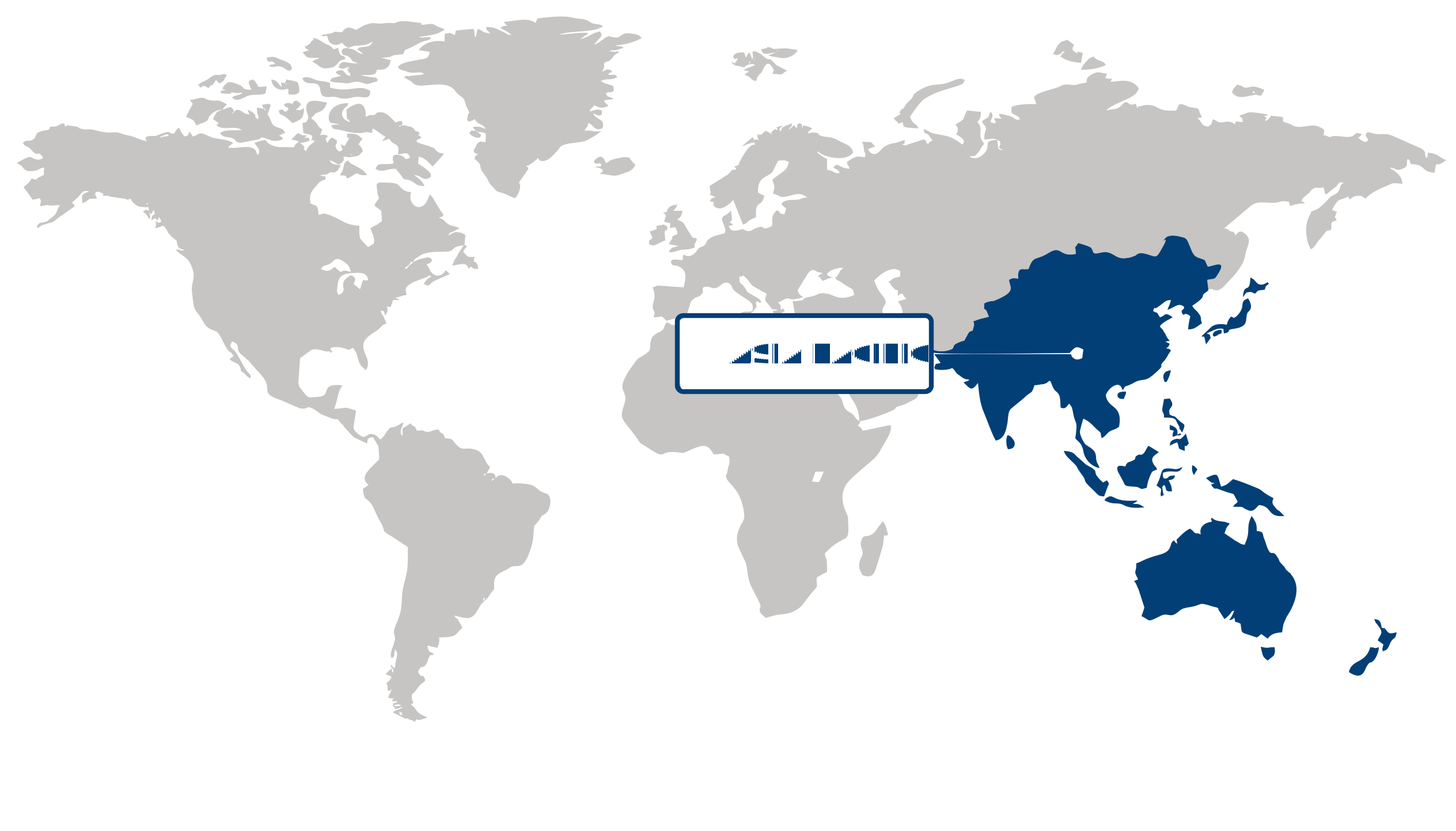
Asia Pacific (Largest Region)
Asia Pacific led the automotive engine valve market with a 44.84% share in 2026, supported by its extensive vehicle manufacturing base, strong automotive component ecosystem, and high demand for passenger and commercial vehicles. Engine valves are essential for controlling gas flow within internal combustion engines, making them a critical component across a broad range of vehicle powertrains. The region's established automotive production infrastructure enables large-scale component manufacturing and supports integrated supply chains for engine and vehicle assembly. Ongoing improvements in engine efficiency, durability, and emissions performance are also encouraging manufacturers to adopt advanced valve materials and precision-engineered components. Continued automotive production and development of increasingly sophisticated powertrain technologies further reinforce Asia Pacific's leading market position.
North America (Fastest-Growing Region)
North America is the fastest-growing region, supported by demand for high-performance vehicles, commercial transportation, and advanced engine technologies. Automakers and component manufacturers are placing greater emphasis on fuel efficiency, durability, and emissions performance, increasing the importance of precisely engineered engine components. Advances in materials and manufacturing processes are enabling valves to withstand demanding operating conditions while supporting improved engine performance. The region's established aftermarket and automotive service ecosystem also creates recurring demand for replacement components. As vehicle manufacturers continue optimizing powertrain efficiency and consumers maintain demand for performance-oriented and utility vehicles, opportunities for advanced engine valve technologies are expanding across North America.
| Parameter | North America | Asia Pacific | Europe | Latin America | MEA |
|---|---|---|---|---|---|
| Innovation Hub i Scale Nascent Developing Advanced | |||||
| Cost-Sensitive Region i Scale Low Medium High | |||||
| Regulatory Environment i Scale Restrictive Neutral Supportive | |||||
| Demand Drivers i Scale Weak Moderate Strong | |||||
| Development Stage i Scale Emerging Developing Developed | |||||
| Adoption Rate i Scale Low Medium High | |||||
| New Entrants / Startups i Scale Sparse Moderate Dense | |||||
| Macro Indicators i Scale Weak Stable Strong |
Key Country Insights
Germany 🇩🇪
OEM precision engineeringGermany automotive engine valve market is anchored in precision engineering requirements from premium OEMs, with strong emphasis on durability, efficiency, and high-speed combustion control. In Germany, suppliers align closely with automotive manufacturers to meet stringent mechanical tolerances and integrate valve systems into advanced internal combustion and hybrid drivetrains.
France 🇫🇷
Emission downsizing focusFrance automotive engine valve market reflects downsizing and emission-reduction strategies, with suppliers adapting components for efficient low-displacement engines and hybrid transitions. In France, OEMs and suppliers prioritize regulatory compliance, lightweight design, and integration into increasingly electrified powertrain ecosystems across passenger vehicle segments.
Italy 🇮🇹
Performance niche engineeringItaly automotive engine valve market is supported by niche performance engineering and specialty automotive suppliers, with demand concentrated in sports cars and aftermarket modifications. In Italy, manufacturers emphasize precision machining, high-performance durability, and integration into both traditional combustion engines and motorsport-oriented applications.
Japan 🇯🇵
Efficient valve miniaturizationJapan automotive engine valve market emphasizes miniaturization and fuel efficiency, with continuous innovation in lightweight materials and precision valve control systems for compact engines. In Japan, OEMs prioritize reliability, emission optimization, and seamless integration into highly efficient hybrid and small displacement engine platforms.
South Korea 🇰🇷
Export OEM integrationSouth Korea automotive engine valve market is shaped by vertically integrated automotive manufacturing ecosystems, with strong focus on cost efficiency and export-oriented vehicle production. In South Korea, suppliers emphasize scalable production, OEM alignment, and support for both internal combustion and hybrid engine platforms.
United States 🇺🇸
Performance emissions balanceUnited States automotive engine valve demand is driven by stringent emissions requirements and performance-oriented vehicle segments, requiring advanced valve timing and thermal resistance solutions. In the U.S., suppliers focus on compatibility with turbocharged engines, aftermarket performance tuning, and integration into evolving hybrid powertrain architectures.
Segment Leadership and Growth Trends
Automotive Engine Valve Market Share (%), by Type, 2026
Go beyond the chart, access full insights & data tables
Request Free Sample ReportType Segment Analysis: Mono Metallic (Largest Segment) vs Hollow (Fastest-Growing Segment)
The mono metallic segment accounted for a 42.19% share of the automotive engine valve market in 2026, supported by its established use in conventional engine architectures and its balance of durability, manufacturing practicality, and cost efficiency. These valves are well suited to applications requiring reliable operation under demanding thermal and mechanical conditions, making them a widely adopted solution across internal combustion engine platforms. Continued emphasis on dependable engine performance and component longevity supports demand for mono metallic valves, particularly where proven valve designs remain important to vehicle manufacturers and engine developers.
Hollow valves are emerging as the fastest-growing type as engine manufacturers increasingly focus on reducing component weight and improving thermal management within high-performance powertrains. Their hollow construction can support lower valve mass and facilitate heat dissipation, helping address engineering priorities related to engine efficiency, operating temperatures, and performance. As vehicle powertrains continue to undergo optimization for improved fuel efficiency and emissions performance, technologies that enable more effective engine operation are gaining importance. This trend is creating favorable conditions for broader adoption of hollow engine valves.
Distribution Channel Segment Analysis: OEMs (Largest Segment) vs Aftermarket (Fastest-Growing Segment)
OEMs held the largest share of the automotive engine valve market in 2026, reflecting the importance of engine valves as integrated components specified during vehicle and engine manufacturing. Original equipment channels benefit from direct incorporation of valve designs into engine architectures, where component compatibility, performance consistency, and quality requirements are closely aligned with manufacturer specifications. The continued production and maintenance of internal combustion engine vehicles sustain demand through OEM procurement, while engineering requirements for reliable engine operation reinforce the role of established supplier relationships within this channel.
The aftermarket segment is the fastest-growing distribution channel, supported by replacement demand arising from engine wear, maintenance requirements, and vehicle servicing. As engines accumulate operating hours, valve components can require inspection or replacement to preserve combustion performance and overall engine functionality. The aftermarket also benefits from the continued presence of vehicles requiring maintenance beyond their original production cycle. Increasing attention to vehicle longevity and preventive maintenance is therefore strengthening demand for replacement engine valves through aftermarket channels.
| Segment | Sub-Segment | Largest Segment | Fastest Growing |
|---|---|---|---|
| Type | Hollow, Bimetallic, Mono Metallic | Mono Metallic | Hollow |
| Distribution Channel | OEMs, Aftermarket | OEMs | Aftermarket |
| Vehicle Type | Passenger Cars, Light Commercial Vehicles, Heavy Commercial Vehicles | Passenger Cars | Light Commercial Vehicles |
| Material | Steel, Titanium, Nickel Alloy | Steel | Nickel Alloy |
Competitive Landscape and Market Positioning
Prominent players in the automotive engine valve market:
1. BorgWarner Inc. (United States)
2. Eaton Corporation plc (Ireland)
3. MAHLE GmbH (Germany)
4. NITTAN Corporation (Japan)
5. Fuji Oozx Inc. (Japan)
6. Ferrea Racing Components Inc. (United States)
7. Guangzhou Wellfar Engine Parts Co. Ltd. (China)
8. Eminent Engitech Pvt. Ltd. (India)
9. Rane Engine Valve Limited (India)
The automotive engine valve market is advancing through improvements in precision engineering and high-performance material development. Collaborative initiatives are enabling enhanced efficiency and durability in engine systems. Ongoing research efforts are supporting next-generation valve designs aligned with evolving automotive standards.
| Company | Market Share | Company Revenue | Revenue CAGR (%) | Product Portfolio | Geographic Presence | Innovation / R&D Focus | Strategic Developments |
|---|---|---|---|---|---|---|---|
| BorgWarner Inc. (United States) | |||||||
| Eaton Corporation plc (Ireland) | |||||||
| MAHLE GmbH (Germany) | |||||||
| NITTAN Corporation (Japan) | |||||||
| Fuji Oozx Inc. (Japan) | |||||||
| Ferrea Racing Components Inc. (United States) | |||||||
| Guangzhou Wellfar Engine Parts Co. Ltd. (China) | |||||||
| Eminent Engitech Pvt. Ltd. (India) | |||||||
| Rane Engine Valve Limited (India). |
Industry Development/News
| Company Name | Date | Key Development |
|---|---|---|
| BorgWarner Inc. | May-25 | BorgWarner Inc. extended multiple volume production contracts with a major North American automotive manufacturer for exhaust gas recirculation systems, including components such as EGR valves, coolers, and modules. The agreements support continued supply for passenger and light commercial vehicles through 2029, reinforcing BorgWarner’s position in combustion and hybrid powertrain emission control systems. |
| Eaton | Mar-24 | Eaton introduced a next-generation Fuel Tank Isolation Valve designed for hybrid vehicles, featuring reduced weight, smaller form factor, and fewer components compared to the prior version. The system addresses evaporative emission challenges in hybrid powertrains and supports the industry shift toward hybrid vehicle architectures by improving installation efficiency and system performance. |
Customize Your Report
Explore examples of how this report can be tailored to different research needs, including custom segments, additional topics or chapters, and related reports. Click a section of the wheel or its numbered marker to explore the available options.
Automotive Engine Valve Market — Custom Segments
| Segment | Sub-Segment |
|---|---|
| Engine Technology | Gasoline Engines, Diesel Engines, Hybrid Engines, Natural Gas Engines |
| Valve Function | Intake Valves, Exhaust Valves, Variable Valve Timing Valves, Exhaust Gas Recirculation Valves |
| Engine Displacement | Below 1.5 Liters, 1.5–2.5 Liters, 2.5–4.0 Liters, Above 4.0 Liters |
Automotive Engine Valve Market — Custom TOC
| Custom Chapter | Custom Details |
|---|---|
| Engine Valve Technology Transition |
|
| Electric Vehicle Impact Assessment |
|
| Lightweight Component Adoption Strategy |
|
Need a different cut of the data?
Request Custom ResearchWhat is the market valuation of automotive engine valve?
What is the forecasted size of the automotive engine valve industry?
How is increasing vehicle production in emerging economies reshaping procurement strategies in the automotive engine valve market?
Why are high-performance and lightweight engine valve technologies becoming more important for future powertrain programs?
Why do Mono Metallic engine valves lead the automotive engine valve market?
Why is the Aftermarket segment growing faster in the automotive engine valve market?
Why does Asia Pacific lead the automotive engine valve market?
What is driving growth in the automotive engine valve market in North America?
Which companies dominate the automotive engine valve landscape?
Our Clients
"The team surpassed our expectations with the report depth. The actionable insights provided proved crucial in navigating market challenges."
Tata Motors
"We found the report to be very informative. The expertise and attention to market nuances significantly influenced our business direction."
DENSO Corporation
"The consumer survey findings were quite good. We now have a clearer picture of the customer churning and retention strategy."
HL Mando
Our Research Team & Methodology
Every Fundamental Business Insights report is built by a dedicated vertical research team, validated through a structured primary-and-secondary methodology, and reviewed for accuracy before it reaches you.
Research Team Overview
Prepared by the Automotive & Transportation Research Team
Delivery
Published
Demand
Available
Support
Trust & Compliance
Research Domains
10 coverage areasResearch Intelligence
| Source | Reference |
|---|---|
| International Organization of Motor Vehicle Manufacturers (OICA) | www.oica.net |
| SAE International | www.sae.org |
| International Energy Agency (IEA) | www.iea.org |
| International Transport Forum (ITF) | www.itf-oecd.org |
| International Road Federation (IRF) | www.irf.global |
| International Organization for Standardization (ISO) | www.iso.org |
| United Nations Economic Commission for Europe (UNECE) | unece.org |
| National Highway Traffic Safety Administration (NHTSA) | www.nhtsa.gov |
| U.S. Department of Transportation (USDOT) | www.transportation.gov |
| European Automobile Manufacturers' Association (ACEA) | www.acea.auto |
| Society of Indian Automobile Manufacturers (SIAM) | www.siam.in |
| International Air Transport Association (IATA) | www.iata.org |
| International Civil Aviation Organization (ICAO) | www.icao.int |
| International Maritime Organization (IMO) | www.imo.org |
| International Union of Railways (UIC) | uic.org |
| American Public Transportation Association (APTA) | www.apta.com |
| International Federation of Robotics (IFR) | ifr.org |
| CharIN | www.charin.global |
| World Shipping Council | www.worldshipping.org |
| International Federation of Freight Forwarders Associations (FIATA) | fiata.org |
Research Workflow & Quality Assurance
Data Collection
Verified information gathered through primary and secondary research.
Data Triangulation
Cross-validation using multiple independent data sources.
Forecast Modelling
Market estimates developed using historical trends and analytical models.
Analyst Validation
Findings reviewed by domain experts for accuracy and consistency.
Editorial & Quality Review
Final editorial, quality, and compliance checks before publication.
Final Publication
Released after successful completion of the internal review process.
Report Coverage
📊 Market Assessment
- Market Size & Forecast
- Market Segmentation
- Regional Analysis
- Growth Drivers & Challenges
- Market Dynamics
🏢 Competitive Intelligence
- Competitive Landscape
- Company Profiles
- Competitive Benchmarking
- Mergers & Acquisitions
- Market Share Analysis or Key Company Strategies
🔍 Strategic Analysis
- Value Chain Analysis
- Porter's Five Forces
- PESTLE Analysis
- Pricing Trends
- Supply-Demand Analysis
🚀 Future Outlook
- Technology Landscape
- Regulatory Landscape
- Investment & Funding Landscape
- Emerging Opportunities
- Future Market Outlook
Have a question about this report or need a custom scope?
Request Customization