Automotive E-Fuel Market Size & Growth Forecast 2027–2036, By Segments (Technology, Product, Renewable Source), Regional Demand Trends (North America, Asia Pacific, Europe), Key Country Insights (U.S., Japan, South Korea, Germany, France, Italy), and Competitive Landscape
Market Size and Growth Outlook
Automotive E-Fuel Market size was more than USD 4.27 Billion in 2026 and is set to grow at 33.76% CAGR between 2027 and 2036, surpassing USD 78.29 Billion by 2036. The industry revenue for 2027 is calculated at USD 5.54 Billion.
Get more details on this report
Request Free Sample ReportAutomotive E-Fuel Market Intelligence Snapshot
Regional Market Dynamics
- Europe leads through ambitious decarbonization policies, established automotive manufacturing, renewable energy integration, and investment in synthetic fuel technologies and infrastructure.
- Asia Pacific is benefiting from strong automotive manufacturing, rising energy demand, renewable power investment, and interest in alternatives that complement vehicle electrification.
Segment Momentum
- Fischer-Tropsch accounted for 61.16% of the market in 2026 due to its ability to produce high-quality synthetic fuels compatible with existing engines and fuel infrastructure while supporting transportation decarbonization efforts.
- On-site solar is the fastest-growing renewable source, driven by expanding distributed solar installations, lower installation costs, and increasing demand for localized, renewable-powered e-fuel production.
Market Expansion Drivers
- Favourable government support and policy initiatives
- Increasing renewable energy integration driving synthetic fuel demand
- Expansion of synthetic fuel production facilities enabling low-carbon transport transition
Leading Market Participants
- Major players in the automotive E-fuel market include ExxonMobil Corporation (United States), Porsche AG (Germany), MAN Energy Solutions SE (Germany), LanzaJet Inc. (United States), Sunfire GmbH (Germany), Climeworks AG (Switzerland), HIF Global (Chile), Shell plc (United Kingdom), BP plc (United Kingdom), TotalEnergies SE (France)
Global Market Forecast Snapshot
Market Outlook
- 2026 Market Size: USD 4.27 Billion
- 2027 Estimated Market Size: USD 5.54 Billion
- Projected Market Size: USD 78.29 Billion by 2036
- Growth Forecast: 33.76% CAGR (2027-2036)
Regional and Segment Outlook
- Leading Regional Market: Europe
- High-Growth Regional Hub: Asia Pacific
- Core Revenue Segment: Fischer-Tropsch (Technology) | E-gasoline (Product) | Wind (Renewable Source)
- Emerging Opportunity Segment: Fischer-Tropsch (Technology) | E-kerosene (Product) | On-site Solar (Renewable Source)
Market Growth Drivers and Industry Trends
Favourable government support and policy initiatives
Governments across multiple regions are strengthening decarbonization strategies through supportive policies that encourage the development and adoption of alternative low-carbon fuels. These initiatives will drive the automotive E-fuel market growth by promoting investments in synthetic fuel technologies through regulatory frameworks, financial incentives, and emissions reduction programs that encourage cleaner transportation solutions. Public policy support also reduces investment uncertainty for fuel producers and infrastructure developers, enabling wider commercialization of e-fuels while complementing existing vehicle fleets that continue to rely on internal combustion engines.
Increasing renewable energy integration driving synthetic fuel demand
The expanding deployment of renewable electricity generation is creating new opportunities to produce synthetic fuels using sustainable energy sources that might otherwise experience periods of surplus generation. The automotive E-fuel market benefits from this trend because renewable power can be converted into synthetic liquid fuels, improving energy utilization while supporting the decarbonization of conventional transport applications. This relationship strengthens the connection between renewable energy systems and the transportation sector by enabling long-term storage of renewable energy in the form of compatible vehicle fuels.
Expansion of synthetic fuel production facilities enabling low-carbon transport transition
Growing investment in dedicated synthetic fuel production facilities is improving the availability of commercially viable e-fuels for transportation applications. The automotive E-fuel market will experience stronger demand as expanded production capacity supports larger supply volumes, improves production efficiency, and enhances the reliability of fuel distribution networks. Scaling manufacturing infrastructure also enables technology refinement, supports supply chain development, and increases the accessibility of low-carbon fuel alternatives for sectors seeking to reduce greenhouse gas emissions without extensive modifications to existing vehicle platforms.
| Growth Driver | Impact on CAGR | Regulatory Influence | Geographic Relevance | Adoption Rate | Impact Timeline |
|---|---|---|---|---|---|
| Favourable government support and policy initiatives | 3% | High | Europe, North America | Emerging | Mid Term |
| Increasing renewable energy integration driving synthetic fuel demand | 2.6% | Moderate | Europe, Asia Pacific, North America | Emerging | Mid Term |
| Expansion of synthetic fuel production facilities enabling low-carbon transport transition | 3% | High | Europe, Middle East & Africa, North America | Emerging | Mid Term |
Unlock insights tailored to your business with our bespoke market research solutions.
Click to get your customized report now.
Regional Demand Dynamics
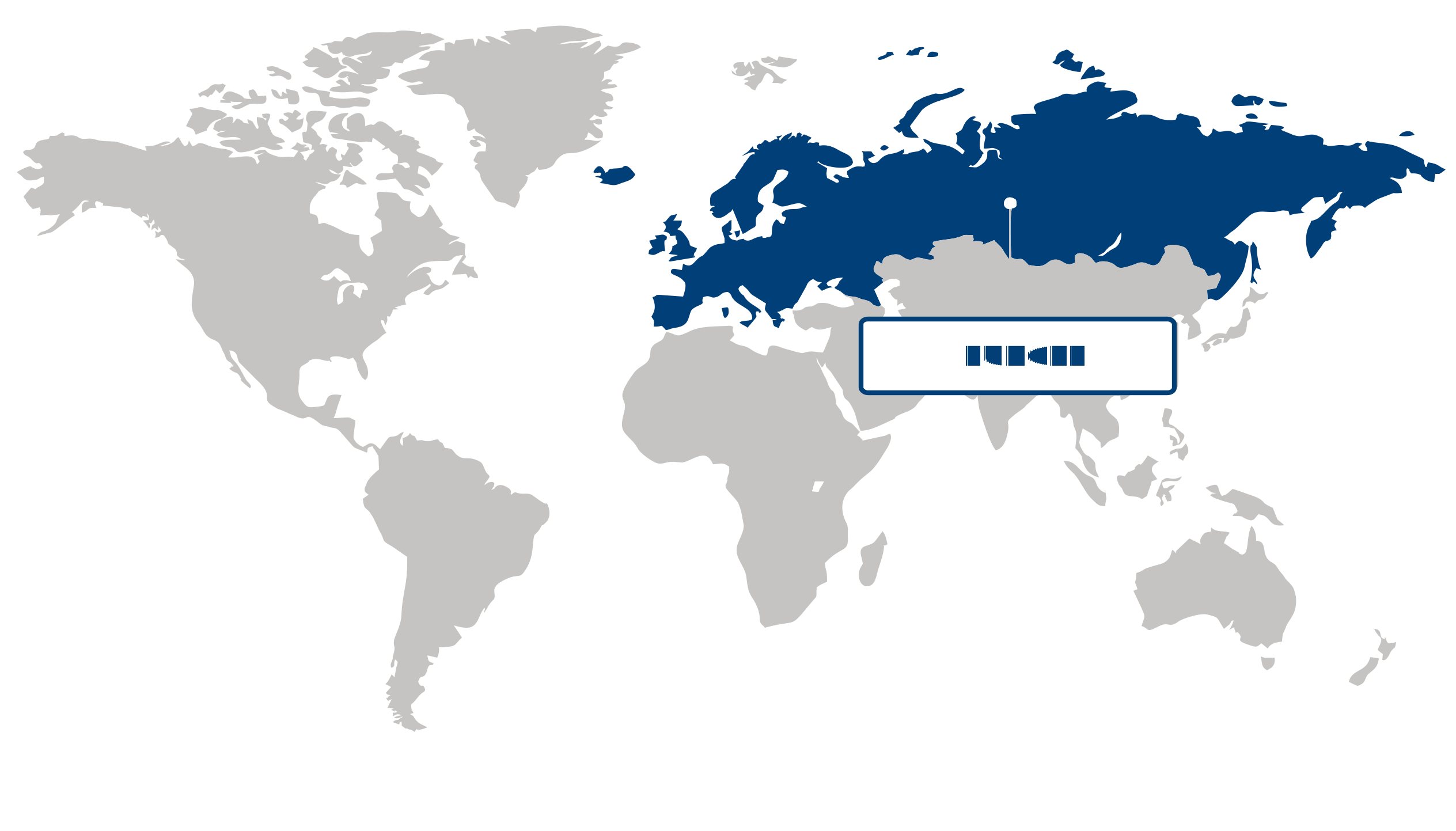
Europe (Largest Region)
Europe held the largest share of the automotive E-fuel market in 2026, supported by ambitious decarbonization policies, established automotive manufacturing capabilities, and strong interest in low-carbon alternatives for sectors that are difficult to electrify. E-fuels offer a potential pathway for reducing the carbon intensity of certain vehicle applications while utilizing existing transportation and fuel infrastructure. The region's focus on renewable energy integration, emissions reduction, and sustainable mobility is encouraging investment in synthetic fuel technologies and related production infrastructure.
Asia Pacific (Fastest-Growing Region)
Asia Pacific is expected to experience the fastest regional growth as governments and automotive industries increasingly explore alternative pathways for reducing transportation emissions. Strong automotive manufacturing activity, rising energy demand, and growing investments in renewable power provide a favorable foundation for e-fuel development. Interest in technologies that can complement vehicle electrification is also increasing, particularly where charging infrastructure, vehicle-use patterns, or existing fuel systems create challenges for a fully electric transition.
| Parameter | North America | Asia Pacific | Europe | Latin America | MEA |
|---|---|---|---|---|---|
| Innovation Hub i Scale Nascent Developing Advanced | |||||
| Cost-Sensitive Region i Scale Low Medium High | |||||
| Regulatory Environment i Scale Restrictive Neutral Supportive | |||||
| Demand Drivers i Scale Weak Moderate Strong | |||||
| Development Stage i Scale Emerging Developing Developed | |||||
| Adoption Rate i Scale Low Medium High | |||||
| New Entrants / Startups i Scale Sparse Moderate Dense | |||||
| Macro Indicators i Scale Weak Stable Strong |
Key Country Insights
United States 🇺🇸
Synthetic Fuel InnovationThe U.S. automotive E-fuel market is advancing through pilot-scale production, renewable hydrogen integration, and collaborations between energy and automotive companies. U.S. stakeholders prioritize scalable production pathways that complement electrification while supporting hard-to-decarbonize vehicle segments.
Germany 🇩🇪
Industrial Decarbonization HubGermany emphasizes automotive E-fuels as part of its strategy to reduce transport emissions while leveraging its automotive engineering base. German manufacturers and fuel producers are investing in demonstration projects and infrastructure supporting synthetic fuel adoption for existing vehicle fleets.
Japan 🇯🇵
Mobility Transition SupportJapan is integrating automotive E-fuels into broader carbon-neutral mobility initiatives alongside electrification and hydrogen technologies. Japanese automakers are evaluating synthetic fuels for internal combustion engines to preserve existing vehicle assets while lowering lifecycle emissions.
South Korea 🇰🇷
Energy Partnership FocusSouth Korea is strengthening automotive E-fuel development through international partnerships for renewable hydrogen and synthetic fuel supply. South Korean companies are aligning fuel production with industrial decarbonization strategies and future mobility requirements.
France 🇫🇷
Low-Carbon Fuel IntegrationFrance encourages automotive E-fuels within broader renewable transport fuel initiatives targeting reduced emissions from conventional vehicles. French industry participants are supporting pilot projects that combine renewable electricity, captured carbon, and advanced fuel synthesis technologies.
Italy 🇮🇹
Performance Mobility ApplicationsItaly is exploring automotive E-fuels for premium vehicles, motorsports, and specialized transport applications requiring liquid fuel compatibility. Italian manufacturers and technology providers are assessing synthetic fuels as a practical option for reducing emissions from existing engine platforms.
Segment Leadership and Growth Trends
Automotive E-Fuel Market Share (%), by Technology, 2026
Go beyond the chart, access full insights & data tables
Request Free Sample ReportTechnology Segment Analysis: Fischer-Tropsch (Largest & Fastest-Growing Segment)
In the automotive E-fuel market, the fischer-tropsch technology segment accounted for a 61.16% share in 2026, making it both the largest and the fastest-growing segment. Its leading position is supported by its ability to convert synthesis gas into high-quality synthetic liquid fuels that are compatible with existing transportation infrastructure and internal combustion engines. The technology is widely recognized for producing fuels with consistent quality, low impurity levels, and favorable combustion characteristics. Increasing efforts to decarbonize transportation while utilizing renewable hydrogen and captured carbon dioxide are further strengthening the adoption of fischer-tropsch technology for large-scale e-fuel production.
Product Segment Analysis: E-gasoline (Largest Segment) vs E-kerosene (Fastest-Growing Segment)
E-gasoline held the largest share of the market at 21.12% in 2026, supported by its compatibility with the extensive global fleet of gasoline-powered vehicles and existing fuel distribution infrastructure. The segment benefits from growing interest in reducing lifecycle emissions without requiring significant modifications to engines or refueling systems. Its ability to integrate into conventional fuel supply chains has contributed to broader commercial acceptance and sustained demand.
The automotive E-fuel market is witnessing the fastest expansion in the e-kerosene segment as demand increases for sustainable synthetic fuels across aviation-related applications connected to the broader e-fuel value chain. Rising investments in renewable fuel production, combined with stronger emphasis on lowering emissions in hard-to-abate transportation sectors, are encouraging greater development of e-kerosene production technologies. These trends are expected to support continued growth of the segment as production capacity and infrastructure expand.
Renewable Source Segment Analysis: Wind (Largest Segment) vs On-site Solar (Fastest-Growing Segment)
Wind-based renewable sources held the largest share of the market in 2026, driven by their ability to provide large-scale renewable electricity for hydrogen production through electrolysis. High generation capacity, established utility-scale deployment, and favorable integration with industrial energy systems have positioned wind power as a key renewable source for automotive e-fuel production. Its capability to deliver substantial renewable energy output supports efficient and continuous synthetic fuel manufacturing.
Holding the fastest growth trajectory, the automotive E-fuel market is seeing increasing momentum in the on-site solar renewable source segment. Expanding deployment of distributed solar installations at production facilities is enabling greater energy independence and supporting localized e-fuel manufacturing. Advances in solar generation technologies, combined with declining installation costs and increasing emphasis on integrating renewable energy directly into production processes, are expected to strengthen the role of on-site solar in future automotive e-fuel development.
| Segment | Sub-Segment | Largest Segment | Fastest Growing |
|---|---|---|---|
| Technology | Fischer-Tropsch, eRWGS, Others | Fischer-Tropsch | Fischer-Tropsch |
| Product | E-gasoline, E-diesel, E-kerosene, Ethanol, E-methanol, Others | E-gasoline | E-kerosene |
| Renewable Source | On-site Solar, Wind | Wind | On-site Solar |
Competitive Landscape and Market Positioning
Leading companies in the automotive E-fuel market:
- ExxonMobil Corporation (United States)
- Porsche AG (Germany)
- MAN Energy Solutions SE (Germany)
- LanzaJet, Inc. (United States)
- Sunfire GmbH (Germany)
- Climeworks AG (Switzerland)
- HIF Global (Chile)
- Shell plc (United Kingdom)
- BP plc (United Kingdom)
- TotalEnergies SE (France)
Competitive dynamics in the automotive e-fuel market are increasingly shaped by the ability to integrate advanced fuel production technologies with evolving transportation decarbonization strategies. Market participants are directing resources toward improving production efficiency, reducing lifecycle emissions, and enhancing compatibility with existing vehicle and fueling infrastructure, creating differentiation beyond simple fuel availability. Competitive positioning is also influenced by access to renewable energy sources, expertise in carbon capture integration, and long-term supply capabilities, while regulatory complexity and the need for large-scale commercialization continue to favor organizations capable of sustaining extensive technological development and cross-sector collaboration.
| Company | Market Share | Company Revenue | Revenue CAGR (%) | Product Portfolio | Geographic Presence | Innovation / R&D Focus | Strategic Developments |
|---|---|---|---|---|---|---|---|
| ExxonMobil Corporation (United States) | |||||||
| Porsche AG (Germany) | |||||||
| MAN Energy Solutions SE (Germany) | |||||||
| LanzaJet Inc. (United States) | |||||||
| Sunfire GmbH (Germany) | |||||||
| Climeworks AG (Switzerland) | |||||||
| HIF Global (Chile) | |||||||
| Shell plc (United Kingdom) | |||||||
| BP plc (United Kingdom) | |||||||
| TotalEnergies SE (France) |
Industry Development/News
| Company Name | Date | Key Development |
|---|
Customize Your Report
Explore examples of how this report can be tailored to different research needs, including custom segments, additional topics or chapters, and related reports. Click a section of the wheel or its numbered marker to explore the available options.
Automotive E-Fuel Market — Custom Segments
| Segment | Sub-Segment |
|---|---|
| Vehicle Type | Passenger Cars, Light Commercial Vehicles, Heavy Commercial Vehicles, Specialty Vehicles |
| Production Scale | Pilot & Demonstration Plants, Small-Scale Commercial Plants, Large-Scale Commercial Plants |
| Distribution Channel | Direct Fuel Supply, Fuel Retail Stations, Fleet & Commercial Fueling Networks |
Automotive E-Fuel Market — Custom TOC
| Custom Chapter | Custom Details |
|---|---|
| Automotive E-Fuel Adoption Pathways |
|
| Automaker and Fuel Supplier Readiness |
|
| E-Fuel Production Economics and Carbon Sourcing |
|
| Automotive E-Fuel Infrastructure Requirements |
|
Need a different cut of the data?
Request Custom ResearchHow big is the automotive E-fuel market?
How will the automotive E-fuel industry grow in terms of size and CAGR by 2036?
How is government support accelerating the commercialization of automotive e-fuels?
How is renewable energy integration strengthening the strategic role of automotive e-fuels?
Why does Fischer-Tropsch technology dominate the automotive e-fuel market?
Which renewable source is expected to witness the fastest growth in the automotive e-fuel market?
Why does Europe lead the automotive E-fuel market?
What is driving faster growth of automotive E-fuels in Asia Pacific?
Who are the major participants shaping the automotive E-fuel landscape?
Our Clients
"The team surpassed our expectations with the report depth. The actionable insights provided proved crucial in navigating market challenges."
Tata Motors
"We found the report to be very informative. The expertise and attention to market nuances significantly influenced our business direction."
DENSO Corporation
"The consumer survey findings were quite good. We now have a clearer picture of the customer churning and retention strategy."
HL Mando
Our Research Team & Methodology
Every Fundamental Business Insights report is built by a dedicated vertical research team, validated through a structured primary-and-secondary methodology, and reviewed for accuracy before it reaches you.
Research Team Overview
Prepared by the Automotive & Transportation Research Team
Delivery
Published
Demand
Available
Support
Trust & Compliance
Research Domains
10 coverage areasResearch Intelligence
| Source | Reference |
|---|---|
| International Organization of Motor Vehicle Manufacturers (OICA) | www.oica.net |
| SAE International | www.sae.org |
| International Energy Agency (IEA) | www.iea.org |
| International Transport Forum (ITF) | www.itf-oecd.org |
| International Road Federation (IRF) | www.irf.global |
| International Organization for Standardization (ISO) | www.iso.org |
| United Nations Economic Commission for Europe (UNECE) | unece.org |
| National Highway Traffic Safety Administration (NHTSA) | www.nhtsa.gov |
| U.S. Department of Transportation (USDOT) | www.transportation.gov |
| European Automobile Manufacturers' Association (ACEA) | www.acea.auto |
| Society of Indian Automobile Manufacturers (SIAM) | www.siam.in |
| International Air Transport Association (IATA) | www.iata.org |
| International Civil Aviation Organization (ICAO) | www.icao.int |
| International Maritime Organization (IMO) | www.imo.org |
| International Union of Railways (UIC) | uic.org |
| American Public Transportation Association (APTA) | www.apta.com |
| International Federation of Robotics (IFR) | ifr.org |
| CharIN | www.charin.global |
| World Shipping Council | www.worldshipping.org |
| International Federation of Freight Forwarders Associations (FIATA) | fiata.org |
Research Workflow & Quality Assurance
Data Collection
Verified information gathered through primary and secondary research.
Data Triangulation
Cross-validation using multiple independent data sources.
Forecast Modelling
Market estimates developed using historical trends and analytical models.
Analyst Validation
Findings reviewed by domain experts for accuracy and consistency.
Editorial & Quality Review
Final editorial, quality, and compliance checks before publication.
Final Publication
Released after successful completion of the internal review process.
Report Coverage
📊 Market Assessment
- Market Size & Forecast
- Market Segmentation
- Regional Analysis
- Growth Drivers & Challenges
- Market Dynamics
🏢 Competitive Intelligence
- Competitive Landscape
- Company Profiles
- Competitive Benchmarking
- Mergers & Acquisitions
- Market Share Analysis or Key Company Strategies
🔍 Strategic Analysis
- Value Chain Analysis
- Porter's Five Forces
- PESTLE Analysis
- Pricing Trends
- Supply-Demand Analysis
🚀 Future Outlook
- Technology Landscape
- Regulatory Landscape
- Investment & Funding Landscape
- Emerging Opportunities
- Future Market Outlook
Have a question about this report or need a custom scope?
Request Customization