Automotive Charge Air Cooler Market Size & Growth Forecast 2027–2036, By Segments (Product Type, Design Type, Fuel Type, Position Type, Vehicle Type), Regional Demand Trends (North America, Asia Pacific, Europe), Key Country Insights (U.S., Japan, South Korea, Germany, France, Italy), and Competitive Landscape
Market Size and Growth Outlook
Automotive Charge Air Cooler Market size was worth USD 13.14 billion in 2026 and is expected to grow at a 6.84% CAGR between 2027 and 2036, crossing USD 25.46 billion by 2036. The industry revenue for 2027 is calculated at USD 13.9 billion.
Get more details on this report
Request Free Sample ReportAutomotive Charge Air Cooler Market Intelligence Snapshot
Regional Market Dynamics
- Asia Pacific held a 48.09% market share in 2026, supported by large-scale vehicle manufacturing and widespread adoption of turbocharged engines across passenger and commercial vehicle production.
- North America is expected to grow at an 8.25% CAGR as automakers adopt engine downsizing and turbocharged powertrains, increasing demand for advanced intake air cooling solutions.
Segment Momentum
- Air-cooled held 62.48% share in 2026 due to simpler integration, proven thermal performance, and compatibility with conventional turbocharged engines used in high-volume vehicle production.
- Liquid-cooled is fastest-growing as automakers seek compact, efficient thermal management solutions that fit tighter engine spaces while handling higher performance and packaging constraints.
Market Expansion Drivers
- Rising turbocharged engine adoption improving fuel efficiency and engine performance demand.
- Increasing emission regulations driving demand for efficient thermal management systems in vehicles.
- Growing commercial and passenger vehicle production expanding demand for engine cooling components.
Leading Market Participants
- Top companies in the automotive charge air cooler market include MAHLE GmbH (Germany), Valeo S.A. (France), Dana Incorporated (United States), Modine Manufacturing Company (United States), Hanon Systems (South Korea), T.RAD Co., Ltd. (Japan), AKG Group (Germany), Banco Products (India) Ltd. (India), Denso Corporation (Japan), Marelli Holdings Co., Ltd. (Japan).
Global Market Forecast Snapshot
Market Outlook
- 2026 Market Size: USD 13.14 billion
- 2027 Estimated Market Size: USD 13.9 billion.
- Projected Market Size: USD 25.46 billion by 2036
- Growth Forecast: 6.84% CAGR (2027-2036)
Regional and Segment Outlook
- Leading Regional Market: Asia Pacific
- High-Growth Regional Hub: North America
- Core Revenue Segment: Air-cooled (Product Type) | Fin & Tube (Design Type) | Diesel (Fuel Type) | Standalone (Position Type) | Passenger Vehicles (Vehicle Type)
- Emerging Opportunity Segment: Liquid-cooled (Product Type) | Bar & Plate (Design Type) | Gasoline (Fuel Type) | Integrated (Position Type) | Light Commercial Vehicles (Vehicle Type)
Market Growth Drivers and Industry Trends
Rising turbocharged engine adoption improving fuel efficiency and engine performance demand
The automotive charge air cooler market is benefiting from the increasing integration of turbocharged engines as vehicle manufacturers seek to enhance power output while maintaining fuel efficiency. Turbocharging compresses intake air before combustion, raising engine performance but also increasing the temperature of the compressed air, which creates a greater need for effective charge air cooling. Charge air coolers reduce intake-air temperatures and improve air density, enabling engines to achieve more efficient combustion and consistent performance under varying operating conditions. Their role in supporting downsized and highly optimized engines is particularly important as automakers balance performance expectations with fuel economy requirements. Growing consumer interest in vehicles that combine responsive acceleration with improved efficiency is encouraging broader adoption of turbocharged powertrains, thereby increasing the need for compact and reliable cooling components across different vehicle platforms.
Increasing emission regulations driving demand for efficient thermal management systems in vehicles
Stricter vehicle emission requirements are encouraging manufacturers to improve combustion efficiency and manage engine operating temperatures more effectively, which will drive the automotive charge air cooler market growth. Effective charge air cooling helps maintain suitable intake temperatures, supporting more controlled combustion and reducing conditions that can contribute to higher emissions. As automakers refine turbocharged engines and other high-efficiency powertrains to comply with evolving environmental requirements, thermal management systems are becoming increasingly important within engine architectures. Charge air coolers are also being developed with greater emphasis on heat-transfer efficiency, packaging flexibility, durability, and weight reduction, allowing manufacturers to integrate thermal management into increasingly compact engine compartments. The need to meet regulatory requirements while maintaining engine performance is therefore strengthening demand for advanced cooling solutions as part of vehicle thermal management systems.
Growing commercial and passenger vehicle production expanding demand for engine cooling components
Rising production of passenger cars and commercial vehicles is creating a broader installation base for engine cooling components, supporting demand across the automotive charge air cooler market. Increasing vehicle manufacturing activity translates directly into higher requirements for components used in turbocharged and high-performance engines, particularly in applications where efficient intake-air temperature control is necessary. Commercial vehicles are especially dependent on reliable thermal management because engines frequently operate under sustained loads and demanding driving conditions, while passenger vehicle manufacturers continue to incorporate turbocharged engines across multiple vehicle categories. Higher production volumes also encourage suppliers to develop scalable manufacturing processes and application-specific cooling configurations that accommodate different engine layouts and vehicle platforms. The expansion of vehicle assembly and powertrain production consequently creates additional procurement opportunities for charge air cooler manufacturers and component suppliers.
| Growth Driver | Impact on CAGR | Regulatory Influence | Geographic Relevance | Adoption Rate | Impact Timeline |
|---|---|---|---|---|---|
| Rising turbocharged engine adoption improving fuel efficiency and engine performance demand | 2.00% | Moderate | Asia Pacific, Europe, North America | High | Near Term |
| Increasing emission regulations driving demand for efficient thermal management systems in vehicles | 1.70% | High | Europe, North America, Asia Pacific | High | Mid Term |
| Growing commercial and passenger vehicle production expanding demand for engine cooling components | 1.40% | Moderate | Asia Pacific, North America | High | Near Term |
Unlock insights tailored to your business with our bespoke market research solutions.
Click to get your customized report now.
Regional Demand Dynamics
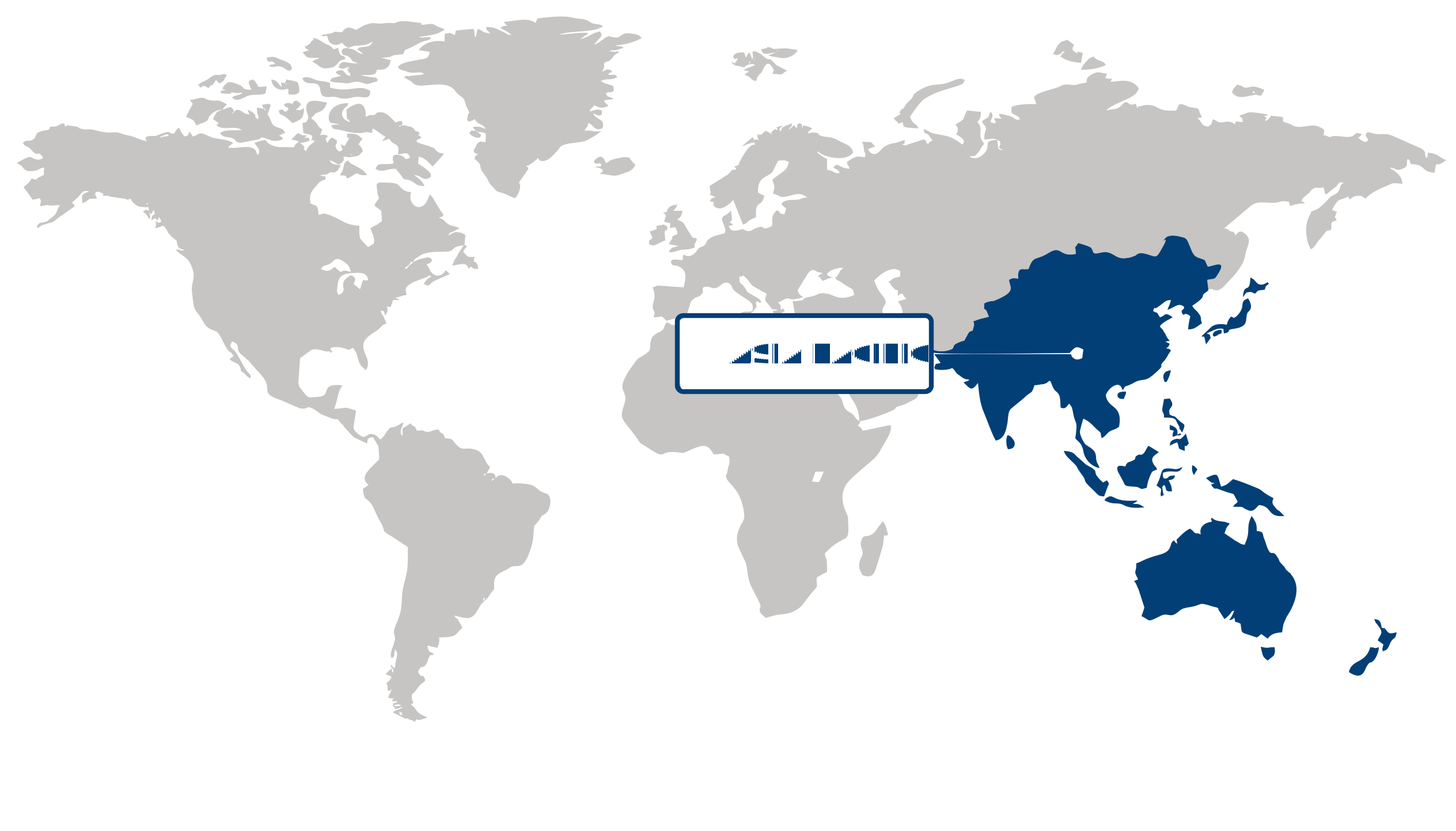
Asia Pacific (Largest Region)
The Asia Pacific automotive charge air cooler market accounted for a 48.09% share in 2026, supported by strong vehicle manufacturing activity, extensive automotive component production, and continued demand for efficient engine technologies. Charge air coolers improve the performance of turbocharged engines by reducing the temperature of compressed intake air, supporting better combustion efficiency and engine output. The region's large automotive manufacturing base and strong presence of passenger and commercial vehicle production provide a broad application environment for these systems. Increasing adoption of turbocharged engines, tightening vehicle emission requirements, and continued improvements in fuel efficiency are encouraging automakers to integrate more effective thermal management technologies. Expanding vehicle production and investment in advanced powertrain technologies are further sustaining demand across the regional automotive supply chain.
North America (Fastest-Growing Region)
North America is the fastest-growing region for automotive charge air coolers, driven by increasing demand for high-performance and fuel-efficient vehicles and continued development of advanced engine thermal management systems. Automakers are placing greater emphasis on optimizing turbocharged powertrains to balance performance, fuel economy, and emissions requirements, supporting the use of efficient charge air cooling solutions. Demand from commercial vehicles and performance-oriented applications provides additional opportunities, while advancements in lightweight materials and compact cooling designs are improving system integration. The region's established automotive engineering capabilities and ongoing investment in vehicle efficiency technologies are further contributing to market expansion.
| Parameter | North America | Asia Pacific | Europe | Latin America | MEA |
|---|---|---|---|---|---|
| Innovation Hub i Scale Nascent Developing Advanced | |||||
| Cost-Sensitive Region i Scale Low Medium High | |||||
| Regulatory Environment i Scale Restrictive Neutral Supportive | |||||
| Demand Drivers i Scale Weak Moderate Strong | |||||
| Development Stage i Scale Emerging Developing Developed | |||||
| Adoption Rate i Scale Low Medium High | |||||
| New Entrants / Startups i Scale Sparse Moderate Dense | |||||
| Macro Indicators i Scale Weak Stable Strong |
Key Country Insights
Germany 🇩🇪
Advanced Powertrain CoolingGermany integrates automotive charge air coolers into sophisticated powertrain systems designed for efficiency and durability. Component manufacturers prioritize compact designs, lightweight materials, and engineering precision to meet evolving vehicle performance expectations.
France 🇫🇷
Efficient Engine SupportFrance applies automotive charge air coolers to enhance engine efficiency while supporting vehicle emissions compliance. Manufacturers prioritize durable cooling technologies compatible with passenger and light commercial vehicle powertrain modernization initiatives.
Italy 🇮🇹
Performance Component ManufacturingItaly manufactures automotive charge air coolers for performance-oriented and commercial vehicle applications requiring reliable thermal control. Companies invest in advanced fabrication techniques and material optimization to improve durability and operational efficiency.
Japan 🇯🇵
Compact Cooling InnovationJapan develops compact automotive charge air cooler solutions optimized for fuel-efficient engines and hybrid vehicle platforms. Manufacturers emphasize high manufacturing quality, reliable thermal performance, and seamless integration into modern vehicle architectures.
South Korea 🇰🇷
OEM Platform IntegrationSouth Korea strengthens automotive charge air cooler development through close collaboration with vehicle manufacturers. Suppliers focus on optimized thermal efficiency, lightweight construction, and scalable production that supports competitive vehicle platform development.
United States 🇺🇸
Thermal Performance SolutionsThe U.S. automotive charge air cooler market focuses on improving engine efficiency and thermal management across passenger and commercial vehicles. Suppliers develop lightweight, durable cooling systems that support stricter emissions requirements and higher engine performance.
Segment Leadership and Growth Trends
Automotive Charge Air Cooler Market Share (%), by Product Type, 2026
Go beyond the chart, access full insights & data tables
Request Free Sample ReportProduct Type Segment Analysis: Air-cooled (Largest Segment) vs Liquid-cooled (Fastest-Growing Segment)
The automotive charge air cooler market was led by the air-cooled charge air cooler segment, which accounted for 62.48% share in 2026. Its established position reflects the practical advantages of simpler construction, comparatively straightforward installation, and effective heat dissipation without requiring a separate liquid-cooling circuit. These characteristics make air-cooled systems well suited to a broad range of conventional automotive applications, where manufacturers and vehicle operators continue to value dependable thermal management and system simplicity.
Liquid-cooled charge air coolers represent the fastest-growing segment as automotive powertrains increasingly require more precise temperature management within constrained engine compartments. Their ability to provide efficient cooling with greater flexibility in component placement is particularly relevant to vehicles adopting higher-performance engines and increasingly integrated thermal-management architectures. The broader shift toward compact engine layouts and more sophisticated powertrain systems is creating additional opportunities for liquid-based charge air cooling solutions.
Design Type Segment Analysis: Fin & Tube (Largest Segment) vs Bar & Plate (Fastest-Growing Segment)
Fin & tube charge air coolers maintained the largest share of the automotive charge air cooler market at 61.22% in 2026. Their widespread adoption is supported by a well-established design that provides effective heat transfer while offering a practical balance of durability, manufacturing familiarity, and cost efficiency. The design remains suitable across numerous vehicle applications, helping sustain demand as automakers continue to require reliable charge-air temperature control for engine performance and efficiency.
Bar & plate charge air coolers are advancing at the fastest pace as manufacturers seek stronger thermal performance and robust construction for increasingly demanding powertrain environments. Their dense core configuration enables effective heat exchange while providing structural strength, making the design attractive for applications exposed to higher thermal and mechanical loads. Increasing emphasis on engine efficiency, performance optimization, and compact thermal-management systems is further supporting adoption of bar & plate configurations.
| Segment | Sub-Segment | Largest Segment | Fastest Growing |
|---|---|---|---|
| Product Type | Air-cooled, Liquid-cooled | Air-cooled | Liquid-cooled |
| Design Type | Fin & Tube, Bar & Plate | Fin & Tube | Bar & Plate |
| Fuel Type | Diesel, Gasoline | Diesel | Gasoline |
| Position Type | Integrated, Standalone | Standalone | Integrated |
| Vehicle Type | Passenger Vehicles, Light Commercial Vehicles, Heavy Commercial Vehicles, Others | Passenger Vehicles | Light Commercial Vehicles |
Competitive Landscape and Market Positioning
Leading companies in the automotive charge air cooler market:
1. MAHLE GmbH (Germany)
2. Valeo S.A. (France)
3. Dana Incorporated (United States)
4. Modine Manufacturing Company (United States)
5. Hanon Systems (South Korea)
6. T.RAD Co. Ltd. (Japan)
7. AKG Group (Germany)
8. Banco Products (India) Ltd. (India)
9. Denso Corporation (Japan)
10. Marelli Holdings Co. Ltd. (Japan)
Thermal efficiency improvements are driving design evolution in the automotive charge air cooler market. Lightweight material integration is enhancing engine performance and fuel optimization. The automotive charge air cooler market is growing with increased focus on emission reduction technologies.
| Company | Market Share | Company Revenue | Revenue CAGR (%) | Product Portfolio | Geographic Presence | Innovation / R&D Focus | Strategic Developments |
|---|---|---|---|---|---|---|---|
| MAHLE GmbH (Germany) | |||||||
| Valeo S.A. (France) | |||||||
| Dana Incorporated (United States) | |||||||
| Modine Manufacturing Company (United States) | |||||||
| Hanon Systems (South Korea) | |||||||
| T.RAD Co. Ltd. (Japan) | |||||||
| AKG Group (Germany) | |||||||
| Banco Products (India) Ltd. (India) | |||||||
| Denso Corporation (Japan) | |||||||
| Marelli Holdings Co. Ltd. (Japan). |
Industry Development/News
| Company Name | Date | Key Development |
|---|---|---|
| Hanon Systems | Mar-21 | Hanon Systems began construction of its fifth manufacturing plant in Korea, expanding its production capacity for automotive thermal management systems. The facility, covering approximately 33,000 square meters, is intended to support growing demand for heat exchange and cooling technologies and strengthen the company’s global manufacturing footprint. |
| Dana Incorporated | Nov-20 | Dana entered a definitive agreement to acquire a division of Modine Manufacturing Company’s automotive thermal management business, including multiple global manufacturing facilities. The transaction expands Dana’s product portfolio into charge air cooling, chillers, and exhaust-gas recirculation systems while significantly strengthening its global production footprint and thermal management capabilities. |
| MAHLE GmbH | Jul-20 | MAHLE completed the acquisition of Behr Hella Service to strengthen its aftermarket thermal management portfolio. The integration expands MAHLE’s capabilities in automotive heat exchange and cooling systems, aligning its aftermarket operations with core OEM competencies and reinforcing its competitive positioning in global thermal management solutions. |
| Dana Inc. | Feb-20 | Dana Inc. acquired Ashwood Innovations Ltd., a manufacturer of permanent magnet electric motors for automotive and material-handling applications. The acquisition strengthens Dana’s exposure to adjacent electrification technologies and supports its positioning in off-road and advanced vehicle systems, enhancing its broader thermal and powertrain-related portfolio integration strategy. |
| Calsonic Kansei | May-19 | Calsonic Kansei merged with Marelli to form an integrated automotive technology company focused on energy management and thermal systems. The combined entity strengthens capabilities across heat exchangers, air conditioning, and power electronics, supporting integrated thermal management solutions and enhancing competitiveness in advanced automotive system integration. |
Customize Your Report
Explore examples of how this report can be tailored to different research needs, including custom segments, additional topics or chapters, and related reports. Click a section of the wheel or its numbered marker to explore the available options.
Automotive Charge Air Cooler Market — Custom Segments
| Segment | Sub-Segment |
|---|---|
| Engine Technology | Turbocharged Diesel Engines, Turbocharged Gasoline Engines, Twin-Turbo Engines, Hybrid Turbocharged Engines |
| OEM vs Aftermarket | OEM Supply, Independent Aftermarket |
| Emission Standard | Euro 5 & Equivalent, Euro 6 & Equivalent, EPA Tier Standards, Other Regional Standards |
Automotive Charge Air Cooler Market — Custom TOC
| Custom Chapter | Custom Details |
|---|---|
| Thermal Management Evolution Roadmap |
|
| Commercial Vehicle Demand Opportunity Analysis |
|
| Lightweight Component Adoption Trends |
|
Need a different cut of the data?
Request Custom ResearchWhat is the current revenue of the automotive charge air cooler market?
What is the projected value of the automotive charge air cooler industry by 2036?
How are turbocharged engine trends influencing demand for automotive charge air coolers?
Why are emission regulations increasing investment in advanced charge air cooling systems?
Why do air-cooled systems dominate the automotive charge air cooler market?
Why is liquid-cooled technology growing faster in this market?
Why does Asia Pacific dominate the automotive charge air cooler market?
How is North America accelerating growth in the automotive charge air cooler market?
Which companies are driving growth in the automotive charge air cooler landscape?
Our Clients
"The team surpassed our expectations with the report depth. The actionable insights provided proved crucial in navigating market challenges."
Tata Motors
"We found the report to be very informative. The expertise and attention to market nuances significantly influenced our business direction."
DENSO Corporation
"The consumer survey findings were quite good. We now have a clearer picture of the customer churning and retention strategy."
HL Mando
Our Research Team & Methodology
Every Fundamental Business Insights report is built by a dedicated vertical research team, validated through a structured primary-and-secondary methodology, and reviewed for accuracy before it reaches you.
Research Team Overview
Prepared by the Automotive & Transportation Research Team
Delivery
Published
Demand
Available
Support
Trust & Compliance
Research Domains
10 coverage areasResearch Intelligence
| Source | Reference |
|---|---|
| International Organization of Motor Vehicle Manufacturers (OICA) | www.oica.net |
| SAE International | www.sae.org |
| International Energy Agency (IEA) | www.iea.org |
| International Transport Forum (ITF) | www.itf-oecd.org |
| International Road Federation (IRF) | www.irf.global |
| International Organization for Standardization (ISO) | www.iso.org |
| United Nations Economic Commission for Europe (UNECE) | unece.org |
| National Highway Traffic Safety Administration (NHTSA) | www.nhtsa.gov |
| U.S. Department of Transportation (USDOT) | www.transportation.gov |
| European Automobile Manufacturers' Association (ACEA) | www.acea.auto |
| Society of Indian Automobile Manufacturers (SIAM) | www.siam.in |
| International Air Transport Association (IATA) | www.iata.org |
| International Civil Aviation Organization (ICAO) | www.icao.int |
| International Maritime Organization (IMO) | www.imo.org |
| International Union of Railways (UIC) | uic.org |
| American Public Transportation Association (APTA) | www.apta.com |
| International Federation of Robotics (IFR) | ifr.org |
| CharIN | www.charin.global |
| World Shipping Council | www.worldshipping.org |
| International Federation of Freight Forwarders Associations (FIATA) | fiata.org |
Research Workflow & Quality Assurance
Data Collection
Verified information gathered through primary and secondary research.
Data Triangulation
Cross-validation using multiple independent data sources.
Forecast Modelling
Market estimates developed using historical trends and analytical models.
Analyst Validation
Findings reviewed by domain experts for accuracy and consistency.
Editorial & Quality Review
Final editorial, quality, and compliance checks before publication.
Final Publication
Released after successful completion of the internal review process.
Report Coverage
📊 Market Assessment
- Market Size & Forecast
- Market Segmentation
- Regional Analysis
- Growth Drivers & Challenges
- Market Dynamics
🏢 Competitive Intelligence
- Competitive Landscape
- Company Profiles
- Competitive Benchmarking
- Mergers & Acquisitions
- Market Share Analysis or Key Company Strategies
🔍 Strategic Analysis
- Value Chain Analysis
- Porter's Five Forces
- PESTLE Analysis
- Pricing Trends
- Supply-Demand Analysis
🚀 Future Outlook
- Technology Landscape
- Regulatory Landscape
- Investment & Funding Landscape
- Emerging Opportunities
- Future Market Outlook
Have a question about this report or need a custom scope?
Request Customization