Automotive Blind Spot Detection System Market Size & Growth Forecast 2027–2036, By Segments (Technology, Vehicle Type, Propulsion Type), Regional Demand Trends (North America, Asia Pacific, Europe), Key Country Insights (U.S., Japan, South Korea, Germany, France, Italy), and Competitive Landscape
Market Size and Growth Outlook
Automotive Blind Spot Detection System Market size stood at USD 4.3 billion in 2026 and is predicted to grow at a 10.07% CAGR from 2027 to 2036, reaching USD 11.22 billion by 2036. The industry revenue for 2027 is estimated at USD 4.66 billion.
Get more details on this report
Request Free Sample ReportAutomotive Blind Spot Detection System Market Intelligence Snapshot
Regional Market Dynamics
- Asia Pacific leads through high vehicle production, extensive integration of driver-assistance features, and strong manufacturing capacity that supports efficient system deployment across domestic and export vehicle programs.
- Europe is forecast to grow at an 11.76% CAGR as automakers expand advanced safety features across mainstream vehicle platforms, increasing adoption of sensor-based driver-assistance technologies.
Segment Momentum
- Radar held a 56.92% market share in 2026 due to its dependable object detection across varying driving conditions, making it the preferred technology for consistent blind spot monitoring and broad vehicle integration.
- Commercial vehicles are the fastest-growing segment because larger vehicles face greater visibility challenges, increasing demand for blind spot detection to improve fleet safety during daily operations and lane changes.
Market Expansion Drivers
- Rising road safety concerns increasing integration of blind spot detection systems in passenger vehicles.
- Advancements in radar, LiDAR, and camera technologies improving accuracy of vehicle detection systems.
- Growing electric and autonomous vehicle production accelerating adoption of advanced driver assistance technologies.
Leading Market Participants
- Key players in the automotive blind spot detection system market include Robert Bosch GmbH (Germany), Continental AG (Germany), Valeo SA (France), Sensata Technologies Holding plc (United States), NXP Semiconductors N.V. (Netherlands), Infineon Technologies AG (Germany), VOXX International Corporation (United States), Rear View Safety, Inc. (United States), Quanzhou Minpn Electronic Co., Ltd. (China), Magna International Inc. (Canada).
Global Market Forecast Snapshot
Market Outlook
- 2026 Market Size: USD 4.3 billion
- 2027 Estimated Market Size: USD 4.66 billion.
- Projected Market Size: USD 11.22 billion by 2036
- Growth Forecast: 10.07% CAGR (2027-2036)
Regional and Segment Outlook
- Leading Regional Market: Asia Pacific
- High-Growth Regional Hub: Europe
- Core Revenue Segment: Radar (Technology) | Passenger Cars (Vehicle Type) | ICE (Propulsion Type)
- Emerging Opportunity Segment: Camera (Technology) | Commercial Vehicles (Vehicle Type) | Electric (Propulsion Type)
Market Growth Drivers and Industry Trends
Rising road safety concerns increasing integration of blind spot detection systems in passenger vehicles
Heightened attention to collision prevention and driver awareness is supporting greater integration of advanced safety features, with road safety concerns driving the automotive blind spot detection system market across passenger vehicles. Blind spot detection systems assist drivers by identifying vehicles or other road users that may not be visible through conventional mirrors, particularly during lane changes, merging, and maneuvering in congested traffic. As vehicle safety expectations increasingly emphasize preventive technologies, manufacturers are incorporating monitoring functions into broader driver assistance packages. Consumer awareness of active safety capabilities is also encouraging demand for vehicles equipped with technologies that provide additional situational awareness during everyday driving.
Advancements in radar, LiDAR, and camera technologies improving accuracy of vehicle detection systems
Technological progress in sensing hardware is enhancing the performance of the automotive blind spot detection system market, as improvements in radar, LiDAR, and camera-based detection strengthen the ability of vehicles to recognize surrounding objects and distinguish relevant road conditions. More capable sensors can provide wider coverage and more precise detection while supporting operation across varying traffic and environmental situations. Integration of multiple sensing technologies can further improve object recognition and reduce limitations associated with relying on a single sensor type. These developments are also enabling blind spot functions to become more closely integrated with warning and driver assistance systems within modern vehicle architectures.
Growing electric and autonomous vehicle production accelerating adoption of advanced driver assistance technologies
The increasing production of electric and autonomous vehicles is creating additional opportunities for the automotive blind spot detection system market as manufacturers incorporate sophisticated sensing and driver assistance capabilities into next-generation vehicle platforms. Electric vehicles are increasingly designed around centralized electronic architectures that can accommodate multiple perception and safety functions, while autonomous driving development requires extensive environmental sensing around the vehicle. Blind spot monitoring can therefore form part of broader perception systems supporting lane awareness, maneuvering assistance, and automated driving functions. The convergence of electrification, vehicle connectivity, and automation is encouraging manufacturers to integrate these technologies more deeply into vehicle safety architectures.
| Growth Driver | Impact on CAGR | Regulatory Influence | Geographic Relevance | Adoption Rate | Impact Timeline |
|---|---|---|---|---|---|
| Rising road safety concerns increasing integration of blind spot detection systems in passenger vehicles | 2.00% | High | Europe, North America | High | Near Term |
| Advancements in radar, LiDAR, and camera technologies improving accuracy of vehicle detection systems | 1.70% | Moderate | Asia Pacific, Europe | High | Mid Term |
| Growing electric and autonomous vehicle production accelerating adoption of advanced driver assistance technologies | 1.50% | Moderate | Asia Pacific, North America | Emerging | Long Term |
Unlock insights tailored to your business with our bespoke market research solutions.
Click to get your customized report now.
Regional Demand Dynamics
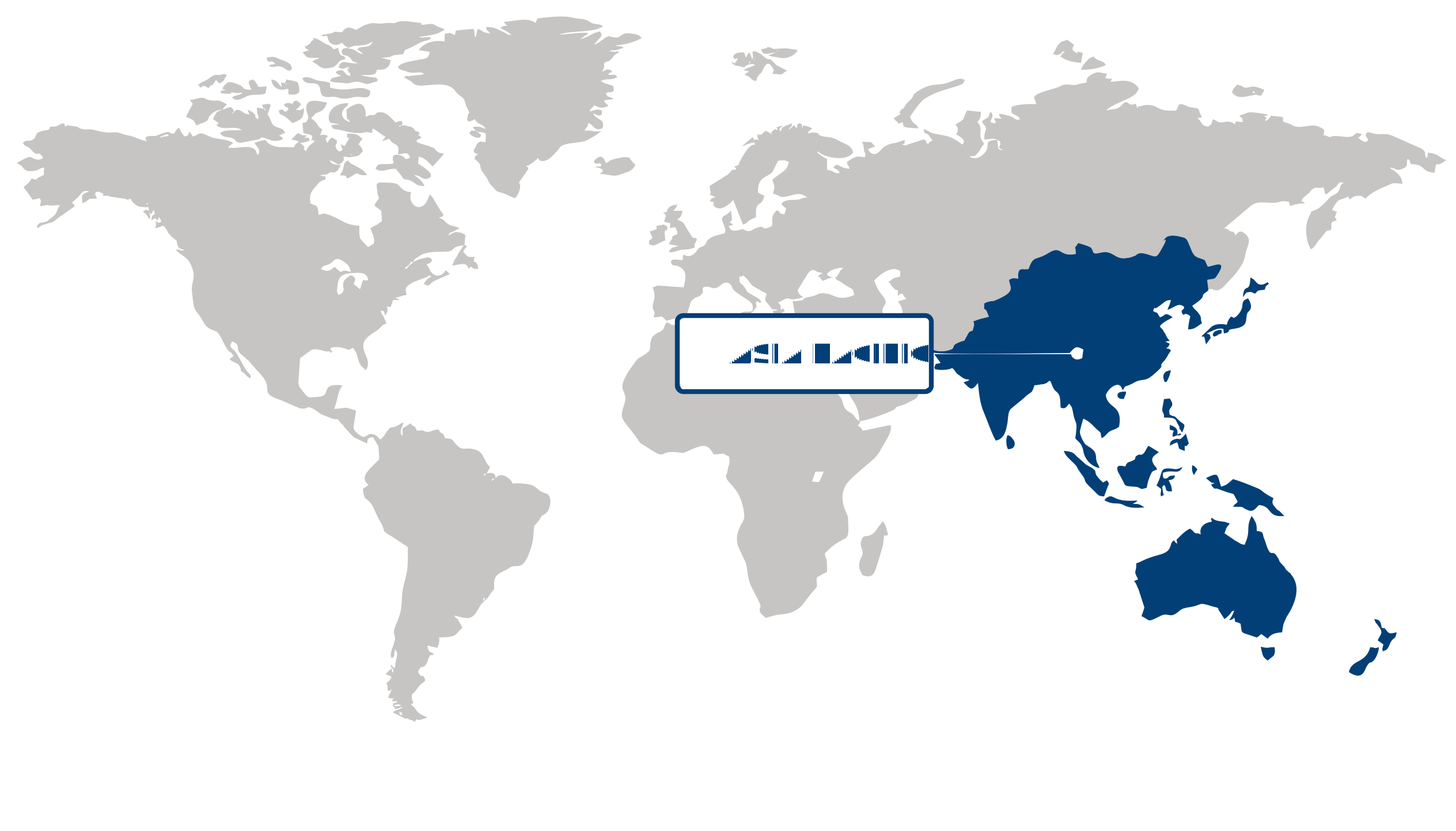
Asia Pacific (Largest Region)
The automotive blind spot detection system market was led by Asia Pacific, which held the largest share in 2026, supported by strong vehicle production, expanding automotive manufacturing capabilities, and increasing integration of advanced driver assistance technologies. Rising consumer interest in vehicle safety and growing adoption of electronic safety features are encouraging manufacturers to incorporate blind spot detection into passenger and commercial vehicles. Regulatory attention toward vehicle safety, technological development in automotive electronics, and the expansion of connected and intelligent vehicle platforms are further supporting regional demand.
Europe (Fastest-Growing Region)
Europe is the fastest-growing region, with market momentum reinforced by strong road-safety priorities and the increasing integration of advanced driver assistance systems into vehicles. Greater emphasis on reducing collisions and improving driver awareness is encouraging adoption of blind spot monitoring technologies. The region’s established automotive engineering ecosystem and focus on vehicle safety standards also create favorable conditions for continued technology integration, particularly as manufacturers expand the use of electronic systems designed to enhance active safety.
| Parameter | North America | Asia Pacific | Europe | Latin America | MEA |
|---|---|---|---|---|---|
| Innovation Hub i Scale Nascent Developing Advanced | |||||
| Cost-Sensitive Region i Scale Low Medium High | |||||
| Regulatory Environment i Scale Restrictive Neutral Supportive | |||||
| Demand Drivers i Scale Weak Moderate Strong | |||||
| Development Stage i Scale Emerging Developing Developed | |||||
| Adoption Rate i Scale Low Medium High | |||||
| New Entrants / Startups i Scale Sparse Moderate Dense | |||||
| Macro Indicators i Scale Weak Stable Strong |
Key Country Insights
Germany 🇩🇪
Premium Safety EngineeringGermany prioritizes automotive blind spot detection systems that complement premium vehicle safety and automated driving functions. Manufacturers are refining radar- and camera-based technologies to enhance driving confidence while meeting evolving regulatory expectations.
France 🇫🇷
Urban Mobility ProtectionFrance promotes blind spot detection technologies that improve safety for passenger vehicles operating in urban environments. Vehicle manufacturers are incorporating intelligent warning systems aligned with broader road safety and mobility initiatives.
Italy 🇮🇹
Safety Feature ExpansionItaly is expanding adoption of automotive blind spot detection systems across mainstream and premium vehicle segments. Manufacturers and suppliers are focusing on cost-effective ADAS integration that supports safer everyday driving experiences.
Japan 🇯🇵
Compact Vehicle SafetyJapan emphasizes blind spot detection solutions optimized for compact vehicles and dense urban traffic conditions. Automotive suppliers are developing space-efficient sensor packages that improve driver awareness without increasing vehicle complexity.
South Korea 🇰🇷
Smart Mobility IntegrationSouth Korea advances blind spot detection systems through connected vehicle development and digital cockpit integration. Domestic automakers are enhancing sensor fusion capabilities to deliver more responsive and intuitive driver assistance features.
United States 🇺🇸
ADAS Integration FocusThe U.S. continues integrating blind spot detection systems into passenger vehicles and commercial fleets as demand for advanced driver assistance technologies expands. Automakers are emphasizing sensor accuracy, software updates, and compatibility with broader vehicle safety platforms.
Segment Leadership and Growth Trends
Automotive Blind Spot Detection System Market Share (%), by Technology, 2026
Go beyond the chart, access full insights & data tables
Request Free Sample ReportTechnology Segment Analysis: Radar (Largest Segment) vs Camera (Fastest-Growing Segment)
Radar technology commanded the largest share of the automotive blind spot detection system market at 56.92% in 2026, owing to its ability to detect surrounding vehicles and obstacles reliably across varying visibility conditions. Radar systems can support blind spot monitoring in darkness, rain, and other challenging environments, making them well suited to safety-critical vehicle applications. Their integration with broader driver-assistance functions and increasing emphasis on collision avoidance are further reinforcing adoption, particularly as automakers continue to expand active safety capabilities across vehicle platforms.
Camera-based systems are advancing rapidly as manufacturers increasingly integrate vision technologies into broader vehicle perception and driver-assistance architectures. Cameras can provide detailed visual information that supports object classification and complements other sensing technologies, improving the vehicle's ability to interpret its surrounding environment. Continued progress in image processing, sensor integration, and intelligent vehicle safety systems is creating stronger opportunities for camera-based blind spot detection.
Vehicle Type Segment Analysis: Passenger Cars (Largest Segment) vs Commercial Vehicles (Fastest-Growing Segment)
Passenger cars represented the largest vehicle type segment in the automotive blind spot detection system market in 2026, supported by growing consumer demand for enhanced safety, convenience, and driver-assistance features. Blind spot detection is particularly valuable in passenger vehicles because it helps drivers identify nearby vehicles that may not be visible through conventional mirrors. Increasing awareness of active safety technologies and the integration of advanced driver-assistance features into passenger vehicles continue to support the segment's established position.
Commercial vehicles are seeing faster adoption as fleet operators place greater emphasis on accident prevention, driver safety, and operational risk management. Larger vehicle dimensions and extensive blind zones make monitoring systems particularly useful for trucks and other commercial platforms operating in dense traffic and complex driving environments. Increasing attention to fleet safety and the broader deployment of electronic driver-assistance technologies are supporting stronger demand for blind spot detection solutions in commercial vehicles.
| Segment | Sub-Segment | Largest Segment | Fastest Growing |
|---|---|---|---|
| Technology | Radar, Camera, Ultrasonic | Radar | Camera |
| Vehicle Type | Passenger Cars, Commercial Vehicles | Passenger Cars | Commercial Vehicles |
| Propulsion Type | ICE, Electric | ICE | Electric |
Competitive Landscape and Market Positioning
Top players in the automotive blind spot detection system market:
1. Robert Bosch GmbH (Germany)
2. Continental AG (Germany)
3. Valeo SA (France)
4. Sensata Technologies Holding plc (United States)
5. NXP Semiconductors N.V. (Netherlands)
6. Infineon Technologies AG (Germany)
7. VOXX International Corporation (United States)
8. Rear View Safety Inc. (United States)
9. Quanzhou Minpn Electronic Co. Ltd. (China)
10. Magna International Inc. (Canada)
Safety enhancement technologies are rapidly advancing the automotive blind spot detection system market, where accuracy in object recognition is becoming critical. System integration with intelligent driving platforms is improving situational awareness on the road. In the automotive blind spot detection system market, sensor-driven innovation is elevating vehicle safety standards.
| Company | Market Share | Company Revenue | Revenue CAGR (%) | Product Portfolio | Geographic Presence | Innovation / R&D Focus | Strategic Developments |
|---|---|---|---|---|---|---|---|
| Robert Bosch GmbH (Germany) | |||||||
| Continental AG (Germany) | |||||||
| Valeo SA (France) | |||||||
| Sensata Technologies Holding plc (United States) | |||||||
| NXP Semiconductors N.V. (Netherlands) | |||||||
| Infineon Technologies AG (Germany) | |||||||
| VOXX International Corporation (United States) | |||||||
| Rear View Safety Inc. (United States) | |||||||
| Quanzhou Minpn Electronic Co. Ltd. (China) | |||||||
| Magna International Inc. (Canada). |
Industry Development/News
| Company Name | Date | Key Development |
|---|---|---|
| Sensata Technologies | Oct-23 | Sensata Technologies launched the PreView Sentry79, a 79 GHz radar-based blind spot monitoring system designed for front and rear vehicle detection. The system enables adjustable detection zones up to 40 meters and enhances driver awareness by improving object detection accuracy, supporting advanced safety functions within ADAS-equipped vehicles. |
| Porsche | May-23 | Porsche partnered with Mobileye to integrate SuperVision advanced driver assistance technology into future vehicle models. The system enables partially automated driving functions including lane changes and collision avoidance while strengthening blind spot detection capabilities through AI-enabled perception systems. |
| Tata Motors | Feb-23 | Tata Motors launched Harrier and Safari dark edition SUVs equipped with ADAS features including blind spot detection, forward collision warning, lane departure warning, and emergency braking. The integration reflects broader expansion of advanced safety systems in mass-market SUV offerings within the Indian automotive market. |
| NXP Semiconductors | Jan-23 | NXP Semiconductors released a 28nm RFCMOS radar-on-chip family designed for next-generation ADAS applications. The solution supports safety-critical functions such as blind spot detection and automatic emergency braking, enhancing semiconductor-level integration for automotive radar systems in advanced driver assistance architectures. |
| OToBrite Electronics | Oct-22 | OToBrite Electronics introduced a blind spot information system for large commercial vehicles leveraging visual AI-based ADAS capabilities. The solution enhances detection and situational awareness for heavy-duty transport applications, supporting improved safety performance in commercial fleet operations through AI-driven monitoring technology. |
| GILLIG LLC | Jan-22 | GILLIG LLC and RR.AI entered a collaboration to develop SAE Level 4 autonomous transit bus technologies incorporating ADAS features such as blind spot detection, pedestrian avoidance, and automated docking systems. The initiative focuses on improving safety and automation capabilities in public transportation vehicles in North America. |
| MG | Nov-21 | MG introduced the 2022 MG ZS EV in the UK featuring ADAS functionalities including blind spot detection, cross traffic alert, lane change assist, and intelligent speed assistance. The integration enhances vehicle safety positioning within the electric SUV segment through expanded driver assistance capabilities. |
Customize Your Report
Explore examples of how this report can be tailored to different research needs, including custom segments, additional topics or chapters, and related reports. Click a section of the wheel or its numbered marker to explore the available options.
Automotive Blind Spot Detection System Market — Custom Segments
| Segment | Sub-Segment |
|---|---|
| Vehicle Price Tier | Economy Vehicles, Mid-Range Vehicles, Premium Vehicles, Luxury Vehicles |
| ADAS Integration Level | Standalone Blind Spot Detection, Integrated ADAS Packages, Advanced Driving Assistance Suites |
| Integration Platform | Electronic Control Unit-Based Systems, Domain Controller-Based Systems, Centralized Vehicle Computing Systems |
Automotive Blind Spot Detection System Market — Custom TOC
| Custom Chapter | Custom Details |
|---|---|
| ADAS Adoption Roadmap |
|
| Vehicle Safety Regulation Impact |
|
| OEM Integration Strategy |
|
Need a different cut of the data?
Request Custom ResearchWhat is the market size of automotive blind spot detection system?
What is the anticipated CAGR of the automotive blind spot detection system industry?
Which market trends are accelerating OEM adoption of blind spot detection systems?
How are sensor technology advancements influencing the automotive blind spot detection system market?
Why is Radar the leading technology in the automotive blind spot detection system market?
Which vehicle type is expanding fastest in the automotive blind spot detection system market?
Why is Asia Pacific the largest market for automotive blind spot detection systems?
Why is Europe the fastest-growing region for automotive blind spot detection systems?
Which organizations are considered leaders in the automotive blind spot detection system landscape?
Our Clients
"The team surpassed our expectations with the report depth. The actionable insights provided proved crucial in navigating market challenges."
Tata Motors
"We found the report to be very informative. The expertise and attention to market nuances significantly influenced our business direction."
DENSO Corporation
"The consumer survey findings were quite good. We now have a clearer picture of the customer churning and retention strategy."
HL Mando
Our Research Team & Methodology
Every Fundamental Business Insights report is built by a dedicated vertical research team, validated through a structured primary-and-secondary methodology, and reviewed for accuracy before it reaches you.
Research Team Overview
Prepared by the Automotive & Transportation Research Team
Delivery
Published
Demand
Available
Support
Trust & Compliance
Research Domains
10 coverage areasResearch Intelligence
| Source | Reference |
|---|---|
| International Organization of Motor Vehicle Manufacturers (OICA) | www.oica.net |
| SAE International | www.sae.org |
| International Energy Agency (IEA) | www.iea.org |
| International Transport Forum (ITF) | www.itf-oecd.org |
| International Road Federation (IRF) | www.irf.global |
| International Organization for Standardization (ISO) | www.iso.org |
| United Nations Economic Commission for Europe (UNECE) | unece.org |
| National Highway Traffic Safety Administration (NHTSA) | www.nhtsa.gov |
| U.S. Department of Transportation (USDOT) | www.transportation.gov |
| European Automobile Manufacturers' Association (ACEA) | www.acea.auto |
| Society of Indian Automobile Manufacturers (SIAM) | www.siam.in |
| International Air Transport Association (IATA) | www.iata.org |
| International Civil Aviation Organization (ICAO) | www.icao.int |
| International Maritime Organization (IMO) | www.imo.org |
| International Union of Railways (UIC) | uic.org |
| American Public Transportation Association (APTA) | www.apta.com |
| International Federation of Robotics (IFR) | ifr.org |
| CharIN | www.charin.global |
| World Shipping Council | www.worldshipping.org |
| International Federation of Freight Forwarders Associations (FIATA) | fiata.org |
Research Workflow & Quality Assurance
Data Collection
Verified information gathered through primary and secondary research.
Data Triangulation
Cross-validation using multiple independent data sources.
Forecast Modelling
Market estimates developed using historical trends and analytical models.
Analyst Validation
Findings reviewed by domain experts for accuracy and consistency.
Editorial & Quality Review
Final editorial, quality, and compliance checks before publication.
Final Publication
Released after successful completion of the internal review process.
Report Coverage
📊 Market Assessment
- Market Size & Forecast
- Market Segmentation
- Regional Analysis
- Growth Drivers & Challenges
- Market Dynamics
🏢 Competitive Intelligence
- Competitive Landscape
- Company Profiles
- Competitive Benchmarking
- Mergers & Acquisitions
- Market Share Analysis or Key Company Strategies
🔍 Strategic Analysis
- Value Chain Analysis
- Porter's Five Forces
- PESTLE Analysis
- Pricing Trends
- Supply-Demand Analysis
🚀 Future Outlook
- Technology Landscape
- Regulatory Landscape
- Investment & Funding Landscape
- Emerging Opportunities
- Future Market Outlook
Have a question about this report or need a custom scope?
Request Customization