Automated Parcel Delivery Terminals Market Size & Growth Forecast 2027–2036, By Segments (Deployment Location, End-use), Regional Demand Trends (North America, Asia Pacific, Europe), Key Country Insights (U.S., Japan, South Korea, Germany, France, Italy), and Competitive Landscape
Market Size and Growth Outlook
Automated Parcel Delivery Terminals Market size was worth USD 1.13 billion in 2026 and is expected to grow at a 11.69% CAGR between 2027 and 2036, attaining USD 3.41 billion by 2036. The industry revenue for 2027 is assessed at USD 1.24 billion.
Get more details on this report
Request Free Sample ReportAutomated Parcel Delivery Terminals Market Intelligence Snapshot
Regional Market Dynamics
- Europe led the market in 2026 due to its mature parcel logistics network, strong e-commerce volumes, dense urban infrastructure, and widespread adoption of terminal-based last-mile delivery and returns.
- Asia Pacific is projected to grow at a 13.66% CAGR, driven by expanding e-commerce fulfillment, rising parcel volumes, and increasing deployment of terminal infrastructure for efficient last-mile delivery.
Segment Momentum
- Indoor deployment held a 61.01% market share in 2026 because controlled, high-traffic locations simplify installation, reduce maintenance challenges, and improve asset utilization and customer handovers for operators.
- Retail is growing fastest as merchants expand click-and-collect, returns handling, and omnichannel fulfillment, using parcel terminals to improve pickup convenience while reducing pressure on in-store service counters.
Market Expansion Drivers
- Rapid e-commerce expansion driving demand for secure last-mile parcel automation solutions.
- Smart city infrastructure development enabling integration of automated parcel lockers.
- Logistics and real estate partnerships accelerating deployment of decentralized delivery networks.
Leading Market Participants
- Prominent companies in the automated parcel delivery terminals market include KEBA AG (Austria), Quadient S.A. (France), InPost S.A. (Poland), Cleveron AS (Estonia), TZ Limited (Australia), Bell and Howell LLC (United States), ByBox Holdings Limited (United Kingdom), Smartbox Ecommerce Solutions Pvt. Ltd. (India), Winnsen Industry Co., Ltd. (China), ENGY Company (South Korea).
Global Market Forecast Snapshot
Market Outlook
- 2026 Market Size: USD 1.13 billion
- 2027 Estimated Market Size: USD 1.24 billion.
- Projected Market Size: USD 3.41 billion by 2036
- Growth Forecast: 11.69% CAGR (2027-2036)
Regional and Segment Outlook
- Leading Regional Market: Europe
- High-Growth Regional Hub: Asia Pacific
- Core Revenue Segment: Indoor (Deployment Location) | Shipping & Logistics (End-use)
- Emerging Opportunity Segment: Outdoor (Deployment Location) | Retail (End-use)
Market Growth Drivers and Industry Trends
Rapid e-commerce expansion driving demand for secure last-mile parcel automation solutions
Rapid e-commerce expansion is increasing parcel volumes and delivery complexity, which will drive the automated parcel delivery terminals market by creating demand for secure and efficient last-mile handling solutions. Retailers, logistics providers, and delivery operators are seeking alternatives to repeated door-to-door delivery attempts as consumers expect convenient collection and flexible delivery options. Automated terminals and parcel lockers can provide controlled access, reduce dependence on recipient availability, and streamline package handover in residential, commercial, and high-traffic locations, particularly as online purchasing becomes more integrated into everyday consumer activity.
Smart city infrastructure development enabling integration of automated parcel lockers
Smart city infrastructure development is enabling greater deployment of connected delivery infrastructure, supporting the automated parcel delivery terminals market through integration with digitally managed urban environments. Automated parcel lockers can be incorporated into transport hubs, residential developments, public facilities, and other connected locations while using digital access, remote monitoring, and centralized management capabilities. Their deployment can help address urban delivery congestion and improve the coordination of parcel collection points with broader smart mobility and infrastructure systems, particularly where cities are seeking more efficient use of limited public and commercial space.
Logistics and real estate partnerships accelerating deployment of decentralized delivery networks
Logistics and real estate partnerships are accelerating the development of decentralized delivery networks, creating additional deployment opportunities for the automated parcel delivery terminals market. Collaboration between delivery operators and property owners allows parcel collection infrastructure to be positioned closer to consumers within apartment complexes, offices, retail properties, and mixed-use developments. These arrangements can improve site accessibility, support higher utilization of existing properties, and reduce the operational challenges associated with individual doorstep deliveries, while property operators can integrate automated parcel services into broader tenant and facility management offerings.
| Growth Driver | Impact on CAGR | Regulatory Influence | Geographic Relevance | Adoption Rate | Impact Timeline |
|---|---|---|---|---|---|
| Rapid e-commerce expansion driving demand for secure last-mile parcel automation solutions | 3.40% | Low | Asia Pacific, Europe, North America | High | Near Term |
| Smart city infrastructure development enabling integration of automated parcel lockers | 2.80% | Moderate | Europe, Asia Pacific, North America | High | Mid Term |
| Logistics and real estate partnerships accelerating deployment of decentralized delivery networks | 2.10% | Moderate | Global | Medium | Mid Term |
Unlock insights tailored to your business with our bespoke market research solutions.
Click to get your customized report now.
Regional Demand Dynamics
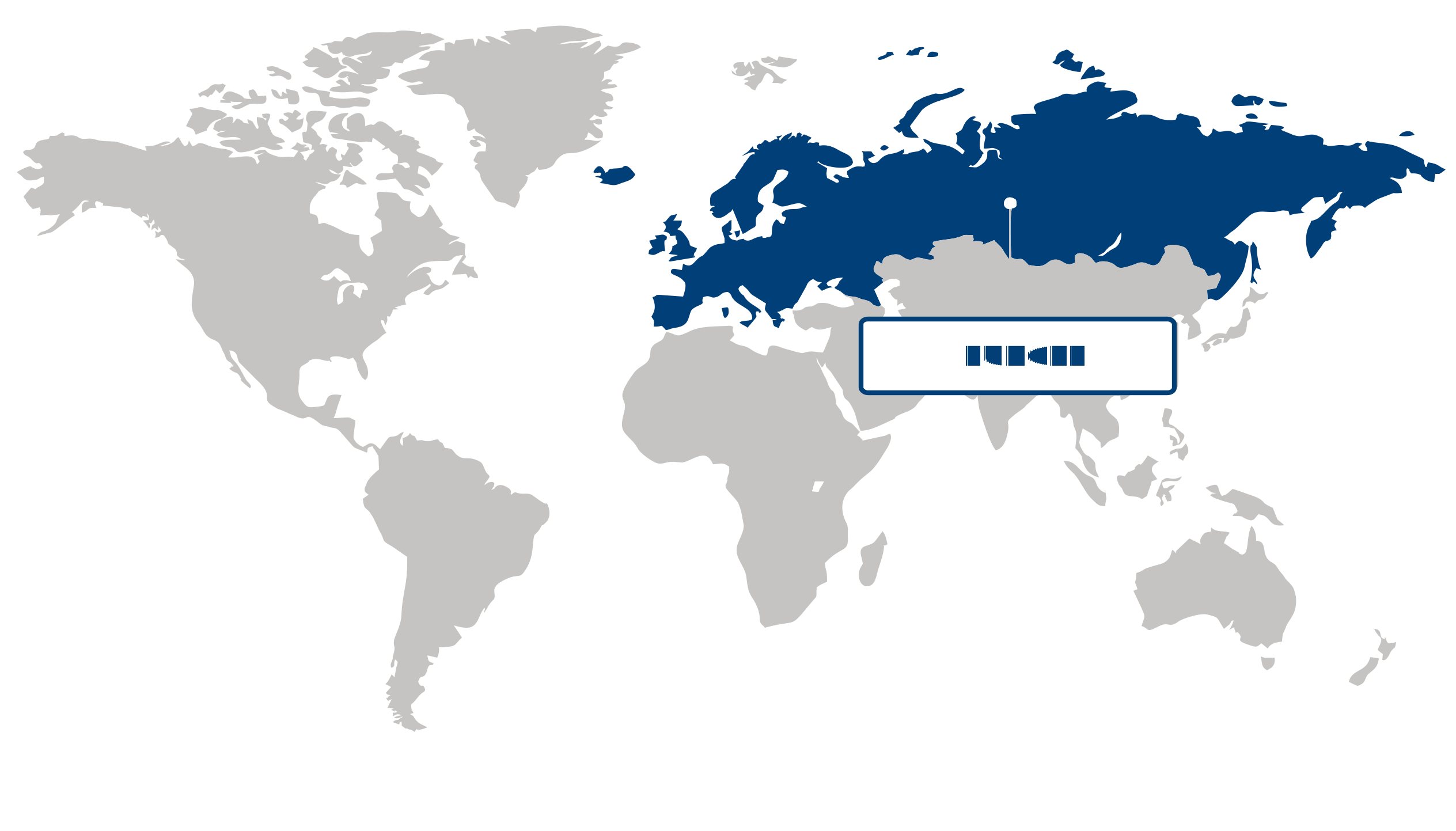
Europe (Largest Region)
Europe maintained the largest position in the automated parcel delivery terminals market in 2026, supported by mature e-commerce ecosystems, dense urban populations, and strong demand for convenient and flexible last-mile delivery solutions. Consumers increasingly value unattended parcel collection and return options that reduce delivery constraints, while logistics operators benefit from automated terminals that improve delivery efficiency and consolidate multiple shipments. Sustainability objectives and efforts to reduce repeated delivery attempts are also encouraging the integration of parcel terminals into urban logistics networks.
Asia Pacific (Fastest-Growing Region)
Asia Pacific is the fastest-growing regional market as e-commerce penetration, urbanization, and parcel volumes continue to expand across major economies. Increasing consumer preference for convenient collection and return options is encouraging logistics providers and retailers to deploy automated delivery infrastructure closer to residential and commercial areas. Investments in smart-city development, digital logistics, and last-mile automation are further creating opportunities for parcel terminals to become an integral part of increasingly technology-driven delivery networks.
| Parameter | North America | Asia Pacific | Europe | Latin America | MEA |
|---|---|---|---|---|---|
| Innovation Hub i Scale Nascent Developing Advanced | |||||
| Cost-Sensitive Region i Scale Low Medium High | |||||
| Regulatory Environment i Scale Restrictive Neutral Supportive | |||||
| Demand Drivers i Scale Weak Moderate Strong | |||||
| Development Stage i Scale Emerging Developing Developed | |||||
| Adoption Rate i Scale Low Medium High | |||||
| New Entrants / Startups i Scale Sparse Moderate Dense | |||||
| Macro Indicators i Scale Weak Stable Strong |
Key Country Insights
Germany 🇩🇪
Smart Urban Delivery NetworksGermany is focusing on automated parcel delivery terminals as part of efficient urban logistics systems. The market is supported by adoption of secure parcel access solutions, integration with delivery networks, and efforts to optimize last-mile operations in densely populated areas.
France 🇫🇷
Sustainable Last-Mile SolutionsFrance’s automated parcel delivery terminals market is shaped by interest in efficient and lower-impact delivery models. Logistics operators are adopting automated collection points to streamline urban distribution, improve delivery coordination, and support changing consumer delivery habits.
Italy 🇮🇹
Retail Logistics ModernizationItaly is incorporating automated parcel delivery terminals into modern retail and logistics strategies. Businesses are exploring secure pickup infrastructure to enhance delivery convenience, improve operational workflows, and provide alternative fulfillment options for urban and suburban customers.
Japan 🇯🇵
Convenience-Based Parcel AccessJapan’s automated parcel delivery terminals market reflects strong demand for convenient and reliable package retrieval solutions. Service providers are expanding automated pickup infrastructure to support time-sensitive deliveries, consumer flexibility, and efficient logistics operations across urban communities.
South Korea 🇰🇷
Digital Delivery InfrastructureSouth Korea is advancing automated parcel delivery terminals through digitally connected logistics services and technology-enabled retail ecosystems. Companies are emphasizing automated pickup experiences, operational efficiency, and integration with online commerce platforms to address evolving delivery expectations.
United States 🇺🇸
E-Commerce Logistics AutomationThe U.S. automated parcel delivery terminals market is driven by increasing demand for flexible last-mile solutions and convenient package collection options. Logistics providers and retailers are deploying automated terminals to improve delivery efficiency, reduce doorstep dependency, and support changing consumer fulfillment preferences.
Segment Leadership and Growth Trends
Automated Parcel Delivery Terminals Market Share (%), by Deployment Location, 2026
Go beyond the chart, access full insights & data tables
Request Free Sample ReportDeployment Location Segment Analysis: Indoor (Largest Segment) vs Outdoor (Fastest-Growing Segment)
The indoor segment held the largest share of the automated parcel delivery terminals market, accounting for 61.01% in 2026. Indoor terminals benefit from controlled operating environments, greater protection from weather-related exposure, and easier integration with existing commercial and transportation facilities. Their placement within retail premises, residential buildings, offices, and logistics facilities also supports reliable parcel collection while improving user convenience and security. As e-commerce fulfillment increasingly emphasizes flexible last-mile delivery, indoor deployments remain attractive where space utilization, controlled access, and operational reliability are key priorities.
Outdoor deployment is gaining momentum as parcel delivery networks expand beyond conventional building-based collection points. Outdoor terminals provide greater accessibility and can be positioned in high-traffic locations, allowing consumers to collect parcels without entering a facility or adhering to conventional operating hours. Their suitability for residential communities, transit-linked areas, and other accessible locations supports the broader shift toward decentralized last-mile delivery and convenient self-service collection.
End-use Segment Analysis: Shipping & Logistics (Largest Segment) vs Retail (Fastest-Growing Segment)
In the automated parcel delivery terminals market, the shipping & logistics segment represented the largest share in 2026. Parcel carriers and logistics operators increasingly rely on automated collection infrastructure to improve last-mile efficiency, reduce dependence on door-to-door delivery, and provide recipients with greater flexibility. Automated terminals can consolidate multiple deliveries at a single location, helping streamline parcel handling while reducing failed delivery attempts and supporting more predictable fulfillment operations.
The retail segment is emerging as the fastest-growing end-use area as retailers increasingly incorporate automated parcel collection into omnichannel fulfillment strategies. Parcel terminals can bridge online ordering with physical retail locations, enabling convenient pickup while creating additional customer touchpoints. The growing emphasis on click-and-collect services, flexible fulfillment, and seamless integration between digital and physical shopping channels is strengthening the role of retail-based automated delivery infrastructure.
| Segment | Sub-Segment | Largest Segment | Fastest Growing |
|---|---|---|---|
| Deployment Location | Indoor, Outdoor | Indoor | Outdoor |
| End-use | Government, Retail, Shipping & Logistics, Others | Shipping & Logistics | Retail |
Competitive Landscape and Market Positioning
Prominent players in the automated parcel delivery terminals market:
1. KEBA AG (Austria)
2. Quadient S.A. (France)
3. InPost S.A. (Poland)
4. Cleveron AS (Estonia)
5. TZ Limited (Australia)
6. Bell and Howell LLC (United States)
7. ByBox Holdings Limited (United Kingdom)
8. Smartbox Ecommerce Solutions Pvt. Ltd. (India)
9. Winnsen Industry Co. Ltd. (China)
10. ENGY Company (South Korea)
Rising e-commerce penetration is driving demand for efficient last-mile delivery infrastructure. Smart locker systems and automated retrieval solutions are improving delivery convenience. The automated parcel delivery terminals market is expanding as logistics networks adopt more contactless and time-efficient models.
| Company | Market Share | Company Revenue | Revenue CAGR (%) | Product Portfolio | Geographic Presence | Innovation / R&D Focus | Strategic Developments |
|---|---|---|---|---|---|---|---|
| KEBA AG (Austria) | |||||||
| Quadient S.A. (France) | |||||||
| InPost S.A. (Poland) | |||||||
| Cleveron AS (Estonia) | |||||||
| TZ Limited (Australia) | |||||||
| Bell and Howell LLC (United States) | |||||||
| ByBox Holdings Limited (United Kingdom) | |||||||
| Smartbox Ecommerce Solutions Pvt. Ltd. (India) | |||||||
| Winnsen Industry Co. Ltd. (China) | |||||||
| ENGY Company (South Korea). |
Industry Development/News
| Company Name | Date | Key Development |
|---|---|---|
| InPost | Mar-25 | InPost announced expansion into Spain and Portugal, targeting deployment of 3,000 parcel terminals by 2026, supported by a €150 million investment. Strategic retail partnerships with Mercadona and El Corte Inglés are expected to secure high-traffic locations, strengthening its European network beyond existing markets in the UK, France, and Italy. |
| Cleveron | Feb-25 | Cleveron unveiled a next-generation robotic grocery terminal featuring multi-temperature zones for frozen, refrigerated, and ambient goods. Scheduled for initial deployments with major European grocery chains from Q2 2025, the solution addresses cold-chain constraints in automated last-mile grocery fulfillment and expands terminal functionality into perishable e-commerce categories. |
| Amazon | Jan-25 | Amazon expanded its Hub by Amazon network to over 15,000 U.S. locations, marking a 50% increase from 2024. The expansion focuses on suburban and retail-linked distribution points, strengthening last-mile logistics infrastructure and reducing dependency on third-party delivery carriers through integrated parcel terminal ecosystems. |
| Hive Box | Dec-24 | Hive Box secured USD 280 million in Series D funding led by Alibaba to accelerate expansion across Southeast Asia. The investment supports planned deployment of approximately 10,000 parcel terminals in Vietnam, Indonesia, and Thailand, leveraging Alibaba ecosystem integrations such as Lazada to enhance deployment efficiency and customer routing. |
| Quadient | Nov-24 | Quadient acquired Denmark-based SwipBox for €85 million, adding 4,500 parcel terminals and strengthening its Nordic market position. The acquisition enhances its installed base and operational footprint in Scandinavia while accelerating broader European expansion in automated parcel locker infrastructure. |
| Bell and Howell | Jun-23 | Bell and Howell deployed its BH QuickCollect GO! Pod solution with a tier-1 U.S. grocery chain, supporting last-mile efficiency through automated pickup technology. The system reduces logistical friction in grocery fulfillment by enabling independent customer retrieval and improving operational flow in retail distribution environments. |
Customize Your Report
Explore examples of how this report can be tailored to different research needs, including custom segments, additional topics or chapters, and related reports. Click a section of the wheel or its numbered marker to explore the available options.
Automated Parcel Delivery Terminals Market — Custom Segments
| Segment | Sub-Segment |
|---|---|
| Parcel Size | Small Parcels, Medium Parcels, Large Parcels, Oversized Parcels |
| Transaction Type | Business-to-Consumer Deliveries, Consumer-to-Business Returns, Consumer-to-Consumer Deliveries |
| Deployment & Operating Model | Single-Operator Networks, Multi-Carrier Networks, Retailer-Operated Networks, Shared Public Networks |
Automated Parcel Delivery Terminals Market — Custom TOC
| Custom Chapter | Custom Details |
|---|---|
| Last-Mile Delivery Transformation Analysis |
|
| Urban Logistics Infrastructure Assessment |
|
| E-Commerce Fulfillment Integration Strategy |
|
Need a different cut of the data?
Request Custom ResearchHow big is the automated parcel delivery terminals market?
How is the automated parcel delivery terminals industry expected to grow over the next 10 years?
How is rapid e-commerce expansion reshaping investment priorities in automated parcel delivery terminals market?
What role do smart city integration and property partnerships play in scaling deployment of automated parcel terminals?
Why does Indoor deployment lead the automated parcel delivery terminals market?
Why is Retail becoming the fastest-growing end-use segment in the automated parcel delivery terminals market?
Why does Europe lead the automated parcel delivery terminals market?
What is driving automated parcel delivery terminal market growth in Asia Pacific?
Who are the major participants shaping the automated parcel delivery terminals landscape?
Our Clients
"The team surpassed our expectations with the report depth. The actionable insights provided proved crucial in navigating market challenges."
Tata Motors
"We found the report to be very informative. The expertise and attention to market nuances significantly influenced our business direction."
DENSO Corporation
"The consumer survey findings were quite good. We now have a clearer picture of the customer churning and retention strategy."
HL Mando
Our Research Team & Methodology
Every Fundamental Business Insights report is built by a dedicated vertical research team, validated through a structured primary-and-secondary methodology, and reviewed for accuracy before it reaches you.
Research Team Overview
Prepared by the Automotive & Transportation Research Team
Delivery
Published
Demand
Available
Support
Trust & Compliance
Research Domains
10 coverage areasResearch Intelligence
| Source | Reference |
|---|---|
| International Organization of Motor Vehicle Manufacturers (OICA) | www.oica.net |
| SAE International | www.sae.org |
| International Energy Agency (IEA) | www.iea.org |
| International Transport Forum (ITF) | www.itf-oecd.org |
| International Road Federation (IRF) | www.irf.global |
| International Organization for Standardization (ISO) | www.iso.org |
| United Nations Economic Commission for Europe (UNECE) | unece.org |
| National Highway Traffic Safety Administration (NHTSA) | www.nhtsa.gov |
| U.S. Department of Transportation (USDOT) | www.transportation.gov |
| European Automobile Manufacturers' Association (ACEA) | www.acea.auto |
| Society of Indian Automobile Manufacturers (SIAM) | www.siam.in |
| International Air Transport Association (IATA) | www.iata.org |
| International Civil Aviation Organization (ICAO) | www.icao.int |
| International Maritime Organization (IMO) | www.imo.org |
| International Union of Railways (UIC) | uic.org |
| American Public Transportation Association (APTA) | www.apta.com |
| International Federation of Robotics (IFR) | ifr.org |
| CharIN | www.charin.global |
| World Shipping Council | www.worldshipping.org |
| International Federation of Freight Forwarders Associations (FIATA) | fiata.org |
Research Workflow & Quality Assurance
Data Collection
Verified information gathered through primary and secondary research.
Data Triangulation
Cross-validation using multiple independent data sources.
Forecast Modelling
Market estimates developed using historical trends and analytical models.
Analyst Validation
Findings reviewed by domain experts for accuracy and consistency.
Editorial & Quality Review
Final editorial, quality, and compliance checks before publication.
Final Publication
Released after successful completion of the internal review process.
Report Coverage
📊 Market Assessment
- Market Size & Forecast
- Market Segmentation
- Regional Analysis
- Growth Drivers & Challenges
- Market Dynamics
🏢 Competitive Intelligence
- Competitive Landscape
- Company Profiles
- Competitive Benchmarking
- Mergers & Acquisitions
- Market Share Analysis or Key Company Strategies
🔍 Strategic Analysis
- Value Chain Analysis
- Porter's Five Forces
- PESTLE Analysis
- Pricing Trends
- Supply-Demand Analysis
🚀 Future Outlook
- Technology Landscape
- Regulatory Landscape
- Investment & Funding Landscape
- Emerging Opportunities
- Future Market Outlook
Have a question about this report or need a custom scope?
Request Customization