Atomic Force Microscope Market Size & Forecasts 2026-2035, By Segments (Product Type, Technology, Application, End User), Growth Opportunities, Innovation Landscape, Regulatory Shifts, Strategic Regional Insights (U.S., Japan, China, South Korea, UK, Germany, France), and Competitive Dynamics (Bruker, Park Systems, Veeco, NT-MDT, JEOL)
Market Size and Growth Outlook
Atomic Force Microscope Market size is projected to expand significantly, moving from USD 556.26 million in 2025 to USD 986.82 million by 2035, with a CAGR of 5.9% during the 2026-2035 forecast period. The expected revenue for 2026 is USD 584.8 million.
Get more details on this report
Request Free Sample ReportAtomic Force Microscope Market Intelligence Snapshot
Regional Market Dynamics
Segment Momentum
Market Expansion Drivers
Leading Market Participants
Global Market Forecast Snapshot
Market Outlook
Regional and Segment Outlook
Market Growth Drivers and Industry Trends
The rising integration of nanoscale material characterization into R&D fuels expansion in the atomic force microscope market by addressing the critical need for precise surface and material analysis at atomic resolution. Leading research institutions and corporations, such as the National Institute of Standards and Technology (NIST), have reported growing use of atomic force microscopy to innovate in fields ranging from biotechnology to advanced materials. This trend enables more nuanced product development cycles and accelerated innovation pipelines. For market participants, this shift invites opportunities to develop specialized, high-precision AFM models tailored to diverse research demands, fostering differentiation. Continued emphasis on nanoscale research will solidify the atomic force microscope market’s position as an indispensable tool, ensuring sustained demand and innovation-driven growth.
Growth of Semiconductor Inspection Processes
The semiconductor industry's intensifying focus on miniaturization and defect detection has significantly driven demand in the atomic force microscope market. Companies like Intel and Taiwan Semiconductor Manufacturing Company (TSMC) increasingly deploy AFM instruments to address critical challenges in node scaling and yield improvement amid tighter fabrication tolerances. Enhanced AFM capabilities facilitate high-resolution topographic imaging and electrical property measurements, essential for advanced process control. This evolution creates strategic openings for AFM suppliers to collaborate on customized inspection solutions and develop hybrid instruments incorporating complementary techniques. The deepening reliance of semiconductors on AFM technology suggests its central role in future manufacturing diagnostics remains secured by advancements aimed at addressing complexity and throughput requirements.
Long-Term Advancements in Nanotechnology Research Tools
Sustained investments by government bodies such as the European Commission under Horizon 2020 and private sector innovation have propelled continuous enhancements in nanotechnology research tools, directly influencing the atomic force microscope market. Upgrades in imaging speed, multi-functionality, and automation enable AFM systems to meet expanding interdisciplinary research needs—from energy storage materials to pharmaceuticals. This dynamic stimulates a competitive environment where both incumbents like Bruker and agile startups pursue incremental feature enhancements and workflow integration. Capitalizing on these trends allows stakeholders to expand into emerging application segments and collaborative research ventures. As nanotechnology evolves towards increasingly complex and functional materials, the atomic force microscope market will benefit from its critical positioning at the forefront of precise nanoscale investigation.
Industry Restraints:
High Capital and Maintenance Costs
The substantial initial investment and ongoing maintenance expenses for atomic force microscopes (AFMs) significantly constrain market growth by limiting accessibility, especially for smaller research institutions and startups. AFMs require complex components, including precision cantilevers and vibration isolation systems, inflating both purchase and upkeep costs. For instance, Bruker Corporation’s product line, while technologically advanced, comes with premium pricing that can deter budget-conscious users, as noted in their 2023 annual report. This financial barrier impacts buyer hesitancy and restricts wider adoption beyond well-funded laboratories. Market leaders face pressure to balance technological innovation with cost efficiency, while newcomers struggle to compete without economies of scale. Moving forward, unless manufacturers develop cost-reduction strategies or modular systems, the capital-intensive nature of AFMs will continue to slow market penetration and maintain a divide between high-end and mid-tier instrument providers.
Complex Regulatory and Standards Compliance
Stringent regulatory requirements and adherence to evolving metrology standards impose operational challenges on AFM manufacturers and users, restraining market expansion. Compliance with regulatory frameworks, such as restrictions on certain materials or electromagnetic emissions, increases product development timelines and costs, as highlighted in Philips Advanced Metrology’s compliance disclosures. Additionally, varying international standards for calibration and measurement traceability cause fragmentation and complicate cross-border sales. These factors limit seamless global deployment of AFMs and elevate entry barriers for new competitors lacking dedicated regulatory expertise. Established firms must invest heavily in legal and compliance resources, diverting focus from innovation or market expansion. As regulatory bodies strengthen quality and safety protocols, the AFM market will remain characterized by slow adaptation rates and an emphasis on compliance-driven product differentiation for the foreseeable future.
| Growth Driver | Impact on CAGR | Regulatory Influence | Geographic Relevance | Adoption Rate | Impact Timeline |
|---|---|---|---|---|---|
| Increased R&D adoption of nanoscale material characterization | 1.80% | Short term (≤ 2 yrs) | North America, Europe (spillover: Asia Pacific) | Low | Moderate |
| Growth of semiconductor inspection processes | 1.60% | Medium term (2–5 yrs) | Asia Pacific, North America (spillover: Europe) | Medium | Moderate |
| Long-term advancements in nanotechnology research tools | 1.20% | Long term (5+ yrs) | Europe (spillover: MEA) | Low | Slow |
Unlock insights tailored to your business with our bespoke market research solutions.
Click to get your customized report now.
Regional Demand Dynamics
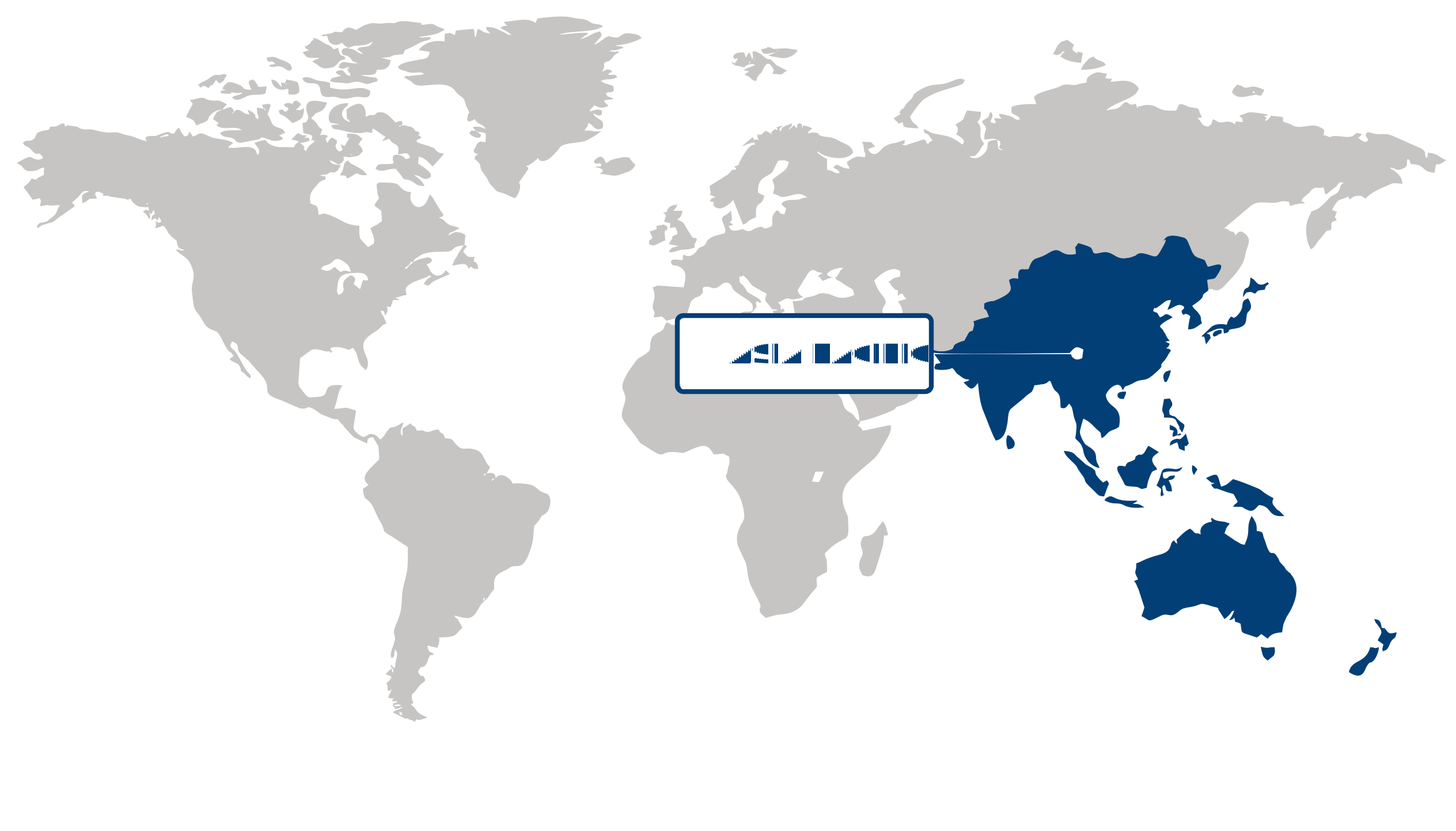
Asia Pacific dominated the atomic force microscope market with a commanding 52% share in 2025, also emerging as the fastest-growing region with an 8.26% CAGR. This supremacy is driven primarily by robust demand in semiconductor manufacturing, nanomaterials innovation, and vigorous research and development activities across leading economies. The region’s accelerated digital transformation and expanding advanced materials sector are creating an environment conducive to high precision imaging tools. Notably, government incentives in countries like China and Japan to support nanotechnology and semiconductor advancements have reinforced market expansion, as documented in reports by the Ministry of Industry and Information Technology of China and Japan’s New Energy and Industrial Technology Development Organization. With intensified investment and evolving industrial ecosystems, Asia Pacific offers strategic opportunities for stakeholders aiming to leverage technological integration and innovation in the atomic force microscope market.
Japan is positioned as a pivotal hub in Asia Pacific’s atomic force microscope market, driven by its advanced semiconductor infrastructure and sustained innovation in nanotechnology. Corporate developments by firms such as Hitachi High-Technologies Corporation and strategic national programs emphasize precision instrumentation, enhancing demand for atomic force microscopes. Japan’s stringent quality standards and focus on R&D foster a stable environment for cutting-edge applications, supporting sophisticated device manufacturing and materials science research. This robust ecosystem underlines Japan’s integral role in regional growth dynamics, securing its position as a critical contributor to Asia Pacific’s expanding market.
China anchors Asia Pacific’s atomic force microscope market through substantial government-led initiatives and accelerating industrial advancements. The country’s strategic focus on semiconductor self-sufficiency and nanomaterials development has heightened demand for high-resolution microscopy instrumentation. Policies from the Ministry of Science and Technology and substantial funding for R&D facilitate rapid technology adoption. Leading enterprises such as Bruker China and Keysight Technologies capitalize on these trends with localized innovations and expanded production capabilities. China’s expansive industrial base and regulatory support amplify the region’s growth momentum, reinforcing Asia Pacific’s preeminent status in the global atomic force microscope market.
North America Market Analysis:
North America held a commanding share in the atomic force microscope market, driven by substantial investments in medical research, advanced material science, and semiconductor industries. The region benefits from a robust ecosystem of research institutions and well-established healthcare infrastructure, which fuels demand for high-precision imaging tools. Increasing emphasis on nanotechnology applications, alongside supportive regulatory frameworks from agencies such as the U.S. Food and Drug Administration (FDA) and the National Institutes of Health (NIH), further underpin market stability. Corporate innovation, exemplified by Agilent Technologies and Bruker Corporation’s product enhancements, showcases North America's commitment to advancing AFM capabilities. The region’s capacity for rapid technological adoption and strong intellectual property protection positions it as a pivotal market with enduring growth potential in atomic force microscopy.
The U.S. dominates North America’s atomic force microscope market due to its vast network of universities and government laboratories driving nanotech innovation. High funding levels from agencies like the NIH and the Department of Energy support cutting-edge applications in biotechnology and materials engineering. Market players leverage strategic partnerships and digital integration, as seen in Veeco Instruments’ launch of AI-enabled AFM systems. Evolving regulatory standards encourage precision and safety, aligning with expanding academic and industrial research demands. This leadership in innovation and policy foresight firmly anchors the U.S. as a strategic growth hub, crucial for sustaining North America's stronghold in the atomic force microscope market.
Europe Market Trends:
Europe maintained notable presence in the atomic force microscope market, benefiting from its robust academic infrastructure and heightened industrial innovation, particularly in materials science and biotechnology sectors. The region’s manufacturing hubs actively invest in precision instrumentation, supported by favorable policy frameworks from the European Union emphasizing research and development. Organizations like the European Molecular Biology Laboratory have advanced microscopy applications, reinforcing demand for high-resolution surface analysis tools. Additionally, increasing digitization within European laboratories enhances operational efficiencies and adoption rates of cutting-edge atomic force microscopes. Despite competitive pressures from emerging markets, Europe’s stringent quality standards and sustainability commitments ensure it remains a pivotal area for growth. Looking ahead, the integration of AI-driven imaging and expanding nanotechnology research promise to unlock significant opportunities, consolidating Europe’s strategic importance in the atomic force microscope market.
Germany plays a commanding role in Europe’s atomic force microscope market, driven by its strong industrial base in automotive, semiconductor, and pharmaceuticals, which demand precise nanoscale imaging. The country’s commitment to research is evident through initiatives like the Fraunhofer Society, fostering innovation in microscopy technologies and enabling companies such as Bruker to lead in product development. Furthermore, Germany’s emphasis on Industry 4.0 accelerates the adoption of automated and intelligent AFM systems, enhancing accuracy and throughput. These factors underscore Germany as a frontrunner in European technological progression, reinforcing the region’s collective market momentum with supply chain efficiencies and advanced talent pools.
France represents an important contributor to Europe’s atomic force microscope market, buoyed by its priority on life sciences research and public-sector investment through organizations like the CNRS (National Centre for Scientific Research). The growing focus on medical diagnostics and nanomedicine drives demand for high-precision atomic force microscopes to study biomolecular interactions at nanoscale resolution. French companies and research institutions increasingly deploy AFM technology for material characterization and drug development, aided by regulatory support for innovation. This trajectory positions France as a key innovation hub, augmenting Europe’s market opportunities by enriching the application diversity and fostering collaboration within transnational research networks.
| Parameter | North America | Asia Pacific | Europe | Latin America | MEA |
|---|---|---|---|---|---|
| Innovation Hub i Scale Nascent Developing Advanced | |||||
| Cost-Sensitive Region i Scale Low Medium High | |||||
| Regulatory Environment i Scale Restrictive Neutral Supportive | |||||
| Demand Drivers i Scale Weak Moderate Strong | |||||
| Development Stage i Scale Emerging Developing Developed | |||||
| Adoption Rate i Scale Low Medium High | |||||
| New Entrants / Startups i Scale Sparse Moderate Dense | |||||
| Macro Indicators i Scale Weak Stable Strong |
Segment Leadership and Growth Trends
Atomic Force Microscope Market Share (%), by Product Type, 2026
Go beyond the chart, access full insights & data tables
Request Free Sample ReportStandard Atomic Force Microscopes held the largest share in the atomic force microscope market in 2025, driven by their broad applicability across research institutions and industrial analysis. Their versatility meets diverse customer preferences, from academic laboratories to quality control in manufacturing, supported by ongoing improvements in user interface and cost-effectiveness. Companies like Bruker have emphasized standard AFMs in product launches targeting multi-disciplinary use, aligning with global research funding from agencies such as the National Science Foundation. This segment provides firms strategic advantages by catering to wide-ranging requirements, including educational purposes and process monitoring. Given the expanding emphasis on standardized, reliable instrumentation in scientific inquiry, Standard Atomic Force Microscopes remain central to the market landscape in the near term.
Analysis by Technology
Tapping Mode represented the largest share in the atomic force microscope market due to its ability to image delicate samples with minimal damage, critical for sensitive applications in life sciences and nanomaterials. This mode aligns with evolving demand for non-invasive techniques that preserve sample integrity, supported by advances in probe design and signal processing from companies like Oxford Instruments Asylum Research. Regulatory considerations for sample preservation in biotech and materials testing further reinforce its adoption. The technology provides competitive differentiation for innovators focused on high-precision, minimally perturbing measurements. With ongoing enhancements in dynamic AFM imaging and increasing integration in automated workflows, Tapping Mode is well-positioned to maintain its leadership over the medium term.
Analysis by Application
Nanotechnology held the largest share in the atomic force microscope market, propelled by mounting global investment in nanoscale research and development. The segment benefits from intensified focus on advanced materials, energy storage, and electronics spearheaded by initiatives from entities such as the European Commission’s Horizon programs. Demand patterns emphasize ultra-high resolution and multifunctional capabilities to characterize nanostructures critical to innovation pipelines. Industry leaders including NT-MDT Spectrum Instruments have expanded their nanotechnology-focused offerings, addressing both academic and industrial users. The ongoing prioritization of nanotech in scientific and commercial endeavors ensures sustained relevance for this application segment, creating significant opportunities for both established players and agile entrants aiming at specialized instrumentation.
| Segment | Sub-Segment | Largest Segment | Fastest Growing |
|---|---|---|---|
| Product Type | Standard Atomic Force Microscopes, High-Resolution Atomic Force Microscopes, Multi-Mode Atomic Force Microscopes | ||
| Technology | Contact Mode, Non-Contact Mode, Tapping Mode, Force Modulation Mode | ||
| Application | Nanotechnology, Materials Science, Biotechnology, Semiconductor Manufacturing | ||
| End User | Academia, Research Institutions, Industrial Laboratories, Pharmaceutical Companies |
Competitive Landscape and Market Positioning
The competitive environment is characterized by continuous advancements driven by these key players’ concerted efforts in technology enhancement and market penetration. Significant endeavors include integrating emerging scanning probe techniques and expanding product lines that address multifunctional surface characterization. Collaborations between research labs and manufacturers bolster innovation pipelines, while strategic acquisitions enhance portfolios and geographic reach. Players such as Bruker and Park Systems intensify their market standing by focusing on application-specific solutions and improved user interface designs. The evolving landscape reflects a persistent drive towards higher resolution, faster imaging, and broader functionality, reinforcing leadership and fostering differentiation amid increasing demand for sophisticated nanoscale exploration.
Strategic / Actionable Recommendations for Regional Players
North American firms should consider deepening synergies with academic institutions and technology startups to accelerate the integration of AI and machine learning in AFM data analysis. Expanding into untapped segments like bio-nanotechnology and semiconductor process control can offer niche growth opportunities tailored to local industrial strengths. Emphasizing modular and scalable solutions will address the need for adaptability in diverse research environments.
In Asia Pacific, players can enhance competitiveness by fostering collaborations that leverage the region’s manufacturing capabilities and large research base. Prioritizing investment in localized product customization and service infrastructure will resonate well with rapidly growing markets. Exploiting advances in semiconductor inspection and life sciences applications may unlock new avenues for sustained expansion in the region.
European companies are advised to capitalize on the continent’s strong research ecosystem by intensifying partnerships across multidisciplinary fields. Facilitating the adoption of sustainable and green manufacturing technologies within AFM production can also differentiate offerings. Strengthening integration of AFM with complementary analytical instrumentation may appeal to industrial and academic users seeking comprehensive nanoscale characterization platforms.
| Company | Market Share | Company Revenue | Revenue CAGR (%) | Product Portfolio | Geographic Presence | Innovation / R&D Focus | Strategic Developments |
|---|---|---|---|---|---|---|---|
| No companies available. | |||||||
Industry Development/News
| Company Name | Date | Key Development |
|---|
Customize Your Report
Explore examples of how this report can be tailored to different research needs, including custom segments, additional topics or chapters, and related reports. Click a section of the wheel or its numbered marker to explore the available options.
Atomic Force Microscope Market — Custom Segments
| Segment | Sub-Segment |
|---|---|
| No segment data available. | |
Atomic Force Microscope Market — Custom TOC
| Custom Chapter | Custom Details | ||
|---|---|---|---|
| No custom TOC data available. | |||
Need a different cut of the data?
Request Custom ResearchHow much is the atomic force microscope industry expected to grow by 2035?
In which region is the atomic force microscope market share the greatest?
In which region is the atomic force microscope sector expanding most rapidly?
Which is the largest sub-segment within the product type segment for atomic force microscope industry?
Why does tapping mode sub-segment dominate the technology segment of atomic force microscope sector?
How does nanotechnology segment fare in the atomic force microscope industry?
What share does research institutions segment hold in the atomic force microscope sector as of 2025?
Which companies are driving growth in the atomic force microscope landscape?
Our Clients
"The team at Fundamental Business Insights & Consulting demonstrated a commitment to excellence, not only in the quality of the report but also in their client-centric approach."
FANUC
"The level of detail in the market segmentation provided were particularly noteworthy. The detailed country-level insights were also very helpful."
B&R Industrial Automation GmbH
"The consultant took the time to understand our specific business objectives, ensuring that the reports were tailored to address our unique challenges and opportunities."
KUKA SE & Co. KGaA
Our Research Team & Methodology
Every Fundamental Business Insights report is built by a dedicated vertical research team, validated through a structured primary-and-secondary methodology, and reviewed for accuracy before it reaches you.
Research Team Overview
Prepared by the Industrial Automation & Equipment Research Team
Delivery
Published
Demand
Available
Support
Trust & Compliance
Research Domains
10 coverage areasResearch Intelligence
| Source | Reference |
|---|---|
| International Society of Automation (ISA) | www.isa.org |
| International Organization for Standardization (ISO) | www.iso.org |
| National Institute of Standards and Technology (NIST) | www.nist.gov |
| IEEE | www.ieee.org |
| VDMA (German Mechanical Engineering Industry Association) | www.vdma.org |
| Association for Advancing Automation (A3) | www.automate.org |
| International Federation of Robotics (IFR) | ifr.org |
| ASME (American Society of Mechanical Engineers) | www.asme.org |
| ASHRAE | www.ashrae.org |
| American Society of Heating, Refrigerating and Air-Conditioning Engineers (ASHRAE) | www.ashrae.org |
| Material Handling Industry (MHI) | www.mhi.org |
| OSHA (Occupational Safety and Health Administration) | www.osha.gov |
| National Fire Protection Association (NFPA) | www.nfpa.org |
| ASTM International | www.astm.org |
| International Electrotechnical Commission (IEC) | www.iec.ch |
| Open Process Automation Forum (The Open Group) | www.opengroup.org/open-process-automation-forum |
| AGMA (American Gear Manufacturers Association) | www.agma.org |
| Association of Equipment Manufacturers (AEM) | www.aem.org |
| Food and Agriculture Organization (FAO) | www.fao.org |
| International Labour Organization (ILO) | www.ilo.org |
Research Workflow & Quality Assurance
Data Collection
Verified information gathered through primary and secondary research.
Data Triangulation
Cross-validation using multiple independent data sources.
Forecast Modelling
Market estimates developed using historical trends and analytical models.
Analyst Validation
Findings reviewed by domain experts for accuracy and consistency.
Editorial & Quality Review
Final editorial, quality, and compliance checks before publication.
Final Publication
Released after successful completion of the internal review process.
Report Coverage
📊 Market Assessment
- Market Size & Forecast
- Market Segmentation
- Regional Analysis
- Growth Drivers & Challenges
- Market Dynamics
🏢 Competitive Intelligence
- Competitive Landscape
- Company Profiles
- Competitive Benchmarking
- Mergers & Acquisitions
- Market Share Analysis or Key Company Strategies
🔍 Strategic Analysis
- Value Chain Analysis
- Porter's Five Forces
- PESTLE Analysis
- Pricing Trends
- Supply-Demand Analysis
🚀 Future Outlook
- Technology Landscape
- Regulatory Landscape
- Investment & Funding Landscape
- Emerging Opportunities
- Future Market Outlook
Have a question about this report or need a custom scope?
Request Customization