Atom Interferometer Market Size & Forecasts 2026-2035, By Segments (Type, Application), Growth Opportunities, Innovation Landscape, Regulatory Shifts, Strategic Regional Insights (U.S., Japan, China, South Korea, UK, Germany, France), and Competitive Dynamics (ColdQuanta, Muquans, AOSense, Toptica Photonics, iXblue)
Market Size and Growth Outlook
Atom Interferometer Market size is estimated to increase from USD 148.05 million in 2025 to USD 614.75 million by 2035, supported by a CAGR exceeding 15.3% during 2026-2035. In 2026, revenues are forecast to reach USD 168.17 million.
Get more details on this report
Request Free Sample ReportAtom Interferometer Market Intelligence Snapshot
Regional Market Dynamics
Segment Momentum
Market Expansion Drivers
Leading Market Participants
Global Market Forecast Snapshot
Market Outlook
Regional and Segment Outlook
Market Growth Drivers and Industry Trends
The increasing focus on enhancing navigational accuracy and defense capabilities is significantly propelling the atom interferometer market. Governments and defense agencies worldwide, including the U.S. Department of Defense, prioritize atom interferometers for their superior ability to provide GPS-independent navigation in GPS-denied environments. This demand is amplified by rising geopolitical tensions and the need for advanced guidance systems in aerospace and military sectors. Leading defense contractors like Lockheed Martin are actively investing in integrating atom interferometers into next-generation inertial navigation systems. For incumbents, this trend enables diversification into defense-specific products, while new entrants can capitalize on niche applications requiring high precision. The ongoing prioritization of autonomous defense solutions suggests sustained momentum in the atom interferometer market’s defense segment.
Growth in Scientific Research and Industrial Sensors
Academic institutions and industrial players increasingly leverage atom interferometers to advance fundamental physics research and develop highly sensitive sensor applications. Institutions such as CERN and the National Institute of Standards and Technology (NIST) utilize atom interferometry to probe gravitational waves and test quantum mechanics, underscoring the technology’s critical role in precision measurement. Concurrently, industries focusing on environmental monitoring and structural health are adopting atom interferometer sensors for their unparalleled accuracy and robustness. This dual demand nurtures a vibrant innovation ecosystem, attracting startups with novel sensor designs and encouraging collaborations between research bodies and industry incumbents. As interdisciplinary scientific collaboration deepens, the atom interferometer market stands to benefit from continuous R&D-driven expansion focused on enhanced sensor functionality and deployment.
Technological Improvements in Atom Interferometer Sensitivity
Advancements in atom interferometer sensitivity, driven by breakthroughs in laser cooling and quantum control methods, are redefining competitive dynamics within the atom interferometer market. Companies like ColdQuanta and Muquans highlight their innovations in achieving longer coherence times and improved noise reduction, enabling devices to detect subtle inertial forces with unprecedented precision. These technological leaps open new avenues for commercial applications, including geophysical exploration and navigation in autonomous vehicles. As products become more sensitive and compact, established entities can optimize existing systems, while new market entrants gain opportunities to develop tailored solutions for emerging use cases. Continued investment in sensitivity enhancement is poised to remain a core strategic focus shaping the market’s future trajectory.
Industry Restraints:
High Development and Operational Costs
The atom interferometer market faces a significant barrier due to the substantial costs associated with research, development, and deployment of atomic-scale measurement technologies. The precision engineering and ultra-high vacuum environments required impose considerable capital expenditures, as observed in Honeywell’s recent financial disclosures detailing increased spending on quantum sensing development. These costs pose a challenge for both well-established firms and startups striving to scale production while maintaining reliability and accuracy. This economic burden limits market accessibility, particularly in price-sensitive segments such as academia and early-stage industrial applications. Consequently, many potential customers delay adoption pending cost reductions or performance improvements. In the near to medium term, ongoing investments in miniaturization and integrated photonics—highlighted in the U.S. Department of Energy’s National Quantum Initiative—may gradually ease these constraints, yet high entry costs will persist as a critical limiting factor for market expansion.
Regulatory and Standardization Challenges
The atom interferometer market encounters constraints from fragmented regulatory frameworks and a lack of universally accepted standards governing device calibration, safety, and data interoperability. This impediment is particularly evident in aerospace and defense applications where adherence to stringent guidelines from bodies such as the Federal Aviation Administration (FAA) and the European Defence Agency (EDA) is mandatory. The absence of harmonized standards results in extended certification timelines and increased compliance costs, complicating market entry for new participants and delaying product deployment for incumbents. For example, Pasqal’s difficulties in securing certifications for quantum sensing platforms within defense sectors illustrate these barriers. Strategic implications include heightened risk aversion among investors and slower cross-border technology diffusion. With ongoing efforts by international consortia like the Quantum Industry Coalition to address standardization, the market may see gradual regulatory alignment, but compliance complexity will remain a decisive factor in shaping competitive positioning.
| Growth Driver | Impact on CAGR | Regulatory Influence | Geographic Relevance | Adoption Rate | Impact Timeline |
|---|---|---|---|---|---|
| Expansion in precision navigation and defense applications | 5.00% | Short term (≤ 2 yrs) | North America, Europe | Medium | Fast |
| Growth in scientific research and industrial sensors | 4.00% | Medium term (2–5 yrs) | Asia Pacific, North America | Low | Moderate |
| Technological improvements in atom interferometer sensitivity | 3.00% | Long term (5+ yrs) | Europe, Asia Pacific | Medium | Moderate |
Unlock insights tailored to your business with our bespoke market research solutions.
Click to get your customized report now.
Regional Demand Dynamics
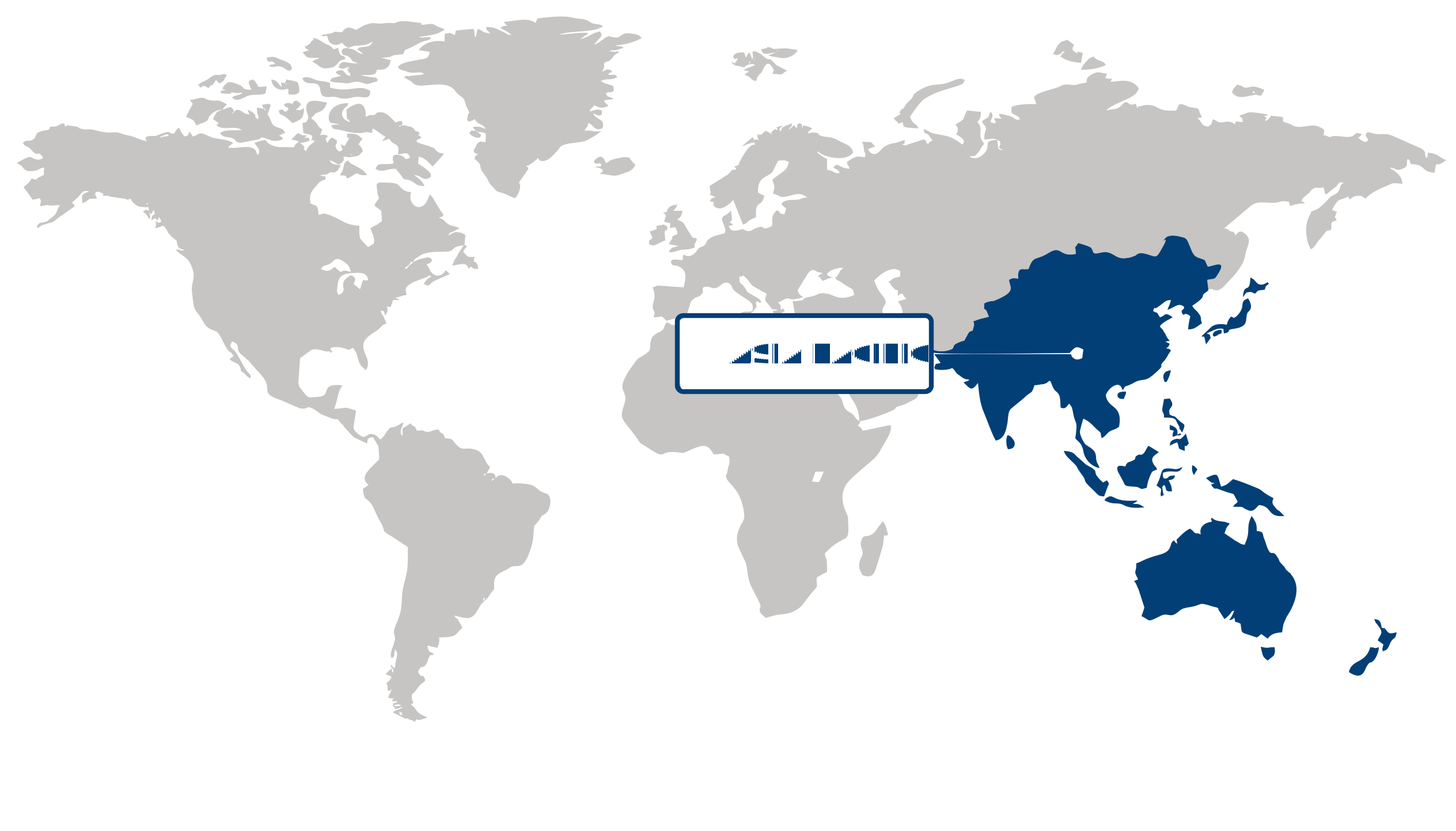
The Asia Pacific region dominated the atom interferometer market in 2025, capturing approximately 38.5% of the global share and registering an unparalleled 18.36% CAGR, making it the largest and fastest-growing market worldwide. This dominance is primarily driven by substantial government funding toward quantum research and development across China, Japan, and South Korea. For instance, China’s Ministry of Science and Technology’s ambitious quantum initiatives have fueled demand for advanced sensing technologies including atom interferometers. Moreover, the region benefits from an expanding skilled workforce and a robust network of national laboratories and technology parks, as highlighted by Japan's Quantum Leap Flagship Program. These factors collectively enhance operational capabilities and innovation cycles, while the Asia Pacific’s focus on technological sovereignty and high-tech infrastructure investments supports sustainable market growth. Consequently, this region presents compelling opportunities for investors, fostering breakthroughs in navigation, metrology, and fundamental science applications.
Japan is positioned as a pivotal hub in the Asia Pacific atom interferometer market, leveraging its strong governmental backing and collaborative industry partnerships. The Japanese Ministry of Education, Culture, Sports, Science and Technology (MEXT)’s support for nanoscale quantum research fuels localized innovation and commercialization, boosting demand for high-precision instrumentation. Japan’s cultural emphasis on precision engineering and quality manufacturing, as demonstrated by companies like Canon and Toshiba Research, further accelerates adoption in both academic and industrial segments. This synergy of policy incentives and technological expertise positions Japan not only as a national leader but also as a key contributor to regional growth by setting benchmarks for quantum-enhanced devices in Asia Pacific.
China plays a transformative role in driving the Asia Pacific atom interferometer market through its expansive quantum technology roadmap and integrated innovation ecosystem. Spearheaded by the Chinese Academy of Sciences’ Quantum Information and Quantum Technology initiatives, China has stimulated widespread adoption of atom interferometry within defense, navigation, and environmental monitoring sectors. The government’s strategic emphasis on self-reliance in quantum technology production, coupled with supportive regulatory frameworks, accelerates product development cycles and market penetration. Additionally, China’s extensive supply chain infrastructure facilitates efficient scaling. These factors collectively reinforce the region’s leadership, positioning China as a cornerstone for ongoing growth and a magnet for investors targeting the Asia Pacific atom interferometer market.
North America Market Analysis:
North America emerged as the fastest-growing region in the atom interferometer market, registering a robust CAGR of 12.5%. This dynamic growth is primarily driven by the increasing investment in defense and aerospace sectors, as these industries seek precise measurement technologies to enhance navigation and sensing capabilities. The region’s emphasis on innovation, supported by institutions such as the U.S. National Institute of Standards and Technology (NIST) and defense agencies, has accelerated advancements in atom interferometry applications. Additionally, the integration of quantum technologies within military and space exploration programs fosters a rapidly evolving ecosystem. The North American market also benefits from strong collaborations between government bodies and private enterprises, enabling streamlined research and development initiatives. With growing focus on quantum sensing and related precision technologies, North America offers significant opportunities for companies aiming to capitalize on expanding demand across defense, aerospace, and scientific research sectors.
The U.S. plays a pivotal role in driving the North American atom interferometer market through substantial federal funding and strategic initiatives in quantum technology. Agencies like the Department of Defense (DoD) and the Department of Energy (DOE) actively support projects integrating atom interferometers into navigation systems and gravitational sensing, setting the country apart in technology deployment and innovation. U.S. companies such as ColdQuanta and Muquans are advancing commercial applications, while DARPA’s investment programs catalyze cutting-edge research. Regulatory support for quantum technology commercialization and strong venture capital presence enhance market readiness. With a keen focus on translating research into viable products, the U.S. remains the backbone of regional growth, making it an essential hub for investors seeking exposure to the atom interferometer market’s future advancements.
Europe Market Trends:
Europe maintained notable presence in the atom interferometer market, driven by the region's robust investment in quantum technologies and precision instrumentation. The continent benefits from a dense network of research institutions and government-backed innovation programs, such as those supported by the European Commission’s Quantum Flagship initiative, fostering cutting-edge developments in atom interferometry. Shifting priorities toward sustainable technologies and enhanced sensing capabilities have spurred demand from aerospace, defense, and environmental monitoring sectors. Supply chains in Europe capitalize on advanced manufacturing hubs with strong regulatory frameworks ensuring high-quality standards, while competitive intensity rises with several startups and established firms expanding their portfolios. The growing pool of specialized talent and increasing cross-border collaborations further bolster technological advancement, positioning Europe as a strategic hub for atom interferometer applications. This landscape offers investors substantial opportunities as the region adapts to evolving scientific needs and scales commercialization efforts.
Germany plays a pivotal role in Europe's atom interferometer market, anchored by its strong industrial infrastructure and leadership in precision engineering. Demand growth aligns with government-supported research initiatives, including funding via the German Aerospace Center (DLR), which integrates atom interferometry in navigation and geophysical exploration projects. Germany’s technology companies, such as Robert Bosch GmbH and TOPTICA Photonics AG, are actively commercializing high-precision instruments, reflecting the country’s emphasis on innovation and quality control. The regulatory environment encourages collaboration between academia and industry, facilitating rapid adoption of atom interferometer technologies. This synergy enhances Germany’s position as a core innovation driver within Europe, making it critical for regional strategic expansion and a focal point for investors targeting scalable, technologically advanced solutions.
France significantly contributes to the European atom interferometer market through its advanced scientific research ecosystem and state-backed quantum technology initiatives. The French National Centre for Scientific Research (CNRS) and the Commissariat à l'énergie atomique et aux énergies alternatives (CEA) spearhead projects that integrate atom interferometry in fundamental physics experiments and practical applications like inertial sensing. France’s focus on high-technology sectors, alongside favorable policies promoting public-private partnerships, underpins strong industry adoption and market growth. Companies such as Muquans actively drive product innovation while benefiting from government incentives aimed at enhancing national competitiveness in quantum technologies. France’s growing influence enhances Europe’s market dynamics by delivering innovative solutions and maintaining momentum in atom interferometer technology commercialization, making it an essential market for regional consolidation and future growth.
| Parameter | North America | Asia Pacific | Europe | Latin America | MEA |
|---|---|---|---|---|---|
| Innovation Hub i Scale Nascent Developing Advanced | |||||
| Cost-Sensitive Region i Scale Low Medium High | |||||
| Regulatory Environment i Scale Restrictive Neutral Supportive | |||||
| Demand Drivers i Scale Weak Moderate Strong | |||||
| Development Stage i Scale Emerging Developing Developed | |||||
| Adoption Rate i Scale Low Medium High | |||||
| New Entrants / Startups i Scale Sparse Moderate Dense | |||||
| Macro Indicators i Scale Weak Stable Strong |
Segment Leadership and Growth Trends
Atom Interferometer Market Share (%), by Type, 2026
Go beyond the chart, access full insights & data tables
Request Free Sample ReportStandalone atom interferometers held largest share in the atom interferometer market in 2025, driven primarily by widespread demand for simpler, lower-complexity systems with established deployment readiness. Their market dominance reflects customer preferences for ease of integration and reliability in existing workflows, especially in defense and aerospace where operational robustness is critical. For instance, Honeywell’s recent press release on standalone quantum sensors highlights enhanced field performance without extensive calibration. Supply chain improvements in optical components and reduced manufacturing costs further support this segment's leadership. Both incumbents and newcomers benefit from streamlined product development cycles and scalability opportunities. With ongoing technological refinements and regulatory endorsements for standalone quantum devices, this segment is positioned to maintain relevance as practical and accessible solutions for diverse real-world environments.
Analysis by Application
Navigation and sensing represented largest share in the atom interferometer market due to the surging demand for high-precision inertial navigation systems, crucial in autonomous vehicles, aerospace, and defense sectors. The segment leads because of its ability to deliver unparalleled accuracy where GPS signals are unreliable or denied, underscored by DARPA’s investments in quantum navigation technologies. Customer demand pivots on robustness, miniaturization, and integration with digital transformation efforts in smart systems. Recent developments from Northrop Grumman emphasize improved sensor resilience and responsiveness. These factors create strategic openings for established aerospace firms and agile startups to innovate adaptive sensing solutions. Given the persistent need for reliable navigation in complex environments, this application segment will continue to drive growth and attract focused R&D in the atom interferometer market.
| Segment | Sub-Segment | Largest Segment | Fastest Growing |
|---|---|---|---|
| Type | Standalone Atom Interferometers, Integrated Atom Interferometer Systems | ||
| Application | Navigation and Sensing, Gravity Measurement, Quantum Computing, Atomic Clocks |
Competitive Landscape and Market Positioning
The competitive atmosphere is characterized by concerted efforts from these players to advance product capabilities and broaden technological reach. Collaborative efforts spanning research consortiums and industry partnerships enhance precision and scalability. Concurrently, investment in proprietary platforms and refined atomic sources underpins differentiation. For instance, the intersection of laser technology expertise from M Squared Lasers and quantum sensor innovations at Qnami drives enhanced performance benchmarks. In this environment, strategic augmentations such as focused innovation in miniaturization and cross-sector alliances have become vital, fortifying the players’ market foothold and enabling accelerated delivery of atom interferometer solutions.
Strategic / Actionable Recommendations for Regional Players
North American entities should deepen interdisciplinary collaborations combining quantum computing with atom interferometry, tapping into robust innovation hubs to accelerate next-generation sensor development. Emphasizing partnerships with federal research initiatives can amplify applied use cases in defense and environmental monitoring.
In Asia Pacific, regional actors could benefit from adapting scalable manufacturing techniques and fostering linkages with global technology suppliers to enhance cost-effectiveness and production volume. Prioritizing growth segments such as navigation and geophysics sensors will provide competitive leverage amid increasing industrial demand.
European players might focus on integrating photonics with atom interferometer systems through strategic alliances with specialized research centers. Leveraging emerging quantum technologies while targeting precision measurement applications in aerospace and healthcare can solidify market differentiation and drive sustained innovation momentum.
| Company | Market Share | Company Revenue | Revenue CAGR (%) | Product Portfolio | Geographic Presence | Innovation / R&D Focus | Strategic Developments |
|---|---|---|---|---|---|---|---|
| No companies available. | |||||||
Industry Development/News
| Company Name | Date | Key Development |
|---|
Customize Your Report
Explore examples of how this report can be tailored to different research needs, including custom segments, additional topics or chapters, and related reports. Click a section of the wheel or its numbered marker to explore the available options.
Atom Interferometer Market — Custom Segments
| Segment | Sub-Segment |
|---|---|
| No segment data available. | |
Atom Interferometer Market — Custom TOC
| Custom Chapter | Custom Details | ||
|---|---|---|---|
| No custom TOC data available. | |||
Need a different cut of the data?
Request Custom ResearchWhat is the expected industry size of atom interferometer by 2035?
Which region holds the largest share of the atom interferometer market?
Which geography represents the strongest growth trajectory for the atom interferometer sector?
What share does standalone atom interferometers segment hold in the atom interferometer sector as of 2025?
Where is the navigation and sensing segment seeing the strongest adoption within the atom interferometer industry?
What are the key competitors in the atom interferometer landscape?
Our Clients
"Working with FBI has been a good experience. The market report provided a holistic view, covering everything from emerging trends to potential risks."
Semtech Corporation
"The experience was highly positive. The team showcased remarkable flexibility in adapting to our specific needs and delivered report that perfectly aligned with all our requirements."
TSMC
"What really stood out to me was how clearly and promptly the Fundamental Business Insights team communicated throughout. It made the collaboration feel effortless."
NXP Semiconductors
Our Research Team & Methodology
Every Fundamental Business Insights report is built by a dedicated vertical research team, validated through a structured primary-and-secondary methodology, and reviewed for accuracy before it reaches you.
Research Team Overview
Prepared by the Electronics & Semiconductors Research Team
Delivery
Published
Demand
Available
Support
Trust & Compliance
Research Domains
10 coverage areasResearch Intelligence
| Source | Reference |
|---|---|
| Semiconductor Industry Association (SIA) | www.semiconductors.org |
| SEMI | www.semi.org |
| JEDEC Solid State Technology Association | www.jedec.org |
| IEEE | www.ieee.org |
| IPC – Association Connecting Electronics Industries | www.ipc.org |
| International Electrotechnical Commission (IEC) | www.iec.ch |
| International Organization for Standardization (ISO) | www.iso.org |
| U.S. Bureau of Industry and Security (BIS) | www.bis.gov |
| U.S. Patent and Trademark Office (USPTO) | www.uspto.gov |
| European Patent Office (EPO) | www.epo.org |
| Taiwan Semiconductor Industry Association (TSIA) | www.tsia.org.tw |
| World Semiconductor Trade Statistics (WSTS) | www.wsts.org |
| International Energy Agency (IEA) | www.iea.org |
| GSMA | www.gsma.com |
| 3GPP | www.3gpp.org |
| ITU (International Telecommunication Union) | www.itu.int |
| Omdia (public insights) | omdia.tech.informa.com |
| Display Supply Chain Consultants (DSCC) | www.displaysupplychain.com |
| U.S. Department of Energy (DOE) | www.energy.gov |
| NIST (National Institute of Standards and Technology) | www.nist.gov |
Research Workflow & Quality Assurance
Data Collection
Verified information gathered through primary and secondary research.
Data Triangulation
Cross-validation using multiple independent data sources.
Forecast Modelling
Market estimates developed using historical trends and analytical models.
Analyst Validation
Findings reviewed by domain experts for accuracy and consistency.
Editorial & Quality Review
Final editorial, quality, and compliance checks before publication.
Final Publication
Released after successful completion of the internal review process.
Report Coverage
📊 Market Assessment
- Market Size & Forecast
- Market Segmentation
- Regional Analysis
- Growth Drivers & Challenges
- Market Dynamics
🏢 Competitive Intelligence
- Competitive Landscape
- Company Profiles
- Competitive Benchmarking
- Mergers & Acquisitions
- Market Share Analysis or Key Company Strategies
🔍 Strategic Analysis
- Value Chain Analysis
- Porter's Five Forces
- PESTLE Analysis
- Pricing Trends
- Supply-Demand Analysis
🚀 Future Outlook
- Technology Landscape
- Regulatory Landscape
- Investment & Funding Landscape
- Emerging Opportunities
- Future Market Outlook
Have a question about this report or need a custom scope?
Request Customization