Articulated Buses Market Size & Growth Forecast 2027–2036, By Segments (Vehicle, Application, Propulsion, Seating Capacity, End Users), Regional Demand Trends (North America, Asia Pacific, Europe), Key Country Insights (U.S., Japan, South Korea, Germany, France, Italy), and Competitive Landscape
Market Size and Growth Outlook
Articulated Buses Market size was worth USD 22.9 Billion in 2026 and is expected to grow at 8.48% CAGR between 2027 and 2036, crossing USD 51.68 Billion by 2036. The industry revenue for 2027 is calculated at USD 24.55 Billion.
Get more details on this report
Request Free Sample ReportArticulated Buses Market Intelligence Snapshot
Regional Market Dynamics
- Asia Pacific led in 2026 as rapid urbanization, expanding public transport networks, population density, and investments in high-capacity mass transit increased demand for articulated buses.
- Dedicated bus corridors and sustainable urban mobility investments are strengthening adoption by improving passenger capacity and operational efficiency on busy urban routes.
Segment Momentum
- Single-decker buses accounted for 88.2% of the market in 2026 because they combine high passenger capacity, efficient boarding, and compatibility with existing urban road infrastructure, making them ideal for busy city transit routes.
- Electric propulsion is the fastest-growing segment as cities invest in zero-emission public transport, supported by government initiatives, improved battery technology, and expanding charging infrastructure for fleet modernization.
Market Expansion Drivers
- Rising urban population growth increasing demand for high-capacity public transit solutions
- Government subsidies and incentives accelerating adoption of articulated bus fleets
- Low-floor accessibility and passenger comfort innovations improving public transport adoption
Leading Market Participants
- Leading companies in the articulated buses market include Alexander Dennis Limited (United Kingdom), BYD Company Limited (China), Volvo Group (Sweden), MAN Truck & Bus SE (Germany), Iveco Group N.V. (Italy), Scania AB (Sweden), Yutong Bus Co., Ltd. (China), New Flyer Industries Inc. (Canada), Van Hool NV (Belgium)
Global Market Forecast Snapshot
Market Outlook
- 2026 Market Size: USD 22.9 Billion
- 2027 Estimated Market Size: USD 24.55 Billion
- Projected Market Size: USD 51.68 Billion by 2036
- Growth Forecast: 8.48% CAGR (2027-2036)
Regional and Segment Outlook
- Leading Regional Market: Asia Pacific
- High-Growth Regional Hub: Asia Pacific
- Core Revenue Segment: Single-decker (Vehicle) | Intracity (Application) | ICE (Propulsion) | High Capacity (Seating Capacity) | Public Transit Authorities (End Users)
- Emerging Opportunity Segment: Double-decker (Vehicle) | Airport Shuttle Services (Application) | Electric (Propulsion) | Low Capacity (Seating Capacity) | Private Transportation Companies (End Users)
Market Growth Drivers and Industry Trends
Rising urban population growth increasing demand for high-capacity public transit solutions
Rapid urbanization is placing greater pressure on existing public transportation networks, prompting transit authorities to invest in vehicles capable of carrying larger passenger volumes without significantly increasing fleet size. The articulated buses market growth is driven by the need to improve operational efficiency on densely traveled routes while reducing traffic congestion and passenger overcrowding. Municipal transport agencies are increasingly deploying articulated buses on high-demand corridors because their larger capacity enables better service frequency management, supports expanding commuter populations, and optimizes the use of available road infrastructure in growing metropolitan areas.
Government subsidies and incentives accelerating adoption of articulated bus fleets
Public investment programs and financial incentives are encouraging transit operators to modernize their fleets with higher-capacity vehicles that improve urban mobility. The articulated buses market benefits from government initiatives aimed at strengthening public transportation systems, reducing congestion, and promoting more sustainable mobility solutions. Funding support lowers the financial burden associated with fleet replacement and expansion, enabling municipalities and public transport providers to procure articulated buses while upgrading transit infrastructure and improving the accessibility and reliability of urban transportation services.
Low-floor accessibility and passenger comfort innovations improving public transport adoption
Advancements in vehicle design are enhancing the travel experience by making public transportation more accessible, comfortable, and convenient for a broader range of passengers. Increasing adoption of low-floor configurations, wider entry doors, ergonomic seating, and improved interior layouts will propel the articulated buses market growth as transit operators prioritize inclusive mobility for elderly passengers, individuals with disabilities, and families with strollers. Enhanced passenger flow, reduced boarding times, and more spacious interiors also contribute to smoother daily operations across busy urban transit networks.
| Growth Driver | Impact on CAGR | Regulatory Influence | Geographic Relevance | Adoption Rate | Impact Timeline |
|---|---|---|---|---|---|
| Rising urban population growth increasing demand for high-capacity public transit solutions | 2% | High | Asia Pacific, Latin America | High | Near Term |
| Government subsidies and incentives accelerating adoption of articulated bus fleets | 1.8% | High | Europe, Asia Pacific | High | Near Term |
| Low-floor accessibility and passenger comfort innovations improving public transport adoption | 1.6% | Moderate | North America, Europe | High | Mid Term |
Unlock insights tailored to your business with our bespoke market research solutions.
Click to get your customized report now.
Regional Demand Dynamics
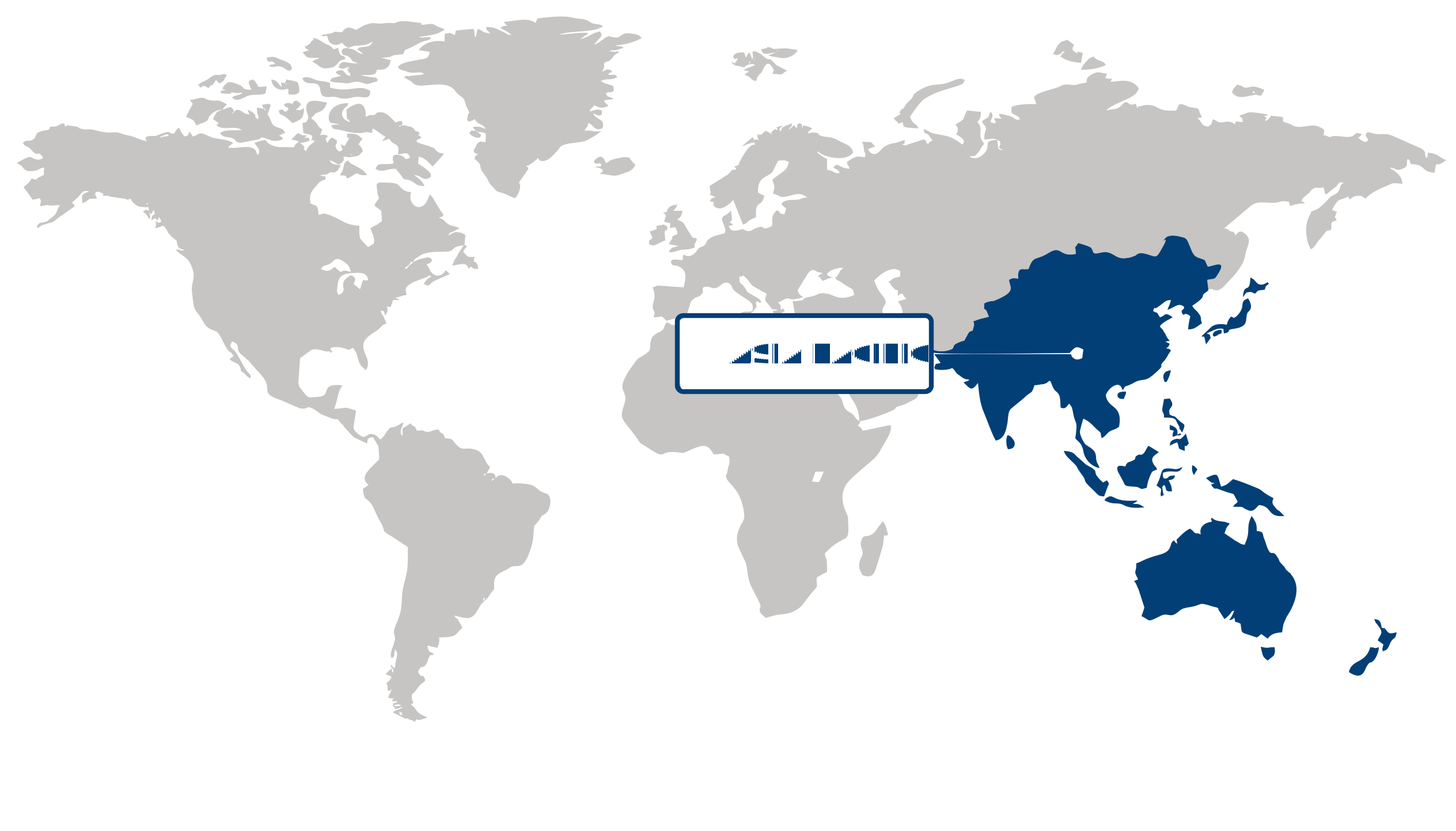
Asia Pacific (Largest & Fastest-Growing Region)
The Asia Pacific region dominated the articulated buses market in 2026 and is expected to maintain the fastest growth, driven by rapid urbanization, expanding public transportation networks, and rising demand for high-capacity transit solutions. Growing population density in major cities is placing greater pressure on existing transportation systems, encouraging authorities to expand mass transit infrastructure and improve passenger mobility. Articulated buses offer higher passenger capacity while supporting efficient operation on busy urban routes, making them increasingly relevant to public transportation modernization. Investments in sustainable urban mobility and the development of dedicated bus corridors are further creating favorable conditions for regional market expansion.
| Parameter | North America | Asia Pacific | Europe | Latin America | MEA |
|---|---|---|---|---|---|
| Innovation Hub i Scale Nascent Developing Advanced | |||||
| Cost-Sensitive Region i Scale Low Medium High | |||||
| Regulatory Environment i Scale Restrictive Neutral Supportive | |||||
| Demand Drivers i Scale Weak Moderate Strong | |||||
| Development Stage i Scale Emerging Developing Developed | |||||
| Adoption Rate i Scale Low Medium High | |||||
| New Entrants / Startups i Scale Sparse Moderate Dense | |||||
| Macro Indicators i Scale Weak Stable Strong |
Key Country Insights
United States 🇺🇸
Urban Transit ExpansionThe U.S. continues investing in articulated buses to improve passenger capacity across busy metropolitan transit corridors. Transit agencies increasingly prioritize low-emission propulsion systems, accessibility improvements, and connected fleet management technologies for public transportation networks.
Germany 🇩🇪
Sustainable Public MobilityGermany advances articulated bus deployment as part of broader urban mobility modernization and emission reduction initiatives. Public transit operators in Germany increasingly adopt electric and hybrid articulated buses supported by investments in charging infrastructure.
Japan 🇯🇵
High-Capacity Transit PlanningJapan selectively expands articulated bus use to improve passenger movement in densely populated urban areas and airport connections. Transit authorities in Japan focus on reliable vehicle performance, operational efficiency, and seamless integration with multimodal transport systems.
South Korea 🇰🇷
Smart Transit IntegrationSouth Korea incorporates articulated buses into smart public transportation strategies aimed at improving urban mobility and passenger experience. Municipal operators in South Korea increasingly adopt connected vehicle technologies and cleaner propulsion systems for high-demand routes.
France 🇫🇷
Clean Fleet DeploymentFrance emphasizes articulated buses that support sustainable urban transport while accommodating increasing passenger volumes. Public transport agencies in France continue investing in electric and alternative-fuel buses to align with municipal environmental objectives.
Italy 🇮🇹
Metropolitan Capacity EnhancementItaly expands articulated bus deployment to improve transit efficiency across congested metropolitan corridors with growing passenger demand. Transit authorities in Italy increasingly prioritize vehicles offering accessibility, lower operating emissions, and reliable service in dense urban environments.
Segment Leadership and Growth Trends
Articulated Buses Market Share (%), by Vehicle, 2026
Go beyond the chart, access full insights & data tables
Request Free Sample ReportVehicle Segment Analysis: Single-decker (Largest Segment) vs Double-decker (Fastest-Growing Segment)
The single-decker segment dominated the articulated buses market, accounting for 88.2% of the market share in 2026. Its leadership is driven by broad deployment across urban public transportation systems, where operators prioritize high passenger capacity, efficient boarding, and compatibility with existing road infrastructure. Single-decker articulated buses offer an effective balance between maneuverability and passenger throughput, making them suitable for high-demand city routes.
The double-decker segment is anticipated to experience the fastest growth as transit authorities explore higher-capacity solutions for densely populated corridors and tourism-focused services. Increasing emphasis on maximizing passenger capacity within limited road space, along with investments in modern public transport systems, is expected to support broader adoption of articulated double-decker buses.
Application Segment Analysis: Intracity (Largest Segment) vs Airport Shuttle Services (Fastest-Growing Segment)
The intracity application segment accounted for the largest share of 70.08% in 2026. Urban transportation networks rely heavily on articulated buses to accommodate high passenger volumes while improving operational efficiency on busy routes. Their ability to transport large numbers of commuters with fewer trips makes them an integral component of metropolitan public transit systems focused on reducing congestion and enhancing mobility.
The airport shuttle services segment is expected to register the fastest growth in the articulated buses market as airports expand passenger handling capacity and invest in efficient ground transportation. Rising air travel, airport infrastructure development, and the need for reliable connections between terminals, parking facilities, and transport hubs are supporting increased deployment of articulated buses for shuttle operations.
Propulsion Segment Analysis: ICE (Largest Segment) vs Electric (Fastest-Growing Segment)
The ICE propulsion segment held the largest position in 2026. Internal combustion engine articulated buses continue to maintain a significant presence due to their proven operational reliability, established refueling infrastructure, and suitability for long operating schedules. Many transit agencies continue utilizing existing ICE fleets while gradually transitioning toward cleaner transportation technologies.
The electric propulsion segment is projected to witness the fastest growth in the articulated buses market as cities accelerate the adoption of zero-emission public transportation. Government support for sustainable mobility, advancements in battery technology, and growing investment in charging infrastructure are encouraging transit operators to modernize fleets with electric articulated buses that contribute to lower emissions and quieter urban transport.
| Segment | Sub-Segment | Largest Segment | Fastest Growing |
|---|---|---|---|
| Vehicle | Single-decker, Double-decker | Single-decker | Double-decker |
| Application | Intracity, Intercity, Airport Shuttle Services, Tour & Charter Services | Intracity | Airport Shuttle Services |
| Propulsion | ICE, Electric | ICE | Electric |
| Seating Capacity | Low Capacity, High Capacity | High Capacity | Low Capacity |
| End Users | Public Transit Authorities, Private Transportation Companies, Tour Operators | Public Transit Authorities | Private Transportation Companies |
Competitive Landscape and Market Positioning
Prominent players in the articulated buses market:
- Alexander Dennis Limited (United Kingdom)
- BYD Company Limited (China)
- Volvo Group (Sweden)
- MAN Truck & Bus SE (Germany)
- Iveco Group N.V. (Italy)
- Scania AB (Sweden)
- Yutong Bus Co., Ltd. (China)
- New Flyer Industries, Inc. (Canada)
- Van Hool NV (Belgium)
The articulated buses market is experiencing a competitive transformation as urban mobility priorities shift toward higher-capacity, efficient, and environmentally responsive public transportation systems. Manufacturers are differentiating through vehicle flexibility, passenger experience improvements, and compatibility with emerging propulsion technologies rather than relying solely on traditional fleet demand. Competitive strength increasingly depends on the ability to support transit operators with reliable platforms that address congestion challenges, operational efficiency goals, and long-term infrastructure modernization.
| Company | Market Share | Company Revenue | Revenue CAGR (%) | Product Portfolio | Geographic Presence | Innovation / R&D Focus | Strategic Developments |
|---|---|---|---|---|---|---|---|
| Alexander Dennis Limited (United Kingdom) | |||||||
| BYD Company Limited (China) | |||||||
| Volvo Group (Sweden) | |||||||
| MAN Truck & Bus SE (Germany) | |||||||
| Iveco Group N.V. (Italy) | |||||||
| Scania AB (Sweden) | |||||||
| Yutong Bus Co. Ltd. (China) | |||||||
| New Flyer Industries Inc. (Canada) | |||||||
| Van Hool NV (Belgium) |
Industry Development/News
| Company Name | Date | Key Development |
|---|---|---|
| Volvo Buses | Jun-26 | Volvo Buses unveiled Australia's first locally developed 18-metre BZL Electric articulated bus. The product introduction expands the manufacturer's zero-emission portfolio in the region and enhances its competitive positioning within high-capacity urban public transport tenders. |
| Daimler Buses | Jun-26 | Daimler Buses secured a contract from operator KVG to supply 28 battery-electric Mercedes eCitaro G articulated buses. The large-scale fleet acquisition directly advances the transport provider's strategic transition toward emission-free municipal public transit operations. |
| Solaris Bus & Coach | Oct-25 | Solaris Bus & Coach signed a commercial contract with MZA Warsaw for the delivery of 50 articulated electric buses. The agreement expands the municipal zero-emission public transport fleet and reinforces the manufacturer's market penetration in the Central European transit segment. |
| Hess | Oct-25 | Hess finalized the production of 30 Van Hool Exqui.City 24 Electric articulated buses for the Paris Tzen 4 BRT line. This project completion enables the deployment of high-capacity electric bus operations following previous structural project delays. |
| MCV | Sep-25 | MCV opened a dedicated production facility in Cairo to manufacture complete Volvo electric city and intercity buses. This strategic move directly expands regional manufacturing capacity for Volvo's electrified bus portfolio and strengthens the localized production supply chain for high-capacity public transport vehicles. |
| GreenMob Capital | Aug-25 | GreenMob Capital entered a strategic partnership with Volvo Buses to launch the world's first fleet of fully electric bi-articulated buses in Goiânia, Brazil. This commercial deployment establishes an operational blueprint for high-capacity, zero-emission urban mass transit systems globally. |
| Castrosua | Jun-25 | Castrosua formed a strategic partnership with BYD and selected PEI Mobility to supply component bellows for its new articulated electric bus platform. This collaboration secures critical value chain components to support the engineering and commercial scale-up of the new articulated e-bus model. |
| Iveco Bus | Jun-25 | Iveco Bus secured a major commercial contract from De Lijn to supply 100 articulated E-WAY electric buses. The significant order materially expands the operator's zero-emission fleet and solidifies Iveco's competitive market share within European public transport electrification initiatives. |
| Volvo Buses | May-25 | Volvo Buses commenced series production of its fully electric articulated and bi-articulated BZRT bus chassis in Brazil. The initiative expands the company's manufacturing footprint in Latin America, positioning it to scale production and capture rising regional demand for high-capacity, zero-emission mass transit systems. |
| Ebusco | Dec-22 | Ebusco expanded its product lineup by introducing an articulated variant of the Ebusco 3.0 model. The 18-meter lightweight composite bus features an extended range of up to 700 km, a battery capacity exceeding 500 kWh, and a maximum capacity of 150 passengers. |
Customize Your Report
Explore examples of how this report can be tailored to different research needs, including custom segments, additional topics or chapters, and related reports. Click a section of the wheel or its numbered marker to explore the available options.
Articulated Buses Market — Custom Segments
| Segment | Sub-Segment |
|---|---|
| Fleet Procurement Model | Direct Fleet Purchase, Competitive Tendering, Leasing & Fleet Financing, Public-Private Partnership |
| Operating Environment | High-Density Urban, Suburban & Peri-Urban, Challenging Terrain, Climate-Intensive Environments |
| Route Characteristics | High-Frequency Trunk Routes, Feeder & Connector Routes, Dedicated Bus Corridor Routes, Mixed-Traffic Routes |
Articulated Buses Market — Custom TOC
| Custom Chapter | Custom Details |
|---|---|
| Urban Transit Investment Outlook |
|
| Zero-Emission Fleet Transition Assessment |
|
| Bus Rapid Transit Expansion Analysis |
|
Need a different cut of the data?
Request Custom ResearchHow large is the articulated buses market?
What is the expected industry size of articulated buses by 2036?
How is urbanization accelerating demand for articulated buses?
Why are government incentives supporting articulated bus fleet modernization?
Why do single-decker articulated buses lead the market?
What is driving the growth of electric articulated buses?
Why does Asia Pacific lead the articulated buses market?
How is Asia Pacific supporting future growth in articulated buses?
Who holds a significant market share in the articulated buses landscape?
Our Clients
"The team surpassed our expectations with the report depth. The actionable insights provided proved crucial in navigating market challenges."
Tata Motors
"We found the report to be very informative. The expertise and attention to market nuances significantly influenced our business direction."
DENSO Corporation
"The consumer survey findings were quite good. We now have a clearer picture of the customer churning and retention strategy."
HL Mando
Our Research Team & Methodology
Every Fundamental Business Insights report is built by a dedicated vertical research team, validated through a structured primary-and-secondary methodology, and reviewed for accuracy before it reaches you.
Research Team Overview
Prepared by the Automotive & Transportation Research Team
Delivery
Published
Demand
Available
Support
Trust & Compliance
Research Domains
10 coverage areasResearch Intelligence
| Source | Reference |
|---|---|
| International Organization of Motor Vehicle Manufacturers (OICA) | www.oica.net |
| SAE International | www.sae.org |
| International Energy Agency (IEA) | www.iea.org |
| International Transport Forum (ITF) | www.itf-oecd.org |
| International Road Federation (IRF) | www.irf.global |
| International Organization for Standardization (ISO) | www.iso.org |
| United Nations Economic Commission for Europe (UNECE) | unece.org |
| National Highway Traffic Safety Administration (NHTSA) | www.nhtsa.gov |
| U.S. Department of Transportation (USDOT) | www.transportation.gov |
| European Automobile Manufacturers' Association (ACEA) | www.acea.auto |
| Society of Indian Automobile Manufacturers (SIAM) | www.siam.in |
| International Air Transport Association (IATA) | www.iata.org |
| International Civil Aviation Organization (ICAO) | www.icao.int |
| International Maritime Organization (IMO) | www.imo.org |
| International Union of Railways (UIC) | uic.org |
| American Public Transportation Association (APTA) | www.apta.com |
| International Federation of Robotics (IFR) | ifr.org |
| CharIN | www.charin.global |
| World Shipping Council | www.worldshipping.org |
| International Federation of Freight Forwarders Associations (FIATA) | fiata.org |
Research Workflow & Quality Assurance
Data Collection
Verified information gathered through primary and secondary research.
Data Triangulation
Cross-validation using multiple independent data sources.
Forecast Modelling
Market estimates developed using historical trends and analytical models.
Analyst Validation
Findings reviewed by domain experts for accuracy and consistency.
Editorial & Quality Review
Final editorial, quality, and compliance checks before publication.
Final Publication
Released after successful completion of the internal review process.
Report Coverage
📊 Market Assessment
- Market Size & Forecast
- Market Segmentation
- Regional Analysis
- Growth Drivers & Challenges
- Market Dynamics
🏢 Competitive Intelligence
- Competitive Landscape
- Company Profiles
- Competitive Benchmarking
- Mergers & Acquisitions
- Market Share Analysis or Key Company Strategies
🔍 Strategic Analysis
- Value Chain Analysis
- Porter's Five Forces
- PESTLE Analysis
- Pricing Trends
- Supply-Demand Analysis
🚀 Future Outlook
- Technology Landscape
- Regulatory Landscape
- Investment & Funding Landscape
- Emerging Opportunities
- Future Market Outlook
Have a question about this report or need a custom scope?
Request Customization