Armored Vehicle Market Size & Growth Forecast 2027–2036, By Segments (Product, Type, Mobility, Mode of Operation, Point of Sale, System), Regional Demand Trends (North America, Asia Pacific, Europe), Key Country Insights (U.S., Japan, South Korea, Germany, France, Italy), and Competitive Landscape
Market Size and Growth Outlook
Armored Vehicle Market size was worth USD 36.2 billion in 2026 and is poised to grow at a 5.7% CAGR between 2027 and 2036, crossing USD 63.02 billion by 2036. The industry revenue for 2027 is assessed at USD 37.94 billion.
Get more details on this report
Request Free Sample ReportArmored Vehicle Market Intelligence Snapshot
Regional Market Dynamics
- Asia Pacific held a 35.19% share in 2026, supported by sustained defense procurement, fleet modernization initiatives, border security priorities, and replacement of aging military vehicle fleets.
- North America is projected to grow at a 6.22% CAGR through modernization programs focused on advanced protection, mobility upgrades, next-generation electronics, and replacement of legacy armored platforms.
Segment Momentum
- Combat Vehicles captured 61.11% of the market in 2026 as armed forces prioritize protected firepower, frontline mobility, and mission readiness for operations in contested environments.
- Electric armored vehicles are growing fastest as defense programs explore quieter mobility, enhanced onboard power, and next-generation capabilities that support evolving military modernization strategies.
Market Expansion Drivers
- Rising geopolitical tensions driving defense modernization and armored fleet procurement programs.
- Increasing asymmetric warfare and terrorism threats accelerating tactical mobility requirements.
- Integration of autonomous systems and hybrid propulsion in next-generation armored platforms.
Leading Market Participants
- Top companies in the armored vehicle market include Rheinmetall AG (Germany), BAE Systems plc (United Kingdom), General Dynamics Corporation (United States), Oshkosh Defense, LLC (United States), Thales Group (France), Elbit Systems Ltd. (Israel), Krauss-Maffei Wegmann GmbH & Co. KG (Germany), Lockheed Martin Corporation (United States), IVECO S.p.A. (Italy), Textron Inc. (United States).
Global Market Forecast Snapshot
Market Outlook
- 2026 Market Size: USD 36.2 billion
- 2027 Estimated Market Size: USD 37.94 billion.
- Projected Market Size: USD 63.02 billion by 2036
- Growth Forecast: 5.7% CAGR (2027-2036)
Regional and Segment Outlook
- Leading Regional Market: Asia Pacific
- High-Growth Regional Hub: North America
- Core Revenue Segment: Combat Vehicles (Product) | Conventional Armored Vehicles (Type) | Wheeled (Mobility) | Manned Armored Vehicles (Mode of Operation) | OEM (Point of Sale) | Fire Control Systems (FCS) (System)
- Emerging Opportunity Segment: Combat Support Vehicles (Product) | Electric Armored Vehicles (Type) | Tracked (Mobility) | Unmanned Armored Vehicles (Mode of Operation) | Retrofit (Point of Sale) | Navigation Systems (System)
Market Growth Drivers and Industry Trends
Rising geopolitical tensions driving defense modernization and armored fleet procurement programs
The armored vehicle market is gaining momentum as rising geopolitical tensions encourage governments to strengthen defense capabilities and modernize existing fleets. Procurement programs are placing greater emphasis on maintaining capable armored platforms, supporting investment in vehicle acquisition and fleet upgrades as defense organizations respond to evolving security requirements.
Increasing asymmetric warfare and terrorism threats accelerating tactical mobility requirements
Increasing asymmetric warfare and terrorism threats are shaping the armored vehicle market by raising the need for protected mobility in complex operational environments. Military and security forces require vehicles that can combine personnel protection with tactical movement, particularly where conventional operating conditions are replaced by unpredictable and dispersed threats.
Integration of autonomous systems and hybrid propulsion in next-generation armored platforms
The armored vehicle market is also being influenced by the integration of autonomous systems and hybrid propulsion into next-generation platforms. Autonomous capabilities can support more advanced operational functions, while hybrid propulsion offers an alternative approach to vehicle power management, encouraging modernization toward technologically sophisticated armored platforms.
| Growth Driver | Impact on CAGR | Regulatory Influence | Geographic Relevance | Adoption Rate | Impact Timeline |
|---|---|---|---|---|---|
| Modernization of military fleets | 1.80% | Short term (≤ 2 yrs) | North America, Europe | Medium | Fast |
| Increasing defense budgets in emerging economies | 2.00% | Medium term (2–5 yrs) | Asia Pacific, Middle East | Low | Moderate |
| Adoption of advanced armor technologies | 1.70% | Long term (5+ yrs) | North America, Europe (spillover: Asia Pacific) | Medium | Slow |
| Rising geopolitical tensions driving defense modernization and armored fleet procurement programs | 2.50% | High | Asia Pacific, Europe, North America | High | Near Term |
| Increasing asymmetric warfare and terrorism threats accelerating tactical mobility requirements | 2.10% | High | Middle East & Africa, Asia Pacific | High | Near Term |
| Integration of autonomous systems and hybrid propulsion in next-generation armored platforms | 1.70% | High | North America, Europe, Asia Pacific | Emerging | Mid Term |
Unlock insights tailored to your business with our bespoke market research solutions.
Click to get your customized report now.
Regional Demand Dynamics
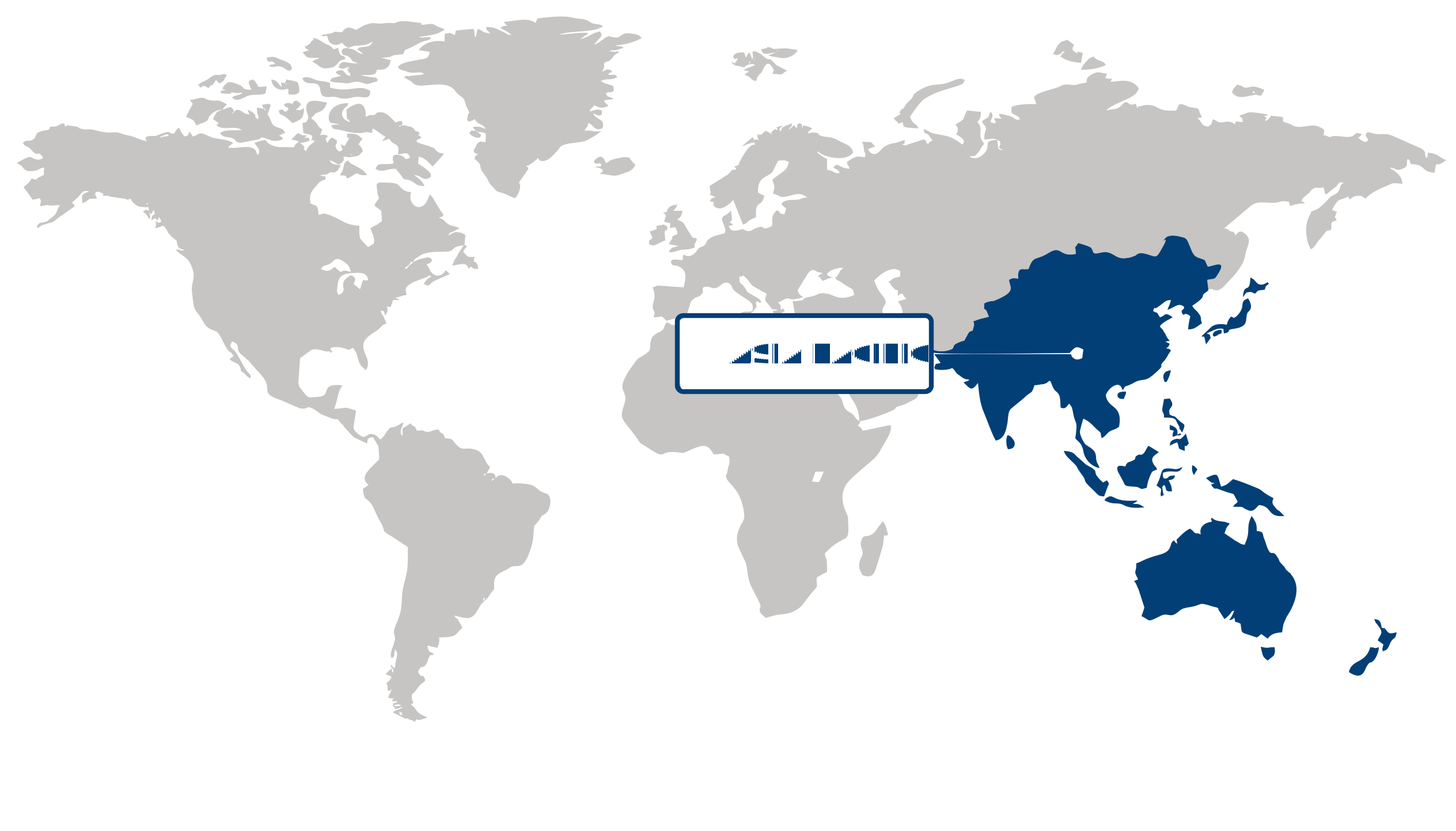
Asia Pacific (Largest Region)
Asia Pacific accounted for the largest share of the armored vehicle market at 35.19% in 2026, supported by heightened defense modernization, evolving security requirements, and substantial investment in military mobility capabilities. Several countries in the region are strengthening land-based defense infrastructure and upgrading vehicle fleets to address changing operational environments, border security concerns, and requirements for protected mobility. Demand extends across troop transport, reconnaissance, logistics, and specialized security applications, encouraging the development of vehicles that combine ballistic protection with improved mobility and communications capabilities. Regional manufacturing capacity and increasing efforts to strengthen domestic defense production also contribute to the market’s strong position.
North America (Fastest-Growing Region)
North America is experiencing the fastest growth as defense organizations place greater emphasis on fleet modernization, survivability, and technologically advanced protected mobility platforms. The need to operate effectively across complex environments is encouraging investment in vehicles incorporating enhanced armor, situational awareness, communications, and mobility technologies. Modernization programs are also creating demand for platforms that can integrate increasingly sophisticated electronic and defensive systems without compromising operational flexibility. In addition, stronger focus on force readiness, supply-chain resilience, and advanced defense manufacturing is supporting continued development of armored vehicle capabilities across military and specialized security applications.
| Parameter | North America | Asia Pacific | Europe | Latin America | MEA |
|---|---|---|---|---|---|
| Innovation Hub i Scale Nascent Developing Advanced | |||||
| Cost-Sensitive Region i Scale Low Medium High | |||||
| Regulatory Environment i Scale Restrictive Neutral Supportive | |||||
| Demand Drivers i Scale Weak Moderate Strong | |||||
| Development Stage i Scale Emerging Developing Developed | |||||
| Adoption Rate i Scale Low Medium High | |||||
| New Entrants / Startups i Scale Sparse Moderate Dense | |||||
| Macro Indicators i Scale Weak Stable Strong |
Key Country Insights
Germany 🇩🇪
European Capability DevelopmentGermany focuses on armored vehicle procurement that strengthens defense readiness and interoperability with allied forces. Investments support upgraded protection technologies, digital systems integration, and adaptable vehicle platforms suited for evolving operational missions.
France 🇫🇷
Expeditionary Mobility FocusFrance prioritizes armored vehicle solutions capable of supporting rapid deployment and diverse mission environments. Procurement decisions increasingly emphasize lightweight protection, digital communication systems, and adaptable vehicle configurations for operational flexibility.
Italy 🇮🇹
Collaborative Defense ManufacturingItaly supports armored vehicle development through collaboration between domestic manufacturers and international defense programs. Italian priorities include upgrading existing fleets with improved protection systems, mobility enhancements, and integrated electronic capabilities.
Japan 🇯🇵
Mobile Defense EnhancementJapan advances armored vehicle capabilities through modernization initiatives emphasizing mobility, crew protection, and operational flexibility. Domestic programs increasingly integrate advanced electronics and improved platform performance to support national defense requirements.
South Korea 🇰🇷
Indigenous Platform ExpansionSouth Korea continues strengthening its armored vehicle industry through domestic development and export-oriented manufacturing capabilities. The market emphasizes advanced mobility solutions, enhanced survivability features, and continuous technology upgrades for modern defense operations.
United States 🇺🇸
Defense Modernization ProgramsThe U.S. armored vehicle market prioritizes fleet modernization with greater emphasis on survivability, mobility, and digital battlefield capabilities. Procurement strategies increasingly incorporate modular platforms and advanced protection systems to support diverse operational requirements.
Segment Leadership and Growth Trends
Armored Vehicle Market Share (%), by Product, 2026
Go beyond the chart, access full insights & data tables
Request Free Sample ReportProduct Segment Analysis: Combat Vehicles (Largest Segment) vs Combat Support Vehicles (Fastest-Growing Segment)
Combat vehicles held the largest share of the armored vehicle market in 2026, accounting for 61.11% share, supported by sustained demand for protected platforms designed for direct combat operations. Their role in battlefield mobility, personnel protection, firepower, and mission survivability makes them a core component of modern defense fleets. Continued emphasis on force modernization, enhanced armor protection, advanced surveillance, and integrated battlefield technologies further reinforces demand for combat vehicles as defense organizations seek platforms capable of operating in increasingly complex threat environments.
Combat support vehicles are gaining momentum as military forces place greater emphasis on logistics, recovery, engineering, command, medical evacuation, and other mission-enabling functions. These platforms improve the operational effectiveness of frontline units by providing protected mobility and essential support under challenging conditions. Growing requirements for integrated and highly mobile military formations are encouraging investment in specialized support platforms, while modernization programs increasingly consider the broader fleet ecosystem rather than combat platforms alone.
Type Segment Analysis: Conventional Armored Vehicles (Largest Segment) vs Electric Armored Vehicles (Fastest-Growing Segment)
Conventional armored vehicles represented the largest segment in 2026, reflecting their established role across military fleets and their compatibility with existing operational infrastructure, maintenance systems, and logistics networks. Proven propulsion technologies continue to support deployment in demanding environments where range, durability, and field-serviceability are critical. Established manufacturing capabilities and familiarity among defense operators also contribute to the continued importance of conventional platforms within modernization and replacement programs.
Electric armored vehicles are emerging as a rapidly advancing area as defense organizations explore lower-emission propulsion, improved energy efficiency, and reduced dependence on conventional fuels. Electric powertrains can support quieter movement and provide onboard electrical capacity for increasingly sophisticated electronic systems, sensors, and communications equipment. Advances in battery technology and military electrification initiatives are therefore encouraging greater consideration of electric propulsion for specialized and next-generation armored platforms.
| Segment | Sub-Segment | Largest Segment | Fastest Growing |
|---|---|---|---|
| Product | Combat Vehicles, Combat Support Vehicles | Combat Vehicles | Combat Support Vehicles |
| Type | Electric Armored Vehicles, Conventional Armored Vehicles | Conventional Armored Vehicles | Electric Armored Vehicles |
| Mobility | Wheeled, Tracked | Wheeled | Tracked |
| Mode of Operation | Manned Armored Vehicles, Unmanned Armored Vehicles | Manned Armored Vehicles | Unmanned Armored Vehicles |
| Point of Sale | OEM, Retrofit | OEM | Retrofit |
| System | Engines, Drive Systems, Communication Systems, Fire Control Systems (FCS), Navigation Systems, Others | Fire Control Systems (FCS) | Navigation Systems |
Competitive Landscape and Market Positioning
Leading companies in the armored vehicle market:
1. Rheinmetall AG (Germany)
2. BAE Systems plc (United Kingdom)
3. General Dynamics Corporation (United States)
4. Oshkosh Defense LLC (United States)
5. Thales Group (France)
6. Elbit Systems Ltd. (Israel)
7. Krauss-Maffei Wegmann GmbH & Co. KG (Germany)
8. Lockheed Martin Corporation (United States)
9. IVECO S.p.A. (Italy)
10. Textron Inc. (United States)
The armored vehicle market is evolving through integration of advanced defense systems and modular protection technologies. Innovation is enhancing mobility, survivability, and situational awareness. The armored vehicle market is also witnessing development of next-generation lightweight armor materials. Emphasis is placed on operational adaptability in complex threat environments.
| Company | Market Share | Company Revenue | Revenue CAGR (%) | Product Portfolio | Geographic Presence | Innovation / R&D Focus | Strategic Developments |
|---|---|---|---|---|---|---|---|
| Rheinmetall AG (Germany) | |||||||
| BAE Systems plc (United Kingdom) | |||||||
| General Dynamics Corporation (United States) | |||||||
| Oshkosh Defense LLC (United States) | |||||||
| Thales Group (France) | |||||||
| Elbit Systems Ltd. (Israel) | |||||||
| Krauss-Maffei Wegmann GmbH & Co. KG (Germany) | |||||||
| Lockheed Martin Corporation (United States) | |||||||
| IVECO S.p.A. (Italy) | |||||||
| Textron Inc. (United States). |
Industry Development/News
| Company Name | Date | Key Development |
|---|---|---|
| Otokar | May-26 | Otokar showcased expanded production capabilities at Black Sea Defense & Aerospace 2026, featuring the first Cobra II manufactured in Romania. By diversifying its portfolio with infantry fighting and unmanned ground vehicles, the company is actively pursuing localized production strategies to capture broader regional market demand for autonomous and mobile defense platforms. |
| KNDS France | Apr-26 | KNDS France completed the acquisition of Texelis Defense, integrating a critical supplier of mobility systems in-house. This move enhances the company’s vertical integration, securing control over drivetrain technologies and strengthening its industrial position to meet rising European demand for advanced, high-performance land platform manufacturing. |
| Rheinmetall | Jan-26 | Rheinmetall, in partnership with Leonardo, delivered the first Lynx KF-41 infantry fighting vehicles to Italy as part of the A2CS modernization program. This deployment marks a significant milestone in fleet renewal, reinforcing Italian land force capabilities and advancing collaborative European defense modernization initiatives for next-generation armored platforms. |
| Roshel | Jun-25 | Roshel established a local manufacturing footprint in Ukraine to facilitate domestic assembly and supply of armored platforms. This strategic move improves the responsiveness and resilience of the armored vehicle supply chain, enabling direct support for regional operational requirements amid ongoing logistical and defense-related challenges. |
| MDT Armor Corp. | Apr-25 | MDT Armor Corp. was awarded a $15.4 million U.S. Army contract to supply armored vehicles and components for the Israel Defense Forces. The agreement solidifies the company’s role as a provider of lightweight armored platforms and ensures continued utilization of its U.S.-based manufacturing infrastructure to support international defense requirements. |
| Czechoslovak Group | Apr-25 | Czechoslovak Group entered a strategic partnership with Axon Vision to integrate AI-powered situational awareness systems into European armored platforms. The agreement, including an initial order for the PANDUR 8×8 EVO, enhances vehicle survivability, sensor fusion capabilities, and digital combat readiness, marking a collaborative effort to modernize existing fleet assets. |
| Patria | Mar-25 | Patria announced a €40 million investment to expand its armored vehicle production facility in Hämeenlinna, Finland. This capacity expansion project is designed to address increasing demand for armored platforms, significantly strengthening the company’s industrial footprint and long-term production scalability within the European defense sector. |
| General Dynamics | Feb-25 | General Dynamics secured a contract to deliver 256 Piranha V armored fighting vehicles to Germany, supporting the tactical network modernization program. The initiative emphasizes the integration of armored mobility with advanced battlefield communication systems, representing a key advancement in the digitization and operational connectivity of German ground forces. |
| Tata Motors Limited | Feb-25 | Tata Motors Limited launched its first NATO-standard Light Armored Multipurpose Vehicle (LAMV) and announced plans for joint production in the UAE. This move signifies a strategic effort to expand the company’s international manufacturing footprint and enhance India’s competitive positioning in the global market for high-standard armored mobility solutions. |
| Arquus | Jan-24 | John Cockerill reached a divestment agreement to acquire Arquus, formerly part of the Volvo Group. This structural consolidation unites turret and vehicle systems expertise under a single defense manufacturing entity, intended to rationalize production capabilities and strengthen the overall competitive positioning of European land systems manufacturers. |
Customize Your Report
Explore examples of how this report can be tailored to different research needs, including custom segments, additional topics or chapters, and related reports. Click a section of the wheel or its numbered marker to explore the available options.
Armored Vehicle Market — Custom Segments
| Segment | Sub-Segment |
|---|---|
| Mission Application | Infantry Operations, Reconnaissance & Surveillance, Logistics & Transport, Command & Control, Peacekeeping & Internal Security |
| Weapon Integration | Small Arms & Machine Guns, Remote Weapon Stations, Cannons & Autocannons, Anti-Tank Missile Systems, Mortar & Indirect-Fire Systems |
| Military Branch | Army, Marine Corps & Naval Infantry, Air Force Ground Operations, Special Operations Forces, Internal Security & Paramilitary Forces |
Armored Vehicle Market — Custom TOC
| Custom Chapter | Custom Details |
|---|---|
| Defense Modernization Program Assessment |
|
| Military Fleet Replacement Opportunity Analysis |
|
| Emerging Threat Adaptation |
|
Need a different cut of the data?
Request Custom ResearchWhat is the current size of the armored vehicle market?
How much is the armored vehicle industry expected to grow by 2036?
How are modernization programs and geopolitical tensions influencing procurement strategies in the armored vehicle market?
Why is demand increasing for combat support vehicles compared to traditional frontline armored platforms?
Why do combat vehicles hold the largest share of the armored vehicle market?
Why are electric armored vehicles the fastest-growing type segment?
Why is Asia Pacific the largest market for armored vehicles?
What is supporting the rapid expansion of the armored vehicle market in North America?
Who are the leading players in the armored vehicle landscape?
Our Clients
"The reports offered a comprehensive view of the Food and Beverage landscape, covering market trends, consumer behavior, and competitive dynamics."
Terma A/S
"Our experience in acquiring market research reports has been outstanding — the depth of analysis and actionable insights have proven invaluable."
The Aerospace Corporation
"Fundamental Business Insights demonstrated a keen understanding of our business needs, delivering reports tailored to our specific objectives."
Kongsberg Gruppen
Our Research Team & Methodology
Every Fundamental Business Insights report is built by a dedicated vertical research team, validated through a structured primary-and-secondary methodology, and reviewed for accuracy before it reaches you.
Research Team Overview
Prepared by the Aerospace & Defence Research Team
Delivery
Published
Demand
Available
Support
Trust & Compliance
Research Domains
10 coverage areasResearch Intelligence
| Source | Reference |
|---|---|
| International Civil Aviation Organization (ICAO) | www.icao.int |
| International Air Transport Association (IATA) | www.iata.org |
| Federal Aviation Administration (FAA) | www.faa.gov |
| European Union Aviation Safety Agency (EASA) | www.easa.europa.eu |
| Aerospace Industries Association (AIA) | www.aia-aerospace.org |
| NATO | www.nato.int |
| U.S. Department of Defense (DoD) | www.defense.gov |
| Defense Advanced Research Projects Agency (DARPA) | www.darpa.mil |
| National Aeronautics and Space Administration (NASA) | www.nasa.gov |
| European Space Agency (ESA) | www.esa.int |
| SAE International | www.sae.org |
| RTCA | www.rtca.org |
| ASTM International | www.astm.org |
| International Organization for Standardization (ISO) | www.iso.org |
| National Institute of Standards and Technology (NIST) | www.nist.gov |
| International Organization for Standardization - Aerospace (IAQG standards via 9100 series) | iaqg.org |
| Airports Council International (ACI World) | aci.aero |
| Missile Defense Agency (MDA) | www.mda.mil |
| Stockholm International Peace Research Institute (SIPRI) | www.sipri.org |
| Jane's (Janes) | www.janes.com |
Research Workflow & Quality Assurance
Data Collection
Verified information gathered through primary and secondary research.
Data Triangulation
Cross-validation using multiple independent data sources.
Forecast Modelling
Market estimates developed using historical trends and analytical models.
Analyst Validation
Findings reviewed by domain experts for accuracy and consistency.
Editorial & Quality Review
Final editorial, quality, and compliance checks before publication.
Final Publication
Released after successful completion of the internal review process.
Report Coverage
📊 Market Assessment
- Market Size & Forecast
- Market Segmentation
- Regional Analysis
- Growth Drivers & Challenges
- Market Dynamics
🏢 Competitive Intelligence
- Competitive Landscape
- Company Profiles
- Competitive Benchmarking
- Mergers & Acquisitions
- Market Share Analysis or Key Company Strategies
🔍 Strategic Analysis
- Value Chain Analysis
- Porter's Five Forces
- PESTLE Analysis
- Pricing Trends
- Supply-Demand Analysis
🚀 Future Outlook
- Technology Landscape
- Regulatory Landscape
- Investment & Funding Landscape
- Emerging Opportunities
- Future Market Outlook
Have a question about this report or need a custom scope?
Request Customization