Apparel Supply Chain Market Size & Growth Forecast 2027–2036, By Segments (Process), Regional Demand Trends (North America, Asia Pacific, Europe), Key Country Insights (U.S., Japan, South Korea, Germany, France, Italy), and Competitive Landscape
Market Size and Growth Outlook
Apparel Supply Chain Market size was more than USD 1.01 trillion in 2026 and is set to grow at a 3.61% CAGR between 2027 and 2036, reaching USD 1.44 trillion by 2036. The industry revenue for 2027 is assessed at USD 1.04 trillion.
Get more details on this report
Request Free Sample ReportApparel Supply Chain Market Intelligence Snapshot
Regional Market Dynamics
- Asia Pacific captured 57.75% of the market in 2026 due to its extensive textile manufacturing base, established supplier networks, export-oriented production, and efficient logistics supporting global apparel sourcing.
- North America is expected to grow at a 4.45% CAGR, supported by investments in supply chain visibility, sourcing diversification, demand forecasting, and technologies improving fulfillment and inventory responsiveness.
Segment Momentum
- Pre-Production held a 76.8% share in 2026 because sourcing, planning, sampling, and supplier coordination directly influence production efficiency, inventory control, and downstream operational performance.
- Pre-Production is growing fastest as apparel companies strengthen front-end planning to reduce delays, minimize excess inventory, and improve responsiveness to changing market demand.
Market Expansion Drivers
- Rising global apparel demand and rapid expansion of online retail channels boosting supply chain throughput efficiency.
- Integration of supply chain management software and real-time data analytics enhancing operational responsiveness.
- Sustainability compliance pressures and nearshoring strategies reshaping sourcing and distribution networks.
Leading Market Participants
- Major companies in the apparel supply chain market include Li & Fung Limited (Hong Kong), INVISTA (Koch Industries, Inc.) (USA), PVH Corp. (USA), H&M Group (Sweden), Inditex S.A. (Spain), Nike, Inc. (USA), Adidas AG (Germany), Shenzhou International Group Holdings Ltd. (China), Fast Retailing Co., Ltd. (Japan), Arvind Limited (India).
Global Market Forecast Snapshot
Market Outlook
- 2026 Market Size: USD 1.01 trillion
- 2027 Estimated Market Size: USD 1.04 trillion.
- Projected Market Size: USD 1.44 trillion by 2036
- Growth Forecast: 3.61% CAGR (2027-2036)
Regional and Segment Outlook
- Leading Regional Market: Asia Pacific
- High-Growth Regional Hub: North America
- Core Revenue Segment: Pre-Production (Process)
- Emerging Opportunity Segment: Pre-Production (Process)
Market Growth Drivers and Industry Trends
Rising global apparel demand and rapid expansion of online retail channels boosting supply chain throughput efficiency
Rising apparel demand and rapid online retail expansion will drive apparel supply chain market growth by increasing the volume and speed of products moving through sourcing, warehousing, fulfillment, and distribution networks. Growing digital retail activity places greater emphasis on efficient order processing and supply chain throughput to accommodate changing purchasing patterns.
Integration of supply chain management software and real-time data analytics enhancing operational responsiveness
Integration of supply chain management software and real-time analytics will propel the apparel supply chain market growth by giving businesses greater visibility into inventory, order flows, and operational conditions. Faster access to supply chain information supports more responsive planning and coordination, enabling apparel businesses to adjust activities as demand and distribution requirements change.
Sustainability compliance pressures and nearshoring strategies reshaping sourcing and distribution networks
Sustainability compliance pressures and expanding nearshoring strategies will reshape apparel supply chain market demand as businesses modify sourcing and distribution structures to address environmental requirements and improve supply network alignment. These changes encourage closer evaluation of supplier locations, sourcing practices, and distribution arrangements as apparel companies adapt their networks to evolving sustainability priorities.
| Growth Driver | Impact on CAGR | Regulatory Influence | Geographic Relevance | Adoption Rate | Impact Timeline |
|---|---|---|---|---|---|
| Rising global apparel demand and rapid expansion of online retail channels boosting supply chain throughput efficiency | 2.00% | Low | Asia Pacific, North America, Europe | High | Near Term |
| Integration of supply chain management software and real-time data analytics enhancing operational responsiveness | 1.50% | Moderate | Asia Pacific, North America, Europe | High | Mid Term |
| Sustainability compliance pressures and nearshoring strategies reshaping sourcing and distribution networks | 1.00% | High | Asia Pacific, Europe, North America | Medium | Long Term |
Unlock insights tailored to your business with our bespoke market research solutions.
Click to get your customized report now.
Regional Demand Dynamics
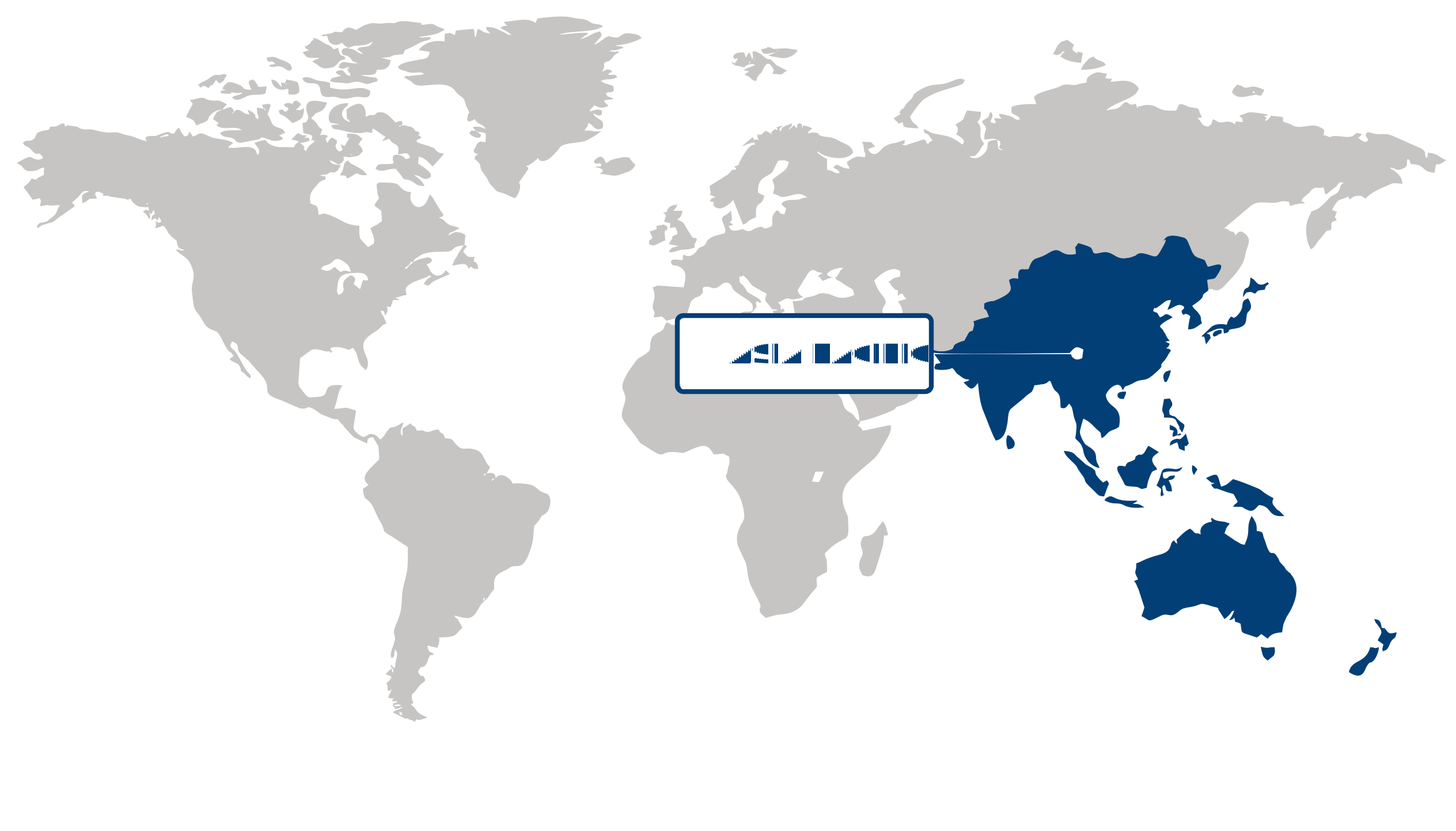
Asia Pacific (Largest Region)
Asia Pacific dominated the apparel supply chain market with a 57.75% share in 2026, reflecting the region’s extensive textile and garment manufacturing ecosystem, established sourcing networks, and strong integration across production stages. The concentration of raw-material suppliers, manufacturers, processing facilities, logistics providers, and export infrastructure enables efficient coordination of apparel production and distribution. Increasing adoption of digital supply chain technologies is improving inventory visibility, demand planning, production scheduling, and procurement efficiency. At the same time, growing consumer demand across the region is encouraging manufacturers and retailers to develop more responsive supply networks capable of supporting diverse product portfolios and faster replenishment.
North America (Fastest-Growing Region)
North America is the fastest-growing region, supported by the increasing need for agile, transparent, and technology-enabled apparel supply chains. Retailers and manufacturers are placing greater emphasis on inventory optimization, demand forecasting, traceability, and faster fulfillment to respond to changing consumer preferences and reduce supply chain disruptions. Growing interest in nearshoring, diversified sourcing, and localized distribution is also encouraging businesses to redesign traditional procurement and logistics models. The integration of automation, data analytics, and digital collaboration tools is further strengthening supply chain responsiveness and creating opportunities for more resilient and customer-focused apparel operations.
| Parameter | North America | Asia Pacific | Europe | Latin America | MEA |
|---|---|---|---|---|---|
| Innovation Hub i Scale Nascent Developing Advanced | |||||
| Cost-Sensitive Region i Scale Low Medium High | |||||
| Regulatory Environment i Scale Restrictive Neutral Supportive | |||||
| Demand Drivers i Scale Weak Moderate Strong | |||||
| Development Stage i Scale Emerging Developing Developed | |||||
| Adoption Rate i Scale Low Medium High | |||||
| New Entrants / Startups i Scale Sparse Moderate Dense | |||||
| Macro Indicators i Scale Weak Stable Strong |
Key Country Insights
Germany 🇩🇪
Sustainable Procurement FocusGermany emphasizes sustainable sourcing practices and traceable apparel supply chains that support regulatory compliance and responsible manufacturing. Businesses continue investing in digital monitoring tools to improve supplier accountability and operational efficiency.
France 🇫🇷
Responsible Supply AlignmentFrance promotes apparel supply chains that prioritize product traceability, ethical sourcing, and environmental responsibility. Companies are integrating digital compliance systems while improving collaboration across manufacturing, logistics, and retail partners.
Italy 🇮🇹
Luxury Production CoordinationItaly focuses on apparel supply chains that preserve craftsmanship while improving production flexibility and supplier coordination. Fashion companies are adopting digital planning tools to optimize premium product manufacturing and delivery schedules.
Japan 🇯🇵
Precision Logistics NetworkJapan strengthens apparel supply chains through efficient logistics, inventory optimization, and close supplier coordination. Companies are adopting automation and demand forecasting technologies to improve fulfillment accuracy and reduce operational disruptions.
South Korea 🇰🇷
Agile Manufacturing SupportSouth Korea is expanding agile apparel supply chain capabilities through smart manufacturing and rapid production planning. Brands and suppliers collaborate on digital workflows that enable quicker response to changing fashion demand and inventory requirements.
United States 🇺🇸
Digital Sourcing StrategyThe U.S. apparel supply chain market increasingly adopts digital platforms to improve sourcing transparency, inventory planning, and supplier collaboration. Companies are strengthening supply chain resilience through diversified sourcing and data-driven operational visibility.
Segment Leadership and Growth Trends
Apparel Supply Chain Market Share (%), by Process, 2026
Go beyond the chart, access full insights & data tables
Request Free Sample ReportProcess Segment Analysis: Pre-Production (Largest & Fastest-Growing Segment)
The pre-production segment represented 76.8% share of the apparel supply chain market in 2026 and also remained the fastest-growing process segment. Its strong position reflects the critical role of planning, design development, material sourcing, sampling, costing, and production preparation in determining overall supply chain efficiency. Increasing pressure on apparel businesses to shorten development cycles, manage inventory more precisely, improve demand responsiveness, and coordinate suppliers effectively is encouraging greater investment in pre-production activities. Digital design tools, integrated planning systems, and data-driven sourcing processes further strengthen this segment by improving visibility and reducing inefficiencies before manufacturing begins.
| Segment | Sub-Segment | Largest Segment | Fastest Growing |
|---|---|---|---|
| Process | Pre-Production, Trade Logistics | Pre-Production | Pre-Production |
Competitive Landscape and Market Positioning
Top players in the apparel supply chain market:
1. Li & Fung Limited (Hong Kong)
2. INVISTA (Koch Industries Inc.) (USA)
3. PVH Corp. (USA)
4. H&M Group (Sweden)
5. Inditex S.A. (Spain)
6. Nike Inc. (USA)
7. Adidas AG (Germany)
8. Shenzhou International Group Holdings Ltd. (China)
9. Fast Retailing Co. Ltd. (Japan)
10. Arvind Limited (India)
The apparel supply chain market is being reshaped by digital transformation and efficiency optimization efforts. Integration of data-driven systems is improving inventory management and production coordination. Expansion of connected supply networks is enhancing responsiveness, while technological adoption supports faster and more transparent operations.
| Company | Market Share | Company Revenue | Revenue CAGR (%) | Product Portfolio | Geographic Presence | Innovation / R&D Focus | Strategic Developments |
|---|---|---|---|---|---|---|---|
| Li & Fung Limited (Hong Kong) | |||||||
| INVISTA (Koch Industries Inc.) (USA) | |||||||
| PVH Corp. (USA) | |||||||
| H&M Group (Sweden) | |||||||
| Inditex S.A. (Spain) | |||||||
| Nike Inc. (USA) | |||||||
| Adidas AG (Germany) | |||||||
| Shenzhou International Group Holdings Ltd. (China) | |||||||
| Fast Retailing Co. Ltd. (Japan) | |||||||
| Arvind Limited (India). |
Industry Development/News
| Company Name | Date | Key Development |
|---|---|---|
| Recover™ | Jun-26 | Recover™ launched its Recover™ Yarns line to scale recycled cotton adoption in textile manufacturing. This initiative strengthens circular material integration within the apparel supply chain, providing a scalable solution for brands aiming to transition toward lower-impact fiber sourcing and enhanced sustainability in upstream material production. |
| Bangladesh–Türkiye Trade Initiative | Jun-26 | Bangladesh and Türkiye are pursuing an $876 million trade corridor and a potential free trade agreement. By combining Bangladesh’s apparel manufacturing scale with Türkiye’s specialized fiber and finishing capabilities, the initiative aims to increase regional trade efficiency and create a more integrated, resilient textile supply chain network. |
| Hellmann Worldwide Logistics / MAS Holdings | May-26 | Hellmann Worldwide Logistics and MAS Holdings are developing a specialized fashion logistics hub in Sri Lanka. The facility is designed to improve regional distribution efficiency and provide end-to-end supply chain solutions, addressing the growing market demand for integrated logistics infrastructure within the global apparel sector. |
| DeSL / Textile Solutions Group | Mar-26 | DeSL partnered with Textile Solutions Group to enhance digital infrastructure across the textile supply chain. This collaboration focuses on integrating digital ecosystem capabilities to improve data connectivity and end-to-end visibility, directly addressing operational inefficiencies in sourcing and production management for apparel industry participants. |
| Unspun | Mar-26 | Unspun appointed former The North Face executive Arne Arens as CEO to accelerate its expansion in automated and localized manufacturing. The leadership transition underscores the company’s strategic shift toward scaling on-demand production technologies, aiming to transform traditional supply chain models through digital manufacturing and reduced lead times. |
| Rotostitch | Dec-25 | Rotostitch secured $1 million in pre-seed funding to advance its robotics-enabled textile production systems. The investment supports the commercialization of automated manufacturing technologies, contributing to the broader industry trend of utilizing robotics to drive efficiency and operational transformation in apparel production workflows. |
| Syre / Nike | Nov-25 | Syre entered a multi-year partnership with Nike to scale circular polyester for sportswear production. This collaboration represents a significant supply chain transformation effort, integrating large-scale circular material sourcing into the athletic apparel manufacturing process to reduce environmental impact and improve resource efficiency. |
| Showroom B2B | Aug-25 | Showroom B2B launched a tech-enabled manufacturing unit in India to improve supply chain responsiveness. By integrating digital capabilities into production, the facility aims to streamline sourcing and strengthen domestic infrastructure, enhancing the ability of apparel brands and exporters to manage production flows with greater agility. |
| Retraced | Sep-24 | Retraced raised €15 million in Series A funding to scale its digital platform for supply chain traceability and compliance. The capital supports the expansion of tools designed to monitor environmental and social risks, enabling brands to improve governance and transparency across complex, global apparel sourcing networks. |
Customize Your Report
Explore examples of how this report can be tailored to different research needs, including custom segments, additional topics or chapters, and related reports. Click a section of the wheel or its numbered marker to explore the available options.
Apparel Supply Chain Market — Custom Segments
| Segment | Sub-Segment |
|---|---|
| Supply Chain Service Provider Type | Freight & Logistics Providers, Warehousing & Fulfillment Providers, Sourcing & Procurement Service Providers, Supply Chain Technology Providers |
| Customer Type | Apparel Manufacturers, Fashion Brands, Retailers, E-commerce Merchants |
| Sourcing Model | Direct Sourcing, Agent-Mediated Sourcing, Contract Manufacturing, Private Label Sourcing |
Apparel Supply Chain Market — Custom TOC
| Custom Chapter | Custom Details |
|---|---|
| Supply Chain Resilience Benchmarking |
|
| Nearshoring and Regionalization Opportunities |
|
| Digital Supply Chain Transformation Assessment |
|
Need a different cut of the data?
Request Custom ResearchWhat is the market valuation of apparel supply chain?
What are the growth projections for the apparel supply chain industry?
How are digital supply chain technologies transforming operational decision-making in the apparel supply chain market?
Why are sustainability and nearshoring becoming strategic priorities in the apparel supply chain market?
Why does the pre-production process dominate the apparel supply chain market?
Why is pre-production also the fastest-growing process in the apparel supply chain market?
Why does Asia Pacific dominate the apparel supply chain market?
What is driving growth in the apparel supply chain market in North America?
Which companies dominate the apparel supply chain landscape?
Our Clients
"The report provided us with a clear direction, and the level of detail was beyond what we expected. I would definitely recommend their services to others."
Haier Appliances
"The collaboration with Fundamental Business Insights has added significant value to our decision-making process, and we look forward to continuing this partnership for our future market research requirements."
Luxottica Group S.p.A.
"The team at FBI delivered an exceptional research report. The insights on industry innovations were particularly impressive and added a lot of value to the overall report."
Nike
Our Research Team & Methodology
Every Fundamental Business Insights report is built by a dedicated vertical research team, validated through a structured primary-and-secondary methodology, and reviewed for accuracy before it reaches you.
Research Team Overview
Prepared by the Consumer Goods & Services Research Team
Delivery
Published
Demand
Available
Support
Trust & Compliance
Research Domains
10 coverage areasResearch Intelligence
| Source | Reference |
|---|---|
| International Organization for Standardization (ISO) | www.iso.org |
| ASTM International | www.astm.org |
| U.S. Consumer Product Safety Commission (CPSC) | www.cpsc.gov |
| European Commission – Consumer Safety | ec.europa.eu/safety-gate |
| Consumer Technology Association (CTA) | www.cta.tech |
| National Retail Federation (NRF) | nrf.com |
| World Retail Congress | www.worldretailcongress.com |
| World Travel & Tourism Council (WTTC) | wttc.org |
| UN Tourism | www.unwto.org |
| Personal Care Products Council (PCPC) | www.personalcarecouncil.org |
| Cosmetics Europe | cosmeticseurope.eu |
| International Housewares Association (IHA) | www.housewares.org |
| American Apparel & Footwear Association (AAFA) | www.aafaglobal.org |
| World Federation of the Sporting Goods Industry (WFSGI) | wfsgi.org |
| Juvenile Products Manufacturers Association (JPMA) | www.jpma.org |
| Pet Industry Joint Advisory Council (PIJAC) | pijac.org |
| International Council of Toy Industries (ICTI) | www.toy-icti.org |
| International Association of Amusement Parks and Attractions (IAAPA) | iaapa.org |
| Organisation for Economic Co-operation and Development (OECD) | www.oecd.org |
| World Bank Data | data.worldbank.org |
Research Workflow & Quality Assurance
Data Collection
Verified information gathered through primary and secondary research.
Data Triangulation
Cross-validation using multiple independent data sources.
Forecast Modelling
Market estimates developed using historical trends and analytical models.
Analyst Validation
Findings reviewed by domain experts for accuracy and consistency.
Editorial & Quality Review
Final editorial, quality, and compliance checks before publication.
Final Publication
Released after successful completion of the internal review process.
Report Coverage
📊 Market Assessment
- Market Size & Forecast
- Market Segmentation
- Regional Analysis
- Growth Drivers & Challenges
- Market Dynamics
🏢 Competitive Intelligence
- Competitive Landscape
- Company Profiles
- Competitive Benchmarking
- Mergers & Acquisitions
- Market Share Analysis or Key Company Strategies
🔍 Strategic Analysis
- Value Chain Analysis
- Porter's Five Forces
- PESTLE Analysis
- Pricing Trends
- Supply-Demand Analysis
🚀 Future Outlook
- Technology Landscape
- Regulatory Landscape
- Investment & Funding Landscape
- Emerging Opportunities
- Future Market Outlook
Have a question about this report or need a custom scope?
Request Customization