Apiculture Market Size & Growth Forecast 2027–2036, By Segments (End Use, Type), Regional Demand Trends (North America, Asia Pacific, Europe), Key Country Insights (U.S., Japan, South Korea, Germany, France, Italy), and Competitive Landscape
Market Size and Growth Outlook
Apiculture Market size was estimated at USD 10.01 billion in 2026 and is projected to grow at a 3.8% CAGR from 2027 to 2036, reaching USD 14.53 billion by 2036. The industry revenue for 2027 is assessed at USD 10.33 billion.
Get more details on this report
Request Free Sample ReportApiculture Market Intelligence Snapshot
Regional Market Dynamics
- Asia Pacific accounted for 37.74% of the market in 2026, driven by extensive honey production, strong beekeeping activity, and established agricultural linkages supporting domestic and export demand.
- North America is forecast to expand at a 4.67% CAGR as demand for pollination services and premium bee products encourages greater investment and operational scaling across commercial beekeeping.
Segment Momentum
- Food & Beverages leads with 46.11% share due to widespread use of honey in packaged foods, beverages, bakery, and natural sweeteners, supported by consistent everyday consumption patterns.
- Propolis is fastest-growing as demand rises for premium bee-derived functional ingredients used in skincare and wellness products, driven by increasing preference for value-added natural formulations.
Market Expansion Drivers
- Rising demand for natural honey and organic sweeteners in food consumption.
- Expanding pharmaceutical and cosmetic use of beeswax and royal jelly derivatives.
- Climate-driven pollinator decline accelerating managed beekeeping and commercial pollination services.
Leading Market Participants
- Key players in the apiculture market include Capilano Honey Limited (Australia), Dabur India Limited (India), Koster Keunen, Inc. (United States), Barkman Honey, LLC (United States), Strahl & Pitsch, Inc. (United States), Miller's Honey Company (United States), Durham's Bee Farm, Inc. (United States), Comvita Limited (New Zealand), Bee Maid Honey Limited (Canada).
Global Market Forecast Snapshot
Market Outlook
- 2026 Market Size: USD 10.01 billion
- 2027 Estimated Market Size: USD 10.33 billion.
- Projected Market Size: USD 14.53 billion by 2036
- Growth Forecast: 3.8% CAGR (2027-2036)
Regional and Segment Outlook
- Leading Regional Market: Asia Pacific
- High-Growth Regional Hub: North America
- Core Revenue Segment: Food & Beverages (End Use) | Honey (Type)
- Emerging Opportunity Segment: Cosmetics (End Use) | Propolis (Type)
Market Growth Drivers and Industry Trends
Rising demand for natural honey and organic sweeteners in food consumption
Increasing consumer interest in naturally sourced food ingredients is supporting the apiculture market as honey gains importance as an alternative to conventional refined sweeteners. Honey is widely used across household food consumption, beverages, bakery products, and other food applications, while organic and minimally processed positioning can appeal to consumers seeking products perceived as more natural. Growing attention to ingredient quality and food sourcing is also encouraging demand for honey with identifiable production and purity characteristics. This shift toward natural sweetening options is supporting beekeepers and honey producers by expanding consumption across both direct-use and processed food applications.
Expanding pharmaceutical and cosmetic use of beeswax and royal jelly derivatives
Broader utilization of bee-derived materials is contributing to the apiculture market as beeswax and royal jelly find applications beyond traditional food consumption. Beeswax offers properties that make it useful in formulations requiring consistency, protective coatings, or emollient characteristics, supporting its incorporation into personal care and pharmaceutical products. Royal jelly is also used in selected wellness and cosmetic formulations because of its association with nutrient-rich and skin-conditioning properties. The diversification of applications for these hive-derived products provides beekeepers with additional revenue streams and encourages greater commercial utilization of materials produced alongside honey.
Climate-driven pollinator decline accelerating managed beekeeping and commercial pollination services
Climate-related pressures affecting pollinator populations are increasing the importance of managed beekeeping, supporting the apiculture market through greater reliance on commercial pollination services. Changes in temperature patterns, habitat conditions, and the availability of flowering plants can disrupt natural pollinator activity and create challenges for agricultural production. Managed bee colonies can help farmers maintain pollination activity for crops that depend heavily on insect pollinators, making the movement and maintenance of bee colonies an increasingly important agricultural service. Demand for managed pollination can also encourage investment in hive management, colony health, transportation, and professional beekeeping operations.
| Growth Driver | Impact on CAGR | Regulatory Influence | Geographic Relevance | Adoption Rate | Impact Timeline |
|---|---|---|---|---|---|
| Rising demand for natural honey and organic sweeteners in food consumption | 1.90% | Low | Asia Pacific, Europe | High | Near Term |
| Expanding pharmaceutical and cosmetic use of beeswax and royal jelly derivatives | 1.60% | Moderate | North America, Europe | Medium | Mid Term |
| Climate-driven pollinator decline accelerating managed beekeeping and commercial pollination services | 1.50% | High | Asia Pacific, Latin America | Emerging | Long Term |
Unlock insights tailored to your business with our bespoke market research solutions.
Click to get your customized report now.
Regional Demand Dynamics
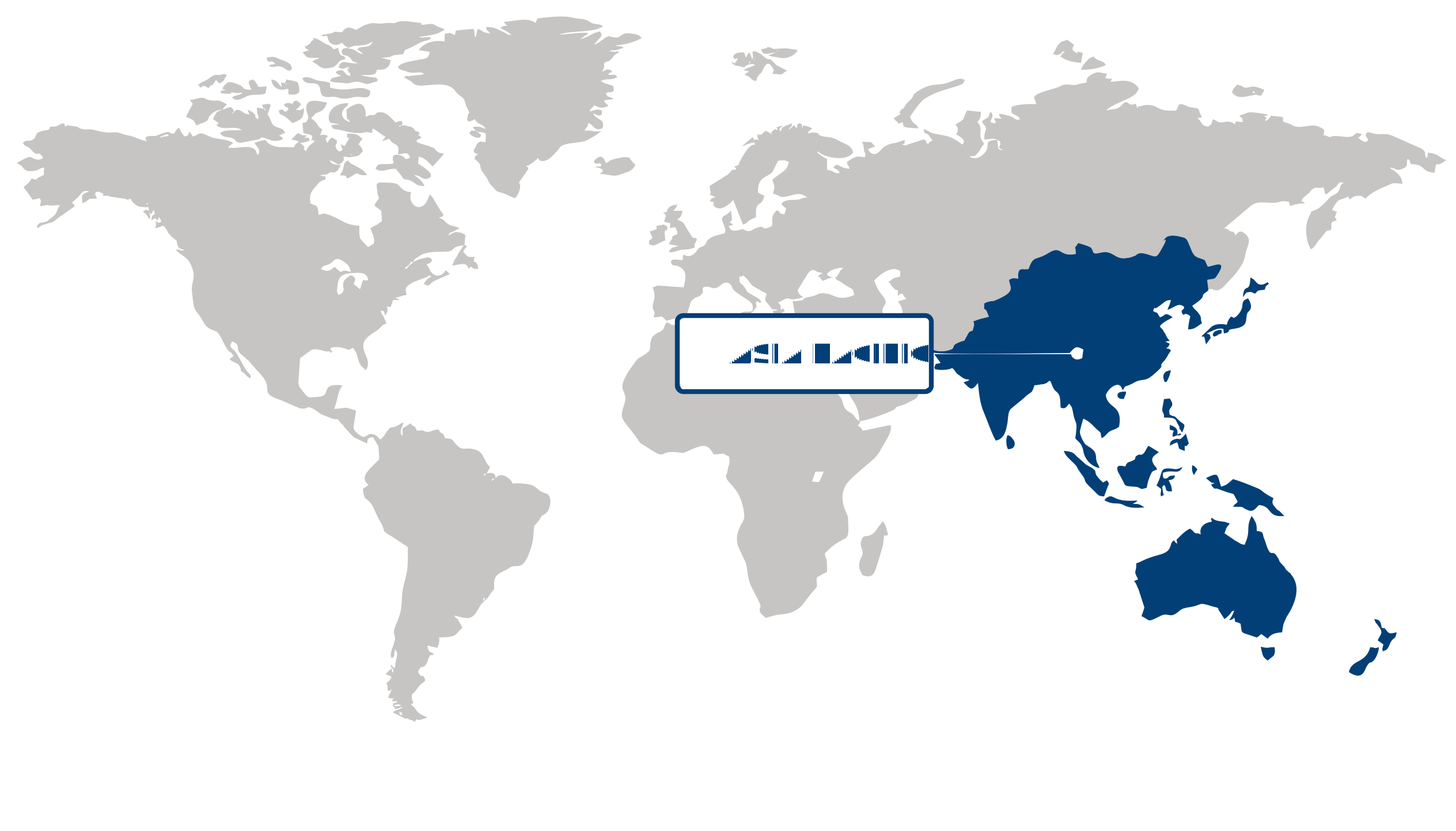
Asia Pacific (Largest Region)
The Asia Pacific apiculture market held the largest share of 37.74% in 2026, supported by extensive beekeeping activity, favorable agricultural conditions, and the importance of honey and other hive products across food, traditional wellness, and personal care applications. The region's diverse floral resources provide opportunities for honey production across varied agricultural landscapes, while rural livelihoods and small-scale farming systems contribute to the breadth of apiculture activity. Rising consumer interest in natural foods and bee-derived products is also strengthening demand, while improvements in beekeeping practices, hive management, and processing capabilities are helping producers enhance product quality and market access.
North America (Fastest-Growing Region)
North America represents the fastest-growing region, supported by increasing consumer demand for natural sweeteners, functional foods, and sustainably sourced agricultural products. Growing awareness of pollinator health is also encouraging greater attention to responsible beekeeping practices and habitat conservation, strengthening the connection between apiculture and broader agricultural sustainability objectives. Advances in hive monitoring, disease management, and beekeeping technology are improving operational efficiency and supporting more informed colony management. At the same time, demand for traceable, premium, and locally produced honey and other hive-derived products is creating additional opportunities for value-added growth across the regional market.
| Parameter | North America | Asia Pacific | Europe | Latin America | MEA |
|---|---|---|---|---|---|
| Innovation Hub i Scale Nascent Developing Advanced | |||||
| Cost-Sensitive Region i Scale Low Medium High | |||||
| Regulatory Environment i Scale Restrictive Neutral Supportive | |||||
| Demand Drivers i Scale Weak Moderate Strong | |||||
| Development Stage i Scale Emerging Developing Developed | |||||
| Adoption Rate i Scale Low Medium High | |||||
| New Entrants / Startups i Scale Sparse Moderate Dense | |||||
| Macro Indicators i Scale Weak Stable Strong |
Key Country Insights
Germany 🇩🇪
Sustainable Beekeeping PracticesGermany emphasizes environmentally responsible apiculture supported by biodiversity initiatives and quality honey production. German beekeepers continue adopting modern hive management techniques while addressing pollinator health and disease prevention challenges.
France 🇫🇷
Artisan Honey DevelopmentFrance supports a diverse apiculture sector through regional honey production and quality-focused beekeeping. French producers increasingly emphasize product authenticity, protected geographical identity, and sustainable practices to strengthen consumer confidence.
Italy 🇮🇹
Regional Honey SpecializationItaly's apiculture market benefits from diverse floral ecosystems that support specialty honey varieties and premium bee products. Italian beekeepers continue improving hive management, disease control, and product traceability to reinforce market value.
Japan 🇯🇵
Premium Honey ProductionJapan prioritizes high-quality honey and value-added bee products supported by controlled production practices. Beekeepers in Japan increasingly focus on premium product differentiation, colony management, and local floral resource preservation.
South Korea 🇰🇷
Technology-Enabled ApiariesSouth Korea is incorporating digital monitoring solutions into apiculture to improve hive management and bee health. Producers in South Korea are expanding premium honey production while emphasizing operational efficiency and sustainable beekeeping methods.
United States 🇺🇸
Commercial Pollination SupportThe U.S. apiculture market is closely linked to commercial pollination services and honey production across large-scale agriculture. Producers in the U.S. increasingly adopt hive monitoring technologies and sustainable beekeeping practices to improve colony health and productivity.
Segment Leadership and Growth Trends
Apiculture Market Share (%), by End Use, 2026
Go beyond the chart, access full insights & data tables
Request Free Sample ReportEnd Use Segment Analysis: Food & Beverages (Largest Segment) vs Cosmetics (Fastest-Growing Segment)
The food & beverages segment led the apiculture market in 2026, accounting for a 46.11% share. Honey and other bee-derived ingredients have broad applications across food formulations, sweeteners, functional foods, beverages, and natural ingredient products. Consumer preference for naturally sourced ingredients and growing interest in products perceived as having nutritional and wellness benefits continue to support demand from food and beverage manufacturers. Established usage patterns and the versatility of apiculture-derived ingredients also reinforce the segment's leading position.
The cosmetics segment is gaining momentum as manufacturers increasingly incorporate bee-derived ingredients into skincare and personal care formulations. Honey, propolis, beeswax, and related materials are valued for their moisturizing, soothing, protective, and naturally derived characteristics. The broader shift toward botanical and naturally positioned cosmetic formulations is encouraging product developers to explore apiculture-based ingredients, while consumer interest in clean-label and multifunctional personal care products is creating additional opportunities for this segment.
Type Segment Analysis: Honey (Largest Segment) vs Propolis (Fastest-Growing Segment)
Honey held the largest share of the apiculture market in 2026, supported by its extensive use across food, beverage, nutraceutical, and personal care applications. Its established consumer acceptance, natural sweetness, and positioning as a versatile ingredient make it a major source of demand across both household and industrial markets. Increasing preference for natural alternatives to conventional sweeteners and continued interest in functional food ingredients further strengthen honey consumption, while its established processing and distribution networks support broad market availability.
Propolis represents the fastest-growing type segment, benefiting from increasing interest in its functional properties and expanding use beyond traditional apiculture applications. Its perceived antimicrobial, antioxidant, and protective characteristics have encouraged incorporation into health-oriented products, oral care formulations, cosmetics, and other specialized applications. Growing consumer awareness of bee-derived functional ingredients and continued product development around natural wellness solutions are broadening the commercial opportunities for propolis.
| Segment | Sub-Segment | Largest Segment | Fastest Growing |
|---|---|---|---|
| End Use | Medical, Food & Beverages, Cosmetics, Others | Food & Beverages | Cosmetics |
| Type | Honey, Beeswax, Propolis, Others | Honey | Propolis |
Competitive Landscape and Market Positioning
Top players in the apiculture market:
1. Capilano Honey Limited (Australia)
2. Dabur India Limited (India)
3. Koster Keunen Inc. (United States)
4. Barkman Honey LLC (United States)
5. Strahl & Pitsch Inc. (United States)
6. Miller's Honey Company (United States)
7. Durham's Bee Farm Inc. (United States)
8. Comvita Limited (New Zealand)
9. Bee Maid Honey Limited (Canada)
Rising focus on sustainable agriculture and pollination efficiency is driving evolution in the apiculture market. Improved hive management techniques are enhancing honey yield and colony health. Continuous innovation is strengthening productivity and ecosystem balance in the apiculture market.
| Company | Market Share | Company Revenue | Revenue CAGR (%) | Product Portfolio | Geographic Presence | Innovation / R&D Focus | Strategic Developments |
|---|---|---|---|---|---|---|---|
| Capilano Honey Limited (Australia) | |||||||
| Dabur India Limited (India) | |||||||
| Koster Keunen Inc. (United States) | |||||||
| Barkman Honey LLC (United States) | |||||||
| Strahl & Pitsch Inc. (United States) | |||||||
| Miller's Honey Company (United States) | |||||||
| Durham's Bee Farm Inc. (United States) | |||||||
| Comvita Limited (New Zealand) | |||||||
| Bee Maid Honey Limited (Canada). |
Industry Development/News
| Company Name | Date | Key Development |
|---|---|---|
| Youth for Agricultural Initiatives | Feb-26 | The association identified a requirement for N36 billion in capital investment to advance commercial honey production in Nigeria. This funding assessment highlights the substantial financial infrastructure needed to address structural constraints, scale production capacity, and modernize the apiculture value chain to meet increasing domestic and regional commercial demands. |
| OECS | Sep-25 | The Organisation of Eastern Caribbean States launched a Common Apiculture Policy to harmonize regional standards and regulatory frameworks. By aligning sector policies across member states, the initiative seeks to improve trade efficiency, enhance product sustainability, and facilitate the coordinated development of the honey industry throughout the Eastern Caribbean region. |
| Texas A&M AgriLife | Jun-25 | Texas A&M AgriLife scaled its specialized beekeeper training programs across Texas to improve colony management and bee health. By providing structured extension services and education to small-scale and hobbyist beekeepers, the initiative aims to enhance regional apiculture capacity and promote professionalized apiary practices to support long-term industry productivity. |
| Food and Agriculture Organization of the United Nations (FAO) | May-25 | The FAO directed a USD 2 million grant to support producer organizations in Samoa, focusing on strengthening honey production and agricultural value chains. This investment is designed to enhance producer capacity, improve market access, and bolster the sustainability of the regional apiculture sector as part of broader food security and agricultural resilience initiatives. |
Customize Your Report
Explore examples of how this report can be tailored to different research needs, including custom segments, additional topics or chapters, and related reports. Click a section of the wheel or its numbered marker to explore the available options.
Apiculture Market — Custom Segments
| Segment | Sub-Segment |
|---|---|
| Production Scale | Small-Scale, Medium-Scale, Large-Scale |
| Processing Type | Raw/Unprocessed, Filtered, Pasteurized/Heat-Treated, Specialty Processed |
| Sales Model | Direct-to-Consumer, Distributor/Wholesaler, Retail, Institutional/Business-to-Business |
Apiculture Market — Custom TOC
| Custom Chapter | Custom Details |
|---|---|
| Pollination Services Economic Impact Analysis |
|
| Sustainable Beekeeping Practices Assessment |
|
| Bee Health Threats and Mitigation Strategies |
|
Need a different cut of the data?
Request Custom ResearchWhat is the market valuation of apiculture?
How is the apiculture industry size expected to evolve during the forecast period?
How is changing consumer demand influencing growth opportunities in the apiculture market?
Why are commercial pollination services becoming a strategic growth area in the apiculture market?
Which end-use segment dominates the apiculture market and why?
Why is propolis the fastest-growing type in the apiculture market?
Which region leads the apiculture market and why?
Why is North America the fastest-growing apiculture market?
Which companies dominate the apiculture landscape?
Our Clients
"The report provided a thorough look at market trends, technological advancements, and the competitive landscape. The depth of insights was really valuable."
ITC Limited
"We would highly recommend Fundamental Business Insights & Consulting to anyone looking for reliable, detailed, and comprehensive market research in the Food industry."
Tyson Foods
"The clarity and presentation of the information were commendable. The report was delivered timely, which made the overall experience smooth and convenient."
Mondelēz International
Our Research Team & Methodology
Every Fundamental Business Insights report is built by a dedicated vertical research team, validated through a structured primary-and-secondary methodology, and reviewed for accuracy before it reaches you.
Research Team Overview
Prepared by the Food & Beverage Research Team
Delivery
Published
Demand
Available
Support
Trust & Compliance
Research Domains
10 coverage areasResearch Intelligence
| Source | Reference |
|---|---|
| Food and Agriculture Organization (FAO) | www.fao.org |
| World Health Organization (WHO) | www.who.int |
| U.S. Food & Drug Administration (FDA) | www.fda.gov |
| European Food Safety Authority (EFSA) | www.efsa.europa.eu |
| U.S. Department of Agriculture (USDA) | www.usda.gov |
| Codex Alimentarius Commission | www.fao.org/fao-who-codexalimentarius |
| International Organization for Standardization (ISO) | www.iso.org |
| AOAC INTERNATIONAL | www.aoac.org |
| Institute of Food Technologists (IFT) | www.ift.org |
| International Dairy Foods Association (IDFA) | www.idfa.org |
| International Sweeteners Association (ISA) | www.sweeteners.org |
| International Probiotics Association (IPA) | internationalprobiotics.org |
| Good Food Institute (GFI) | gfi.org |
| American Feed Industry Association (AFIA) | www.afia.org |
| International Feed Industry Federation (IFIF) | ifif.org |
| Specialty Food Association (SFA) | www.specialtyfood.com |
| Brewers Association | www.brewersassociation.org |
| International Bottled Water Association (IBWA) | bottledwater.org |
| International Alliance for Dietary/Food Supplement Associations (IADSA) | www.iadsa.org |
| OECD Agriculture & Food | www.oecd.org/agriculture |
Research Workflow & Quality Assurance
Data Collection
Verified information gathered through primary and secondary research.
Data Triangulation
Cross-validation using multiple independent data sources.
Forecast Modelling
Market estimates developed using historical trends and analytical models.
Analyst Validation
Findings reviewed by domain experts for accuracy and consistency.
Editorial & Quality Review
Final editorial, quality, and compliance checks before publication.
Final Publication
Released after successful completion of the internal review process.
Report Coverage
📊 Market Assessment
- Market Size & Forecast
- Market Segmentation
- Regional Analysis
- Growth Drivers & Challenges
- Market Dynamics
🏢 Competitive Intelligence
- Competitive Landscape
- Company Profiles
- Competitive Benchmarking
- Mergers & Acquisitions
- Market Share Analysis or Key Company Strategies
🔍 Strategic Analysis
- Value Chain Analysis
- Porter's Five Forces
- PESTLE Analysis
- Pricing Trends
- Supply-Demand Analysis
🚀 Future Outlook
- Technology Landscape
- Regulatory Landscape
- Investment & Funding Landscape
- Emerging Opportunities
- Future Market Outlook
Have a question about this report or need a custom scope?
Request Customization