Antimicrobial Textiles Market Size & Growth Forecast 2027–2036, By Segments (Active Agent, Application), Regional Demand Trends (North America, Asia Pacific, Europe), Key Country Insights (U.S., Japan, South Korea, Germany, France, Italy), and Competitive Landscape
Market Size and Growth Outlook
Antimicrobial Textiles Market size was over USD 14.6 billion in 2026 and is likely to grow at a 6.56% CAGR between 2027 and 2036, crossing USD 27.56 billion by 2036. The industry revenue for 2027 is assessed at USD 15.41 billion.
Get more details on this report
Request Free Sample ReportAntimicrobial Textiles Market Intelligence Snapshot
Regional Market Dynamics
- Asia Pacific held a 36.89% share in 2026, supported by its extensive textile manufacturing base, integrated production capabilities, and strong demand across healthcare, apparel, and industrial applications.
- Europe is projected to grow at a 7.91% CAGR as demand rises for high-performance antimicrobial textiles in regulated healthcare and hygiene-focused applications where durability and compliance are essential.
Segment Momentum
- Synthetic organic compounds held a 50.03% share in 2026 due to their proven antimicrobial performance, compatibility with existing textile manufacturing processes, and suitability for high-volume commercial production.
- Medical textile is both the largest and fastest-growing application, holding 48.23% of the market in 2026, driven by ongoing demand for infection control, hygiene, and durable antimicrobial performance in healthcare fabrics.
Market Expansion Drivers
- Rising hospital-acquired infection concerns driving demand for antimicrobial medical textiles.
- Expanding use in healthcare apparel and bedding increasing institutional textile adoption.
- Nanotechnology-enabled fabric innovations enhancing durability and microbial resistance performance.
Leading Market Participants
- Top companies in the antimicrobial textiles market include Milliken & Company (United States), Indorama Ventures Public Company Limited (Thailand), UNITIKA LTD. (Japan), Herculite Products Inc. (United States), LifeThreads LLC (United States), PurThread Technologies, Inc. (United States), Baltex (United Kingdom), U-Long High-Tech Textile Co., Ltd. (Taiwan), Rajshree Fabrics (India), HeiQ Materials AG (Switzerland).
Global Market Forecast Snapshot
Market Outlook
- 2026 Market Size: USD 14.6 billion
- 2027 Estimated Market Size: USD 15.41 billion.
- Projected Market Size: USD 27.56 billion by 2036
- Growth Forecast: 6.56% CAGR (2027-2036)
Regional and Segment Outlook
- Leading Regional Market: Asia Pacific
- High-Growth Regional Hub: Europe
- Core Revenue Segment: Synthetic Organic Compounds (Active Agent) | Medical Textile (Application)
- Emerging Opportunity Segment: Biobased Agents (Active Agent) | Medical Textile (Application)
Market Growth Drivers and Industry Trends
Rising hospital-acquired infection concerns driving demand for antimicrobial medical textiles
Persistent concerns surrounding healthcare-associated infections are increasing attention toward textile surfaces that can help limit microbial proliferation, and the antimicrobial textiles market growth is being supported by their use in infection-conscious healthcare environments. Hospital bedding, gowns, curtains, uniforms, patient garments, and other textile products can come into frequent contact with patients, healthcare personnel, and surrounding surfaces, creating interest in materials designed with antimicrobial properties. Incorporating antimicrobial functionality into these textiles can complement established hygiene and cleaning protocols by helping manage microbial activity between routine cleaning cycles. Healthcare institutions are therefore evaluating textile solutions that combine practical usability with additional hygienic properties for patient-care and clinical environments.
Expanding use in healthcare apparel and bedding increasing institutional textile adoption
Greater utilization of specialized textiles across healthcare facilities is creating wider application opportunities, with the antimicrobial textiles market benefiting from adoption in medical apparel, bedding, linens, curtains, and related institutional products. Healthcare workers and patients require textiles that can withstand repeated washing, frequent handling, and demanding operating conditions while maintaining functional performance. Antimicrobial treatments can add a layer of microbial-control functionality to commonly used textile products without requiring major changes to established textile applications. As healthcare providers modernize patient-care environments and place greater emphasis on hygiene-oriented materials, antimicrobial features are becoming relevant across a broader range of institutional textile procurement requirements.
Nanotechnology-enabled fabric innovations enhancing durability and microbial resistance performance
Advances in nanotechnology are enabling manufacturers to engineer textile surfaces with more controlled antimicrobial functionality, supporting the antimicrobial textiles market growth through improvements in performance and material efficiency. Nano-enabled treatments can facilitate the incorporation of antimicrobial agents into fibers or fabric surfaces while supporting targeted interactions with microorganisms. Research and development in nanoscale coatings, particles, and fiber modifications is also focused on improving treatment durability so that antimicrobial properties can remain effective through repeated use and laundering. These innovations are particularly relevant for medical and institutional textiles, where long-term functionality, fabric integrity, and resistance to microbial contamination must be considered alongside comfort and routine maintenance requirements.
| Growth Driver | Impact on CAGR | Regulatory Influence | Geographic Relevance | Adoption Rate | Impact Timeline |
|---|---|---|---|---|---|
| Rising hospital-acquired infection concerns driving demand for antimicrobial medical textiles | 2.40% | High | Asia Pacific, Europe | High | Near Term |
| Expanding use in healthcare apparel and bedding increasing institutional textile adoption | 2.10% | High | North America, Asia Pacific | High | Near Term |
| Nanotechnology-enabled fabric innovations enhancing durability and microbial resistance performance | 1.90% | Moderate | Global | Medium | Mid Term |
Unlock insights tailored to your business with our bespoke market research solutions.
Click to get your customized report now.
Regional Demand Dynamics
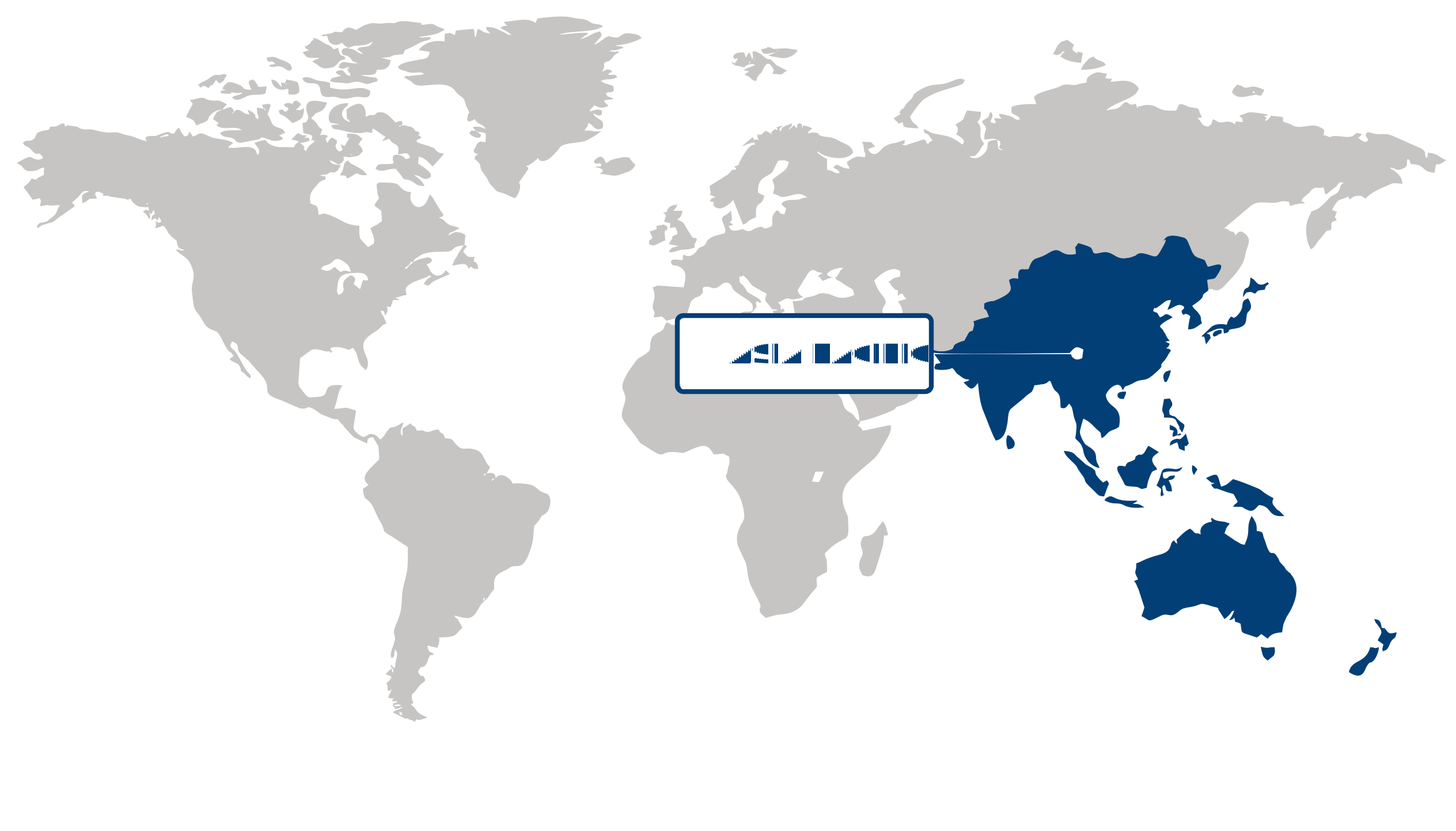
Asia Pacific (Largest Region)
Asia Pacific led the antimicrobial textiles market with a 36.89% share in 2026, supported by its extensive textile manufacturing base and growing demand for functional fabrics. Increasing awareness of hygiene and textile performance is encouraging the incorporation of antimicrobial properties into apparel, healthcare textiles, and other fabric applications. Expanding industrial production and continued development of value-added textile products are further supporting regional demand.
Europe (Fastest-Growing Region)
Europe is the fastest-growing region, driven by increasing emphasis on hygiene, product performance, and sustainable textile solutions. Growing demand for functional fabrics across healthcare, apparel, and consumer applications is encouraging the adoption of antimicrobial treatments. Greater focus on textile quality and innovation is also supporting the development and commercialization of higher-value antimicrobial products across the region.
| Parameter | North America | Asia Pacific | Europe | Latin America | MEA |
|---|---|---|---|---|---|
| Innovation Hub i Scale Nascent Developing Advanced | |||||
| Cost-Sensitive Region i Scale Low Medium High | |||||
| Regulatory Environment i Scale Restrictive Neutral Supportive | |||||
| Demand Drivers i Scale Weak Moderate Strong | |||||
| Development Stage i Scale Emerging Developing Developed | |||||
| Adoption Rate i Scale Low Medium High | |||||
| New Entrants / Startups i Scale Sparse Moderate Dense | |||||
| Macro Indicators i Scale Weak Stable Strong |
Key Country Insights
Germany 🇩🇪
Technical Textile IntegrationGermany is emphasizing antimicrobial functionalities in technical textiles used across healthcare and industrial applications. Producers in Germany are focusing on advanced treatment technologies and performance validation to meet strict quality and product safety expectations.
France 🇫🇷
Premium Hygiene TextilesFrance is promoting antimicrobial textiles in healthcare and premium consumer products where quality and sustainability considerations are influencing material selection. Textile producers in France are developing treatments that deliver hygiene benefits while meeting environmental performance expectations.
Italy 🇮🇹
Protective Fashion ApplicationsItaly is integrating antimicrobial properties into textiles used in fashion, hospitality, and healthcare segments. Manufacturers in Italy are focusing on value-added fabrics that combine aesthetic appeal with enhanced hygiene performance to support product differentiation.
Japan 🇯🇵
Functional Fabric InnovationJapan is prioritizing antimicrobial textiles that combine hygiene benefits with comfort and long-term durability. Textile companies in Japan are integrating antimicrobial technologies into everyday apparel and healthcare products to address growing consumer preference for functional materials.
South Korea 🇰🇷
Performance Apparel AdoptionSouth Korea is increasingly utilizing antimicrobial textiles in activewear and lifestyle products where hygiene and odor control are important purchase considerations. Manufacturers are expanding the use of advanced textile treatments to differentiate products in competitive apparel markets.
United States 🇺🇸
Healthcare Protection MaterialsThe U.S. antimicrobial textiles market is being driven by demand from healthcare, sportswear, and institutional applications requiring enhanced hygiene performance. Textile manufacturers in the U.S. are incorporating durable antimicrobial technologies that maintain effectiveness through repeated washing cycles.
Segment Leadership and Growth Trends
Antimicrobial Textiles Market Share (%), by Active Agent, 2026
Go beyond the chart, access full insights & data tables
Request Free Sample ReportActive Agent Segment Analysis: Synthetic Organic Compounds (Largest Segment) vs Biobased Agents (Fastest-Growing Segment)
Synthetic organic compounds held the largest share of the antimicrobial textiles market in 2026, accounting for 50.03% share. Their leading position is supported by established use in textile treatments designed to inhibit microbial growth, control odors, and improve product hygiene across a wide range of fabric applications. Synthetic antimicrobial agents offer consistent performance and can be incorporated into textile manufacturing processes to provide durable functional properties. Rising awareness of textile hygiene, increasing demand for performance fabrics, and broader use of antimicrobial materials in healthcare, consumer, and industrial applications continue to reinforce their market presence.
Biobased agents are experiencing the fastest growth as textile manufacturers and consumers increasingly emphasize environmentally preferable materials and safer product formulations. Growing interest in renewable inputs and sustainability is encouraging the development of antimicrobial treatments derived from biological or naturally sourced materials. The shift toward environmentally conscious textile production is creating opportunities for biobased antimicrobial technologies, particularly where manufacturers seek to combine functional performance with sustainability objectives. Increasing demand for textiles with both hygiene-enhancing and environmental attributes is supporting the segment's momentum.
Application Segment Analysis: Medical Textile (Largest & Fastest-Growing Segment)
Medical textiles held the largest share of the antimicrobial textiles market in 2026, accounting for 48.23% share, and are also the fastest-growing application segment. Their strong position reflects the critical importance of infection control, hygiene, and microbial management across healthcare environments. Antimicrobial textile technologies are increasingly incorporated into products used in medical settings to help reduce microbial contamination and support cleaner healthcare environments. Growing attention to hospital hygiene, infection prevention, and the functional performance of medical fabrics is reinforcing demand for antimicrobial textiles in healthcare applications, while continued innovation in healthcare materials is sustaining the segment's growth momentum.
| Segment | Sub-Segment | Largest Segment | Fastest Growing |
|---|---|---|---|
| Active Agent | Synthetic Organic Compounds, Metal & Metallic Salts, Biobased Agents | Synthetic Organic Compounds | Biobased Agents |
| Application | Medical Textile, Apparel, Home Textile, Others | Medical Textile | Medical Textile |
Competitive Landscape and Market Positioning
Leading companies in the antimicrobial textiles market:
1. Milliken & Company (United States)
2. Indorama Ventures Public Company Limited (Thailand)
3. UNITIKA LTD. (Japan)
4. Herculite Products Inc. (United States)
5. LifeThreads LLC (United States)
6. PurThread Technologies Inc. (United States)
7. Baltex (United Kingdom)
8. U-Long High-Tech Textile Co. Ltd. (Taiwan)
9. Rajshree Fabrics (India)
10. HeiQ Materials AG (Switzerland)
Functional textile innovation is shaping the antimicrobial textiles market. Advanced treatment technologies are improving hygiene performance and durability. Continuous R&D efforts are expanding applications across healthcare and apparel sectors.
| Company | Market Share | Company Revenue | Revenue CAGR (%) | Product Portfolio | Geographic Presence | Innovation / R&D Focus | Strategic Developments |
|---|---|---|---|---|---|---|---|
| Milliken & Company (United States) | |||||||
| Indorama Ventures Public Company Limited (Thailand) | |||||||
| UNITIKA LTD. (Japan) | |||||||
| Herculite Products Inc. (United States) | |||||||
| LifeThreads LLC (United States) | |||||||
| PurThread Technologies Inc. (United States) | |||||||
| Baltex (United Kingdom) | |||||||
| U-Long High-Tech Textile Co. Ltd. (Taiwan) | |||||||
| Rajshree Fabrics (India) | |||||||
| HeiQ Materials AG (Switzerland). |
Industry Development/News
| Company Name | Date | Key Development |
|---|---|---|
| Researchers (Telangana, India & South Korea) | Dec-24 | Researchers from Telangana and South Korea developed an eco-friendly method for producing antimicrobial textiles using silver nanoparticles synthesized from Bryophyllum pinnatum leaf extract. The process enables coating of cotton fabrics with antimicrobial functionality through a sustainable deposition technique, advancing environmentally friendly textile treatment approaches. |
| 1888 Mills, LLC | Oct-24 | 1888 Mills partnered with FUZE Technologies to integrate the F1 antimicrobial textile treatment into fabric applications. The solution provides chemical-free, water-based antimicrobial performance without binders or surfactants, strengthening durable hygiene functionality in textile products across institutional and consumer applications. |
| Noble Biomaterials | Oct-22 | Noble Biomaterials introduced Ionic+ Botanical, a fabric treatment solution using renewable citric-based technology to inhibit microbial growth and reduce odor. The product enhances antimicrobial textile durability and expands sustainable finishing solutions for performance textiles. |
| HeiQ Materials AG | Jun-21 | HeiQ Materials AG acquired Life Material Technologies Limited, a Hong Kong-based producer of bio-based antimicrobial additives. The acquisition expands HeiQ’s capabilities in bio-based antimicrobial technologies and strengthens its position in surface hygiene solutions, enhancing its product portfolio for antimicrobial textile applications. |
| Milliken & Company | Mar-21 | Milliken & Company acquired Zebra-chem GmbH, strengthening its peroxide masterbatch capabilities to support higher recycled content integration in polymer-based textile applications. The acquisition enhances its advanced materials portfolio and supports circularity-driven innovation in textile manufacturing processes. |
| Murata Manufacturing Co., Ltd. | Jun-20 | Murata Manufacturing Co., Ltd. and Teijin Frontier Co., Ltd. jointly developed PIECLEX, a piezoelectric fabric that generates electrical energy while exhibiting antimicrobial properties. The collaboration establishes a multifunctional textile category integrating energy harvesting and hygiene performance for advanced textile applications. |
| Milliken & Company | Apr-20 | Milliken & Company shifted textile manufacturing to produce medical PPE during the COVID-19 pandemic, incorporating BioSmart antimicrobial technology into protective garments. The initiative expanded production of hygiene-enhanced medical textiles, supporting healthcare supply chain resilience during peak demand conditions. |
| Milliken & Company | Jan-20 | Milliken & Company acquired Borchers Group Limited, a specialty chemicals firm focused on coating additives and catalyst technologies. The acquisition enhances Milliken’s advanced materials capabilities and supports development of functional textile and coating solutions, including antimicrobial and performance-enhancing applications. |
Customize Your Report
Explore examples of how this report can be tailored to different research needs, including custom segments, additional topics or chapters, and related reports. Click a section of the wheel or its numbered marker to explore the available options.
Antimicrobial Textiles Market — Custom Segments
| Segment | Sub-Segment |
|---|---|
| Fabric Type | Cotton, Polyester & Other Synthetics, Blended Fabrics, Cellulosic & Other Specialty Fabrics |
| Treatment Method | Coating & Finishing, Fiber Incorporation, Microencapsulation & Other Advanced Treatments |
| Distribution Channel | Direct Sales, Textile Chemical Distributors, Online & Specialty Channels |
Antimicrobial Textiles Market — Custom TOC
| Custom Chapter | Custom Details |
|---|---|
| Healthcare Procurement Opportunity Assessment |
|
| Functional Textile Adoption Across End-Use Industries |
|
| Antimicrobial Technology Positioning Benchmark |
|
Need a different cut of the data?
Request Custom ResearchHow large is the antimicrobial textiles market?
What is the expected industry size of antimicrobial textiles by 2036?
How is rising demand for infection control reshaping procurement priorities in the antimicrobial textiles market?
Why is nanotechnology integration becoming important for antimicrobial textile performance and adoption?
Why do synthetic organic compounds dominate the antimicrobial textiles market?
Why is medical textile the fastest-growing application in the antimicrobial textiles market?
Why is Asia Pacific the leading antimicrobial textiles market?
Why is Europe the fastest-growing regional market for antimicrobial textiles?
Who holds a significant market share in the antimicrobial textiles landscape?
Our Clients
"The report helped us understand emerging consumer trends in our product category. It clarified where to focus innovation for the next product launch."
LyondellBasell
"The regional forecast section was incredibly useful. We were able to identify two new potential partners in Europe thanks to the vendor mapping you included."
SABIC
"We appreciated how actionable the recommendations were. It guided us to improve supply chain resilience."
Olin Corporation
Our Research Team & Methodology
Every Fundamental Business Insights report is built by a dedicated vertical research team, validated through a structured primary-and-secondary methodology, and reviewed for accuracy before it reaches you.
Research Team Overview
Prepared by the Chemicals & Materials Research Team
Delivery
Published
Demand
Available
Support
Trust & Compliance
Research Domains
10 coverage areasResearch Intelligence
| Source | Reference |
|---|---|
| American Chemistry Council (ACC) | www.americanchemistry.com |
| European Chemical Industry Council (Cefic) | cefic.org |
| International Council of Chemical Associations (ICCA) | icca-chem.org |
| European Chemicals Agency (ECHA) | echa.europa.eu |
| U.S. Environmental Protection Agency (EPA) | www.epa.gov |
| ASTM International | www.astm.org |
| International Organization for Standardization (ISO) | www.iso.org |
| National Institute of Standards and Technology (NIST) | www.nist.gov |
| Plastics Industry Association (PLASTICS) | www.plasticsindustry.org |
| European Biplastics | www.european-bioplastics.org |
| The Adhesive and Sealant Council (ASC) | www.ascouncil.org |
| National Association of Corrosion Engineers (AMPP) | www.ampp.org |
| Society of Plastics Engineers (SPE) | www.4spe.org |
| International Fertilizer Association (IFA) | www.fertilizer.org |
| CropLife International | croplife.org |
| Packaging Europe | packagingeurope.com |
| Flexible Packaging Association (FPA) | www.flexpack.org |
| Battery Council International (BCI) | batterycouncil.org |
| International Copper Association (ICA) | internationalcopper.org |
| World Steel Association | worldsteel.org |
Research Workflow & Quality Assurance
Data Collection
Verified information gathered through primary and secondary research.
Data Triangulation
Cross-validation using multiple independent data sources.
Forecast Modelling
Market estimates developed using historical trends and analytical models.
Analyst Validation
Findings reviewed by domain experts for accuracy and consistency.
Editorial & Quality Review
Final editorial, quality, and compliance checks before publication.
Final Publication
Released after successful completion of the internal review process.
Report Coverage
📊 Market Assessment
- Market Size & Forecast
- Market Segmentation
- Regional Analysis
- Growth Drivers & Challenges
- Market Dynamics
🏢 Competitive Intelligence
- Competitive Landscape
- Company Profiles
- Competitive Benchmarking
- Mergers & Acquisitions
- Market Share Analysis or Key Company Strategies
🔍 Strategic Analysis
- Value Chain Analysis
- Porter's Five Forces
- PESTLE Analysis
- Pricing Trends
- Supply-Demand Analysis
🚀 Future Outlook
- Technology Landscape
- Regulatory Landscape
- Investment & Funding Landscape
- Emerging Opportunities
- Future Market Outlook
Have a question about this report or need a custom scope?
Request Customization