Alcoholic Drinks Market Size & Growth Forecast 2027–2036, By Segments (Type, Distribution Channel), Regional Demand Trends (North America, Asia Pacific, Europe), Key Country Insights (U.S., Japan, South Korea, Germany, France, Italy), and Competitive Landscape
Market Size and Growth Outlook
Alcoholic Drinks Market size stood at USD 2 trillion in 2026 and is predicted to grow at a 8.17% CAGR from 2027 to 2036, crossing USD 4.39 trillion by 2036. The industry revenue for 2027 is assessed at USD 2.14 trillion.
Get more details on this report
Request Free Sample ReportAlcoholic Drinks Market Intelligence Snapshot
Regional Market Dynamics
- Asia Pacific leads with 37.21% share, supported by large consumer base, strong product segmentation, and high-volume distribution across modern retail and traditional trade channels.
- North America is growing at 11.07% CAGR, driven by premiumization, flavor innovation, and rising demand for convenient and low-alcohol formats supported by strong retail and on-premise visibility.
Segment Momentum
- Beer held a 39.01% share in 2026, supported by widespread consumer familiarity, strong retail availability, broad product offerings, and consistent purchasing driven by established drinking habits and brand loyalty.
- Internet retailing is expanding rapidly because consumers value home delivery, easier price and brand comparison, broader product selection, and greater convenience for planned and repeat purchases.
Market Expansion Drivers
- Premiumization trend driven by consumer shift toward craft, artisanal, and high-quality alcoholic beverages.
- Rising youth disposable income accelerating demand for experiential and lifestyle-oriented alcohol consumption.
- Expansion of RTD alcoholic beverages enhancing convenience-led consumption and product innovation cycles.
Leading Market Participants
- Prominent players in the alcoholic drinks market include Anheuser-Busch InBev SA/NV (Belgium), Diageo plc (United Kingdom), Pernod Ricard SA (France), Bacardi Limited (Bermuda), Suntory Holdings Limited (Japan), Constellation Brands, Inc. (United States), Asahi Group Holdings, Ltd. (Japan), Carlsberg A/S (Denmark), Molson Coors Beverage Company (United States), Brown-Forman Corporation (United States).
Global Market Forecast Snapshot
Market Outlook
- 2026 Market Size: USD 2 trillion
- 2027 Estimated Market Size: USD 2.14 trillion.
- Projected Market Size: USD 4.39 trillion by 2036
- Growth Forecast: 8.17% CAGR (2027-2036)
Regional and Segment Outlook
- Leading Regional Market: Asia Pacific
- High-Growth Regional Hub: North America
- Core Revenue Segment: Beer (Type) | Pub, Bars & Restaurants (Distribution Channel)
- Emerging Opportunity Segment: Hard Seltzer (Type) | Internet Retailing (Distribution Channel)
Market Growth Drivers and Industry Trends
Premiumization trend driven by consumer shift toward craft, artisanal, and high-quality alcoholic beverages
Consumer preferences are increasingly moving toward distinctive and higher-quality drinking experiences, supporting premiumization across the alcoholic drinks market. Interest in craft production, artisanal characteristics, distinctive ingredients, and refined product profiles is encouraging consumers to explore beverages positioned around quality and authenticity rather than solely affordability. Producers are responding by developing differentiated offerings that emphasize flavor complexity, provenance, specialized production methods, and curated consumption experiences. The growing appeal of products perceived as unique or carefully crafted is also supporting greater variety within established beverage categories, allowing consumers to select products aligned with individual tastes and lifestyle preferences.
Rising youth disposable income accelerating demand for experiential and lifestyle-oriented alcohol consumption
Increasing disposable income among younger adult consumers is influencing purchasing behavior as alcohol becomes more closely associated with social experiences, leisure activities, and lifestyle preferences. Within the alcoholic drinks market, this trend is encouraging demand for beverages that complement dining, celebrations, social gatherings, and entertainment-oriented occasions. Younger consumers are also showing interest in discovering different beverage styles and incorporating distinctive drinks into social experiences, creating demand for products with differentiated flavor profiles, presentation, and positioning. The connection between alcohol consumption and experiential occasions is expanding consumption beyond conventional drinking patterns and supporting greater experimentation across beverage categories.
Expansion of RTD alcoholic beverages enhancing convenience-led consumption and product innovation cycles
The increasing availability of ready-to-drink alcoholic beverages is strengthening convenience-oriented consumption, particularly for consumers seeking portable products that require little or no preparation. The alcoholic drinks market is being shaped by RTD formats that combine alcoholic beverages with flavors, mixers, and convenient packaging, making them suitable for social gatherings, outdoor occasions, and other informal consumption settings. Product development in this segment is also expanding through experimentation with flavor combinations, beverage styles, packaging formats, and alcohol profiles, giving consumers a wider range of options. The straightforward serving experience and portability of RTD products can reduce preparation requirements while supporting their use across diverse consumption occasions.
| Growth Driver | Impact on CAGR | Regulatory Influence | Geographic Relevance | Adoption Rate | Impact Timeline |
|---|---|---|---|---|---|
| Premiumization trend driven by consumer shift toward craft, artisanal, and high-quality alcoholic beverages | 2.60% | Moderate | Asia Pacific, North America | High | Near Term |
| Rising youth disposable income accelerating demand for experiential and lifestyle-oriented alcohol consumption | 2.30% | Low | Asia Pacific, Europe | High | Near Term |
| Expansion of RTD alcoholic beverages enhancing convenience-led consumption and product innovation cycles | 2.10% | Moderate | North America, Asia Pacific | High | Near Term |
Unlock insights tailored to your business with our bespoke market research solutions.
Click to get your customized report now.
Regional Demand Dynamics
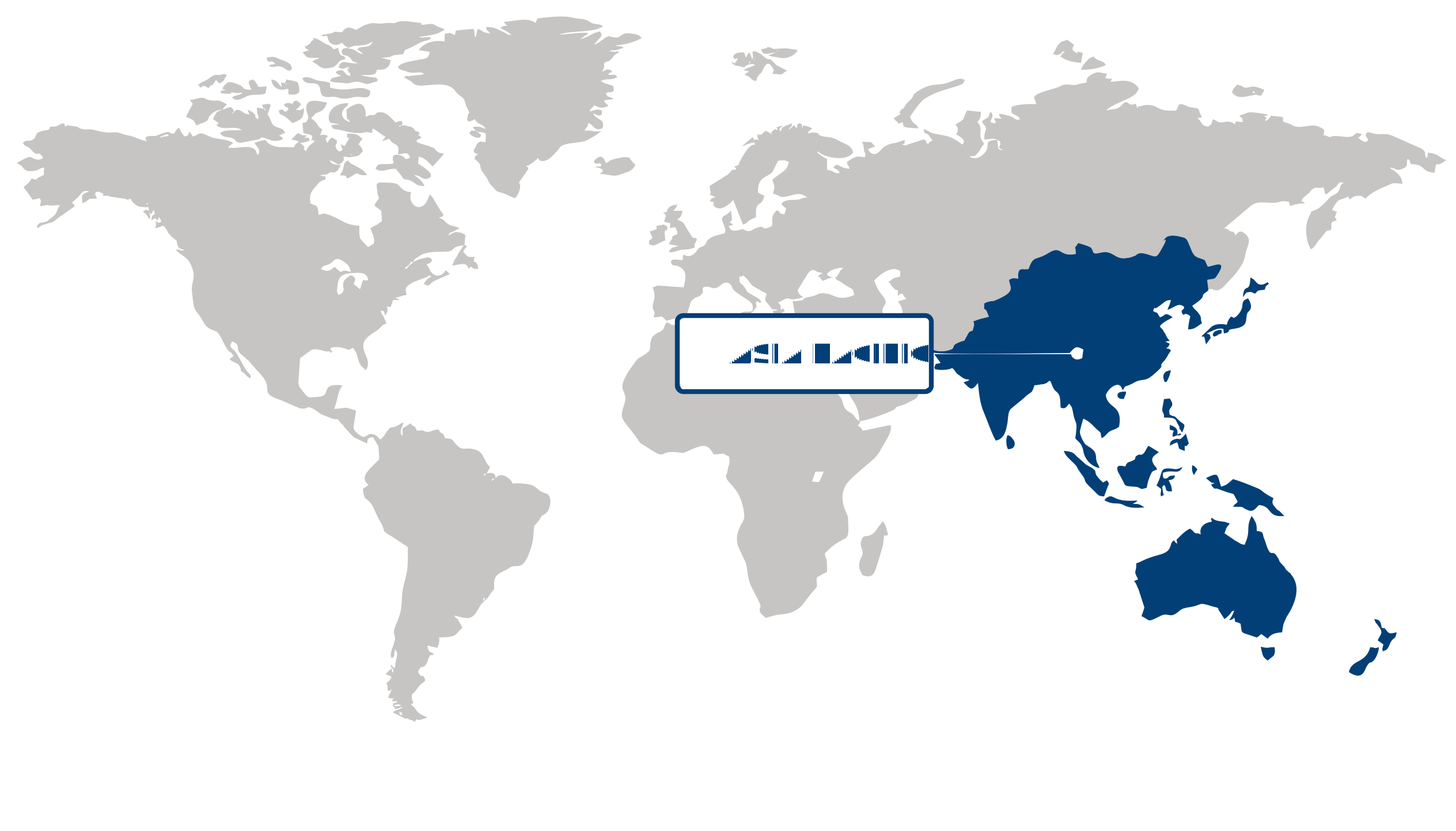
Asia Pacific (Largest Region)
Asia Pacific held the largest share of the alcoholic drinks market at 37.21% in 2026, supported by a broad consumer base, established drinking cultures, and expanding demand across both mature and emerging economies. Rising disposable incomes, urbanization, and evolving consumer preferences are encouraging greater interest in premium and differentiated alcoholic beverages. Expanding modern retail networks and the increasing availability of diverse product offerings are also contributing to sustained regional demand.
North America (Fastest-Growing Region)
North America represents the fastest-growing regional market, supported by shifting consumption preferences and increasing interest in premium, craft, and differentiated alcoholic beverages. Consumers are placing greater emphasis on product quality, variety, and distinctive drinking experiences, encouraging innovation across beverage categories. Strong retail and hospitality infrastructure, combined with continued product diversification, is creating favorable conditions for market expansion.
| Parameter | North America | Asia Pacific | Europe | Latin America | MEA |
|---|---|---|---|---|---|
| Innovation Hub i Scale Nascent Developing Advanced | |||||
| Cost-Sensitive Region i Scale Low Medium High | |||||
| Regulatory Environment i Scale Restrictive Neutral Supportive | |||||
| Demand Drivers i Scale Weak Moderate Strong | |||||
| Development Stage i Scale Emerging Developing Developed | |||||
| Adoption Rate i Scale Low Medium High | |||||
| New Entrants / Startups i Scale Sparse Moderate Dense | |||||
| Macro Indicators i Scale Weak Stable Strong |
Key Country Insights
Germany 🇩🇪
Heritage Brewing DemandGermany maintains strong demand for established beer traditions while producers diversify into premium, specialty, and alcohol-free beverages. Companies are balancing heritage product portfolios with innovation that responds to evolving consumer expectations and retail purchasing patterns.
France 🇫🇷
Premium Wine EvolutionFrance continues to balance established wine traditions with growing interest in premium spirits and innovative beverage formats. Producers are expanding sustainable production practices and premium positioning while adapting portfolios to evolving domestic and international consumption preferences.
Italy 🇮🇹
Authentic Regional PortfolioItaly's alcoholic drinks market benefits from strong regional beverage traditions supported by premium product positioning. Producers are investing in product authenticity, quality-focused branding, and export-ready portfolios while expanding low-alcohol and specialty beverage offerings.
Japan 🇯🇵
Convenience-Led ConsumptionJapan's alcoholic drinks market is influenced by convenience retail channels and demand for compact, premium beverage formats. Manufacturers are introducing innovative flavors, functional positioning, and moderate-alcohol products that align with changing consumer lifestyles and social drinking habits.
South Korea 🇰🇷
Lifestyle Beverage ExpansionSouth Korea is experiencing strong product diversification as consumers explore premium spirits, flavored beverages, and ready-to-drink options. Producers are responding with innovative packaging, localized flavors, and digital marketing strategies that strengthen consumer engagement across retail channels.
United States 🇺🇸
Premium Brand InnovationThe U.S. alcoholic drinks market continues to emphasize premium offerings, flavor innovation, and diversified product portfolios. Producers are expanding ready-to-drink beverages, craft categories, and low-alcohol options to address changing consumer preferences across multiple consumption occasions.
Segment Leadership and Growth Trends
Alcoholic Drinks Market Share (%), by Type, 2026
Go beyond the chart, access full insights & data tables
Request Free Sample ReportType Segment Analysis: Beer (Largest Segment) vs Hard Seltzer (Fastest-Growing Segment)
Beer dominated the alcoholic drinks market in 2026, accounting for a 39.01% share. Its established consumer base, broad availability, and suitability across a wide range of social occasions continue to support its leading position. The category benefits from extensive product variety, spanning mainstream offerings, premium selections, and specialty products that cater to different taste preferences. Strong integration with foodservice and on-trade consumption also reinforces demand, while the continued introduction of differentiated flavors and formats helps maintain the segment's relevance among evolving consumer groups.
The hard seltzer segment is the fastest-growing type, supported by increasing consumer interest in lighter, convenient, and flavor-driven alcoholic beverage options. Its appeal is strengthened by changing lifestyle preferences and demand for products perceived as more contemporary and suited to casual social occasions. Ready-to-drink convenience, diverse flavor profiles, and growing visibility across retail and hospitality channels are contributing to adoption. As consumers continue to explore alternatives beyond traditional alcoholic beverages, hard seltzer is gaining traction as a flexible and modern category.
Distribution Channel Segment Analysis: Pub, Bars & Restaurants (Largest Segment) vs Internet Retailing (Fastest-Growing Segment)
The pub, bars and restaurants segment held the largest share of the alcoholic drinks market in 2026, representing 32.12%. These venues remain important consumption channels because alcoholic beverages are closely associated with social gatherings, dining occasions, entertainment, and nightlife. On-premise establishments also provide consumers with access to a diverse range of beverage types and encourage trial through professionally curated menus and food pairings. The experiential nature of consuming alcoholic drinks in social settings continues to underpin the segment's substantial market presence.
Internet retailing is the fastest-growing distribution channel, driven by the expansion of digital commerce and the growing preference for convenient purchasing experiences. Online platforms allow consumers to browse a broad selection of products, compare offerings, and access specialized or premium beverages that may have limited availability through physical stores. The increasing integration of delivery services and digital ordering is further supporting channel growth, particularly among consumers seeking convenience and greater product choice.
| Segment | Sub-Segment | Largest Segment | Fastest Growing |
|---|---|---|---|
| Type | Beer, Spirits, Wine, Perry & Rice Wine, Hard Seltzer, Others | Beer | Hard Seltzer |
| Distribution Channel | Pub, Bars & Restaurants, Internet Retailing, Liquor Stores, Grocery Shops, Supermarkets, Others | Pub, Bars & Restaurants | Internet Retailing |
Competitive Landscape and Market Positioning
Leading companies in the alcoholic drinks market:
1. Anheuser-Busch InBev SA/NV (Belgium)
2. Diageo plc (United Kingdom)
3. Pernod Ricard SA (France)
4. Bacardi Limited (Bermuda)
5. Suntory Holdings Limited (Japan)
6. Constellation Brands Inc. (United States)
7. Asahi Group Holdings Ltd. (Japan)
8. Carlsberg A/S (Denmark)
9. Molson Coors Beverage Company (United States)
10. Brown-Forman Corporation (United States)
The alcoholic drinks market is witnessing evolving consumer preferences toward premium, craft, and low-alcohol beverage options. Producers are introducing innovative flavor profiles and diversified product formats to align with shifting lifestyle trends. Expansion into new consumption occasions and modern retail channels is further supporting market growth.
| Company | Market Share | Company Revenue | Revenue CAGR (%) | Product Portfolio | Geographic Presence | Innovation / R&D Focus | Strategic Developments |
|---|---|---|---|---|---|---|---|
| Anheuser-Busch InBev SA/NV (Belgium) | |||||||
| Diageo plc (United Kingdom) | |||||||
| Pernod Ricard SA (France) | |||||||
| Bacardi Limited (Bermuda) | |||||||
| Suntory Holdings Limited (Japan) | |||||||
| Constellation Brands Inc. (United States) | |||||||
| Asahi Group Holdings Ltd. (Japan) | |||||||
| Carlsberg A/S (Denmark) | |||||||
| Molson Coors Beverage Company (United States) | |||||||
| Brown-Forman Corporation (United States). |
Industry Development/News
| Company Name | Date | Key Development |
|---|---|---|
| Diageo plc | Dec-24 | Diageo launched the India Rare Spirits initiative, an exclusive cask program offering customized, aged malt whiskeys to the Indian market. This development signifies a strategic shift toward premiumization and luxury bespoke services, leveraging innovative craftsmanship to engage high-net-worth consumers in one of the world's fastest-growing spirits markets. |
| Diageo plc | Sep-24 | Diageo expanded its portfolio in India with the launch of the X Series by McDowell’s & Co., introducing new offerings across vodka, dry gin, citron rum, and dark rum categories. This entry into white and dark spirits represents a major diversification effort to capture share across multiple spirit segments. |
| Grupo Jumex | May-24 | Grupo Jumex entered the alcoholic drinks market through a strategic partnership with AriZona Beverages to introduce a new line of alcoholic beverages to the U.S. market. This collaboration leverages established distribution networks to facilitate the company's expansion into the competitive ready-to-drink alcoholic segment. |
| The Coca-Cola Company | May-24 | The Coca-Cola Company partnered with Bacardi to develop and launch a co-branded ready-to-drink cocktail. This strategic alliance integrates the companies' respective expertise in beverage formulation and spirit production, strengthening their foothold in the high-growth ready-to-drink alcoholic category through collaborative product commercialization. |
| Kraft Heinz | May-24 | Kraft Heinz transitioned into the ready-to-drink alcoholic category with the launch of Crystal Light Vodka Refreshers. By extending a legacy brand into the lower-ABV cocktail space, the company is diversifying its portfolio to address consumer demand for convenient, lower-calorie alcoholic options while testing new market segments. |
| Live Nation | May-24 | Live Nation acquired an equity stake in non-alcoholic tonic brand Hiyo as part of a strategic partnership to expand alcohol-free beverage offerings across major concert and event venues. This investment secures a dedicated supply for high-traffic venues, reflecting the company’s focus on meeting the rising consumer interest in mindful drinking. |
| Pernod Ricard | May-24 | Pernod Ricard’s corporate venture arm prioritized investments in the non-alcoholic beverage segment, specifically targeting functional and alternative drink categories. This strategy aligns with the firm’s long-term capital allocation toward high-growth niches within the broader beverage market, catering to evolving consumer preferences for sophisticated alcohol-alternative products. |
| Darling Drinks | May-24 | Darling Drinks expanded its distribution footprint for its non-alcoholic beer line, securing placement in major retail channels including Whole Foods stores in Florida and Texas. This retail expansion is critical for increasing market penetration in the alcohol-free beer category and enhancing brand accessibility within competitive national markets. |
| Carlsberg | Apr-24 | Carlsberg announced the acquisition of Britvic for approximately £3.3 billion, a strategic move to consolidate a comprehensive portfolio across alcoholic and soft drinks. This transaction significantly enhances the company's competitive positioning and scale, allowing for broader distribution capabilities and operational synergies within the beverage industry. |
Customize Your Report
Explore examples of how this report can be tailored to different research needs, including custom segments, additional topics or chapters, and related reports. Click a section of the wheel or its numbered marker to explore the available options.
Alcoholic Drinks Market — Custom Segments
| Segment | Sub-Segment |
|---|---|
| Price Tier | Economy, Mid-Range, Premium, Super-Premium |
| Consumption Occasion | Everyday Consumption, Social Gatherings, Celebrations & Events, Dining & Hospitality, Gifting |
| Packaging Format | Bottles, Cans, Pouches & Flexible Packaging, Kegs & Bulk Containers |
Alcoholic Drinks Market — Custom TOC
| Custom Chapter | Custom Details |
|---|---|
| Premiumization and Consumer Trading-Up Assessment |
|
| Alcohol Moderation and Low- and No-Alcohol Opportunity Assessment |
|
| Hospitality, Tourism and Experience-Driven Consumption Outlook |
|
Need a different cut of the data?
Request Custom ResearchWhat is the current size of the alcoholic drinks market?
What is the forecasted size of the alcoholic drinks industry?
How is premiumization influencing competitive strategies in the alcoholic drinks market?
What role are ready-to-drink beverages playing in market expansion?
Why is beer the largest product segment in the alcoholic drinks market?
Why is internet retailing the fastest-growing distribution channel in the alcoholic drinks market?
Why is Asia Pacific the largest alcoholic drinks market region?
What is driving North America growth in alcoholic drinks market?
Who are the leading players in the alcoholic drinks landscape?
Our Clients
"The report provided a thorough look at market trends, technological advancements, and the competitive landscape. The depth of insights was really valuable."
ITC Limited
"We would highly recommend Fundamental Business Insights & Consulting to anyone looking for reliable, detailed, and comprehensive market research in the Food industry."
Tyson Foods
"The clarity and presentation of the information were commendable. The report was delivered timely, which made the overall experience smooth and convenient."
Mondelēz International
Our Research Team & Methodology
Every Fundamental Business Insights report is built by a dedicated vertical research team, validated through a structured primary-and-secondary methodology, and reviewed for accuracy before it reaches you.
Research Team Overview
Prepared by the Food & Beverage Research Team
Delivery
Published
Demand
Available
Support
Trust & Compliance
Research Domains
10 coverage areasResearch Intelligence
| Source | Reference |
|---|---|
| Food and Agriculture Organization (FAO) | www.fao.org |
| World Health Organization (WHO) | www.who.int |
| U.S. Food & Drug Administration (FDA) | www.fda.gov |
| European Food Safety Authority (EFSA) | www.efsa.europa.eu |
| U.S. Department of Agriculture (USDA) | www.usda.gov |
| Codex Alimentarius Commission | www.fao.org/fao-who-codexalimentarius |
| International Organization for Standardization (ISO) | www.iso.org |
| AOAC INTERNATIONAL | www.aoac.org |
| Institute of Food Technologists (IFT) | www.ift.org |
| International Dairy Foods Association (IDFA) | www.idfa.org |
| International Sweeteners Association (ISA) | www.sweeteners.org |
| International Probiotics Association (IPA) | internationalprobiotics.org |
| Good Food Institute (GFI) | gfi.org |
| American Feed Industry Association (AFIA) | www.afia.org |
| International Feed Industry Federation (IFIF) | ifif.org |
| Specialty Food Association (SFA) | www.specialtyfood.com |
| Brewers Association | www.brewersassociation.org |
| International Bottled Water Association (IBWA) | bottledwater.org |
| International Alliance for Dietary/Food Supplement Associations (IADSA) | www.iadsa.org |
| OECD Agriculture & Food | www.oecd.org/agriculture |
Research Workflow & Quality Assurance
Data Collection
Verified information gathered through primary and secondary research.
Data Triangulation
Cross-validation using multiple independent data sources.
Forecast Modelling
Market estimates developed using historical trends and analytical models.
Analyst Validation
Findings reviewed by domain experts for accuracy and consistency.
Editorial & Quality Review
Final editorial, quality, and compliance checks before publication.
Final Publication
Released after successful completion of the internal review process.
Report Coverage
📊 Market Assessment
- Market Size & Forecast
- Market Segmentation
- Regional Analysis
- Growth Drivers & Challenges
- Market Dynamics
🏢 Competitive Intelligence
- Competitive Landscape
- Company Profiles
- Competitive Benchmarking
- Mergers & Acquisitions
- Market Share Analysis or Key Company Strategies
🔍 Strategic Analysis
- Value Chain Analysis
- Porter's Five Forces
- PESTLE Analysis
- Pricing Trends
- Supply-Demand Analysis
🚀 Future Outlook
- Technology Landscape
- Regulatory Landscape
- Investment & Funding Landscape
- Emerging Opportunities
- Future Market Outlook
Have a question about this report or need a custom scope?
Request Customization