Aircraft Winglets Market Size & Growth Forecast 2027–2036, By Segments (Fit, End-use, Type), Regional Demand Trends (North America, Asia Pacific, Europe), Key Country Insights (U.S., Japan, South Korea, Germany, France, Italy), and Competitive Landscape
Market Size and Growth Outlook
Aircraft Winglets Market size was more than USD 3.2 Billion in 2026 and is set to grow at 8.69% CAGR between 2027 and 2036, attaining USD 7.36 Billion by 2036. The industry revenue for 2027 is assessed at USD 3.44 Billion.
Get more details on this report
Request Free Sample ReportAircraft Winglets Market Intelligence Snapshot
Regional Market Dynamics
- Europe leads through its mature aerospace ecosystem, focus on fuel efficiency and emissions reduction, advanced aviation infrastructure, and sustainability-driven demand.
- Asia Pacific is expected to grow fastest as passenger traffic, fleet modernization, aviation infrastructure investment, and regional aircraft manufacturing and maintenance capabilities expand.
Segment Momentum
- Line fit accounted for 66.43% of the market in 2026 as factory-installed winglets optimize aerodynamic performance during aircraft production while reducing installation complexity and improving fuel efficiency.
- Retrofit is the fastest-growing fit segment because airlines are upgrading existing fleets with advanced winglets to improve fuel efficiency, extend aircraft service life, and reduce operating costs.
Market Expansion Drivers
- Rising fuel efficiency demands driving widespread adoption of advanced aerodynamic winglet technologies
- Aircraft fleet modernization programs accelerating retrofitting of next-generation winglet systems
- Advancements in composite materials improving aerodynamic efficiency and reducing aircraft drag losses
Leading Market Participants
- Leading players in the aircraft winglets market include Aviation Partners Boeing (USA), Aviation Partners Inc. (USA), BLR Aerospace (USA), Tamarack Aerospace Group Inc. (USA), FACC AG (Austria), GKN Aerospace (United Kingdom), Daher (France), RUAG Aerostructures (Switzerland), Kaman Corporation (USA), Winglet Technology LLC (USA)
Global Market Forecast Snapshot
Market Outlook
- 2026 Market Size: USD 3.2 Billion
- 2027 Estimated Market Size: USD 3.44 Billion
- Projected Market Size: USD 7.36 Billion by 2036
- Growth Forecast: 8.69% CAGR (2027-2036)
Regional and Segment Outlook
- Leading Regional Market: Europe
- High-Growth Regional Hub: Asia Pacific
- Core Revenue Segment: Line Fit (Fit) | Commercial Aviation (End-use) | Blended Winglets (Type)
- Emerging Opportunity Segment: Retrofit (Fit) | Military Aviation (End-use) | Split Scimitar Winglets (Type)
Market Growth Drivers and Industry Trends
Rising fuel efficiency demands driving widespread adoption of advanced aerodynamic winglet technologies
Airlines continue to prioritize operational efficiency as fuel consumption remains a major component of aircraft operating costs. This focus will drive the aircraft winglets market growth by encouraging broader adoption of advanced winglet technologies that improve aerodynamic performance, reduce induced drag, and enhance overall aircraft efficiency during flight. Improved aerodynamic characteristics also contribute to optimized route economics by supporting better aircraft performance across short-, medium-, and long-haul operations without requiring major structural redesigns.
Aircraft fleet modernization programs accelerating retrofitting of next-generation winglet systems
Aircraft operators are extending the service life of existing fleets through modernization initiatives that improve operational performance while maintaining regulatory compliance. The aircraft winglets market benefits from these retrofit programs as airlines increasingly install next-generation winglet systems to enhance fuel efficiency and operational capability without replacing entire aircraft. Modernization projects also allow operators to align older aircraft with evolving performance expectations while improving competitiveness across commercial aviation markets.
Advancements in composite materials improving aerodynamic efficiency and reducing aircraft drag losses
Continuous progress in composite material technologies is enabling the production of lighter, stronger, and more aerodynamically optimized winglet structures. These innovations will propel the aircraft winglets market growth by allowing manufacturers to design winglets that deliver improved structural performance while minimizing additional aircraft weight. Enhanced material properties also support greater design flexibility, enabling winglet configurations that withstand demanding flight conditions while contributing to more efficient airflow management and reduced aerodynamic losses.
| Growth Driver | Impact on CAGR | Regulatory Influence | Geographic Relevance | Adoption Rate | Impact Timeline |
|---|---|---|---|---|---|
| Rising fuel efficiency demands driving widespread adoption of advanced aerodynamic winglet technologies | 2.6% | High | North America, Europe, Asia Pacific | High | Near Term |
| Aircraft fleet modernization programs accelerating retrofitting of next-generation winglet systems | 2.3% | High | Europe, North America | High | Near Term |
| Advancements in composite materials improving aerodynamic efficiency and reducing aircraft drag losses | 2% | Moderate | Asia Pacific, North America | High | Mid Term |
Unlock insights tailored to your business with our bespoke market research solutions.
Click to get your customized report now.
Regional Demand Dynamics
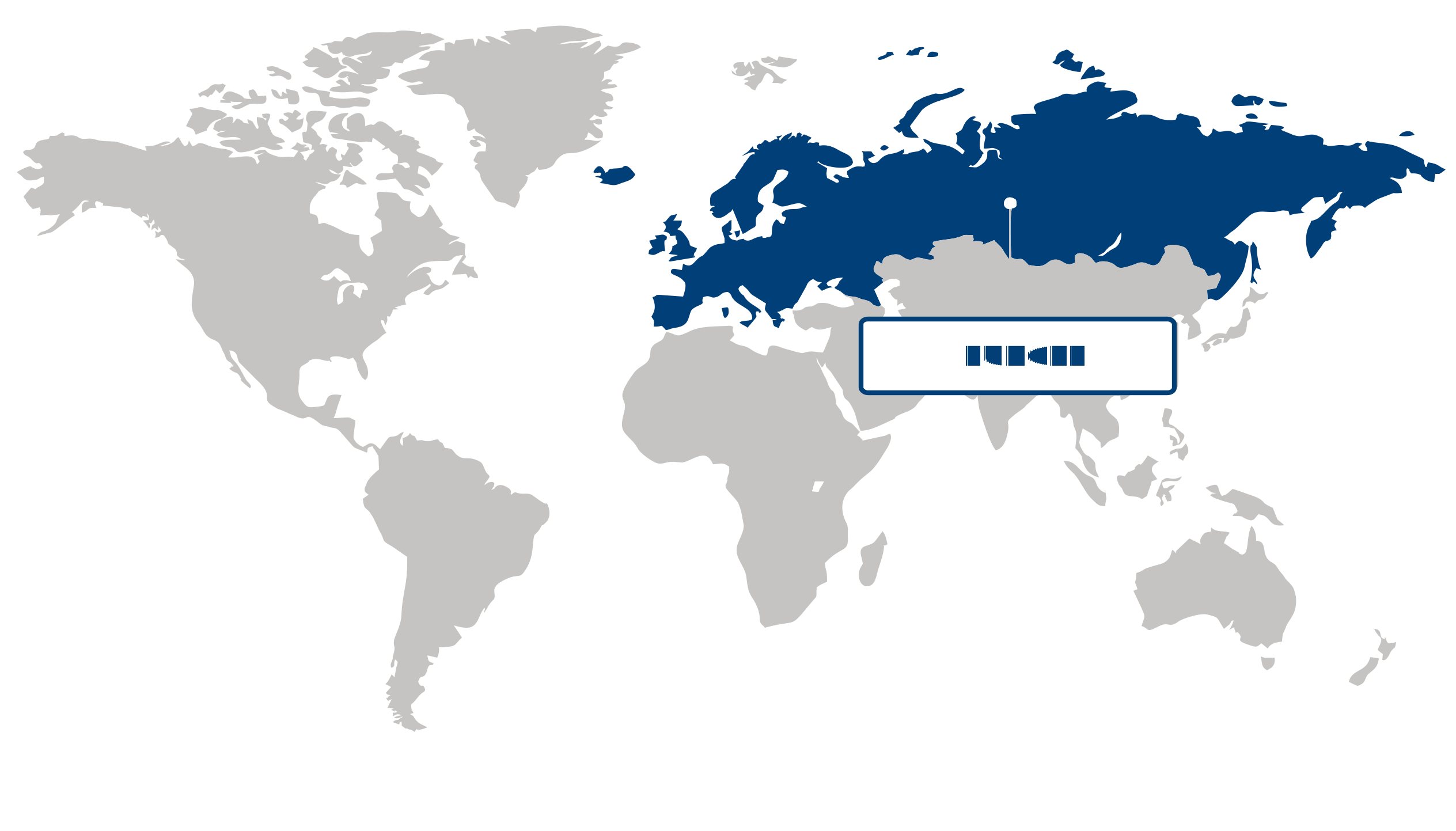
Europe (Largest Region)
Europe held the largest position in the aircraft winglets market in 2026, supported by its mature aerospace manufacturing ecosystem, emphasis on aircraft efficiency, and strong focus on reducing fuel consumption and emissions. The region's advanced aviation infrastructure and continued development of lightweight aerodynamic technologies are encouraging the integration of winglets across commercial and other aircraft platforms. Regulatory pressure to improve aviation sustainability further supports demand for technologies that enhance aerodynamic performance.
Asia Pacific (Fastest-Growing Region)
Asia Pacific is expected to register the fastest growth, driven by expanding air passenger traffic, fleet modernization, and increasing investments in aviation infrastructure. The region's growing aircraft manufacturing and maintenance capabilities are creating additional opportunities for aerodynamic efficiency technologies, while airlines and aviation operators are increasingly focused on improving aircraft performance and operating efficiency.
| Parameter | North America | Asia Pacific | Europe | Latin America | MEA |
|---|---|---|---|---|---|
| Innovation Hub i Scale Nascent Developing Advanced | |||||
| Cost-Sensitive Region i Scale Low Medium High | |||||
| Regulatory Environment i Scale Restrictive Neutral Supportive | |||||
| Demand Drivers i Scale Weak Moderate Strong | |||||
| Development Stage i Scale Emerging Developing Developed | |||||
| Adoption Rate i Scale Low Medium High | |||||
| New Entrants / Startups i Scale Sparse Moderate Dense | |||||
| Macro Indicators i Scale Weak Stable Strong |
Key Country Insights
United States 🇺🇸
Fuel Efficiency UpgradesThe U.S. aircraft winglets market is supported by airlines seeking aerodynamic improvements that reduce operating costs and extend aircraft performance. Suppliers focus on retrofit programs alongside winglet integration for newly manufactured commercial aircraft.
Germany 🇩🇪
Aerodynamic Design ExpertiseGermany emphasizes advanced winglet engineering that complements its aircraft manufacturing and aerospace research capabilities. German companies invest in precision aerodynamic optimization and lightweight composite structures to improve aircraft efficiency.
Japan 🇯🇵
Composite Technology IntegrationJapan applies advanced composite manufacturing expertise to aircraft winglet production for improved aerodynamic performance. Japanese suppliers prioritize lightweight materials and precise manufacturing processes compatible with modern commercial aircraft requirements.
South Korea 🇰🇷
Aerospace Manufacturing ExpansionSouth Korea is expanding participation in aircraft winglet manufacturing through growing aerospace production capabilities. Domestic companies strengthen expertise in composite fabrication and component integration for international aircraft supply programs.
France 🇫🇷
Commercial Aircraft OptimizationFrance supports aircraft winglet development through its strong commercial aerospace manufacturing ecosystem. French manufacturers focus on aerodynamic refinements and certified structural solutions that improve operational efficiency across commercial fleets.
Italy 🇮🇹
Composite Component SupplyItaly contributes to the aircraft winglets market through specialized production of composite aerospace structures and precision components. Italian suppliers emphasize manufacturing quality and collaborative development with international aircraft manufacturers to meet evolving design requirements.
Segment Leadership and Growth Trends
Aircraft Winglets Market Share (%), by Fit, 2026
Go beyond the chart, access full insights & data tables
Request Free Sample ReportFit Segment Analysis: Line Fit (Largest Segment) vs Retrofit (Fastest-Growing Segment)
Holding the largest share of the aircraft winglets market, the line fit segment accounted for 66.43% in 2026. The segment benefits from the growing integration of winglets during aircraft manufacturing, allowing manufacturers to optimize aerodynamic performance from the outset. Factory-installed winglets reduce installation complexity while supporting improved fuel efficiency and operational performance, making line fit the preferred approach for newly produced aircraft.
The retrofit segment is expected to record the fastest growth as airlines increasingly modernize existing fleets to improve fuel efficiency and extend aircraft service life. Installing advanced winglets on in-service aircraft enables operators to enhance aerodynamic performance without replacing entire fleets. Rising fleet upgrade initiatives and the continued emphasis on lowering operating costs are driving stronger demand for retrofit solutions.
End-use Segment Analysis: Commercial Aviation (Largest Segment) vs Military Aviation (Fastest-Growing Segment)
Commercial aviation emerged as the largest end-use segment in 2026, supported by the industry's continuous focus on reducing fuel consumption and improving operational efficiency. The expansion of airline fleets, increasing passenger traffic, and growing investments in fuel-saving aircraft technologies have encouraged widespread adoption of winglets across commercial aircraft. Their contribution to enhanced flight performance and lower operating costs continues to reinforce the segment's dominant position.
The military aviation segment is anticipated to witness the fastest growth as defense organizations invest in aircraft modernization and performance enhancement programs. Improved range, endurance, and fuel efficiency are becoming increasingly important for military operations, encouraging the integration of advanced winglet technologies into a broader range of defense aircraft platforms.
Type Segment Analysis: Blended Winglets (Largest Segment) vs Split Scimitar Winglets (Fastest-Growing Segment)
Blended winglets held the largest segment in 2026, driven by their well-established ability to reduce aerodynamic drag and improve overall aircraft efficiency. Their extensive adoption across commercial fleets, proven operational reliability, and compatibility with numerous aircraft models have made them a preferred winglet configuration within the aviation industry.
In the aircraft winglets market, split scimitar winglets are projected to experience the fastest growth as airlines increasingly adopt advanced aerodynamic upgrades to maximize fuel savings and operational performance. Their enhanced wingtip design delivers greater efficiency improvements compared with conventional configurations, making them an attractive option for fleet modernization and long-term cost optimization.
| Segment | Sub-Segment | Largest Segment | Fastest Growing |
|---|---|---|---|
| Fit | Line Fit, Retrofit | Line Fit | Retrofit |
| End-use | Commercial Aviation, Military Aviation, General Aviation | Commercial Aviation | Military Aviation |
| Type | Sharklets, Split Scimitar Winglets, Wingtip Fences, Blended Winglets, Others | Blended Winglets | Split Scimitar Winglets |
Competitive Landscape and Market Positioning
Top players in the aircraft winglets market:
- Aviation Partners Boeing (USA)
- Aviation Partners, Inc. (USA)
- BLR Aerospace (USA)
- Tamarack Aerospace Group, Inc. (USA)
- FACC AG (Austria)
- GKN Aerospace (United Kingdom)
- Daher (France)
- RUAG Aerostructures (Switzerland)
- Kaman Corporation (USA)
- Winglet Technology LLC (USA)
Airframe efficiency requirements are reshaping competition in the aircraft winglets market, with manufacturers increasingly differentiating through aerodynamic optimization, lightweight material integration, and compatibility with both newly produced and in-service aircraft. Suppliers capable of supporting retrofit programs alongside original equipment applications are expanding their addressable opportunities, as operators seek performance improvements without extensive fleet replacement. Competitive momentum is also shifting toward engineering capabilities that simplify certification, reduce installation complexity, and accommodate a wider range of aircraft platforms, making technical adaptability as important as aerodynamic performance in securing long-term demand.
| Company | Market Share | Company Revenue | Revenue CAGR (%) | Product Portfolio | Geographic Presence | Innovation / R&D Focus | Strategic Developments |
|---|---|---|---|---|---|---|---|
| Aviation Partners Boeing (USA) | |||||||
| Aviation Partners Inc. (USA) | |||||||
| BLR Aerospace (USA) | |||||||
| Tamarack Aerospace Group Inc. (USA) | |||||||
| FACC AG (Austria) | |||||||
| GKN Aerospace (United Kingdom) | |||||||
| Daher (France) | |||||||
| RUAG Aerostructures (Switzerland) | |||||||
| Kaman Corporation (USA) | |||||||
| Winglet Technology LLC (USA) |
Industry Development/News
| Company Name | Date | Key Development |
|---|---|---|
| FACC | Jul-24 | FACC equipped the 2000th Airbus aircraft with sharklets, which are upwardly curved wingtips designed to reduce fuel consumption and improve range primarily on the Airbus A320 Family, with the milestone component scheduled for assembly and delivery to an airline in the Arab world. |
| Tamarack Aerospace | Jun-23 | SkyAlps signed a letter of intent with Tamarack Aerospace to install Eco-SmartWing active winglets across its De Havilland Dash 8-400 fleet, aiming to enhance aircraft performance and safety while reducing emissions, noise pollution, and fuel consumption. |
Customize Your Report
Explore examples of how this report can be tailored to different research needs, including custom segments, additional topics or chapters, and related reports. Click a section of the wheel or its numbered marker to explore the available options.
Aircraft Winglets Market — Custom Segments
| Segment | Sub-Segment |
|---|---|
| Aircraft Size Class | Regional and Small Aircraft, Narrow-Body Aircraft, Wide-Body Aircraft, Business and General Aviation Aircraft, Military Aircraft |
| Winglet Material | Aluminum Alloys, Composite Materials, Titanium Alloys, Hybrid Materials |
| Fleet Deployment Strategy | New Aircraft Delivery Programs, Fleet Modernization Programs, Fuel-Efficiency Retrofit Programs, Aircraft Life-Extension Programs |
Aircraft Winglets Market — Custom TOC
| Custom Chapter | Custom Details |
|---|---|
| Winglet Retrofit Business Case |
|
| Fleet Compatibility and Retrofit Potential |
|
| Winglet Technology Commercialization Pathways |
|
Need a different cut of the data?
Request Custom ResearchWhat is the current revenue of the aircraft winglets market?
What is the forecasted size of the aircraft winglets industry?
Why are airlines investing in advanced winglet technologies?
How are fleet modernization programs driving demand for aircraft winglets?
Why does the line fit segment lead the aircraft winglets market?
What is driving the rapid growth of retrofit winglets?
Why does Europe lead the aircraft winglets market?
How is Asia Pacific driving growth in the aircraft winglets market?
Which companies are driving growth in the aircraft winglets landscape?
Our Clients
"The reports offered a comprehensive view of the Food and Beverage landscape, covering market trends, consumer behavior, and competitive dynamics."
Terma A/S
"Our experience in acquiring market research reports has been outstanding — the depth of analysis and actionable insights have proven invaluable."
The Aerospace Corporation
"Fundamental Business Insights demonstrated a keen understanding of our business needs, delivering reports tailored to our specific objectives."
Kongsberg Gruppen
Our Research Team & Methodology
Every Fundamental Business Insights report is built by a dedicated vertical research team, validated through a structured primary-and-secondary methodology, and reviewed for accuracy before it reaches you.
Research Team Overview
Prepared by the Aerospace & Defence Research Team
Delivery
Published
Demand
Available
Support
Trust & Compliance
Research Domains
10 coverage areasResearch Intelligence
| Source | Reference |
|---|---|
| International Civil Aviation Organization (ICAO) | www.icao.int |
| International Air Transport Association (IATA) | www.iata.org |
| Federal Aviation Administration (FAA) | www.faa.gov |
| European Union Aviation Safety Agency (EASA) | www.easa.europa.eu |
| Aerospace Industries Association (AIA) | www.aia-aerospace.org |
| NATO | www.nato.int |
| U.S. Department of Defense (DoD) | www.defense.gov |
| Defense Advanced Research Projects Agency (DARPA) | www.darpa.mil |
| National Aeronautics and Space Administration (NASA) | www.nasa.gov |
| European Space Agency (ESA) | www.esa.int |
| SAE International | www.sae.org |
| RTCA | www.rtca.org |
| ASTM International | www.astm.org |
| International Organization for Standardization (ISO) | www.iso.org |
| National Institute of Standards and Technology (NIST) | www.nist.gov |
| International Organization for Standardization - Aerospace (IAQG standards via 9100 series) | iaqg.org |
| Airports Council International (ACI World) | aci.aero |
| Missile Defense Agency (MDA) | www.mda.mil |
| Stockholm International Peace Research Institute (SIPRI) | www.sipri.org |
| Jane's (Janes) | www.janes.com |
Research Workflow & Quality Assurance
Data Collection
Verified information gathered through primary and secondary research.
Data Triangulation
Cross-validation using multiple independent data sources.
Forecast Modelling
Market estimates developed using historical trends and analytical models.
Analyst Validation
Findings reviewed by domain experts for accuracy and consistency.
Editorial & Quality Review
Final editorial, quality, and compliance checks before publication.
Final Publication
Released after successful completion of the internal review process.
Report Coverage
📊 Market Assessment
- Market Size & Forecast
- Market Segmentation
- Regional Analysis
- Growth Drivers & Challenges
- Market Dynamics
🏢 Competitive Intelligence
- Competitive Landscape
- Company Profiles
- Competitive Benchmarking
- Mergers & Acquisitions
- Market Share Analysis or Key Company Strategies
🔍 Strategic Analysis
- Value Chain Analysis
- Porter's Five Forces
- PESTLE Analysis
- Pricing Trends
- Supply-Demand Analysis
🚀 Future Outlook
- Technology Landscape
- Regulatory Landscape
- Investment & Funding Landscape
- Emerging Opportunities
- Future Market Outlook
Have a question about this report or need a custom scope?
Request Customization