Agricultural Pheromones Market Size & Growth Forecast 2027–2036, By Segments (End Use, Type, Mode of Action), Regional Demand Trends (North America, Asia Pacific, Europe), Key Country Insights (U.S., Japan, South Korea, Germany, France, Italy), and Competitive Landscape
Market Size and Growth Outlook
Agricultural Pheromones Market size stood at USD 5.92 Billion in 2026 and is predicted to grow at 16.33% CAGR from 2027 to 2036, crossing USD 26.87 Billion by 2036. The industry revenue for 2027 is assessed at USD 6.76 Billion.
Get more details on this report
Request Free Sample ReportAgricultural Pheromones Market Intelligence Snapshot
Regional Market Dynamics
- Europe led in 2026 as sustainable crop protection, stringent pesticide regulations, and integrated pest management increased adoption of pheromone-based solutions.
- Asia Pacific is the fastest-growing region, supported by expanding agricultural production, rising food demand, modern farming practices, and greater interest in sustainable pest management.
Segment Momentum
- Horticulture is the largest and fastest-growing end-use segment because growers increasingly use pheromone-based solutions to protect high-value crops through targeted pest management while supporting sustainable and residue-conscious farming practices.
- Sex pheromones are the largest and fastest-growing type as they help monitor pests and disrupt insect reproduction, enabling targeted crop protection with reduced reliance on broad-spectrum chemical treatments.
Market Expansion Drivers
- Rising adoption of eco-friendly pest management and biopesticide solutions
- Expansion of integrated pest management (IPM) practices in modern agriculture
- Government subsidies and policy support accelerating sustainable agriculture transition
Leading Market Participants
- Major companies in the agricultural pheromones market include BASF SE (Germany), Syngenta Group (Switzerland), Koppert Biological Systems (Netherlands), Biobest Group NV (Belgium), Suterra LLC (United States), ISCA Technologies, Inc. (United States), Provivi Inc. (United States), Russell IPM Ltd (United Kingdom), Shin-Etsu Chemical Co., Ltd. (Japan), Sumitomo Chemical Co., Ltd. (Japan)
Global Market Forecast Snapshot
Market Outlook
- 2026 Market Size: USD 5.92 Billion
- 2027 Estimated Market Size: USD 6.76 Billion
- Projected Market Size: USD 26.87 Billion by 2036
- Growth Forecast: 16.33% CAGR (2027-2036)
Regional and Segment Outlook
- Leading Regional Market: Europe
- High-Growth Regional Hub: Asia Pacific
- Core Revenue Segment: Horticulture (End Use) | Sex Pheromones (Type) | Mating Disruption (Mode of Action)
- Emerging Opportunity Segment: Horticulture (End Use) | Sex Pheromones (Type) | Mating Disruption (Mode of Action)
Market Growth Drivers and Industry Trends
Rising adoption of eco-friendly pest management and biopesticide solutions
Increasing awareness of sustainable farming practices is encouraging growers to reduce dependence on conventional chemical pesticides, and this shift will drive the agricultural pheromones market growth through greater adoption of environmentally responsible pest management solutions. Pheromone-based technologies enable targeted pest control while minimizing impacts on beneficial insects, soil quality, and surrounding ecosystems. Farmers also value these solutions for supporting residue-conscious crop production and improving compatibility with broader sustainable agriculture initiatives.
Expansion of integrated pest management (IPM) practices in modern agriculture
Modern agricultural systems increasingly emphasize balanced pest control strategies, creating favorable conditions for the agricultural pheromones market as integrated pest management practices become more widely adopted. Pheromones play an important role in monitoring pest populations, disrupting mating cycles, and enabling timely intervention before infestations become severe. Their compatibility with biological controls and selective crop protection methods allows growers to manage pest pressure while preserving ecological balance and reducing unnecessary pesticide applications.
Government subsidies and policy support accelerating sustainable agriculture transition
Public initiatives promoting environmentally responsible farming are strengthening demand for biological crop protection technologies, allowing the agricultural pheromones market to benefit from expanding policy support and financial incentives for sustainable agriculture. Governments are encouraging growers to adopt low-impact pest management approaches through subsidy programs, extension services, and regulatory frameworks that favor reduced chemical inputs. These measures encourage wider implementation of pheromone-based solutions across commercial farming operations while supporting compliance with evolving environmental and agricultural standards.
| Growth Driver | Impact on CAGR | Regulatory Influence | Geographic Relevance | Adoption Rate | Impact Timeline |
|---|---|---|---|---|---|
| Rising adoption of eco-friendly pest management and biopesticide solutions | 6% | High | Asia Pacific, Europe | High | Near Term |
| Expansion of integrated pest management (IPM) practices in modern agriculture | 5.3% | High | North America, Asia Pacific | High | Mid Term |
| Government subsidies and policy support accelerating sustainable agriculture transition | 5% | High | Asia Pacific, Latin America | High | Mid Term |
Unlock insights tailored to your business with our bespoke market research solutions.
Click to get your customized report now.
Regional Demand Dynamics
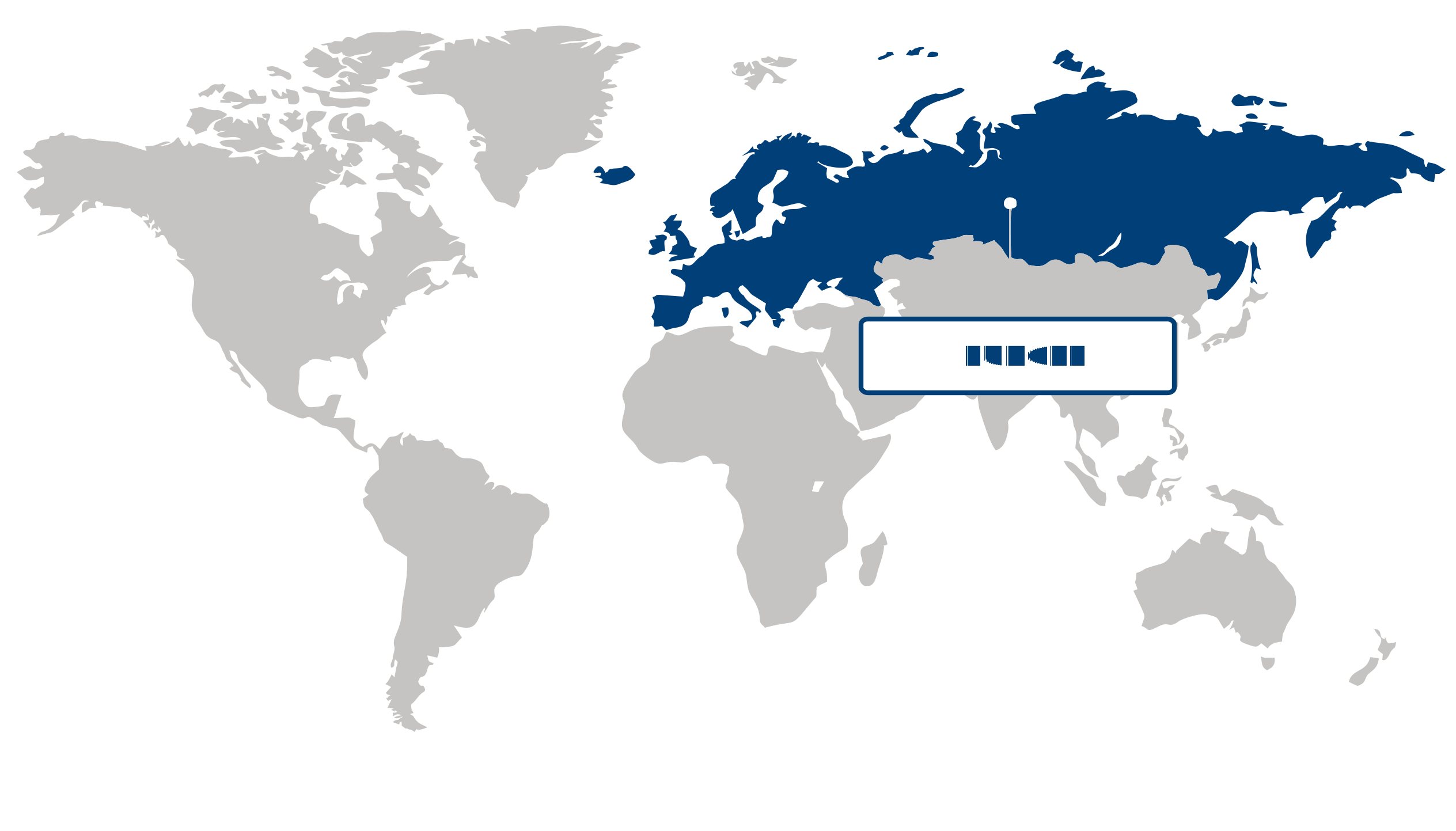
Europe (Largest Region)
Europe held the largest position in the agricultural pheromones market in 2026, supported by strong adoption of sustainable crop protection practices, stringent regulations governing conventional pesticides, and growing demand for environmentally responsible agricultural inputs. The region’s emphasis on integrated pest management is encouraging farmers to adopt pheromone-based solutions for targeted pest monitoring and control. Increasing awareness of residue reduction, biodiversity protection, and sustainable farming is further supporting the use of agricultural pheromones as an alternative or complementary approach to conventional crop protection methods.
Asia Pacific (Fastest-Growing Region)
Asia Pacific is expected to be the fastest-growing region, driven by expanding agricultural production, rising food demand, and increasing awareness of sustainable pest management practices. Growing concerns regarding crop losses and the environmental impact of excessive chemical pesticide use are encouraging greater interest in biological and pheromone-based solutions. Improvements in agricultural practices, increasing adoption of modern farming technologies, and supportive efforts toward reducing chemical residues are creating favorable conditions for wider deployment of agricultural pheromones across the region.
| Parameter | North America | Asia Pacific | Europe | Latin America | MEA |
|---|---|---|---|---|---|
| Innovation Hub i Scale Nascent Developing Advanced | |||||
| Cost-Sensitive Region i Scale Low Medium High | |||||
| Regulatory Environment i Scale Restrictive Neutral Supportive | |||||
| Demand Drivers i Scale Weak Moderate Strong | |||||
| Development Stage i Scale Emerging Developing Developed | |||||
| Adoption Rate i Scale Low Medium High | |||||
| New Entrants / Startups i Scale Sparse Moderate Dense | |||||
| Macro Indicators i Scale Weak Stable Strong |
Key Country Insights
United States 🇺🇸
Integrated Pest ManagementThe U.S. expands the use of agricultural pheromones within integrated pest management programs to reduce reliance on conventional pesticides. Growers increasingly adopt pheromone-based monitoring and mating disruption across high-value crops requiring sustainable crop protection.
Germany 🇩🇪
Sustainable Crop ProtectionGermany encourages agricultural pheromones as part of environmentally responsible pest control strategies. Farmers in Germany prioritize solutions that improve crop protection while supporting regulatory expectations for reduced chemical pesticide use.
Japan 🇯🇵
Specialty Crop ApplicationsJapan focuses on agricultural pheromones for specialty crops where precise pest monitoring and targeted control improve production quality. Japanese growers value technologies that minimize environmental impact while maintaining efficient pest management practices.
South Korea 🇰🇷
Precision Farming AdoptionSouth Korea integrates agricultural pheromones into precision farming programs to improve pest detection and optimize intervention timing. Agricultural producers in South Korea increasingly combine pheromone technologies with digital monitoring systems for better field management.
France 🇫🇷
Biological Control IntegrationFrance promotes agricultural pheromones alongside biological crop protection methods to support sustainable farming systems. French growers increasingly adopt pheromone solutions that complement integrated pest management across vineyards, orchards, and specialty crops.
Italy 🇮🇹
Orchard Pest ManagementItaly emphasizes agricultural pheromones for orchards, vineyards, and other high-value crops where selective pest control is essential. Italian producers prioritize pheromone-based solutions that improve monitoring accuracy while supporting sustainable agricultural production.
Segment Leadership and Growth Trends
Agricultural Pheromones Market Share (%), by End Use, 2026
Go beyond the chart, access full insights & data tables
Request Free Sample ReportEnd Use Segment Analysis: Horticulture (Largest & Fastest-Growing Segment)
The horticulture segment dominated the agricultural pheromones market in 2026 and also represented the fastest-growing end-use segment. Pheromone-based solutions are increasingly used in horticultural production to monitor and control insect populations while supporting more targeted pest management practices. The need to protect high-value fruits, vegetables, and other horticultural crops from pest damage is encouraging the adoption of alternatives that can reduce reliance on conventional chemical treatments. Growing interest in sustainable agriculture, integrated pest management, and residue-conscious crop production is further supporting the expansion of the horticulture end-use segment.
Type Segment Analysis: Sex Pheromones (Largest & Fastest-Growing Segment)
Sex pheromones accounted for the largest share of the agricultural pheromones market in 2026 and are also expected to be the fastest-growing pheromone type. These pheromones are widely used to influence insect mating behavior, support pest monitoring, and disrupt reproduction as part of targeted crop protection strategies. Their effectiveness in managing specific pest populations while reducing unnecessary exposure to broad-spectrum chemical treatments is increasing their appeal among growers. The growing adoption of environmentally responsible pest management practices and integrated approaches to crop protection is strengthening demand for the sex pheromones type segment.
Mode of Action Segment Analysis: Mating Disruption (Largest & Fastest-Growing Segment)
Mating disruption held the largest share of the agricultural pheromones market in 2026 and also emerged as the fastest-growing mode of action. This approach reduces the ability of targeted pests to locate mates, helping limit reproduction and suppress pest populations over time. Its targeted nature makes it attractive for crop protection programs seeking to reduce dependence on conventional pesticide applications while maintaining effective pest management. Increasing emphasis on sustainable farming, integrated pest management, and environmentally conscious agricultural practices is supporting the expanding adoption of the mating disruption mode of action.
| Segment | Sub-Segment | Largest Segment | Fastest Growing |
|---|---|---|---|
| End Use | Horticulture, Field Crops, Others | Horticulture | Horticulture |
| Type | Sex Pheromones, Aggregation Pheromones, Alarm Pheromones, Trail Pheromones, Others | Sex Pheromones | Sex Pheromones |
| Mode of Action | Mating Disruption, Mass Trapping, Attract-and-kill, Monitoring and Detection, Others | Mating Disruption | Mating Disruption |
Competitive Landscape and Market Positioning
Prominent players in the agricultural pheromones market:
- BASF SE (Germany)
- Syngenta Group (Switzerland)
- Koppert Biological Systems (Netherlands)
- Biobest Group NV (Belgium)
- Suterra LLC (United States)
- ISCA Technologies, Inc. (United States)
- Provivi, Inc. (United States)
- Russell IPM Ltd (United Kingdom)
- Shin-Etsu Chemical Co., Ltd. (Japan)
- Sumitomo Chemical Co., Ltd. (Japan)
Commercial success in the agricultural pheromones market is becoming closely tied to the ability to improve formulation stability and field performance under diverse environmental conditions rather than simply expanding product portfolios. Developers are investing in advanced delivery systems that extend effectiveness and reduce application complexity, while expanding regulatory acceptance of environmentally responsible crop protection solutions is encouraging broader participation from specialized technology providers. Competition is also evolving around expertise in pest-specific formulations, localized agronomic knowledge, and the ability to adapt products to varying cultivation practices, allowing innovation in biological efficacy and application precision to shape market positioning.
| Company | Market Share | Company Revenue | Revenue CAGR (%) | Product Portfolio | Geographic Presence | Innovation / R&D Focus | Strategic Developments |
|---|---|---|---|---|---|---|---|
| BASF SE (Germany) | |||||||
| Syngenta Group (Switzerland) | |||||||
| Koppert Biological Systems (Netherlands) | |||||||
| Biobest Group NV (Belgium) | |||||||
| Suterra LLC (United States) | |||||||
| ISCA Technologies Inc. (United States) | |||||||
| Provivi Inc. (United States) | |||||||
| Russell IPM Ltd (United Kingdom) | |||||||
| Shin-Etsu Chemical Co. Ltd. (Japan) | |||||||
| Sumitomo Chemical Co. Ltd. (Japan) |
Industry Development/News
| Company Name | Date | Key Development |
|---|---|---|
| Syngenta Biologicals | Sep-24 | Syngenta Biologicals and Provivi unveiled a strategic partnership to commercialize the YSB Eco-Dispenser and FAW Eco-Granules for Asian rice and corn systems, with commercial launches targeted for 2026. |
| Bayer | Jan-23 | Bayer established a strategic partnership with M2i Group to supply farmers with advanced pheromone-based biological crop protection products specifically targeting Lepidoptera pests across stone fruits, pome fruits, tomatoes, and grapes. |
Customize Your Report
Explore examples of how this report can be tailored to different research needs, including custom segments, additional topics or chapters, and related reports. Click a section of the wheel or its numbered marker to explore the available options.
Agricultural Pheromones Market — Custom Segments
| Segment | Sub-Segment |
|---|---|
| Target Pest Species | Lepidopteran Pests, Coleopteran Pests, Dipteran Pests, Hemipteran Pests, Other Target Pests |
| Crop Production System | Open-Field Crops, Protected Crops, Orchard and Plantation Crops, High-Value Specialty Crops |
| Formulation Format | Mating Disruption Dispensers, Lure-Based Traps, Granular Formulations, Liquid Formulations |
Agricultural Pheromones Market — Custom TOC
| Custom Chapter | Custom Details |
|---|---|
| Integrated Pest Management Adoption |
|
| Crop-Specific Pheromone Opportunity Mapping |
|
| Biological Crop Protection Substitution |
|
Need a different cut of the data?
Request Custom ResearchHow large is the agricultural pheromones market?
How will the agricultural pheromones industry grow in terms of size and CAGR by 2036?
What is driving the adoption of pheromone-based pest management solutions?
How are integrated pest management programs supporting agricultural pheromone demand?
Why does horticulture lead the agricultural pheromones market?
Which pheromone type is growing the fastest in the agricultural pheromones market?
What supports Europe’s leadership in the agricultural pheromones market?
Why is Asia Pacific expected to grow rapidly in agricultural pheromones?
Who holds a significant market share in the agricultural pheromones landscape?
Our Clients
"The report helped us understand emerging consumer trends in our product category. It clarified where to focus innovation for the next product launch."
LyondellBasell
"The regional forecast section was incredibly useful. We were able to identify two new potential partners in Europe thanks to the vendor mapping you included."
SABIC
"We appreciated how actionable the recommendations were. It guided us to improve supply chain resilience."
Olin Corporation
Our Research Team & Methodology
Every Fundamental Business Insights report is built by a dedicated vertical research team, validated through a structured primary-and-secondary methodology, and reviewed for accuracy before it reaches you.
Research Team Overview
Prepared by the Chemicals & Materials Research Team
Delivery
Published
Demand
Available
Support
Trust & Compliance
Research Domains
10 coverage areasResearch Intelligence
| Source | Reference |
|---|---|
| American Chemistry Council (ACC) | www.americanchemistry.com |
| European Chemical Industry Council (Cefic) | cefic.org |
| International Council of Chemical Associations (ICCA) | icca-chem.org |
| European Chemicals Agency (ECHA) | echa.europa.eu |
| U.S. Environmental Protection Agency (EPA) | www.epa.gov |
| ASTM International | www.astm.org |
| International Organization for Standardization (ISO) | www.iso.org |
| National Institute of Standards and Technology (NIST) | www.nist.gov |
| Plastics Industry Association (PLASTICS) | www.plasticsindustry.org |
| European Biplastics | www.european-bioplastics.org |
| The Adhesive and Sealant Council (ASC) | www.ascouncil.org |
| National Association of Corrosion Engineers (AMPP) | www.ampp.org |
| Society of Plastics Engineers (SPE) | www.4spe.org |
| International Fertilizer Association (IFA) | www.fertilizer.org |
| CropLife International | croplife.org |
| Packaging Europe | packagingeurope.com |
| Flexible Packaging Association (FPA) | www.flexpack.org |
| Battery Council International (BCI) | batterycouncil.org |
| International Copper Association (ICA) | internationalcopper.org |
| World Steel Association | worldsteel.org |
Research Workflow & Quality Assurance
Data Collection
Verified information gathered through primary and secondary research.
Data Triangulation
Cross-validation using multiple independent data sources.
Forecast Modelling
Market estimates developed using historical trends and analytical models.
Analyst Validation
Findings reviewed by domain experts for accuracy and consistency.
Editorial & Quality Review
Final editorial, quality, and compliance checks before publication.
Final Publication
Released after successful completion of the internal review process.
Report Coverage
📊 Market Assessment
- Market Size & Forecast
- Market Segmentation
- Regional Analysis
- Growth Drivers & Challenges
- Market Dynamics
🏢 Competitive Intelligence
- Competitive Landscape
- Company Profiles
- Competitive Benchmarking
- Mergers & Acquisitions
- Market Share Analysis or Key Company Strategies
🔍 Strategic Analysis
- Value Chain Analysis
- Porter's Five Forces
- PESTLE Analysis
- Pricing Trends
- Supply-Demand Analysis
🚀 Future Outlook
- Technology Landscape
- Regulatory Landscape
- Investment & Funding Landscape
- Emerging Opportunities
- Future Market Outlook
Have a question about this report or need a custom scope?
Request Customization